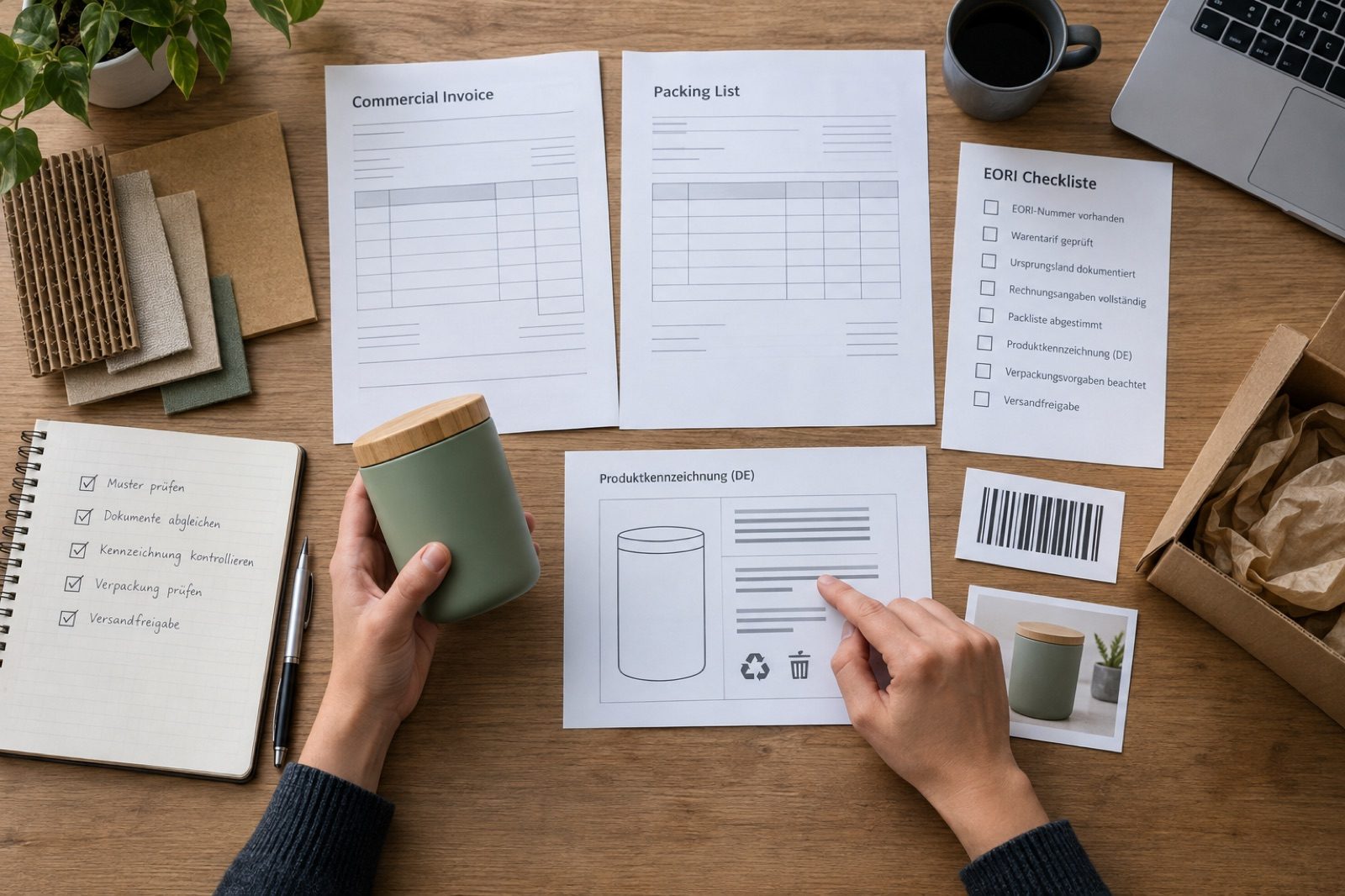
A release gate for Austrian businesses importing 1688 products for resale: importer and EORI, product evidence, German labels, packaging duties and matching shipment documents.
Importing 1688 Products for Sale in Austria: Use a Release Gate Before Shipping
An Austrian business should not release a 1688 order for international shipment merely because the supplier has finished production. Before the goods leave China, the business needs a documented decision: is the importer identified, are the customs records consistent, can the product legally be placed on the Austrian market, and have packaging obligations been assigned?
This article is a shipment-release checklist for a small business that has already selected a 1688 product and intends to sell it in Austria. It does not repeat a general 1688 purchasing tutorial and it does not treat a supplier certificate as automatic EU approval.
Legal and policy sources checked on 28 September 2026. Product rules vary by category and can change. Obtain specialist advice where the product is regulated or the importer role is unclear.
Gate 1: identify the importer before paying the balance
Write down the legal entity that will act as importer. Under EU product-safety rules, an importer is an EU-established person or business that places a product from a non-EU country on the Union market. The name on the plan should be consistent across the purchasing contract, commercial invoice, customs declaration and product traceability file.
An Austrian business engaged in customs activities normally needs an EORI number. Austria's Unternehmensserviceportal states that economic operators carrying out customs activities require EORI registration, and the Austrian customs portal is used for relevant electronic procedures.
Check:
- full legal name and Austrian business address;
- VAT and EORI details where applicable;
- person responsible for customs records;
- customs representative and agreed scope, if one is used;
- delivery term and who pays duty, VAT, clearance and destination charges;
- whether the order is a sample, an internal-use import or stock for resale.
Do not accept “door to door” as a substitute for these answers. A logistics quote can cover transport without transferring the importer's legal duties.
Official reference: Austrian business portal information on importing goods and EORI.
Gate 2: classify the actual product, not the 1688 listing title
The supplier's Chinese title is rarely detailed enough for customs or compliance. Build a product identity sheet with:
- exact commercial name and intended use;
- model, SKU and batch reference;
- material or composition;
- dimensions, unit weight and quantity;
- country of origin;
- power source, voltage, battery type or wireless function;
- brand or private-label arrangement;
- parts and accessories included;
- proposed CN or HS classification and the evidence supporting it.
The final customs classification belongs to the importer and customs process, not to the seller. If the code changes the duty, licence or product-control requirement, ask a qualified customs professional before shipment.
If you still need to establish whether the supplier can deliver the agreed product, complete the 1688 supplier verification checklist before using this release gate.
Gate 3: determine which product rules apply
The EU General Product Safety Regulation is a baseline for consumer products, but many categories also have specific rules. Electrical products, radio equipment, toys, machinery, personal protective equipment, cosmetics, food-contact items and other regulated goods can require different documentation, tests or registrations.
Do not ask the supplier only, “Does it have CE?” CE marking is required only for product categories covered by relevant EU harmonisation legislation. A CE logo alone does not prove compliance.
For a product within a CE regime, the file may need the correct EU declaration of conformity, applicable legislation and standards, technical documentation, testing evidence, manufacturer information and traceability. For products outside a CE regime, general safety and category-specific duties still apply; adding a CE mark when it is not legally required is not a solution.
Under the GPSR, an importer must verify required manufacturer information and product identification, provide its own contact details where required, ensure necessary instructions and safety information are understandable in the target market, and avoid placing a product on the market when there is reason to believe it is non-compliant.
Read the product-specific law before approving mass production. An old test report for a similar model, a blurred certificate or a laboratory logo in a sales image is not enough.
Official reference: EU General Product Safety Regulation, importer obligations.
Gate 4: prepare Austrian-market labels and instructions
For consumer products sold in Austria, German is the practical default for warnings and instructions that consumers must understand, subject to the product-specific rules. Prepare the actual artwork before shipment rather than planning to “fix labels later.”
Check the product, retail packaging and accompanying documents for:
- manufacturer name and postal and electronic contact details;
- importer or other required EU responsible-person details;
- type, batch, serial number or another product identifier;
- German warnings and safety instructions when required;
- age restrictions or user limitations;
- electrical, battery, disposal or recycling markings where applicable;
- CE marking and notified-body details only when legally required;
- quantity, composition or other product-specific information;
- a method to link the product to its supplier, order and batch.
If you sell online, the product offer may also need to display manufacturer or responsible-person details, product identification, warnings and safety information before purchase. A compliant sticker on a box in the warehouse does not repair an incomplete online offer automatically.
Ask for a pre-production label proof and a photograph of the applied label on the real sample. Translation should be reviewed by someone who understands both German and the product's safety context.
Gate 5: assign packaging responsibility in Austria
Packaging compliance is not solved by using recyclable cardboard. Austria's business portal identifies Austria-established importers as primary obligated parties for packaging around imported goods in relevant circumstances. Businesses that place packaging on the Austrian market need to determine which packaging categories and quantities they are responsible for and how participation, reporting and records will be handled.
Use a packaging worksheet:
- sales packaging around each unit;
- grouped packaging;
- transport packaging that remains in Austria;
- material type and weight by category;
- party that first places the packaging on the Austrian market;
- licensing or collection-system arrangement;
- reporting owner and evidence retained.
The position is different for a foreign distance seller with no Austrian establishment delivering packaged goods directly to Austrian private consumers. Austria requires such foreign distance sellers to appoint an authorised representative for the applicable packaging duties. Do not confuse that rule with the obligations of an Austrian importer that buys stock and resells it locally.
Official references: Austrian packaging primary obligations and authorised representatives for foreign distance sellers.
Gate 6: make the commercial invoice, packing list and goods agree
Before dispatch, compare the documents line by line. The commercial invoice should identify seller and buyer, goods, quantities, unit and total values, currency, origin, delivery term and other information required for the transaction. The packing list should match carton count, contents, gross and net weight, and package marks.
Resolve these mismatches before shipping:
- invoice uses a generic description but the goods are technical products;
- order quantity differs from packed quantity;
- model on the product differs from the test report;
- importer name is missing or inconsistent;
- country of origin is unclear;
- packaging artwork does not match the approved proof;
- battery or wireless attributes are absent from the logistics review;
- one carton mixes products requiring incompatible routes or documents.
Do not describe commercial stock as samples or gifts, and do not reduce the value to manage tax. Accurate documents are part of the release decision.
Gate 7: approve a sample or hold the shipment
Use a simple result: RELEASE, HOLD or STOP.
RELEASE
Use only when the importer, EORI and customs route are ready; product rules are identified; the evidence matches the exact model; labels and German information are approved; packaging responsibility is assigned; and invoice, packing list and goods agree.
HOLD
Use when a correction is possible before export: missing artwork, unclear invoice description, incomplete test scope, inconsistent model number, unanswered packaging data or a sample that still needs an observable check.
Keep the order out of consolidation while the issue is open. Eligible ordinary goods can remain under the applicable warehouse arrangement while documents are completed.
STOP
Stop when the supplier cannot identify the manufacturer, refuses to provide essential evidence, uses another product's report, cannot apply required traceability, or the product cannot lawfully or safely be placed on the Austrian market.
The cost already spent on a sample is not a reason to import a non-compliant batch.
What to ask the supplier and warehouse
Send the supplier one numbered request:
- Confirm legal manufacturer and factory address.
- Confirm exact model, materials and country of origin.
- Provide the product-specific compliance documents and current reports.
- Provide editable label and instruction artwork.
- Confirm batch or serial traceability.
- Provide unit and packaging material weights.
- Provide commercial invoice and packing-list drafts.
- Confirm how cartons and models will be separated.
- Provide a production sample or agreed evidence before balance payment.
- Do not substitute components, model or packaging without written approval.
The warehouse can receive the order, record parcels, photograph labels, count units, measure cartons and keep a disputed batch separate when those services are agreed. A warehouse cannot certify EU compliance or replace a laboratory, conformity-assessment body, customs broker or Austrian legal adviser.
A practical release file
Store together:
- supplier identity and order terms;
- product specification and approved sample evidence;
- risk assessment;
- declarations, reports and technical documents required for the category;
- label and German instruction approvals;
- importer and responsible-person details;
- EORI and customs-representation records;
- invoice and packing list;
- packaging material data and compliance arrangement;
- inspection photos and non-conformity decisions;
- transport eligibility confirmation and final carton data.
Use the 1688 buying service overview only for the purchasing and warehouse workflow. The Austrian business remains responsible for deciding whether the goods may be imported and sold.
How YDA Express can support the China side
YDA Express can assist with supported 1688 purchasing, supplier communication, China payment arrangements, warehouse receipt, requested visible checks, domestic return coordination, storage for eligible ordinary goods, consolidation, repacking and comparison of international transport options.
YDA Express does not issue Austrian EORI numbers, act as the competent market-surveillance authority, determine final customs classification, provide a legal conformity certificate, appoint a packaging representative, guarantee customs clearance or assume the importer's final responsibility.
Before paying a balance or approving shipment, send the exact product link, specification, quantity, destination, expected sales channel and the evidence that must be checked. The correct outcome can be release, hold or stop.
📲 Download the YDA Express App
Use the YDA Express App to place China purchasing orders, view product check photos, manage packages, and arrange consolidation and international forwarding.