A Canadian business sourcing from 1688 should validate samples, define the importer, prepare supplier and customs records, classify goods, plan CARM responsibilities and calculate landed cost before a bulk order.
1688 can give a Canadian business access to factories and domestic wholesale pricing, but a low unit price is not an import plan. Before a bulk order, the buyer needs a verified sample, a documented supplier, a Canadian importer strategy, accurate customs data and a landed-cost model.
Separate sample, pilot and bulk stages
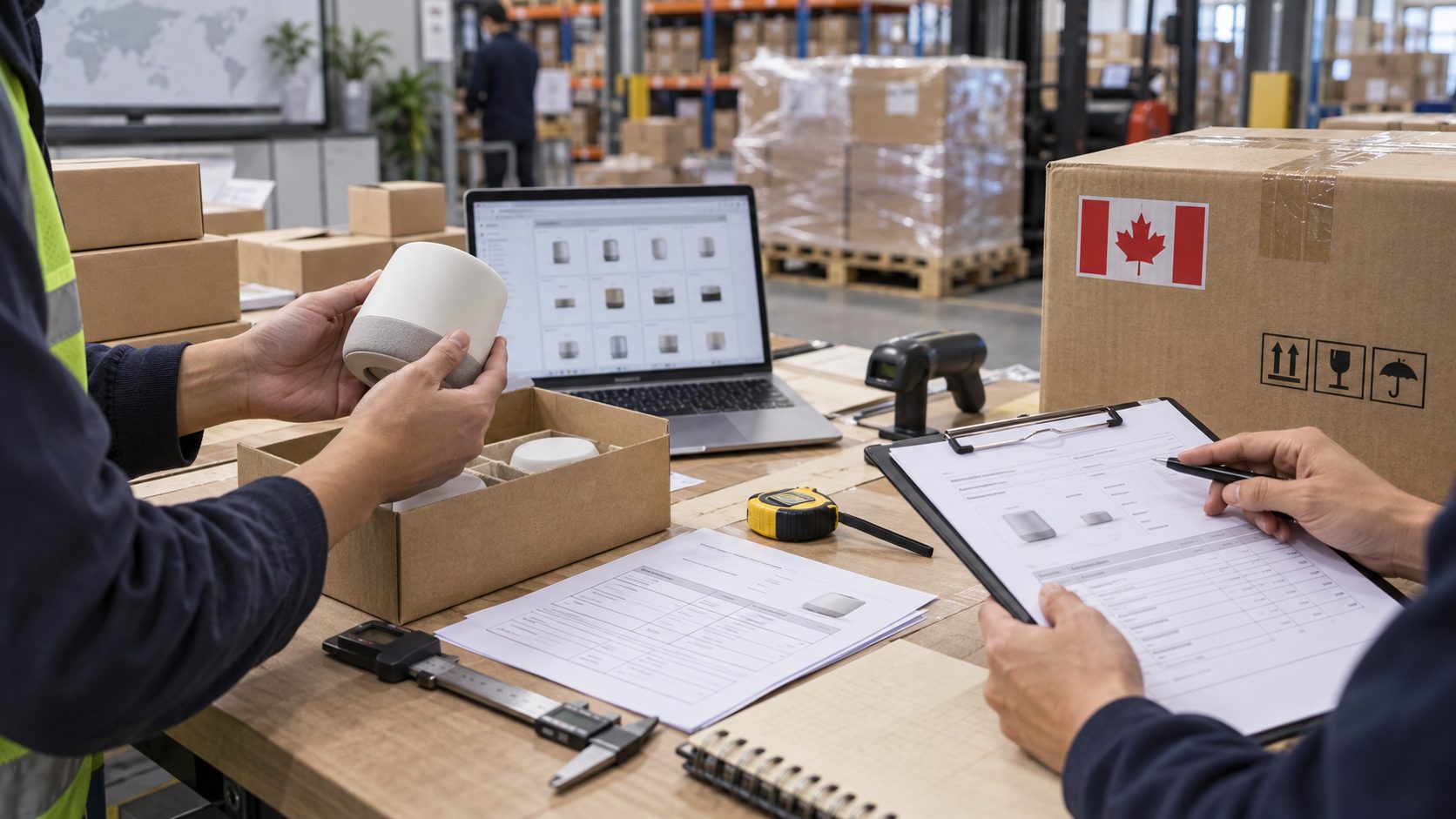
A sample answers whether the physical product matches the listing. A pilot order tests repeatability, packaging, defect rate and shipping data. A bulk order should begin only after the first two stages produce acceptable evidence.
Do not compare a sample courier quote with pallet or carton freight. Record unit weight, packed carton dimensions, units per carton and gross weight during the pilot stage. These measurements are more useful than a seller's rough estimate.
The 1688 purchasing guide explains purchasing assistance and supplier communication.
Build a supplier file before paying
Keep the supplier's legal business name, address, contact, 1688 store link, quotation, payment recipient, product specification, lead time and after-sales terms. Ask whether the seller is the manufacturer, trading company or distributor.
The product file should include model, material, dimensions, colour, packaging, tolerances, labels, accessories, battery information and any test reports. A certificate should be checked for product model, issuing body, date and applicant; a PDF with a familiar logo is not automatically valid.
Approve a reference sample
Photograph the approved sample and create a short specification with measurable acceptance points. For example: dimensions, weight range, visible finish, connector type, included accessories, carton quantity and label content.
A warehouse can compare visible features and count units, but professional quality control may be required for function, performance or statistical inspection. Define what happens when units fail: rework, replacement, refund or acceptance at a discount.
Decide who is the Canadian importer
Before shipment, identify the importer of record and who will provide instructions to the customs broker or carrier. A China supplier, purchasing agent and freight forwarder each has a different role; none should be assumed to carry Canadian importer responsibility without a written arrangement.
Commercial importers may need a Canadian business number and import-export program account and must follow CBSA accounting requirements. CARM is the CBSA system of record for commercial imports. Businesses seeking Release Prior to Payment privileges must meet the applicable CARM registration and financial-security requirements.
Use the official CBSA commercial importing guide and arrange professional advice when the importer structure is unclear.
Classify the product before quoting duty
Canadian duty depends on tariff classification, origin and tariff treatment. A supplier's six-digit HS suggestion can help, but the Canadian importer remains responsible for using the correct Canadian classification.
Prepare a plain technical description with material, function, composition and how the product is used. If one kit contains different components, do not assume that the code for the main marketing name is sufficient. Check restrictions, permits, anti-dumping or special import measures where relevant.
CBSA's duties and taxes guide explains classification, tariff treatment, valuation and estimating amounts.
Prepare commercial documents that agree
The commercial invoice, packing list, purchase order and transport data should tell the same story.
A usable commercial invoice normally identifies seller, buyer, consignee, invoice number and date, detailed product description, quantity, unit and total value, currency, country of origin, delivery term and payment information.
A packing list should show carton count, contents by carton, net and gross weight, dimensions and marks. Differences between the invoice and packing list can delay release. “Parts,” “samples” or “accessories” are not adequate descriptions by themselves.
Understand Incoterms and quote boundaries
EXW, FOB, DAP and DDP do not mean the same allocation of cost or responsibility. Do not choose a term only because the seller calls it convenient. Ask who handles China pickup, export declaration, main transport, insurance, Canadian customs entry, duty and tax, terminal charges and final delivery.
A DDP quote requires particular scrutiny: identify the importer used, documents produced, tax treatment and what proof the Canadian buyer will receive. A low all-inclusive number without a written scope can hide compliance or destination charges.
GST/HST and business records
Imported goods are generally subject to GST or the federal part of HST unless a specific non-taxable rule applies. A GST/HST-registered business that is the importer may be able to claim an input tax credit when it meets the CRA requirements and keeps supporting evidence.
The invoice, accounting entry and importer identity must align. Do not assume tax is recoverable merely because a freight quote says “tax included.” Review the official CRA GST/HST import guidance with the company's accountant.
Build a landed-cost model
Calculate:
- product price and tooling;
- China domestic freight and pickup;
- purchasing, inspection and warehouse service;
- export packaging and labelling;
- international freight and insurance;
- customs brokerage and disbursement;
- customs duty and special measures;
- GST/HST or other tax;
- terminal, storage and last-mile charges;
- expected defect, return and warranty cost.
Divide the total by sellable units, not ordered units. If 2% of a batch is expected to be unsellable, the usable-unit cost is higher. Run a conservative scenario for exchange-rate and freight changes.
Shipping-plan data for the warehouse
Provide purchase-order number, supplier, expected domestic tracking, SKU, carton quantity and required checks. Multiple suppliers should not be mixed until each order is reconciled.
For consolidation, compare carton-level weight and dimensions. Palletisation may protect goods and simplify handling but adds weight and volume. Small cartons may travel by courier or air; larger commercial shipments require route-specific planning. No transport mode has a guaranteed universal delivery time.
Restricted and regulated products
Electrical goods, wireless devices, children's products, cosmetics, food, medical products, chemicals, batteries and branded goods may require additional review. Transport acceptance is not proof of Canadian regulatory compliance.
Confirm licences, product standards, labelling, bilingual requirements where applicable, intellectual-property rights and safety obligations before bulk production. YDA Express does not issue Canadian product approvals.
What YDA Express can do
YDA Express can assist with 1688 purchasing, China warehouse receiving, sample and parcel photos, basic visible checks, consolidation and international forwarding. Professional inspection can be arranged only when specifically scoped and available.
The Canadian business remains responsible for supplier approval, product legality, importer records, classification, value, permits, CARM and destination accounting. Customs, tax authorities and carriers make final determinations.
Pre-bulk checklist
- Approve a physical sample.
- Confirm supplier legal and payment details.
- Freeze product and packaging specifications.
- Record real carton weight and dimensions.
- Identify importer of record and broker.
- Prepare business and import accounts.
- Confirm classification, origin and restrictions.
- Align invoice, packing list and purchase order.
- Define Incoterm responsibilities in writing.
- Model duty, tax, brokerage and defects.
- Run a pilot shipment before scaling.
- Keep records for accounting and customs review.
Frequently asked questions
Can a purchasing agent be the Canadian importer?
Not automatically. Importer responsibility requires an appropriate legal and documentary arrangement.
Is the 1688 supplier's HS code enough?
It is a starting point. The Canadian importer must confirm the correct classification for Canada.
Does DDP remove the buyer's compliance risk?
No. The buyer should know who imports, how values and taxes are declared and what records will be provided.
Can GST/HST always be recovered?
No. Eligibility depends on registration, importer status, business use and supporting documentation. Confirm with an accountant.
📲 Download the YDA Express App
Use the YDA Express App to place China purchasing orders, view product check photos, manage packages, and arrange consolidation and international forwarding.