
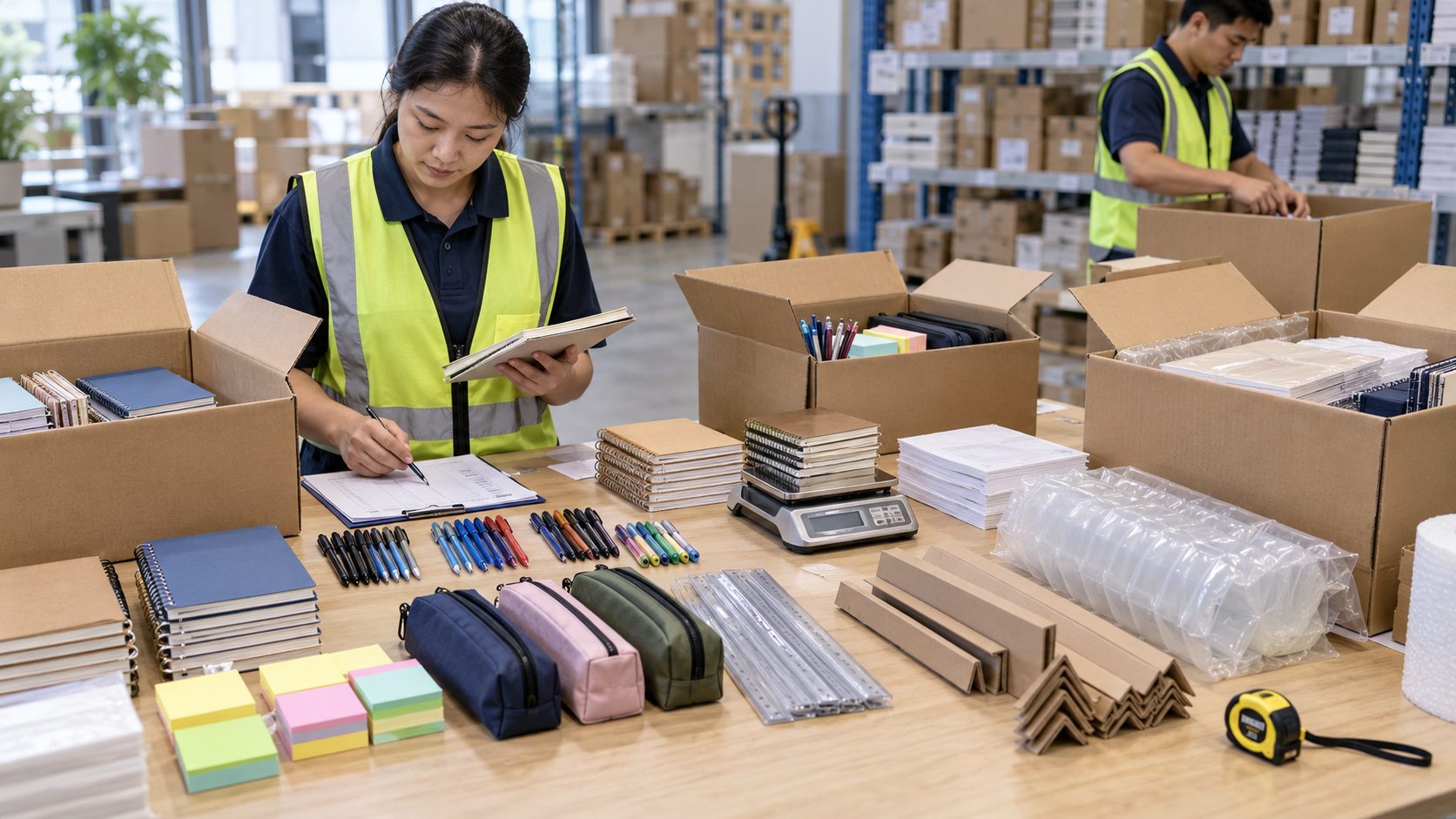
A practical consolidation checklist for stationery brands buying from several China suppliers, covering receiving records, packing compatibility, restricted-item review and chargeable weight.
Updated: October 6, 2026
If several Chinese suppliers are sending notebooks, pens, markers, adhesives and desk accessories to one warehouse, the safest plan is not to put every parcel into one carton as soon as it arrives. First match each parcel to the correct purchase order and SKU, then separate products by handling and transport risk, and only then design the final cartons around protection and chargeable weight.
This guide is for stationery brands and small retailers that have already purchased the goods. It does not replace supplier selection or sample approval. If you are still comparing factories, use our stationery procurement guide first.
The three-gate consolidation decision
Approve consolidation only when the order passes all three gates below. A parcel marked “delivered” has passed none of them by itself.
Gate 1: every inbound parcel is identified
Create one receiving record for each domestic shipment. At minimum, record:
- supplier name and purchase-order reference;
- domestic tracking number and arrival date;
- expected SKU, colour or design, and quantity;
- number of inbound cartons or bags;
- exterior and opening photos;
- shortage, visible damage or wrong-item notes; and
- the supplier's return or correction deadline.
Do not consolidate an unidentified parcel. Once outer packaging is discarded and similar pens or notebooks are mixed, proving which supplier caused a shortage becomes much harder. A structured China warehouse receiving process should preserve the link between supplier, tracking number and SKU until the check is closed.
Gate 2: the products are compatible in one carton
“Stationery” is a retail category, not a transport classification. A paper notebook and a solvent-based marker may appear in the same catalogue but require different handling decisions.
- Dry paper goods: protect notebooks, cards and loose paper from moisture, bending and crushed corners. Keep flat items square and use corner protection where needed.
- Pens and ordinary markers: confirm caps are secure and inner packaging prevents movement. Ask the supplier for product composition when ink or solvent content is unclear.
- Glue, correction fluid, paint pens, aerosols or solvent-based products: pause consolidation until the exact composition, quantity and route acceptance have been checked. Do not relabel or describe these merely as “office supplies.”
- Electronic stationery or items with batteries: identify the battery type and configuration before choosing a route.
- Glass, ceramic or sharp desk accessories: use separate protective packing so heavy paper stock cannot crush fragile pieces and sharp points cannot puncture other goods.
The IATA Dangerous Goods Regulations explain that dangerous goods must be correctly classified, packed, marked, labelled and documented for air transport. This does not mean every ink product is dangerous goods. It means the forwarder needs accurate product information before confirming acceptance.
Gate 3: the carton plan improves protection without hiding cost
Ask for both actual weight and external carton dimensions after repacking. International transport may be charged on the greater of actual weight and dimensional weight, according to the selected service. The divisor and rounding rule must come from the quotation for that route.
Removing oversized retail boxes can reduce volume, but do not remove packaging that is needed for:
- product protection;
- barcode or variant identification;
- batch or compliance information;
- resale presentation already approved by the brand; or
- evidence needed to resolve a supplier claim.
The right answer is sometimes two or three cartons rather than one. For example, dense notebooks can make a single box too heavy, while an underfilled carton of pencil cases may become unnecessarily bulky. A general parcel consolidation guide explains the basic workflow; the decision here is specific to mixed stationery SKUs.
A practical packing decision matrix
Use this as an approval checklist, not as a universal packing instruction.
| Product group | Main risk | Minimum decision before consolidation |
|---|---|---|
| Notebooks, paper and cards | Moisture, bent corners, high density | Keep dry and flat; split cartons if final weight becomes impractical |
| Pens, pencils and rulers | Movement, mixed variants, puncture | Retain SKU separation; secure long or pointed items |
| Ink, glue and paint products | Leakage or transport restriction | Confirm composition and route acceptance before packing |
| Battery-powered stationery | Undeclared battery | Identify battery type and quantity; obtain route approval |
| Glass or ceramic desk items | Crushing and breakage | Use independent cushioning and avoid direct contact with dense paper goods |
| Private-label products | Variant or artwork mix-up | Preserve approved labels, batch references and count evidence |
What to check before the warehouse starts repacking
Send one written consolidation instruction that answers these questions:
- Which supplier parcels belong to this outbound shipment?
- Which SKUs must remain in separate inner bags or bundles?
- Which items require photos, quantity checks or defect sampling?
- Which retail packaging may be removed, and which must remain?
- Are any liquids, aerosols, batteries, magnets, powders or sharp items present?
- What is the maximum acceptable carton weight or size for the quoted service?
- Who may approve substitutions, split cartons or disposal of packaging?
Avoid instructions such as “remove all packaging” or “make it as small as possible.” They are easy to follow but can destroy product protection and traceability.
Build a cost worksheet before approving shipment
Do not judge consolidation only by the number of cartons. Compare the full landed logistics picture:
- domestic delivery from each supplier to the warehouse;
- receiving, counting or inspection service;
- repacking materials and labour;
- actual and dimensional weight after repacking;
- international freight and route-specific surcharges;
- destination handling, duties and taxes where applicable; and
- the cost of correcting a shortage before export versus after delivery.
A smaller carton is useful only if it remains compliant, protects the goods and lowers the relevant chargeable weight. Request final photos, carton dimensions, gross weight and a SKU-level packing list before authorising dispatch.
Where YDA Express can help—and where we cannot
YDA Express can receive parcels from multiple Chinese suppliers, record arrivals, provide requested check photos, combine approved items, repack them and arrange an international forwarding option based on the declared product and destination.
We cannot guarantee that a product is unrestricted without its material, battery or composition information. We also cannot replace your supplier contract, approve private-label artwork on your behalf, or determine the final duty and tax treatment for every destination. The buyer remains responsible for truthful product information and any importer obligations.
Final release checklist
Release the consolidated shipment only when:
- every inbound tracking number is matched to a supplier and SKU;
- shortages and visible defects are resolved or accepted in writing;
- sensitive products have been disclosed and accepted for the route;
- the final carton plan preserves SKU traceability and product protection;
- actual dimensions and gross weight have been reported;
- the final quote uses the same service and chargeable-weight basis you approved; and
- the packing list and consignee details have been checked.
If one of these items is still unclear, hold the shipment. Correcting the record while the goods are in China is normally easier than reconstructing mixed cartons after international delivery.
📲 Download the YDA Express App
Use the YDA Express App to place China purchasing orders, view product check photos, manage packages, and arrange consolidation and international forwarding.