Before a custom abaya is cut, agree what each measurement means, who adds ease, and how length, sleeves and closures will be checked. Use one seller-approved specification.
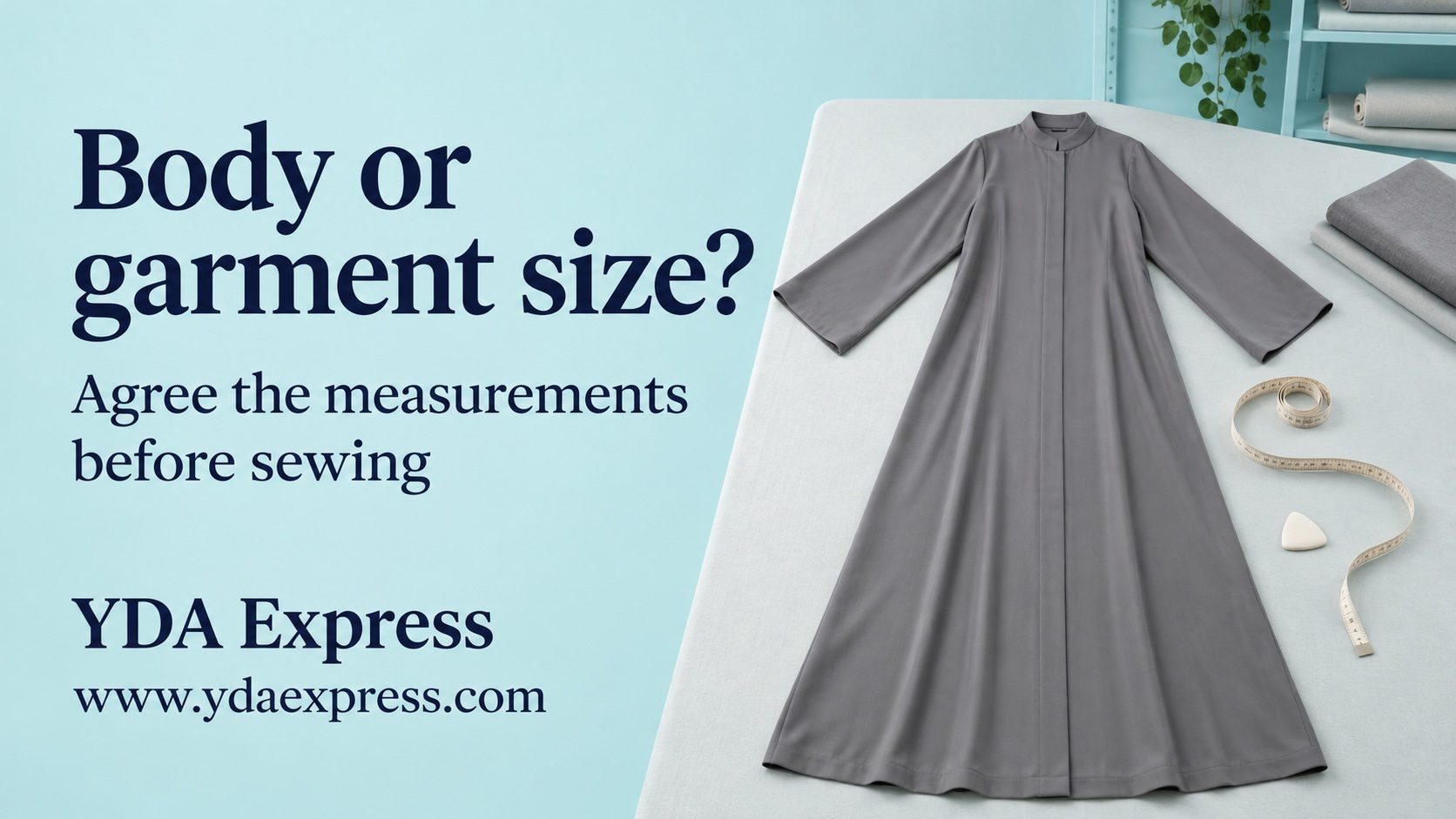
For a custom abaya, send the maker the measurements it requests and agree what the finished garment should measure. Do not send an unlabeled list and assume the seller will add the right looseness. First establish whether it wants body measurements, measurements from an abaya you like, or finished targets. Write down who adds the allowance for movement and drape.
This is a purchase-approval worksheet for one fabric abaya from a Taobao seller or 1688 supplier. It is relevant to buyers in the Middle East and elsewhere, without assuming one regional size system or common import law. Brand guides and seller-policy examples checked: 16 November 2026. They demonstrate questions to ask your actual maker; they are not that maker's terms.
The same word can mean a different measurement
“Bust” might mean your body circumference, a garment circumference, or one width measured flat. “Sleeve” needs a starting point. Never compare these values as if they describe the same distance.
For example, Shehna Hussain's existing abaya chart uses one-side flat bust/waist widths and neck-to-wrist sleeves. Space by DïA's fit guide instead defines finished bust/hip circumferences and sleeve length from the shoulder point. Neither definition is a universal rule for abayas.
Ask the chosen seller to mark its measuring points on a plain garment sketch. Confirm centimetres or inches; if conversion is needed, keep the original value and the agreed converted value together. Do not silently change units when forwarding the brief.
A size such as 54 or a letter such as M is only a selected label until the seller explains its meaning for that design. Height can help discuss length, but does not define the bust, upper arm or desired hem position.
Keep body inputs and finished targets in separate columns
Take body measurements using the maker's stated method. Describe the underlayer you intend to wear and ask whether it wants measurements over that layer. Do not add extra centimetres to your body figures without saying so.
Separately measure an abaya whose fit you like, following the same points the seller will use. Photograph the tape on the garment if a measurement needs explanation. Close fastenings as agreed and lay it naturally without stretching. You usually need measurement evidence, not identifiable body photographs.
Use a short approval sheet:
| Field | What must be agreed |
|---|---|
| Design and fabric | Listing/option, cut, composition, lining, stretch and selected colour |
| Body inputs | Named points, units and whether measured over the intended underlayer |
| Finished targets | Length, chest/hip, shoulder, upper arm, sleeve and cuff points relevant to this cut |
| Ease | Who calculates it, at which points, and whether finished targets already include it |
| Construction | Open/closed front, overlap, fastening position, pockets and included belt/shayla |
| Acceptance | Measuring method, maker's stated tolerance and remedy for a mismatch |
The fields are questions, not a promise that every seller can customize every point. A maker may offer only a standard width with selectable length. If that cannot meet your requirements, choose another design rather than label the purchase fully bespoke.
Agree the silhouette before approving the pattern
Ease is the difference between the relevant body measurement and finished garment measurement. It affects movement and shape, but there is no single allowance that suits every fabric, cut or wearer. Ask the maker to propose it, then approve the resulting targets.
Do not add ease twice: once yourself and again when the maker reads the numbers as body measurements. Nor should you derive a closed bust circumference from an open-front garment's width without the maker defining front overlap and the measuring method. A generous hem does not prove there is room in the upper arm.
Discuss the actions that matter to you: sitting, reaching forward, fastening the front and wearing your usual underlayer. Confirm sleeve and cuff openings, not just total sleeve length. Agree the hem position with your planned footwear, the length starting point and whether front/back lengths differ. These are personal wearing choices, not legal or religious approval.
A photograph of colour or fabric under one light cannot guarantee opacity or drape in every setting. If either is decisive, request a fabric swatch or sample where available and agree the cost. A reference photo alone is insufficient evidence of fabric composition.
Make the seller answer before paying for cutting
Send the sheet and ask the maker to return one confirmed version. Its response should identify missing inputs, finished dimensions it can achieve, any standard points it will not alter, the tolerance it accepts and the production estimate. A reply saying only “custom size available” leaves the key decision open.
On Taobao, keep the selected option and written agreement with the actual order. On 1688, distinguish one sample or personal garment from a production order: ask whether the supplier accepts that quantity and what the quote includes. The 1688 sourcing workflow covers sample and order approval; do not assume a bulk listing offers individual tailoring.
Before deposit, ask when cutting becomes irreversible, whether later changes cost extra, who pays for correction/postage and what evidence is required if the finished garment differs. Rima Atelier's FAQ, for example, states that its made-to-measure pieces are final sale. That is one brand's term, not a blanket rule removing rights for faulty or misdescribed goods.
Obtain your actual seller's terms. The Taobao return-cost guide explains why an accepted refund may still leave transport or completed service costs. If an agent will order, use the buying-agent quote checklist to agree who controls the order and any refund.
Compare receipt with the approved sheet
Before purchase, ask YDA Express which specific communication, photographs or flat measurements can be arranged and at what price. Do not assume a tailoring, fitting or measurement service is included. The warehouse cannot reproduce your try-on, judge comfort or certify fibre content.
If an agreed check is available, compare the same measuring points and method against the approved sheet. Hold an observable mismatch before export and ask the maker about correction. Preserve labels and packaging until that decision is settled. An acceptable tape measurement still does not guarantee personal fit.
Then confirm the actual destination, personal or resale use, materials and trims for route and import-cost review. This worksheet assigns no universal Middle East tax, exemption or importer qualification. Recheck seller terms, import requirements and carrier conditions before dispatch; an earlier check date does not freeze them.
Release the order only when maker and buyer are working from the same dated specification. If the definition, finished target or mismatch remedy remains unclear, keep the cutting approval pending.
📲 Download the YDA Express App
Use the YDA Express App to place China purchasing orders, view product check photos, manage packages, and arrange consolidation and international forwarding.