Learn how a customs broker can save your China parcel from delays and unexpected fees. Practical advice for overseas shoppers and small business importers.
Your long-awaited package from China has been stuck in customs for a week. Tracking just says “Customs Clearance In Progress,” and you’re refreshing the page like a nervous stock trader. You ordered these items for your small online store—if they don’t show up soon, you’ll owe refunds or lose customers. Sound familiar?
Here’s the thing: customs clearance is often the invisible tripwire of international shipping. And the person who can make it smooth or a nightmare? The customs broker, known in China as customs broker. Most shippers don’t think about this until it’s too late. But if you’re buying from China regularly, getting to know this role can save you from expensive headaches.
What Does a Customs Broker Actually Do?
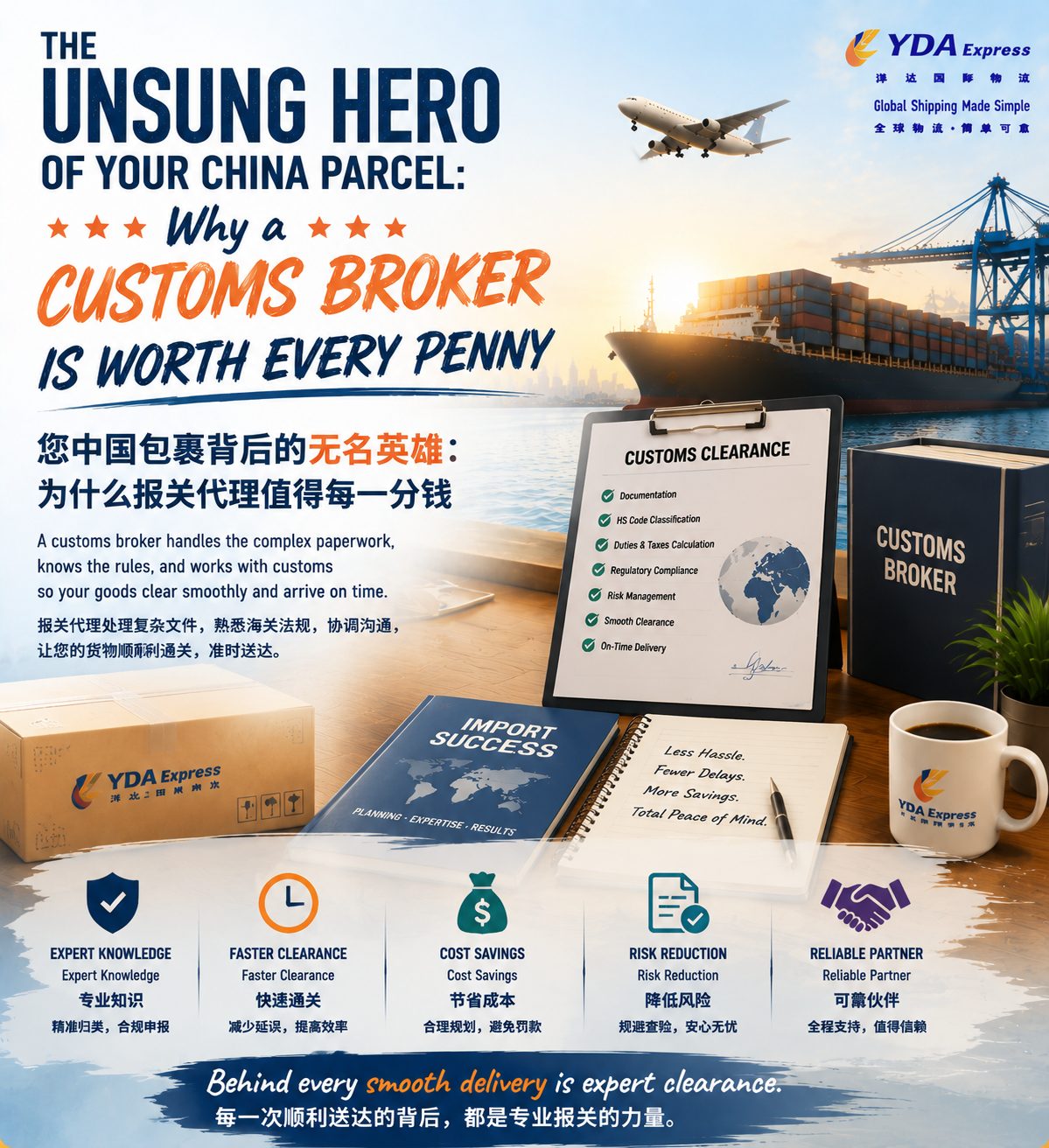
A customs broker acts as the middleman between you and the border authorities—like the U.S. Customs and Border Protection (CBP), the UK’s HMRC, or the Canada Border Services Agency. Their job is to make sure your shipment crosses the border without getting flagged, seized, or hit with surprise charges.
Practically, that means they:
- Classify your goods using the correct Harmonized System (HS) code. A wrong code can mean overpaying duties, or worse, a fine.
- Prepare and submit the necessary documents: commercial invoice, packing list, certificate of origin, and sometimes special permits.
- Calculate and pay the right taxes and duties on your behalf, so you’re not left guessing.
- Deal with any queries from customs officers—explaining why a shipment of “gifts” is actually commercial goods, for example.
Without one, you’re effectively navigating a foreign bureaucracy in a language you may not speak, with rules that change based on what you’re shipping and where it’s going.
The Hidden Chaos of Customs Without a Pro
Let’s say you’ve bought a batch of wireless earbuds from a supplier on 1688.com. You’ve had them sent to a Chinese warehouse for consolidation. The forwarder prints labels, stuffs everything into a box, and ships it via DHL to the UK. Then you get a message: “Shipment held – awaiting commercial invoice review.”
Panic sets in. The invoice you uploaded says “electronics” and has a total value of $200. But the customs officer wants details: brand, model, intended use, exact country of manufacture. They might suspect undervaluation, because those earbuds retail for much more. Without a proper declaration, your parcel can sit in a warehouse for days, racking up storage fees. Or it gets returned, and you’re out the shipping cost. Or—worst of all—it’s destroyed, and you have to explain to your customer why they’re not getting their order.
These hiccups happen every day. A few common triggers:
- Vague descriptions: “Clothes” doesn’t cut it. Is it a cotton t-shirt or a down jacket? The duty rates differ.
- Missing certifications: Children’s paint sets may need ASTM or EN71 safety certificates. Without them, they’re illegal to import.
- Restricted items: Think lithium batteries (fire risk) or plant seeds. If a carrier flies your parcel, battery limits are strict, and finicky.
Honestly, customs isn’t trying to be difficult. They’re enforcing safety, tax, and trade laws. A broker who knows these laws inside out can keep your peace of mind intact.
When a Forwarder Is Also Your Broker (And Why That Helps)
Here’s where a China-based parcel forwarder with customs expertise really shines. They don’t just move boxes; they understand what needs to happen before a box even leaves the warehouse.
At YdaExpress, we process hundreds of parcels a week to destinations like the US, UK, Canada, and Australia. The ones that sail through customs are almost always those where the paperwork was vetted by someone who knows the destination’s import rules. For example, did you know that sending a wooden toy to Australia can require a fumigation certificate? Or that some US states have stricter rules on lithium-ion batteries than others? A good forwarder with customs know-how will flag that early on.
We’ve also seen the flip side: packages from individual shoppers who declared their stuff as “sample” or “gift” to dodge duties, only to have a customs officer reject it because the goods were clearly commercial. In one case, a customer ordered 30 phone cases and marked them as “personal use,” thinking it was harmless. Customs opened the box, saw the quantity, and applied a penalty along with a fine. The delay cost him two weeks and a frustrated client.
When your forwarder doubles as your customs guide, they can:
- Pre-screen your invoice for red flags.
- Advise on realistic values and item descriptions that match customs databases.
- Bundle multiple orders correctly to appear as a legitimate single shipment, not a suspicious assortment.
- Pick the right shipping channel: sometimes a slower, postal-based service avoids the scrutiny that DHL or FedEx trigger, depending on the country and package value.
How to Choose a Forwarder That Handles Customs Well
Not every shipping company offers true customs support. Some just hand your parcel to a courier and wash their hands of it. So when you’re shopping around for a China forwarding service, ask these questions:
- “Do you prepare the commercial invoice for my shipment?” The best forwarders will generate it based on your input, ensuring it matches the declared value and contains all required fields—buyer name, seller name, detailed descriptions, HS codes, and incoterms like DDP (Delivered Duty Paid) if you prefer to prepay taxes.
- “What happens if my parcel gets held at customs?” A responsible company will have a team that monitors tracking and proactively contacts you (and the carrier) to resolve issues. If they say “that’s your problem,” walk away.
- “Can you ship DDP so I don’t have to pay duties upon delivery?” DDP means the forwarder calculates and pre-pays the duties and taxes. You pay a single all-in price upfront. This is a huge plus for recipients—no more surprise bills from the courier before delivery.
- “Do you have experience with my country’s import rules?” A forwarder that regularly ships to your country will know the typical pitfalls. For instance, Canada is strict about Chinese-made textiles and often requires a vendor declaration. Australia has biosecurity checks for anything with plant or animal materials. The US cares about proper value declarations and intellectual property—shipping fake designer bags is a fast track to a seizure notice.
Real Talk: What Does This Cost You vs. Save You?
Many buyers avoid using a customs-savvy forwarder because they think it costs extra. Yes, you might pay a small fee for documentation or DDP service—often between $5 and $20, depending on complexity. But compare that to the risks:
- A storage fee at a customs warehouse can run $50 to $200 a day in some places.
- A returned parcel can cost you double shipping (China outbound + return to sender).
- Lost goods mean losing the product value, shipping fees, and possibly seller penalties.
- Legal fines for serious non-compliance can reach thousands.
So, that modest broker fee is essentially cheap insurance. It’s the difference between gambling and planning.
Making Customs Boring (The Goal)
I’ll let you in on a logistics secret: the best customs clearance is the one that nobody notices. It’s completely uneventful. Your package moves from “arrived at destination country” to “out for delivery” with barely a pause. That’s what you pay for—the skill to make it look easy.
Getting there requires a forwarder who treats paperwork as seriously as they treat physical handling. They should know, for example, that sending a leather bag to the EU might qualify for a preferential tariff if the bag is made from Chinese leather (not Italian), but only if the certificate of origin is right. Or that a bluetooth speaker with an in-built battery needs a UN38.3 test report attached to the airway bill when using FedEx.
These details sound tiny, but they compound. Miss one, and your week blows up.
The Bottom Line
Whether you’re restocking your Etsy shop with handmade craft supplies, importing the latest tech gadgets for your Shopify store, or just doing a personal mega-haul from Taobao, don’t let customs be an afterthought. A customs broker—or in English, a customs clearance agent—isn’t just for giant freight companies. It’s for anyone who wants their stuff to arrive on time, without drama.
At YdaExpress, we’ve built our entire fulfillment process around helping overseas buyers avoid those “stuck in customs” horror stories. From checking your shopping list for risky items to generating clear, compliant invoices, we handle the red tape so you can focus on what matters—your customers or your own excitement.
Ready to make China shipping boringly simple? Send us a message on WhatsApp at +8616666169028 or head over to ydaexpress.com to start a conversation. Our team will walk you through the best options for your country and your purchases. No jargon, no guesswork—just packages that show up when they should.
📦 China Parcel Forwarding & International Shipping Already placed your order? Send your purchases to our China warehouse for parcel receiving, photo inspection, up to 180 days of free storage, package consolidation, international shipping, and real-time tracking.
📲 Download the YDA Express App One app for shopping, purchasing assistance, package management, consolidation, international shipping, and worldwide delivery.
🌍 More Helpful Guides Explore practical guides on shopping from China, parcel forwarding, shipping costs, and customs clearance.