Confused by customs forms when ordering from China? This guide explains customs declaration in plain English, with practical tips to avoid delays, reduce fees, and ensure your package clears smoothly. Learn how YdaExpress can help.
You’ve found the perfect item on Taobao or 1688. The price is great, the seller responsive. But then comes the shipping form with a box marked “customs declaration.” Suddenly it’s a knot of anxiety: What do I put? Will my package get seized? How much tax will I pay?
If that sounds familiar, you’re not alone. Every day, thousands of people ship goods from China and face the same question: how to handle customs declaration (bàoguān) — customs declaration. It’s not as complicated as it seems, but getting it wrong can mean delays, extra charges, or worse, a package returned.
In this article, I’ll break down what you really need to know about customs declaration for international shipments from China. No fluff, just the facts that matter when you’re an everyday shopper or small business importing from China.
What Exactly Is Customs Declaration?
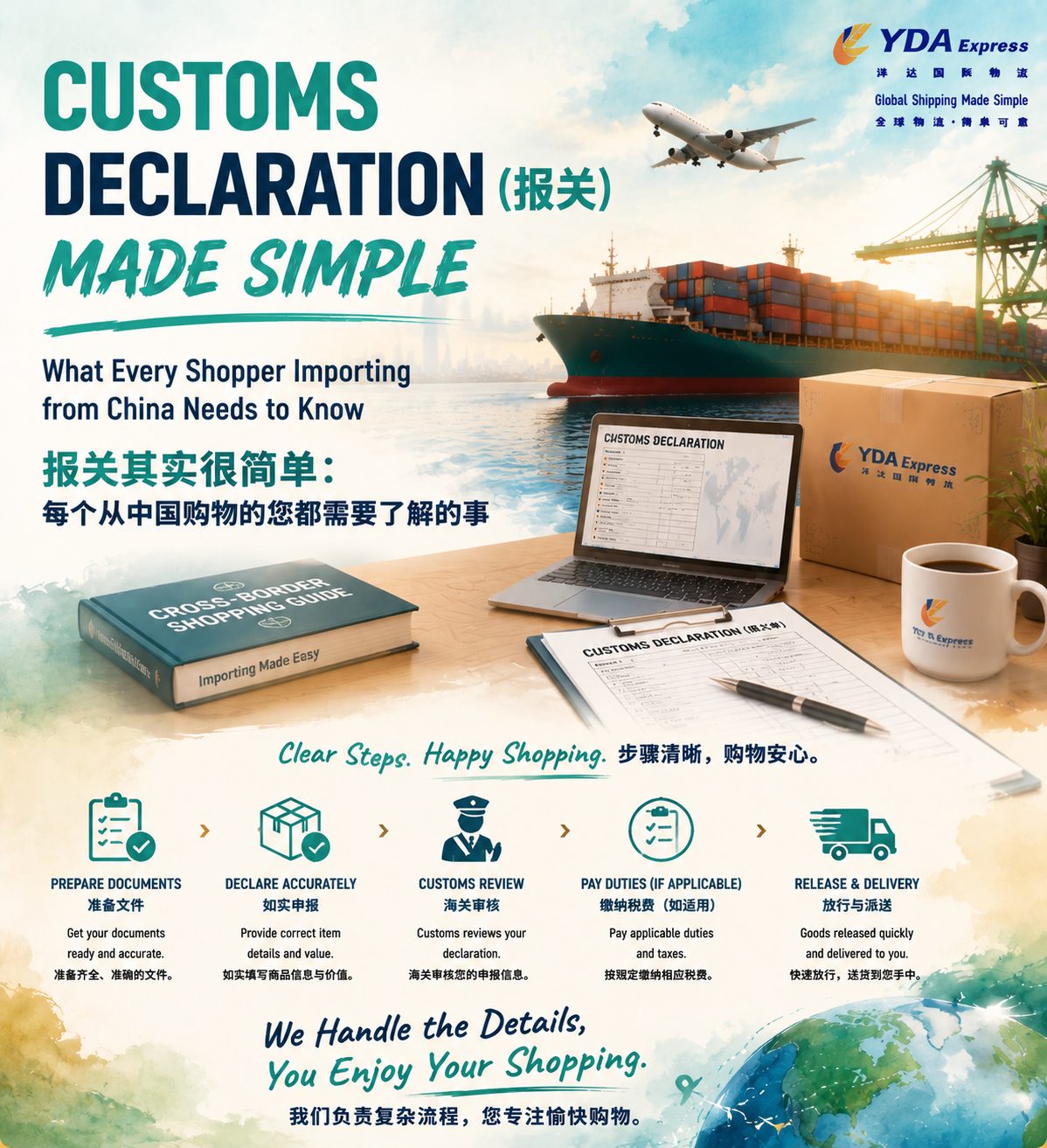
Customs declaration is the official process where you tell government authorities what’s inside your package, what it’s worth, and why it’s entering the country. Think of it as a passport for your goods. In Chinese, it’s called customs declaration (bàoguān), literally “declare to customs.”
Every country has its own rules, but the basics are universal: you submit a form (often electronically) with details like shipper and receiver information, item description, quantity, value, and weight. Customs officers review it, assess any duties or taxes, and decide whether to release the shipment or inspect it further.
For small packages — say, a few t-shirts or electronics parts — the process is usually straightforward. Larger shipments or restricted items (like batteries, liquids, food) can get more scrutiny.
Here’s the thing: even a tiny mistake on a customs form can cause delays. I’ve seen a $20 package held for two weeks because the description simply said “gift” instead of “cotton t-shirt.” That’s why understanding the basics pays off.
The Key Pieces of a Customs Declaration
When you ship from China, you’ll typically need to provide:
- Item description: A clear, specific description in English. Not “sample” or “stuff,” but “men’s cotton t-shirt” or “USB charging cable.”
- Harmonized System (HS) code: An internationally standardized number that identifies the product type. For example, 6109.10 for cotton t-shirts. You can look these up online. Many carriers or forwarders can help assign them.
- Quantity and unit value: How many units and the price per unit. This determines the total declared value.
- Country of origin: Usually “CN” for China, but check if the goods were made elsewhere.
- Reason for export: For most personal or small business shipments, it’s “sale” or “gift.”
Sounds simple, but each field can trip you up. For instance, undervaluing items to avoid duties is a common tactic — and a risky one. Customs authorities aren’t naive. If they suspect the value is unrealistically low (like a smartphone declared at $10), they may hold the package, ask for proof of payment, or even fine you.
At YdaExpress, we often help customers correct these details before the package leaves our warehouse. A little upfront honesty goes a long way.
Why Customs Declaration Matters More Than You Think
You might wonder: it’s just a small package, why bother? Here’s why it matters:
- Duties and taxes: Most countries impose import duties and VAT/GST on goods above a certain value (the de minimis threshold). For example, the U.S. has a de minimis of $800 per day per person — packages under that are generally duty-free. But the EU has a far lower threshold, around €150 for customs duty and €22 for VAT (though rules are changing). If you declare inaccurately, you could underpay and face penalties, or overpay because you didn’t claim the right exemption.
- Restricted items: Certain goods need special permits or can’t be imported at all (e.g., certain batteries, food, plants). A proper declaration flags these upfront so you don’t get a surprise seizure.
- Delivery speed: A well-prepared declaration gets through customs faster. Carriers like DHL and FedEx have dedicated customs teams, but they still rely on you providing correct info.
Common Customs Declaration Mistakes (And How to Sidestep Them)
Over the years, I’ve seen small errors cause big headaches. Here are the top mistakes and how to avoid them:
1. Vague or Incomplete Descriptions
“Personal effects” or “merchandise” won’t cut it. Customs wants to know exactly what’s inside. If you’re shipping a mix of items, list each one separately. For example: “1 set of plastic building blocks, 2 plush toys, 1 pair of children’s shoes.”
2. Under-declaration of Value
Yes, you might save a few dollars in duty, but the risk isn’t worth it. Customs can search online for similar products. If they find a listing that shows your $200 handbag selling for $50, you’ll be on the hook for back duties plus penalties. In extreme cases, goods are confiscated.
3. Wrong HS Codes
Using the wrong HS code can lead to overpayment or underpayment. It’s not always easy to find the right one. If you’re stuck, ask your forwarder — they deal with this daily. An HS code like 9503.00.0071 for “dolls” might seem right, but if it’s actually a robotic toy, the code could be different and duties may vary.
4. Ignoring the Recipient’s Country Rules
Each country has unique regulations. Canada is strict about wood packaging materials; Australia bans certain seeds; Germany requires WEEE registration for electronics. Before you ship, do a quick check or consult someone who knows.
How Different Carriers Handle customs declaration
Not all shipping methods are equal when it comes to customs. Here’s a quick rundown:
- Express Couriers (DHL, FedEx, UPS): These companies have in-house customs brokers. They’ll clear your package using the information you provide, and they often advance duties and taxes on your behalf, then bill you later. It’s fast but can come with brokerage fees. For example, FedEx charges a disbursement fee for advancing duty payments.
- Postal Services (EMS, China Post, USPS): Packages go through regular customs channels. They’re usually handled in bulk, and clearance may be slower. The advantage is that you often avoid brokerage fees and small packages sometimes slip through without duty on low-value items — but that’s not guaranteed.
- Air Freight and Sea Freight: For larger shipments, you’ll need a customs broker or your freight forwarder will handle clearance through a formal entry. This involves more paperwork but is necessary for commercial quantities.
What Role Does a Parcel Forwarder Play?
If you’re buying from multiple Chinese sellers, a parcel forwarder like YdaExpress can be a game-changer. Here’s why:
- Consolidation: We receive your orders from different sellers, check them, and repack them into one box. That means one customs declaration instead of many, which reduces the chance of errors and can lower shipping costs.
- Documentation expertise: Our team knows exactly how to describe items, assign HS codes, and format commercial invoices to satisfy customs in destinations like the US, UK, Canada, Australia, and across Europe. We see daily what flies through and what gets flagged.
- Warehouse storage: You can accumulate items over time and we’ll hold them for free up to 90 days, then ship when you’re ready.
- Flexible shipping options: We work with multiple carriers and can recommend the best balance of speed, cost, and customs-friendliness.
At YdaExpress, we handle hundreds of shipments weekly, and a big part of our job is making customs declaration painless for customers. We’ve helped people ship everything from clothing and accessories to specialty food items, always ensuring the paperwork is spot-on.
Practical Tips for Smoother Customs Clearance
Here are a few actionable tips I’ve picked up after years in logistics:
- Be honest with value: Always declare the real purchase price. If you got a discount, use the actual paid amount. Keep receipts or order confirmations handy in case customs asks.
- Use plain English descriptions: “Bluetooth wireless earphones” not “electronic audio device.” Be specific but not overly technical.
- Check prohibited items lists: Every country’s customs website has a list. A quick check can save you from ordering something that can’t be shipped.
- Consider insurance: If your package is valuable, insure it based on the full value. In case of loss or damage, a proper customs declaration helps the claim.
- Ask for help: If terms like “EEI” (Electronic Export Information) or “DDP” (Delivered Duty Paid) confuse you, don’t guess. A good forwarder will explain things in plain language.
When to Use a Customs Broker
For occasional small packages, you likely won’t need a separate broker — your carrier or forwarder handles it. But if you’re importing commercial quantities regularly, a licensed customs broker can advise on duty rates, tariff classifications, and trade agreements that might save you money. Some countries require a physical importer of record, which a broker can help establish.
Wrapping Up: Don’t Let customs declaration Stress You Out
Customs declaration isn’t meant to be a barrier; it’s a system to keep things fair and secure. When you get it right, it’s just a step in the shipping process. The key is having accurate information and a reliable partner.
If you’re buying from China and want to avoid the headache of filling out forms incorrectly or risking your package getting stuck, consider using a professional forwarding service. At YdaExpress, we handle the entire shipping process — from receiving your parcels to managing customs documentation — so you can shop with confidence. Our team is experienced, responsive, and focused on making cross-border logistics simple.
Ready to get started? Visit https://www.ydaexpress.com to create a free account and receive your China warehouse address. Or if you have questions, drop us a message on WhatsApp at +8616666169028. We’re here to help, one package at a time.
📦 China Parcel Forwarding & International Shipping Already placed your order? Send your purchases to our China warehouse for parcel receiving, photo inspection, up to 180 days of free storage, package consolidation, international shipping, and real-time tracking.
📲 Download the YDA Express App One app for shopping, purchasing assistance, package management, consolidation, international shipping, and worldwide delivery.
🌍 More Helpful Guides Explore practical guides on shopping from China, parcel forwarding, shipping costs, and customs clearance.