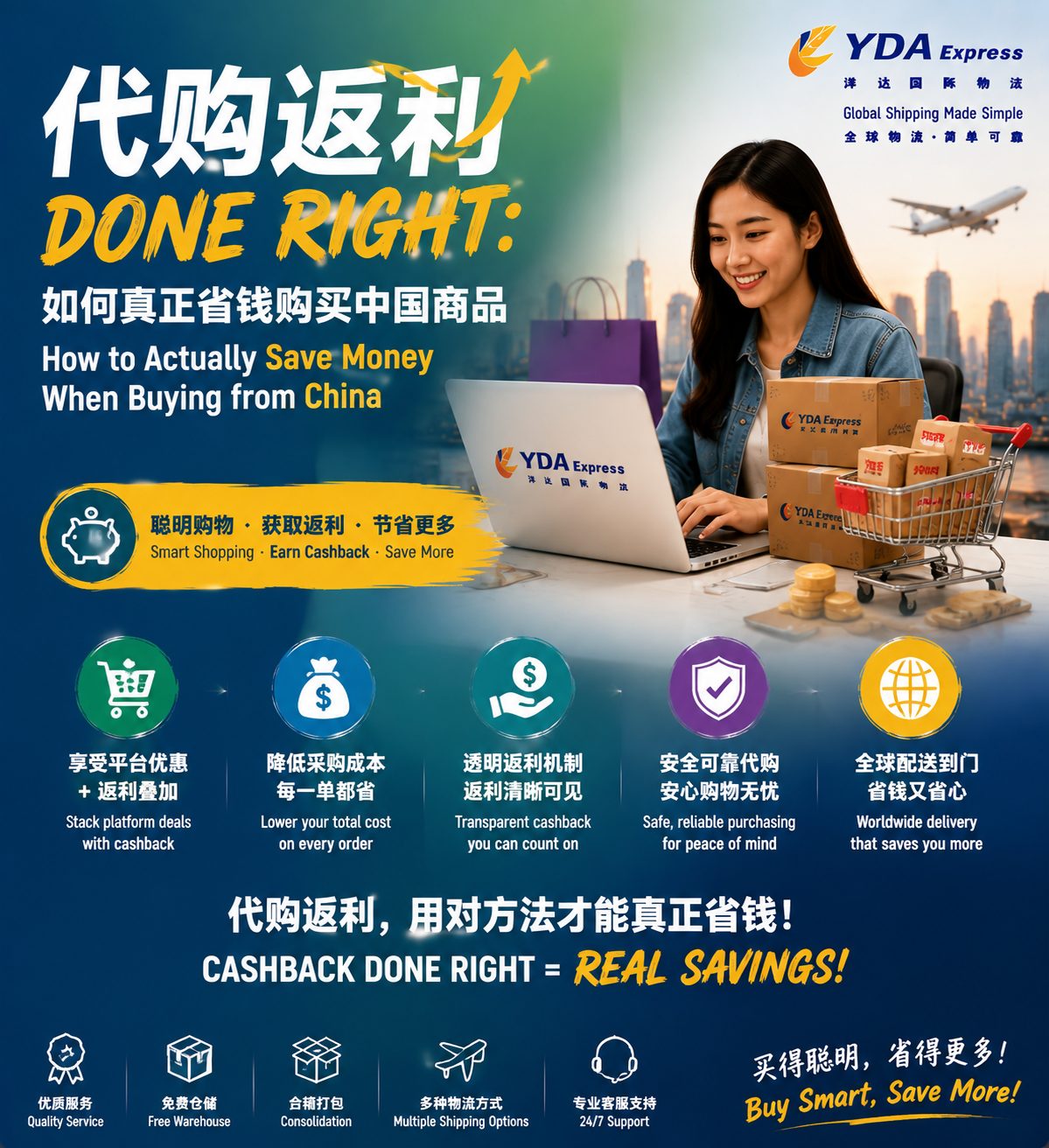
Learn how purchasing-agent cashback works, avoid common pitfalls, and use a trusted China parcel forwarder like YdaExpress to keep more money in your pocket when importing goods.
If you’ve ever tried to buy something directly from a Chinese online store—a niche gadget from Taobao, bulk phone cases from 1688, or even a custom dress from a WeChat seller—you’ve probably stumbled across the term proxy buying. It literally means “proxy buying,” but in practice, it’s a whole ecosystem of agents and middlemen who help overseas shoppers navigate platforms, language barriers, and logistics. And if you dig a little deeper, you’ll hear about purchasing-agent cashback (dàigòu fǎnlì)—cashback or rebates that some agents offer. Sounds like free money, right?
Here’s the thing: it’s not magic, and it’s definitely not always straightforward. Over the years, I’ve seen enough confused customers and questionable deals to know that a little clarity goes a long way. So let’s walk through what purchasing-agent cashback really means, how it can trim your costs, and where you need to keep your eyes wide open.
What Exactly Is purchasing-agent cashback?
At its core, purchasing-agent cashback is a cash-back arrangement between you and the person or platform handling your China purchase. When you use a daigou service, you’re hiring someone to buy items on your behalf and then ship them to you. The agent might charge a service fee, a percentage of the item cost, or build their profit into the exchange rate. But some agents also advertise that they’ll share a portion of their own earnings with you—the “cashback” part.
Where does that money come from? Often, it’s not from thin air. On Chinese e-commerce platforms, sellers frequently offer commissions to affiliates or bulk buyers. A daigou agent who regularly buys in volume might secure discounts that aren’t available to a one-off customer. They keep a slice and pass the rest back to you as a rebate. Other times, the agent operates on razor-thin service fees and uses the rebate to attract customers, hoping to make it up on volume or shipping charges.
The Real Mechanics Behind the Cashback
To be fair, the system isn’t as opaque as it first seems. Let’s say you want a handbag from a Taobao shop that has a 5% commission program for agents. The bag costs ¥500. When your daigou places the order through their affiliate link, they earn ¥25. If they promise you a 3% rebate, you get ¥15 back after the transaction settles. The agent pockets ¥10. Everyone wins—provided everything goes smoothly.
But here’s where it gets sticky: not all rebates are created equal. Some agents inflate the item price before applying a “discount,” so the net cost to you goes up. Others delay payment of rebates for weeks, hoping you’ll forget. And a few less reputable operators use the promise of high cashback to obscure poor shipping practices or hidden consolidation fees. I’ve personally encountered cases where a customer was promised a 10% rebate, only to find that the exchange rate was so lousy they actually paid 15% more than the market rate.
If you’re shopping from the UK, the US, or Australia, the appeal is obvious: who wouldn’t want to claw back a few bucks on every order? But to make it work without getting burned, you need to know the landscape.
The Pros and Cons for Regular Shoppers
For small-scale importers—someone reselling enamel pins on Etsy, or a parent buying school supplies for a local group—purchasing-agent cashback can genuinely improve margins. A 3% rebate on a $2,000 order isn’t pocket change. And if you consolidate multiple small orders into one shipment, the savings stack up.
On the flip side, chasing the highest cashback rate can lead you to agents who skimp on packing, underdeclare customs value without asking, or use the cheapest possible carrier with no tracking. A parcel that arrives crushed or stuck in customs for three weeks is rarely worth a few extra dollars off the front end.
There’s also the hassle factor. Some rebate programs require you to submit claim forms, screenshots, or wait until the product ships before you see a cent. If you’re not organized, those small refunds just never materialize.
How to Spot a Trustworthy Offer
So, how do you separate the wheat from the chaff? A few red flags:
- Guaranteed high rates. If an agent promises 10% cashback on every order with no cap, be suspicious. Legitimate margins on most products don’t support that.
- Complicated payout rules. Watch out for terms like “rebate available only after 30 days of delivery” or “minimum withdrawal of $50.”
- Exchange rate manipulation. Always check the rate they’re using against a standard benchmark like XE.com or your credit card’s rate. Even a small skew can eat any rebate.
On the positive side, look for agents who are transparent about their fee structure upfront, reply to questions promptly, and don’t pressure you into committing to large volumes until you’ve tested the waters with a small order.
Here’s something that often gets overlooked: you don’t necessarily need a pure daigou agent to benefit from rebates. Many Chinese platforms themselves offer promotional discounts, coupon stacking, and store-level vouchers. If you have a solid parcel forwarding partner, you can shop directly, snag those deals, and then simply ship. At that point, the “rebate” is the money you saved by cutting out the middleman’s markup.
Where Forwarders Like YdaExpress Fit In
That’s the point at which the conversation shifts from daigou services to something more hands-on and often more cost-effective. YdaExpress is not a daigou agent per se; it’s a China-based parcel forwarder that also offers purchasing assistance when you need it. That distinction matters.
When you use a forwarder, you’re typically in control of the buying process. You find the product, negotiate with the seller if you can, and place the order. Then you send everything to a YdaExpress warehouse address in China. From there, the team consolidates multiple packages into one box, optimizes the packing to reduce dimensional weight, and ships via carriers like DHL, FedEx, UPS, or specialist lines depending on your destination. Because they’re not acting as the buyer, there’s no hidden commission or rebate game to decode—the fee is for logistics, plain and simple.
But what if you aren’t comfortable navigating Chinese sites yourself? YdaExpress can step in as a purchasing agent for individual items or small batches. They’ll check stock, communicate with sellers, and handle payment. In those cases, any rebate or discount they secure from the seller typically goes toward reducing your total cost or offsetting service fees. It’s not flashy, but it’s honest.
A Practical Workflow to Save Money
Let’s make this concrete. Imagine you’re in the US and you want to buy a batch of ceramic mugs from a Jingdezhen seller on 1688. You could go the daigou route and hope for a 3% rebate. Or you could do this:
- Open an account with YdaExpress (free) and get a unique Chinese warehouse address.
- Contact the seller directly via AliPay or WeChat, form a tentative order, and ask about bulk pricing.
- Pay the seller directly through a method that offers buyer protection.
- Have the mugs delivered to the YdaExpress warehouse. The team will inspect the outer packaging and alert you if any carton looks crushed.
- While that’s happening, you might order a few sample mugs from another city. Both parcels arrive at the warehouse, and the team consolidates them into one sturdy box. They’ll weigh it, give you shipping options with real transit times, and let you choose.
- Ship it. Because the forwarder isn’t marking up the product, you keep the difference that would have gone to a daigou, and you avoid rebate games entirely.
I’ve seen this approach save customers 8–15% compared to a traditional daigou, especially on commodity items where the agent’s service fee can add up. It’s not a rebate in the classic sense—it’s just cost avoidance.
What About Customs and Duties?
This is a big one for UK and EU shoppers in particular. Since Brexit and updated EU VAT rules, import charges can hit small parcels hard if they’re not handled correctly. A daigou agent who doesn’t understand destination-country regulations might fill in the customs paperwork incorrectly just to “save” you tax, which can lead to penalties. Or they might do the opposite and overdeclare value, sticking you with a fat bill.
With a forwarder like YdaExpress, you have control over the declared value and HS code description. They’ll advise on what typically works for your country (for example, how much to declare for the US de minimis threshold of $800, or how to structure invoices for EU IOSS compliance), but the final call is yours. That consciousness about the whole journey—not just the purchase—is what separates a frustrating import experience from a smooth one.
When Daigou Rebates Actually Make Sense
I don’t want to paint purchasing-agent cashback as always bad. For certain buyers, it’s a sound strategy. If you’re dealing with a boutique item from a seller who only works through WeChat, and the agent has an established relationship, the rebate is a genuine thank-you for the referral. Small-time collectors of Chinese brands or cosmetics often find that the community-based agents who source limited-edition drops will share affiliate commissions without drama. In those tight-knit circles, the cashback is almost an afterthought to reliable access.
The key is to weigh the effective total cost—item price + domestic shipping in China + agent fee + international freight + any duties—against what you’d pay if you managed the process yourself via a forwarder. Run the numbers on two or three small test orders. If the daigou route consistently comes out cheaper and the service is reliable, stick with it. But if you’re paying for the rebate through inflated shipping, you’re not really saving anything.
One More Thing: Platform Rebates vs. Agent Rebates
Sometimes the rebate isn’t from the agent at all. Alipay and apps like Fanli.com offer cashback for buyers who click through their portal. If you have a Chinese bank account and a friend on the ground, you can claim these directly. But for overseas shoppers without local banking, it’s a headache. That’s where a forwarder with a purchasing service can help: they can claim platform rebates legitimately and either deduct them from your next order or apply them as a shipping credit. It’s not always advertised, but it’s worth asking about.
What’s the Bottom Line?
If there’s one takeaway, it’s this: purchasing-agent cashback isn’t free money. It’s a pricing tool, and like any tool, it can be used well or poorly. The savviest importers I know use it as a tiebreaker, not a primary reason for choosing a supplier. They focus on product quality, packing standards, carrier options, and transparent communication first. The rebate is just a nice bonus if it materializes.
If you’re new to buying from China, I’d suggest starting with a forwarder that offers purchasing support, like YdaExpress. You’ll learn the ropes without the rebate smoke and mirrors. Once you understand how shipping weights affect cost, which lines bypass customs bottlenecks, and how Chinese holidays impact lead times, you’ll be in a much stronger position to evaluate whether a daigou’s cashback promise is actually worth it.
Shipping from China doesn’t have to feel like a maze. With a clear process and a partner who communicates honestly, you can focus on growing your business or snagging that one-of-a-kind item without worrying about nickel-and-dime rebate tricks. If you have questions about a specific product or want a quote on consolidating an order, reach out on WhatsApp at +8616666169028 or visit ydaexpress.com. The team handles everything from single parcels to full container loads, and they’ll walk you through the numbers in plain terms—no rebate gimmick required.
📦 China Parcel Forwarding & International Shipping Already placed your order? Send your purchases to our China warehouse for parcel receiving, photo inspection, up to 180 days of free storage, package consolidation, international shipping, and real-time tracking.
📲 Download the YDA Express App One app for shopping, purchasing assistance, package management, consolidation, international shipping, and worldwide delivery.
🌍 More Helpful Guides Explore practical guides on shopping from China, parcel forwarding, shipping costs, and customs clearance.