Understand the full breakdown of daigou prices—commissions, shipping, hidden fees—and learn how a transparent China forwarding agent saves you money and headaches.
Daigou Pricing Explained: Why Your China Shopping Agent Quotes Are Higher Than Taobao Prices
You’ve found it—the perfect dress on Taobao for ¥180, or a set of smart home gadgets on 1688 that cost a third of what you’d pay locally. The online price seems too good to be true. Then you ask a daigou (purchasing agent) for an all-in quote and the number they send back makes you blink. Suddenly that ¥180 dress is ¥350, and you’re left wondering if you’re being ripped off.
The short answer? Probably not. The long answer involves a handful of costs that simply don’t show up on a product listing. If you understand what makes up a daigou price, you’ll not only avoid nasty surprises but also spot the agents who are truly giving you a fair deal.
Why Daigou Prices Are Always Higher Than the Taobao Price
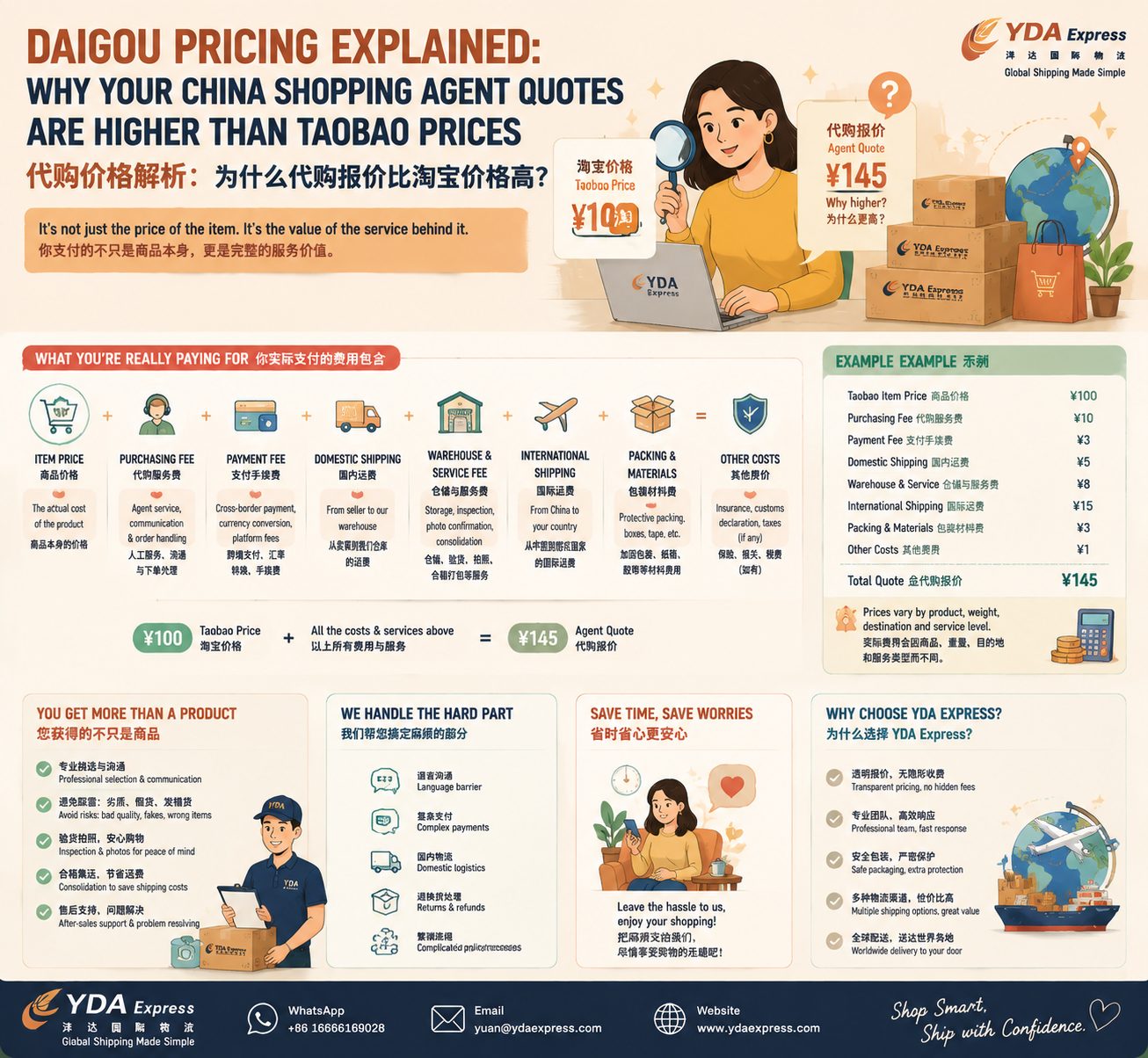
Here’s the thing: when you look at a product on Taobao, 1688, or JD.com, you’re seeing the base price a seller charges to ship inside China. That’s it. No international freight, no agent service, no extras. A daigou price bundles all the behind‑the‑scenes costs that pop up before the package lands on your doorstep.
Let’s break down each layer.
1. Agent Commission or Service Fee
Every daigou needs to get paid for their time. In traditional models, this is often a percentage of the item’s price—anywhere from 5% to 15%. So on a ¥500 handbag, you might pay ¥50–75 just for the buying service. Percentage‑based fees can quickly inflate if you’re ordering expensive items, even though the actual effort to buy a ¥50 cable and a ¥5,000 watch isn’t all that different.
Some modern China purchasing agents, especially those that operate more like logistics companies than personal shoppers, have moved to a flat fee per order. YDA Express, for instance, charges a single fixed fee for purchasing assistance regardless of order value (more on that later). That approach often saves money on big‑ticket purchases and makes costs predictable.
2. Domestic Shipping Inside China
Most sellers on Chinese marketplaces offer free domestic shipping only within mainland China—and often only to addresses in major cities. When you work with a daigou, your order first travels from the seller to the agent’s warehouse. That leg can cost ¥6 to ¥15 per parcel, sometimes higher for large or heavy items. If you’re ordering from several different sellers, those domestic fees add up fast. An agent may also charge a small handling fee for receiving and checking in the package.
3. Currency Conversion and Payment Processing Fees
Paying Chinese sellers usually requires Alipay, WeChat Pay, or bank transfers. Overseas customers rarely have direct access to those, so the agent pays on your behalf using their own CNY balance. They’ll typically convert your payment at a slightly worse than mid‑market exchange rate—say, 1–3% above the interbank rate—to cover their own conversion fees and risks. On top of that, platforms like PayPal or credit card processors may tack on another 3–5% if you’re paying in a non‑Chinese currency. So a ¥1,000 cart might actually cost you ¥1,080 in yuan‑equivalent once the exchange margin is applied.
4. International Shipping: The Big One
This is where the price really jumps. Shipping a 1 kg parcel from China to the US or Europe via an express carrier like DHL or FedEx typically starts around ¥80–120 for the cheapest economy routes, but can easily surpass ¥200 for faster services. A 5 kg box? You’re often looking at ¥350–600 just for freight. And that’s before any repackaging or consolidation.
Volumetric weight is another gotcha. Carriers charge based on whichever is greater: actual weight or volumetric weight (length × width × height / 5000 for cm/kg). That puffy jacket might weigh only 800 grams but take up the space of 3 kg, tripling your shipping costs. Experienced agents repack packages to minimize volume, removing excess seller packaging and consolidating multiple items into a single box. YDA Express reports that their repack service can shrink shipping bills by 20–30% on average, but it’s still a genuine cost.
5. Consolidation, Inspection, and Extra Services
If you’re ordering from five different sellers, someone has to hold all those parcels, match them to your account, take photos, and perhaps check for obvious defects. That labor isn’t free. Most daigous charge a small fee per parcel for receiving and storage—often ¥1–5 per day after a free storage period, plus ¥5–15 for photos or detailed inspections. When you add up ten parcels, that’s ¥50–150 before you even ship.
Then there’s the consolidation itself: pulling items together, checking they all belong, and repacking into one shipment. Some agents include this service for free; others bill a nominal ¥20–50 per consolidated box. It’s a small price to pay to avoid ten separate international shipments.
6. Customs Duties, Taxes, and Compliance
For most personal shipments valued under the de minimis threshold (e.g., $800 in the US, €22 in many EU countries), you won’t pay duties. But higher‑value items can attract customs charges upon arrival. A daigou may or may not include duty in their quote—usually they don’t, because it’s unpredictable. However, an agent who knows how to write customs‑friendly descriptions and uses the right HS codes can lower your risk of being hit with extra fees. This isn’t so much a visible line item in your daigou price, but a value‑add that saves you money down the line.
When you add all that up, a ¥180 dress can legitimately cost ¥300–400 landed. The alternative—paying domestic US prices of $70+ for a similar dress—still leaves you ahead, but it’s not the ¥25 bargain the initial taobao page suggested. That’s just the reality.
The Two Main Daigou Pricing Models (And Which One Typically Costs Less)
There are basically two ways China purchasing agents make money. Knowing the difference will instantly make you a smarter shopper.
Percentage‑Based Commission: The Classic Daigou
This is the model used by many traditional personal shoppers. They charge you, say, 10% of the product price, plus actual shipping. So if you buy a ¥2,000 coat, they pocket ¥200. The upside: it’s simple to calculate; the cost scales with product value. The downside: it’s poor value on expensive items. That ¥200 commission may cover only five minutes of placing an order, while the same agent might earn just ¥5 on a ¥50 phone case. Over time, you’re overpaying for high‑ticket purchases.
Flat‑Fee Service: The Logistics‑Focused Forwarder
Companies like YDA Express, which originally built their business on parcel forwarding, often offer purchasing assistance as a bolt‑on service with a flat fee—say ¥15 per order, regardless of order value. They aren’t trying to profit from how much you spend on products. Their margin comes from shipping volume and value‑added warehousing services. For customers placing large Taobao hauls, this model almost always works out cheaper. The £150 Patagonia dupe from 1688? ¥15 fee. The ¥8,000 drone? Still ¥15. You only pay for what the logistics actually costs.
To be fair, the flat‑fee model isn’t always better if you order single tiny items. A ¥300 order with a ¥15 fee is effectively 5% commission, pretty much in line with percentage agents. But as your order value climbs or you batch dozens of items, the savings become obvious. At YDA Express, customers often bundle 20+ small items into one purchasing request and ship everything together—the per‑item purchasing cost drops to pennies.
What to Look for in a Reliable China Purchasing Agent
Not all daigou pricing is transparent. Some agents bake hidden markups into the exchange rate or shipping quote, or they’ll avoid telling you when a seller’s “free domestic shipping” isn’t actually free. Here’s how to spot a good one.
Upfront Fee Schedule
Any decent agent should have a public fee schedule—or at least give you one on request. If they hem and haw about how much their service costs, walk away. At YDA Express, the purchasing fee is clearly ¥15 per order, domestic shipping costs are passed through at cost, and international shipping rates are calculated directly via partner carriers with no markup. That kind of clarity is rare and worth seeking out.
Photo Quality and Communication
A trustworthy agent will send photos of your items when they arrive at the warehouse. Not just a blurry picture of a plastic bag, but clear shots that let you spot defects or wrong variants. They should be reachable on WhatsApp or WeChat, replying within a few hours during business time. This isn’t a direct pricing matter, but it prevents costly mistakes.
Shipping Options and Knowledge
Do they offer more than one carrier? Can they advise you on the trade‑off between fast-but-expensive DHL and slower-but-cheaper SF International? An agent with logistics expertise can save you a bundle just by recommending the right shipping method for your country. For instance, Germany-bound packages often face heavy duties if shipped via DHL but sail through with a well‑prepared China Post‑DHL hybrid service. A knowledgeable agent knows these quirks.
Transparent Weight and Dimensions
Before you pay for international shipping, ask for the final weight and box dimensions. Some agents will quote you an inflated weight to cover their own shipping profit. Reputable ones weigh each package on arrival and show you a photo of the scale. YDA Express does this as standard—you pay what the scale says, not a rounded‑up guess.
How to Estimate Your All‑In Daigou Price Before You Order
You don’t need to wait for a quote to get a realistic idea of what you’ll pay. Here’s a quick DIY method.
First, sum up the item prices. Add 8–12% for domestic Chinese shipping if it’s not included. Then add the agent’s service fee—either a percentage or a flat rate. For international shipping, use an online calculator from a carrier like DHL or a forwarder’s website. Remember to estimate volumetric weight: multiply item dimensions (in cm), divide by 5,000, and compare to actual weight. Take the larger number. For a rough ballpark, a 5 kg parcel via DHL to the US is about ¥400, to the UK about ¥450, to Australia ¥420.
Throw in ¥20–50 for optional photos or consolidation, and you’ll have a pretty accurate landed cost. If the agent’s quote comes back significantly higher without explanation, ask why. Sometimes a seller charges hidden fees, or the item weighs more than expected. Legitimate agents will explain.
At YDA Express, the website (https://www.ydaexpress.com) has a built‑in shipping calculator and a dedicated purchasing request form. You can upload your Taobao links, and the team will reply with an all‑in quote, usually within a few hours. Everything is itemized: product price, domestic delivery, purchasing fee, international shipping. No mystery numbers.
The Bottom Line on Daigou Prices
Honestly, “cheap” daigou services rarely turn out well. You either pay hidden fees down the line or end up with shoddy packing that damages your goods. The key is finding a partner who charges fairly for their work and is up‑front about every single charge. Whether you’re trying to grab a few fashion items or sourcing inventory for a small business, that kind of transparency makes all the difference.
If you’re ready to start your next China shopping spree, get in touch with YDA Express. Their team will give you a clear breakdown—no surprises, no hidden percentages. Reach them on WhatsApp at +86 16666169028, drop an email to yuan@ydaexpress.com, or explore their website at https://www.ydaexpress.com. Because knowing exactly what you’ll pay is worth more than any percentage off.