Daigou retail isn’t just for luxury bags anymore. This guide explains how everyday buyers and small businesses use proxy shopping from China to access Taobao, 1688, JD, and Pinduoduo—without a bank account, local address, or language skills. You’ll learn how consolidation, shipping choices, and a reliable agent can save you time and money.
A friend in London recently showed me a handmade ceramic tea set she’d found on Taobao. The seller only shipped within mainland China, the product page was entirely in Mandarin, and she didn’t have Alipay. That’s the moment most people give up. But she had it on her kitchen table two weeks later, bubble‑wrapped and customs‑cleared, for less than the shipping alone would have cost from a Western boutique. How? Daigou retail.
Most English‑language guides talk about daigou as if it still means a student in Sydney stuffing a suitcase with luxury bags. Those days are mostly gone. Daigou retail has shifted from underground handbag runs to a professional, logistics‑backed service that gives overseas buyers the same access as a local living in Shanghai. And it’s not just for one‑off finds. Small businesses use it to source inventory, hobbyists grab limited‑run collectibles, and even designers order samples from 1688 without opening a factory relationship.
What daigou retail actually means today
Retail purchasing assistance means using an intermediary to buy products from Chinese shops on your behalf. It combines the purchasing task with whatever receiving and forwarding services you have agreed.
Over the last decade this model professionalized. Instead of a WeChat contact with variable availability, you now deal with companies that run warehouses, integrate with multiple carriers, and offer order dashboards. They’ve basically built the cross‑border logistics layer that Chinese platforms lack. And honestly, that’s the part most buyers don’t think about until a package gets stuck.
Here’s the thing: when you buy from a Chinese e‑commerce site directly, you’re relying on the platform’s international shipping—if it’s even offered. Taobao’s Global Consolidation and Cainiao have improved, but choices are limited. You can’t consolidate orders from different sellers into one thoroughly‑packed box, ask for photos of the actual item before it leaves, or hold goods until a cheaper shipping window opens. A daigou retail provider does all of that because they aren’t just a freight forwarder; they’re your receiving department in China.
How the process works, step by step
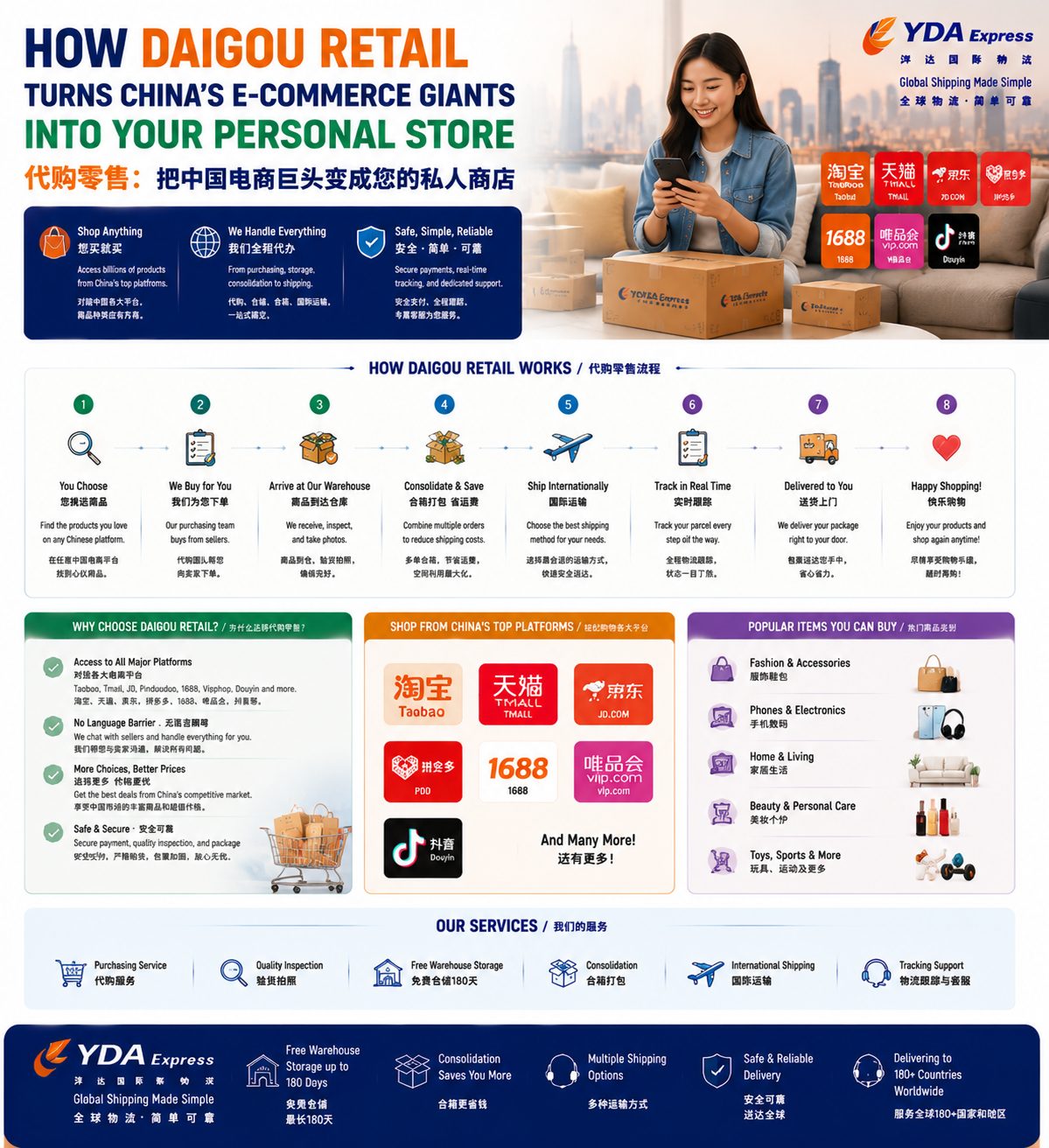
Let’s walk through a typical order so you can see what happens after you hit “pay.” Suppose you want three items from different Taobao stores, plus a bulk pack of phone accessories from 1688. This is a real scenario we handle often at YdaExpress.
- You share the product links with your agent. Maybe you paste them into an order form, or if you’re working with a service that has its own app, you bookmark them.
- The agent confirms availability, price, and domestic shipping fees inside China. For 1688 orders, they might question MOQs (minimum order quantities) and negotiate if needed.
- You pay the agent—usually via PayPal, credit card, bank transfer, or whatever method the service supports. The agent pays the supplier in yuan.
- Goods arrive at the agent’s warehouse. Unlike a simple forwarder, a retail daigou agent checks the items. They’ll match the received products against your order, take photos, and sometimes weigh each piece individually. If something looks damaged or wrong, they flag it before it’s too late to return.
- You choose how to ship. This is where consolidation becomes valuable. Instead of three separate small parcels (each costing a minimum charge), your agent combines everything into one box. They’ll repack to save volume weight—especially important when air freight charges by whichever is larger: actual weight or dimensional weight. A poorly consolidated box of light, bulky clothes can cost three times more than a tightly packed one.
- The agent prepares customs paperwork. For retail quantities, this is usually straightforward, but they’ll know how to describe goods to avoid unnecessary holds. A shipment marked “gift” with vague item descriptions raises flags; an agent writes an accurate, low‑risk commercial invoice that reflects what’s actually inside.
- The parcel moves through the logistics network—air express like DHL or FedEx, a slower air cargo consolidator, or sea freight—and lands on your doorstep.
That entire chain is what makes daigou retail different from forwarding alone. The agent acts as your eyes and hands before money leaves the country.
Why people choose daigou retail over direct buying
Access is the obvious first answer. Platforms like JD or Taobao often block non‑Chinese IPs, require a mainland bank account, or refuse overseas payment cards. But even if you get past those hurdles, you’re stuck with the seller’s own view of the product. No quality check. No way to consolidate five orders into one shipment without paying retail international rates five times.
Let’s talk money. Chinese domestic shipping to a warehouse is absurdly cheap—often free. Once everything’s in one place, you have choices. Air express is fast but pricey. A 2‑kg consolidated box to the US West Coast via DHL might cost $25‑$40 and arrive in 3‑5 business days, all in. An equivalent box sent directly from each seller would mean three separate DHL packages at $20‑$25 each because of minimum rate scales. That’s $60‑$75 versus $25‑$40 for the same items.
Sea freight turns the economics upside down for heavier goods. You can ship a 15‑kg box of home goods from Guangzhou to a warehouse in Germany for around $60‑$80 with consolidation, then local delivery adds $15‑$20. The same weight via air express would run $150‑$200. The trade‑off is time: sea takes 25‑40 days. If you’re stocking a small store, that difference pays for a lot of inventory.
There’s also the language and payment barrier. Sure, you can use browser translation and maybe connect a credit card through some workaround, but when an order goes wrong, you’re alone. A daigou agent speaks the language and knows how to push for refunds on Chinese customer‑service channels. We’ve recovered money for clients who received counterfeit items on platforms that non‑Chinese speakers find impenetrable.
The logistics layer you don’t see but definitely need
In a perfect world, every package you order from China would arrive undamaged, with the correct customs code, on the delivery date you expected. The real world has styrofoam peanuts that crush into dust over a 4,000‑mile flight. It has customs officers who open boxes marked “electronics” if the paperwork isn’t crystal clear. A good daigou retail provider thinks about this stuff so you don’t have to.
At YdaExpress, we store incoming goods in a clean, CCTV‑monitored warehouse that’s dry and temperature‑controlled—not a humid shed that ruins paper goods or electronics. We log every item by weight, dimensions, and condition. When consolidation happens, we choose the right box. If you’ve ordered a ceramic vase and a set of wrenches, they don’t go in the same outer carton without proper separation. Small details, massive impact.
Then there’s the shipping carrier mix. A package to a residential address in London often does better with a service like DHL, which has its own customs brokerage. But a larger commercial shipment to a business address in Sydney might be cheaper and smoother with a specialist air cargo consol followed by local delivery. There’s no universal best carrier—only the right fit for your volume, destination, and what’s inside. A single‑carrier model forces every customer into the same solution. A daigou retail provider with multiple contracts can match the method to the mission.
Customs is the silent budget‑killer. When you ship a 12‑kg package marked as “personal items” with a declared value of $20, alarm bells ring. Even if it clears, the undervaluation can delay things. Honest, detailed invoices: “1 × cotton dress, value $15; 1 × plastic kitchen scale, value $8” eliminate ambiguity. Most countries now use automated risk assessment; a vague description gets pulled for manual review. Experienced agents write declarations that satisfy both the law and the machine.
Choosing a daigou retail partner without regrets
I’ve seen too many people pick a service based on the lowest per‑kilogram rate and then wonder why their package arrived with half the items missing and no recourse. The rate is just one variable. Look for an agent who shows you real‑world examples of how they’ve handled shipments like yours. Ask specific questions: Can I see photos of my items before they’re consolidated? Do you charge for storage if I want to hold goods and wait for a better shipping window? What happens if a seller sends the wrong color?
Transparency in fees matters more than a low headline rate. Some agents charge a flat percentage of the item cost separate from shipping; others build their margin into the exchange rate they offer when you pay in dollars and they pay in yuan. Neither is wrong, but you need to know which model you’re dealing with. At YdaExpress, we show the product cost in yuan, the exchange rate applied, any domestic shipping fees, and a separate international shipping quote—all before you commit. No hidden 8% “service fee” buried in a re‑pack line item.
Response time is another practical filter. If an agent takes three days to reply to a simple question about an order status, imagine how they’ll handle a customs hold. During our busiest season, we aim to respond within a few hours on WhatsApp, and we keep a shared tracking log so clients can check status themselves without asking. Small operations run by one person can’t scale that once volumes climb.
Who benefits most from daigou retail?
Individual shoppers are the obvious group—anyone who wants a specific Chinese‑market product but doesn’t want to gamble on a random AliExpress seller. But we’re seeing a sharp rise in micro‑businesses. A boutique owner in Canada might order 20 units of handmade leather wallets from a Taobao craft store, have them checked and consolidated, then shipped by sea to Toronto. That’s not enormous volume, but it’s a legitimate supply chain built without her ever flying to China.
Amazon and eBay resellers use daigou retail for sourcing products they can’t buy wholesale. Some use 1688 for factory‑direct pricing on small quantities. Others use it for inspection—they’ll order a sample via daigou before committing to a full container. The proxy agent acts as a first‑line quality filter, which is worth far more than the consolidation fee.
Event organizers, interior designers, and even hobby clubs benefit. Imagine a cycling club in Australia ordering custom jerseys from a Chinese manufacturer. The daigou agent handles color matching, sizing, and packaging, then ships one consolidated box to the club president. No individual members deal with logistics.
Tips to get the most out of daigou retail
First, plan around sales. Chinese e‑commerce has major events like Singles’ Day (11.11) and 618 in June. Prices drop, but warehouses get slammed. If you time your orders to arrive at the agent before the peak, you can consolidate and ship out before the rush clogs logistics networks. December is always a bear; if you can ship in November, do it.
Use consolidation windows. Most services give free storage for 30 days, sometimes longer. Group multiple small purchases over a few weeks, then ship them as one shipment. This cuts per‑item shipping cost dramatically. Just be mindful of storage fees and order values—you don’t want boxes piling up for months.
Be honest about the contents. I mentioned this earlier, but it bears repeating. When your agent asks what’s in the box, tell them exactly. A ceramic vase and a lithium battery are entirely different customs realities. Surprises at the border cause the kind of delays that ruin your week.
Check the agent’s payment terms and refund policy. Good ones will offer a clear refund for undeliverable orders or items that fail inspection. If the policy reads like an airline’s terms of carriage—dense and one‑sided—walk away.
Making your first move
Daigou retail isn’t complicated once you’ve done it a couple of times. The real learning curve is trusting a service with your money and your merchandise. That’s why we built YdaExpress to be transparent—you always see item photos, you always get a real weight and cost breakdown, and you always have someone to talk to on WhatsApp when things get messy.
If you’re sitting on a list of Taobao links right now, wondering whether they’ll ever make it to your door, take one small step. Send us one product link via WhatsApp and ask us to walk you through the process. No commitment, no upsell, just a real‑world quote so you can see how daigou retail actually works.
Visit https://www.ydaexpress.com or message us on WhatsApp at +8616666169028. The tea set, the leather bag, the sample order—whatever it is, we’ll help you get it.
📦 China Parcel Forwarding & International Shipping Already placed your order? Send your purchases to our China warehouse for parcel receiving, photo inspection, up to 180 days of free storage, package consolidation, international shipping, and real-time tracking.
📲 Download the YDA Express App One app for shopping, purchasing assistance, package management, consolidation, international shipping, and worldwide delivery.
🌍 More Helpful Guides Explore practical guides on shopping from China, parcel forwarding, shipping costs, and customs clearance.