A practical guide for overseas shoppers using daigou services, covering customs duties, VAT, agent fees, and how to avoid surprise charges when importing from China.
You’ve finally found the perfect handbag on a Chinese shopping platform. The price is amazing, the seller has great reviews, and your daigou agent promises hassle-free delivery. Then, a week later, you get an email: your package is held in customs and you owe an extra $80 in taxes and fees. That moment stings. It’s also completely avoidable if you know what to expect.
What Exactly Is Daigou?
Daigou simply means “buying on behalf of.” In practice, it’s a personal shopper or agent in China who purchases goods from local websites like Taobao, JD, or 1688 and then ships them overseas to you. The service has exploded in popularity because it gives you access to products that are often unavailable or overpriced outside China. But here’s the thing—cross-border shopping isn’t just about the price tag in yuan. The final cost almost always includes layers of fees that many first-time buyers overlook.
Why Taxes and Fees Catch So Many People Off Guard
Honestly, the biggest reason is that online listings rarely show the full picture. A $50 dress can quickly become a $120 expense after factoring in agent commissions, international shipping, import duties, and local taxes. Compounding the confusion, every country has its own thresholds and rules. What’s tax-free in the U.S. might attract a 20% VAT charge in the U.K. And even if your item technically falls below the de minimis value, courier handling fees can still appear. I’ve personally seen customers panic over a €12 DHL processing charge that had nothing to do with the product value—it was simply the fee for presenting the item to customs.
At YdaExpress, we handle the buying and shipping for customers worldwide—but we always stress that import taxes and fees are a reality of cross-border shopping. Knowing what they are and why they exist is the first step to budgeting properly.
Breaking Down the Real Costs of Daigou
To keep it practical, let’s walk through every dollar that leaves your pocket in a typical daigou transaction. The product price is just the start.
Agent Service Fees
Daigou agents don’t work for free. Most charge a fee based on the order value—often 5–10%—or a flat rate per item. Some also build their margin into the exchange rate if you pay in a foreign currency. A transparent agent will break this out clearly. With YdaExpress, for instance, you see exactly what you’re paying for the purchase assistance and what’s going to the supplier. This matters because a higher declared value on your package can push you past tax-free thresholds, so inflated agent charges only make customs more expensive later.
International Shipping—Not Just Postage
The cost to move a box across the ocean isn’t just a stamp. You’re paying for a complex network of air or sea freight, fuel surcharges, and last-mile delivery. Weight and size matter in ways that surprise people. A lightweight but bulky jacket can cost as much to ship as a set of dumbbells because couriers charge by volumetric weight. YdaExpress often helps customers consolidate multiple purchases into one repacked box, which can slash the dimensional weight without skimping on protection. But no matter how you ship, this part of the bill is unavoidable and can equal or exceed the item’s price on small orders.
Customs Duties: The Big One
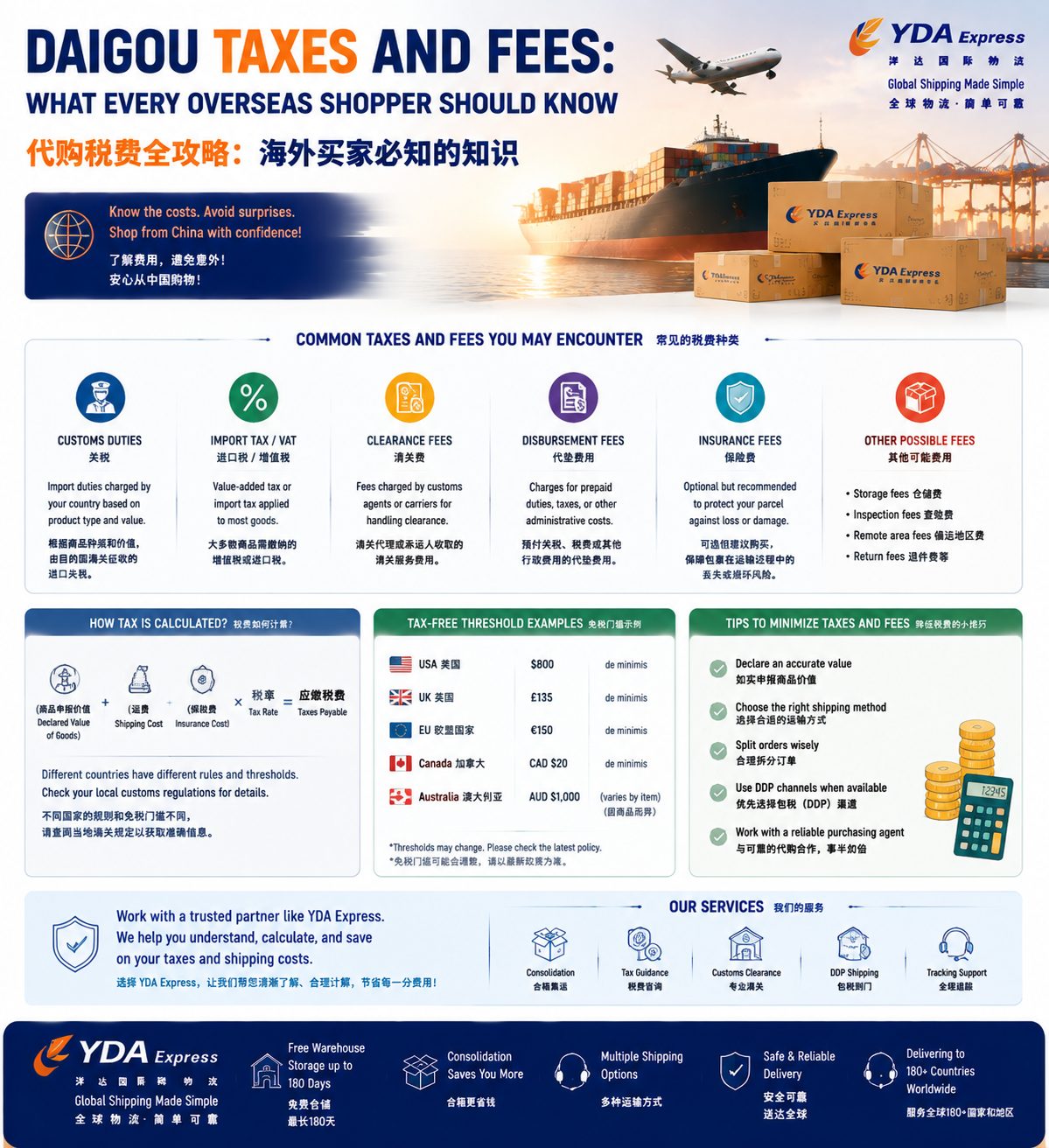
Import duties are a tax on your goods when they cross a border. They’re calculated as a percentage of the item’s value, and the rate depends entirely on the product’s classification—its Harmonized System (HS) code. For example, a cotton t-shirt imported into the United States might carry a duty of 16.5%, while a laptop is duty-free. A luxury leather handbag sent to the EU could face a 3–5% customs duty. The exact percentage isn’t something to guess; you can look it up on your government’s tariff database. If your daigou agent ships via DHL, FedEx, or UPS, those carriers will automatically charge you the duty plus an advancement fee for paying on your behalf. Be ready.
Value-Added Tax (VAT) or Goods and Services Tax (GST)
Many countries add a consumption tax on imports, similar to what you’d pay at a local store. In the European Union, VAT rates often hover around 20–25%. The UK charges 20% VAT on most goods. Canada’s GST/HST can range from 5% to 15% depending on the province. Australia applies 10% GST. The kicker? VAT is usually calculated on the CIF value—Cost, Insurance, and Freight. That means you pay tax not only on the item but also on the shipping and insurance costs. So a €200 dress with €30 shipping could be assessed €46 VAT in Germany (20% of €230). It adds up fast.
Brokerage and Handling Fees
This is the silent budget-killer. Express carriers like FedEx and DHL charge a fee to act as your customs broker—preparing documentation, calculating taxes, and advancing the duty. That fee can be a flat €10–€20 or a percentage of the declared value. National postal services (like USPS or Canada Post) sometimes include basic customs clearance for free, but they’re slower and offer less tracking. When you choose a shipping method, always ask whether brokerage is included, because an unexpected $20 handling fee on a $30 item is just painful.
How Different Countries Handle Import Taxes
The rules aren’t universal, and this is where a little homework pays off.
- United States: U.S. policy has changed: CBP states that duty-free de minimis treatment for shipments valued at or below $800 was suspended effective August 29, 2025, and the suspension continues in 2026. A U.S.-bound parcel below $800 is not automatically duty-free. Duties, taxes, fees and entry requirements depend on the product, origin, customs value, classification, shipment method and current rules. Check current CBP guidance before dispatch.
- Canada: Unfortunately low at CAD $20 for most goods. After that, you’ll pay duties, GST, and a handling fee from Canada Post or the courier. USMCA rules can reduce duties on goods made in North America, but items from China don’t qualify.
- United Kingdom: For goods worth £135 or less, the seller or platform should charge VAT at the point of sale under new rules. Above that, you’ll pay import duty, VAT, and potentially a customs handling fee from Royal Mail or the courier.
- European Union: From July 2021, all goods entering the EU are subject to VAT, regardless of value. The old €22 de minimis exemption is gone. Goods above €150 also attract customs duty. Expect an extra handling fee from the postal service or express courier.
- Australia: Threshold is AUD $1,000 for most shipments. Under that, you usually pay nothing extra unless it’s tobacco or alcohol. Above that, GST, customs duty, and a processing fee apply.
Knowing your country’s rules before you order is essential. I always recommend using an official customs calculator or asking your agent for a pre-shipment estimate.
5 Ways to Avoid Surprise Daigou Fees
Here’s practical advice that works, based on thousands of shipments we’ve seen at YdaExpress.
1. Ask for a cost breakdown before you commit. A reputable agent will tell you the item price, their service charge, domestic shipping, and an estimate for international postage. Don’t accept vague numbers like “shipping included”—make them line-item it.
2. Don’t under-declare value to save tax. It’s a common request, and a dangerous one. Customs authorities worldwide use sophisticated data analysis. If you’re caught, you’ll face fines, seizure, or a permanent black mark that delays every future package. The small savings aren’t worth the risk.
3. Use consolidation to reduce per-shipment costs, but watch the total. Combining three small parcels into one box saves on shipping and reduces the number of brokerage fees. However, the combined value might push you over your country’s de minimis limit, triggering duties you wouldn’t have paid otherwise. So do the math first.
4. Choose a customs-friendly shipping method. Some courier services include basic brokerage in the shipping price; others add it as a surprise. YdaExpress offers multiple channels, including ones where the landed cost is more predictable. Ask what’s covered.
5. Research your product’s HS code and duty rate. It sounds technical, but you can search for “US HTS code” or “UK trade tariff” and find the duty percentage in minutes. If the rate is zero for your item, you’ll worry a lot less when the package arrives.
The YdaExpress Approach: Transparency from Start to Finish
Here’s the thing: at YdaExpress, we’ve seen plenty of customers who thought shopping from China meant no extra costs beyond the advertised price. In reality, international shipping always involves more than just postage. By understanding daigou taxes and fees upfront, you’ll avoid the worst kind of surprises. That’s why we’re blunt about costs. Our purchasing service fee is fixed and clear, our shipping quotes show every surcharge, and our team can walk you through what customs will likely charge for your specific order and destination. No fluff, no hidden markups.
If you’re planning to shop from China, let YdaExpress help. Our team can walk you through the costs, recommend the best shipping method for your destination, and make sure your package gets through customs smoothly. Contact us via WhatsApp at +8616666169028 or visit our website at https://www.ydaexpress.com to get started.
📦 China Parcel Forwarding & International Shipping Already placed your order? Send your purchases to our China warehouse for parcel receiving, photo inspection, up to 180 days of free storage, package consolidation, international shipping, and real-time tracking.
📲 Download the YDA Express App One app for shopping, purchasing assistance, package management, consolidation, international shipping, and worldwide delivery.
🌍 More Helpful Guides Explore practical guides on shopping from China, parcel forwarding, shipping costs, and customs clearance.