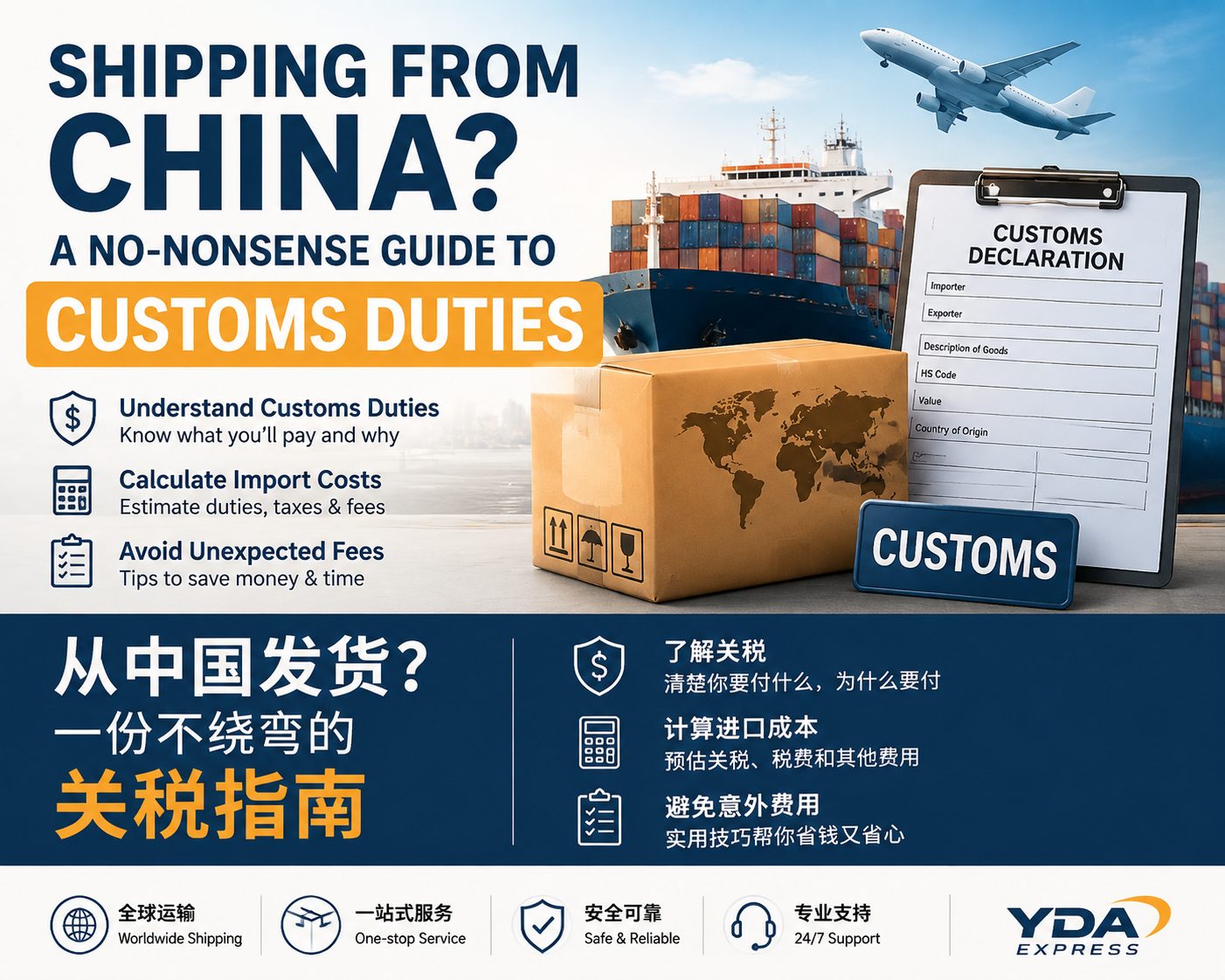
Learn how customs duties and import taxes work when shipping from China in 2026. Understand tariffs, HS codes, de minimis rules, and avoid unexpected costs with YDA Express.
Introduction
If you’ve ever had a parcel from China held up by customs, you know that sinking feeling. You track the package, see “customs clearance delay,” and then get a letter or email demanding payment before they’ll release your goods. It’s frustrating. But once you understand how customs duties work, you can plan for them and avoid the worst surprises. This guide breaks it down in plain English, whether you’re an occasional AliExpress shopper or a small business owner importing parts.
What Are Customs Duties?
Customs duties (also called tariffs) are basically taxes that governments charge on goods entering the country. They’re not random—they follow rules set by each country. The idea is to generate revenue and, in many cases, to make imported goods a bit more expensive so local products stay competitive. When you buy from China and ship to the US, UK, EU, or elsewhere, your shipment might cross a threshold that triggers these charges.
Each country sets a de minimis value—a magic number below which no duty is charged. In the United States, that number is $800. So if your shipment’s total value (goods plus shipping and insurance) is under $800, you usually pay zero duty. Canada’s de minimis is CAD $20 for duty (though GST/HST still applies on most things). The UK has a £135 threshold; above that, both duty and import VAT can apply. EU countries: for shipments over €150, duties kick in. But don’t let these numbers fool you. Some products, like alcohol, tobacco, or textiles, always attract duty regardless of value. And if customs thinks your shipment is for commercial use rather than personal, they might scrutinize more closely.
Here’s a real example: A customer of ours orders a batch of custom-printed T-shirts from a supplier on 1688.com. The total product cost is $600, and freight is $80. He’s shipping to Los Angeles. Since it’s under $800, he expects no duty—and he’s right, as long as it’s a single shipping event. But if the order is split into two $400 shipments that arrive close together, customs might combine their value and charge duty. This happens more often than you’d think.
How Are Customs Duties Calculated?
Duty isn’t a flat fee. It’s calculated as a percentage of the customs value—and that value includes not just what you paid for the stuff, but also the cost of freight and insurance. So if you bought $1000 worth of electronics and paid $200 for air freight, the customs value is $1200, and duty is applied to that full amount.
The percentage comes from something called the Harmonized System (HS) code. Nearly every product in the world has an HS code, a numerical classification that customs uses to determine the duty rate. A wool sweater might have an HS code with a duty rate of 17.5%, while a USB cable could be 0%. Getting the HS code right is where a lot of importers trip up. If you use the wrong code, you might underpay (and get fined later) or overpay.
Let’s say you’re importing wooden furniture. The HS code for “wooden chairs” might carry a 3% duty, but “wooden kitchen furniture” could be 0%. An experienced forwarder can help you classify items correctly. At YdaExpress, we often see shippers misclassify items because they rely on the supplier’s description alone. A supplier might label something “plastic toy” when it’s actually a model with electronic parts, which changes the HS code. That small mistake can lead to a customs hold.
Duty rates also depend on the country of origin and any trade agreements. China doesn’t have many special trade deals with Western countries, so most goods from China face the standard tariff rates.
Common Customs Duty Surprises
Under-valuation by the supplier. Many Chinese sellers, especially on platforms like Alibaba or Taobao, will offer to declare a lower value on the customs form to help you “save taxes.” It’s tempting, but it’s illegal. Customs officers can flag your package, estimate the real value themselves, and charge duties plus penalties. In worst cases, they seize the goods. We always recommend declaring the actual transaction value. It keeps you honest and avoids problems.
The freight cost blindsiding you. Some shipping methods like express (DHL, FedEx, UPS) include the freight cost in the customs value automatically. If you’re not expecting that, the duty can be higher than your calculation. For example, a £200 item with £50 shipping to the UK might cross the £135 threshold because of the combined value, triggering both duty and VAT.
Courier fees for paying duty on your behalf. FedEx, UPS, and DHL often pre-pay customs charges to speed up delivery, then send you a bill later along with an additional handling fee. That handling fee can be a flat amount or a percentage. It’s easy to forget, and the first time you see it, it feels like a stealth charge.
Personal vs. commercial shipments. If you’re buying for personal use, you might get a break. But if customs notices a pattern of similar items, they may treat it as commercial and deny any de minimis exemption. This is common for small business owners who order samples or small batches frequently.
Seasonal delays and random inspections. Even if you’ve declared everything perfectly, customs can hold your shipment for a random check. During peak seasons like Christmas, backlogs can add days or weeks. The duty itself isn’t the issue; it’s the wait. But if paperwork isn’t perfect, that hold can drag on.
How a Freight Forwarder Can Make Customs Easier
This is where a service like YdaExpress comes in. When you use a parcel forwarding or purchasing agent, they’re not just shipping boxes; they’re handling the customs documentation. They know how to fill out the commercial invoice so it satisfies customs officials without raising red flags. They consolidate multiple orders into one shipment, which can keep individual values low while reducing overall freight costs. And if duty does apply, some forwarders offer DDP (Delivered Duty Paid) options—meaning the forwarder pays all import fees upfront, and you receive the goods with nothing left to worry about.
For example, if you’re using YdaExpress’s Taobao purchasing service, you buy your items, they arrive at our warehouse, we check the contents and weight, and we prepare the export docs. For the customs declaration, we list the HS codes clearly. If you’re in the UK, we can even calculate estimated duties and give you the option to pay them through us so the delivery flows smoothly. That kind of transparency takes the stress out of cross-border shopping.
Practical Tips for Everyday Shippers
Know your destination country’s rules. The US de minimis is generous, but other countries aren’t. Always look up the latest thresholds because they change. Don’t rely on a single blog post from three years ago.
Ask your supplier for HS codes early. Before you ship, get the full HS code for each product. If they don’t know it, ask for the product category so you can look it up on your country’s customs website. This isn’t just for duty; it helps you check whether there are any anti-dumping duties or special restrictions.
Keep records. Save your receipts, order confirmations, and payment proofs. If customs questions your declared value, you’ll need to show what you actually paid. You’d be surprised how many people throw away their transaction details.
Use consolidated shipping wisely. If you have ten small orders from different sellers, sending them individually can mean ten separate customs experiences. With consolidation, you get one shipment and one customs entry. It’s cleaner and cheaper.
Consider the total landed cost. The price you pay to your Chinese supplier is only part of the story. The total includes shipping, insurance, customs duty, import VAT, and any local delivery fees. Calculate this upfront so you can price your products correctly if you’re reselling.
Talk to a professional. You don’t need to become a customs broker. But a 15-minute chat with a freight forwarder can save you from a costly mistake. At YdaExpress, we answer questions like these every day—what’s the best shipping method for my ceramic mugs? Will my wooden toys get held up? Do I need to worry about FDA clearance for this supplement?
A Word on Recent Changes and What’s Ahead
Customs rules are never static. In recent years, some countries have been adjusting their de minimis thresholds downward or tightening enforcement on e-commerce imports. The US has proposed changes that could affect imports from China, and the EU is rolling out more stringent requirements for product safety and accurate declarations. Brexit also rewrote the rules for UK-Europe trade, adding complexity for anyone importing via the UK. Staying informed isn’t optional; it’s part of costing your imports correctly.
That said, most individual shippers and small businesses won’t feel the impact drastically unless they’re importing high volumes. The key is to stay flexible and work with a team that keeps up with the changes. At YdaExpress, we monitor these developments so our customers don’t have to.
Conclusion
Nobody likes paying extra, but customs duties are a fact of international shipping. The good news is that they’re predictable if you take a few basic steps: know the thresholds, classify your items correctly, and use a forwarder who cares about documentation. That way, instead of a stressful surprise, you get a clear picture of what you owe—and you can plan for it.
If you’re ready to make your shipping from China easier, reach out to YdaExpress. We can handle warehouse storage, order consolidation, packaging, and smooth customs clearance. Visit our website at https://www.ydaexpress.com or send us a message on WhatsApp at +8616666169028. We’re happy to talk through your shipment and help you avoid the duty headaches. 📲 Download the YDA Express App
One app for shopping from China, purchasing services, free warehouse storage, package consolidation, and international shipping.
Shop directly from Taobao, 1688, JD.com, Tmall, Pinduoduo, and other Chinese marketplaces, or let our China Shopping Agent handle everything for you. Enjoy a free China warehouse, package consolidation, worldwide shipping, and real-time parcel tracking—all in one app.
🌍 Explore More Articles
Looking for more practical guides on shopping from China, parcel forwarding, package consolidation, and international shipping?