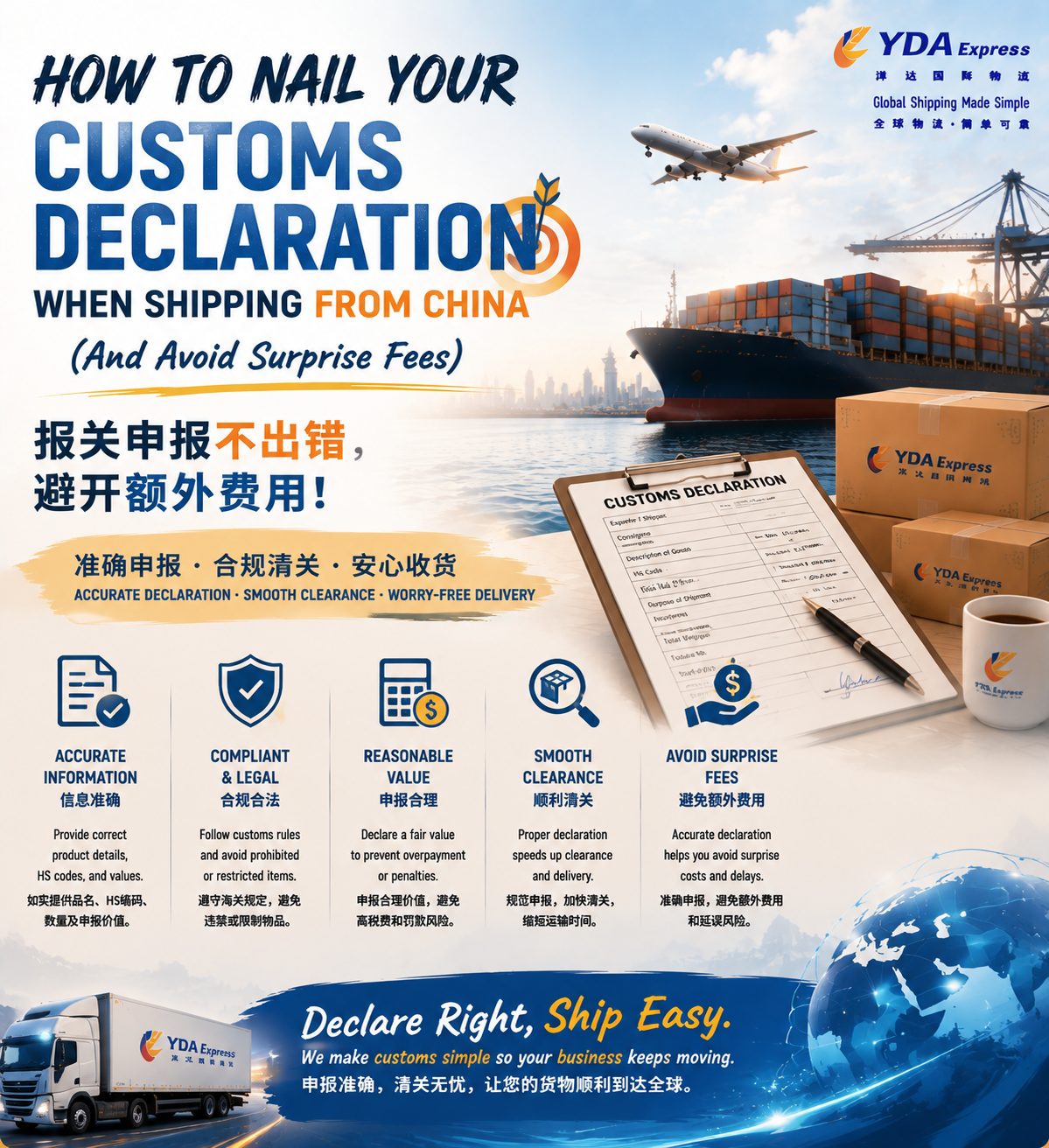
Mastering customs declaration is key to stress-free international shopping. Learn common pitfalls, country-specific rules, and how a reliable China parcel forwarder can help you clear shipments smoothly and avoid unexpected costs.
Imagine: you've scored that perfect niche product from a Taobao seller, or maybe you've stocked up on festival supplies from 1688. You use a parcel forwarder to consolidate everything, and it's dispatched. Then you get a notice: your package is stuck in customs. You owe import duties, and the courier is charging a disbursement fee. Frustrating, right? Most of the time, that headache comes down to one thing: how the customs declaration was handled.
What Exactly Is a Customs Declaration?
When something crosses a border, you have to tell the destination country's customs authority what's in the package, what it's worth, and why it's being sent. That's the declaration. It's not just paperwork—it's a legal statement. If it's inaccurate, you could face delays, fines, or even have your goods seized.
Every country has its own rules, but the core concepts are similar. The declaration includes:
- A description of the goods (not just "clothes", but "women's cotton t-shirt")
- The declared value (this is what you paid, not a random low number)
- The HS code (harmonized system code, a 6-10 digit number that classifies the product)
- The sender and receiver details.
In the forwarding world, the shipper (your China forwarder) or the courier fills this out based on what you tell them. So the accuracy starts with you.
Why It Matters More Than You Think
Here's the thing: many people think customs is just about paying tax. But a sloppy declaration can cause bigger problems. Let's walk through some real outcomes.
Shipment delays. If the description is vague, customs may hold it for inspection. That adds days, sometimes weeks. I've seen "electronic accessory" flagged for manual review when "USB charging cable, plastic, 1 meter" would have sailed through.
Return or destruction. Some goods are restricted. If you fail to declare something that's prohibited (like certain batteries or food items), they may not give you a chance to fix it. It just gets sent back—or destroyed. And that cost falls on you.
Higher fees. If the courier has to intercede on your behalf, they'll charge a brokerage or disbursement fee. DHL and FedEx are known for this, and it can be a flat $15-20 or a percentage of the duty. A correct declaration can sometimes allow self-clearance if you're near a customs office, saving that fee.
Audit risk. If customs suspects undervaluation, they may flag your address for future shipments. That means more scrutiny every time.
Common Mistakes Overseas Shoppers Make
From working with hundreds of customers at YdaExpress, I can tell you the typical errors fall into a few categories.
1. Undervaluing the Goods
It's tempting to ask your forwarder to put $10 on a $200 shipment. But customs officials aren't naive. They know what things cost. If your declared value looks way off, they may research the product online or simply assign their own value—often higher than what you paid. For the US, the de minimis threshold is $800, so for low-value shipments, there's no duty anyway. Lying for a $50 package only risks trouble for nothing. Countries like the UK, Canada, and Australia have lower thresholds (e.g., £135, CAD$20, AUD$1000), so being honest matters more.
2. Vague Item Descriptions
"Gift" or "personal effects" are red flags. Customs want to know exactly what's inside. If you bought a set of handmade ceramic mugs from a craft store on Taobao, say "ceramic mugs, handmade, set of 4". That helps the officer quickly classify it and move on.
3. Wrong HS Code or No Code
For business shipments, HS codes are critical. For personal shipments, they're not always required but help a lot. A wrong code can trigger incorrect duty rates. For the EU, the HS code is mandatory for everything since July 2021. If you don't provide one, your forwarder might choose a generic code that attracts a higher tariff. Take a minute to look up the code or ask your forwarder for guidance.
4. Incorrect Quantity or Weight
If you declare 2 items but the X-ray shows 5, expect a hold. Always count accurately. For consolidated shipments from multiple sellers, make sure your packing list matches what's actually in the box. A good forwarder will double-check and update the declaration if they repack, but you should still provide accurate initial info.
5. Ignoring Country-Specific Restrictions
Each country bans or restricts different items. The US has FDA regulations for food and medical devices. The UK strictly controls plant and animal products. Australia has tough biosecurity rules. Before you buy, check if it's allowed. If you try to declare it under a misleading description, you risk legal trouble.
How Customs Declaration Works in a Parcel Forwarding Service
When you use a China parcel forwarder, the process usually goes like this:
- You give the order details: what you bought, the price (in RMB or your currency), quantity, and weight.
- The forwarder receives your packages, may consolidate them, and then asks you to confirm the declaration values and descriptions for the combined shipment.
- They create the shipping label and commercial invoice (for courier services) or the CN22/CN23 customs form (for postal services).
- The goods are dispatched, and the declaration goes electronically ahead of the parcel.
At YdaExpress, we always ask clients to provide a clear breakdown. We'll flag anything that looks incomplete. For example, if you write "phone accessories" but we see a phone case, a screen protector, and a cable, we'll suggest breaking it down. This attention to detail saves a lot of back-and-forth later.
Navigating Different Destination Countries
Customs practices vary. Here's a quick rundown for some popular destinations when receiving from China.
United States
US Customs and Border Protection (CBP) is generally lenient for low-value personal shipments. The $800 de minimis means most small parcels enter duty-free. But if you're over $800, duty applies based on HS code classification and origin. The US also has Section 301 tariffs on certain Chinese goods, though personal shipments are rarely targeted. Still, be accurate with descriptions to avoid inspection. Carriers like DHL and UPS will clear customs on your behalf and bill you for any charges.
United Kingdom
Post-Brexit, the UK now applies VAT on all imports, with no low-value relief unless the goods are worth £135 or less. For goods over £135, customs duty may also apply. The HS code is mandatory for all courier shipments. If you use a forwarder and choose Royal Mail, they'll handle clearance and charge a £8 handling fee. Couriers like DHL charge £11 or 2.5% of duties, whichever is higher. Avoid surprises by knowing the VAT rate (usually 20%) and duty rate before ordering.
European Union
The EU removed the €22 VAT exemption in 2021. Now, VAT is due on everything, and the Import One-Stop Shop (IOSS) program allows sellers or forwarders to charge VAT at the point of sale. If your shipment comes through a postal service without IOSS, you'll pay VAT and a clearance fee (e.g., PostNL charges €13 plus VAT). For courier shipments, you often pay before delivery. A correct declaration with HS code ensures the right VAT and possibly duty (most goods under €150 duty-free, but some, like luxury items, still attract duty).
Canada
Canada has a de minimis of CAD$20 for duty and CAD$40 for taxes. Over that, you're charged GST/HST/PST depending on province, plus duty if applicable. Canada Post charges a $9.95 handling fee; couriers charge more. A clear declaration helps avoid delays in a system that can be slow.
Australia
The low-value threshold is AUD$1000 for GST exemption, but duty kicks in over AUD$1000. Biosecurity screening is strict. If you declare "wooden toy", it must be pest-free or treated. Australia Post will hold and inspect if unsure. A precise description can prevent unnecessary quarantine.
Practical Tips for a Smooth Customs Clearance
Here are a few rules of thumb from our experience sending thousands of parcels.
- Keep your invoices. When you buy from Taobao or 1688, save the order screenshots. If customs questions the value, you have proof.
- Don't mix prohibited items with legal ones. If you try to sneak in a banned item, the whole shipment could be refused.
- Use real names and addresses. Customs verifies identity. A fake name can flag the parcel as suspicious.
- Be proactive with high-value items. If you're shipping something above the de minimis, calculate the expected duty and VAT so you're not shocked. Some forwarders can prepay duties for a fee (DDP service), which can be worth it for convenience.
- Ask your forwarder about insurance. If something's lost in customs, proper insurance with the correct declared value ensures you're covered.
At YdaExpress, we often remind customers: the declared value on the shipping invoice is also the insured value for most carriers. So if you undervalue to save duty, you're also under-insuring your package. That's a gamble I don't recommend.
When Things Go Wrong
Even with preparation, errors happen. Here's what to do if your package is stuck.
First, don't panic. The notice (from the courier or customs) will usually state the reason: missing documentation, valuation query, restricted item, etc. Contact your forwarder immediately. They can often provide additional invoices or clarify the contents. For courier shipments, the courier's brokerage department will reach out to you directly; respond promptly to avoid storage fees.
If you genuinely disagree with a duty assessment, you can appeal, but the process varies by country. In the US, you file a protest with CBP. In the UK, you can challenge HMRC. But for small amounts, it's rarely worth the time. Better to avoid the problem upfront.
The Bottom Line
Customs declaration isn't complicated, but it does require honesty and attention. Whether you're shipping a single phone case or a pallet of electronics from China, the key is clear, accurate information. A trustworthy forwarder makes it easy, but you set the foundation.
If you're looking for a parcel forwarding service that helps you navigate China shipping and customs without the jargon, YdaExpress is built for that. We handle warehouse storage, consolidation, and shipping with a focus on getting your package through customs cleanly. Our team checks your declaration details before dispatch, and we're quick to assist if any issues arise. Check out our shipping calculator at ydaexpress.com or reach us on WhatsApp at +8616666169028. We'll help you keep your cross-border shopping simple, reliable, and affordable.
📦 China Parcel Forwarding & International Shipping Already placed your order? Send your purchases to our China warehouse for parcel receiving, photo inspection, up to 180 days of free storage, package consolidation, international shipping, and real-time tracking.
📲 Download the YDA Express App One app for shopping, purchasing assistance, package management, consolidation, international shipping, and worldwide delivery.
🌍 More Helpful Guides Explore practical guides on shopping from China, parcel forwarding, shipping costs, and customs clearance.