A straightforward guide for everyday shippers on what happens behind the scenes during import customs clearance, with practical tips to avoid delays, extra fees, and paperwork headaches when bringing goods in from China.
You’ve been tracking that package for two weeks. It finally lands in your country. Then the status flips to “held in customs.” And the waiting begins. If you’ve ever imported something—whether a single gadget from Alibaba or a whole carton of samples—you know that customs can feel like a black hole. It doesn’t have to be that way.
Import customs clearance, put simply, is the process by which government authorities check and release goods coming into a country. They want to know three things: what’s inside, how much it’s worth, and whether any duties or taxes apply. For shipments from China, this can get tricky because the value, product description, and classification codes are often where things go wrong. But once you understand the basics, you can avoid most problems before they start.
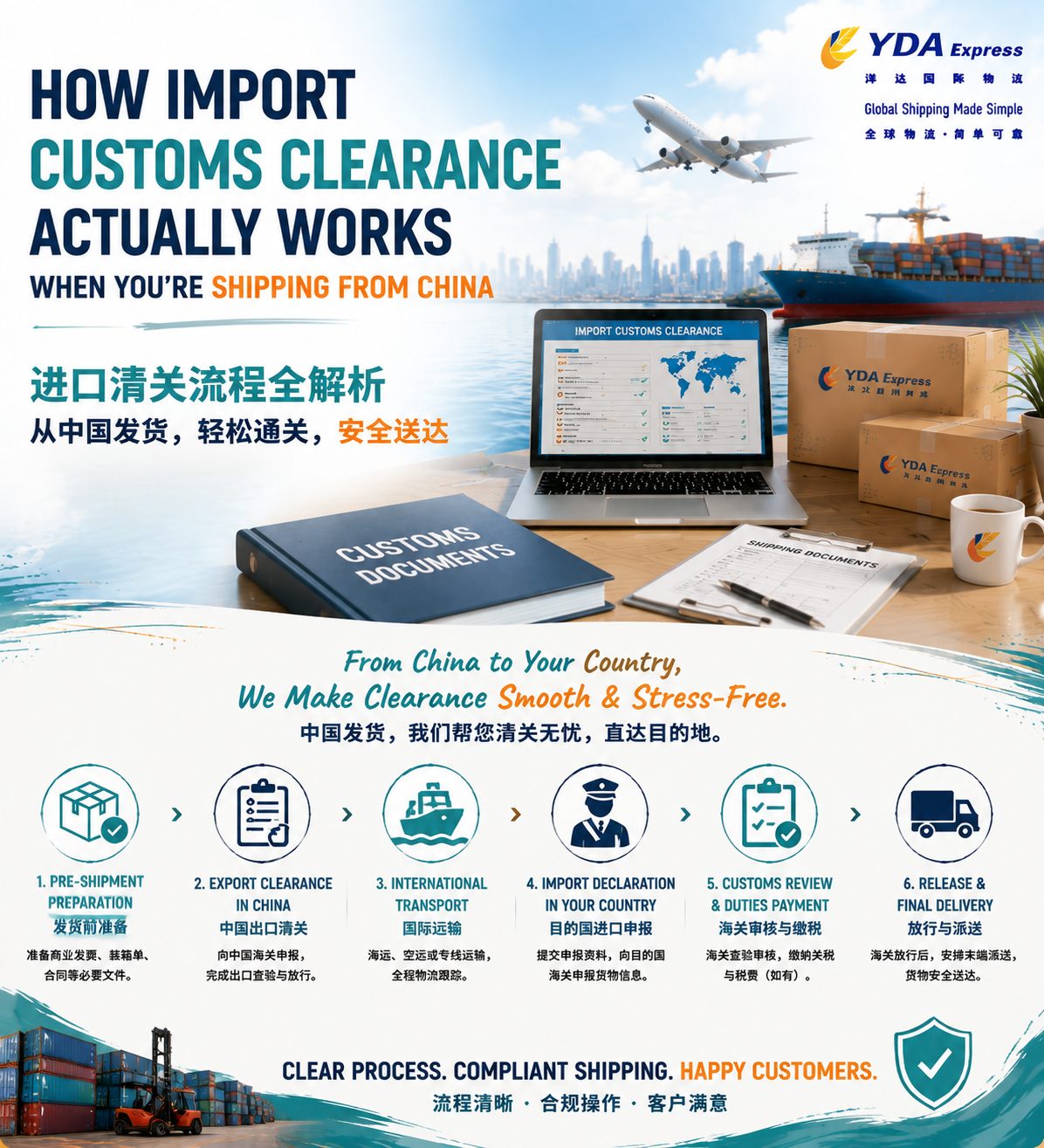
What Actually Happens During Clearance
When your parcel arrives at a port, airport, or mail handling center, customs officers scan the documentation attached to it. For express couriers like DHL, FedEx, or UPS, the carrier usually submits an electronic manifest ahead of time. For postal services like China Post and EMS, the data transfer is messier—sometimes incomplete, which triggers closer inspection.
Officers look at the commercial invoice first. That document lists the shipper, consignee, item description, quantity, unit value, total value, and country of origin. If any of those fields are vague or suspicious, your shipment gets flagged. “Gift” or “sample” used to fool nobody. A proper, honest commercial invoice is your best friend here.
They also check the Harmonized System (HS) code. These six- to ten-digit numbers classify everything from LED light strips to ceramic mugs. A wrong HS code can push your duty rate from 0% to 7.5% or even trigger a full inspection. At YdaExpress, we see a lot of small e-commerce sellers guess their codes based on a quick Google search. That’s risky. The correct code affects the duty rate, and customs databases are cross-referenced with things like intellectual property watchlists and safety regulations.
If everything looks fine, the shipment clears in hours—sometimes minutes. But if they have questions, you might get a request for more documents, a payment demand for duties and taxes, or a physical inspection that can take days or weeks.
The Paperwork That Keeps Things Moving
Three core documents matter for most non-commercial imports from China:
- Commercial Invoice: Needs the seller’s and buyer’s full names, addresses, and contact details. Must describe goods clearly—not just “parts” but “aluminum bike frame brackets, model XYZ-200.” The declared value must match the actual transaction value, including any shipping costs that aren’t listed separately.
- Packing List: Breaks down the shipment into cartons, weight, dimensions, and contents per box. While not always legally required, it helps customs confirm the invoice and speed up physical checks.
- Air Waybill or Bill of Lading: The transport document. For air freight or express, it’s the AWB; for sea freight, the B/L. Customs uses this to verify the shipment route and total cargo quantity.
Depending on the country and product type, you might also need certificates of origin, conformity documents (like CE, FCC), or permits for regulated items (toys, electronics, cosmetics). If you’re importing batteries, even button cells in a remote control, the carrier will ask for the UN38.3 test report and MSDS. No paperwork, no movement.
Duties and Taxes: Why That $5 Item Can Cost $35
Here’s where a lot of first-time importers get stung. Most countries have a de minimis threshold—a value below which no duties or taxes are assessed. U.S. policy has changed: CBP states that duty-free de minimis treatment for shipments valued at or below $800 was suspended effective August 29, 2025, and the suspension continues in 2026. A U.S.-bound parcel below $800 is not automatically duty-free. Duties, taxes, fees and entry requirements depend on the product, origin, customs value, classification, shipment method and current rules. Check current CBP guidance before dispatch. For the UK, it’s £135 (but for goods over that, VAT applies and customs duty kicks in at £0 but often waived if duty is under £1). The EU has a €150 threshold for customs duty, but VAT is charged from the first euro since July 2021, unless the marketplace or seller is registered in the Import One-Stop Shop (IOSS).
If your shipment exceeds the threshold, you pay:
- Customs Duty – A percentage of the CIF value (cost, insurance, freight). For common consumer goods from China, this can be 0–12% depending on the HS code. For textiles and certain footwear, rates can spike.
- Value-Added Tax (VAT) or sales tax – Applied on top of the CIF plus any duty. In the EU, that’s typically around 20%. In the UK, 20%. Canada charges GST/HST. Australia charges 10% GST on imports over AU$1,000.
- Brokerage or handling fees – Carriers often add a fixed fee for processing customs clearance. DHL and FedEx charge around $15–$20 for personal shipments, sometimes a percentage of the duty for commercial ones. Postal services are usually cheaper but slower and less transparent.
Example: You buy a $200 leather bag from a Taobao store. Shipping is $40, insurance $5. The CIF value is $245. If the HS code for leather handbags carries a 7% duty rate, you owe $17.15 in duty. Then if your country has 20% VAT, the tax is applied to $245 + $17.15 = $262.15, so VAT is $52.43. Total added cost: $69.58 plus any carrier disbursement fee. And you can’t get your bag until you pay.
To be fair, many smaller parcels slip through without charges even when they technically should be assessed. Customs resources are limited. But relying on luck isn’t a strategy. One audit or a spike in e-commerce enforcement can lead to a cluster of backdated bills and frustrated customers.
Common Pitfalls That Hold Up Shipments
Undervaluing goods. Sellers sometimes offer to declare a lower value “to help you save tax.” This is illegal. Customs authorities have valuation databases and market knowledge. If they think the value is too low, they’ll hold the shipment and ask for a PayPal receipt or bank transfer proof. You’ll face penalties and delays. For commercial importers, this can even lead to a customs audit that affects your future shipments.
Vague descriptions. “Clothing” is not enough. “100% cotton women’s T-shirts, knitted, pack of 5” does the job. The more specific you are, the less an officer has to interpret. They might open the box just to see what “electronics accessories” really means. That takes time and can result in repacking that damages the items.
Prohibited or restricted items. Each country has a list of things you can’t import without special licenses: food, plants, supplements, certain electronics with wireless frequencies, toys without safety test reports. An innocent-looking Bluetooth speaker might need FCC certification in the US or CE mark in the EU. If you’re not sure, check the destination country’s customs website or ask your forwarder.
Choosing the wrong Incoterm. For the average overseas shopper buying on Taobao and having a forwarder ship it, this rarely matters. But if you’re a small business negotiating with a supplier, terms like DDP (Delivered Duty Paid) vs. FOB (Free On Board) change who bears the customs risk. DDP from China is rare and expensive; most suppliers ship EXW or FOB, leaving you to handle import clearance and pay duties on arrival.
How the Shipping Method Changes the Experience
Courier companies (DHL, FedEx, UPS) have integrated brokerage services. They’ll contact you by email or SMS when duties are due, and you can pay online before delivery. The process is fast, but brokerage charges are non-negotiable. FedEx’s “International Economy” service often includes a fee of $15 or 2.5% of duties, whichever is greater. DHL’s is similar. If you’re importing regularly, those fees add up.
Postal operators (USPS via EMS, Royal Mail via Parcelforce, Canada Post) typically hand off the parcel to the local customs authority without prepaying duties. You receive a notice to pick up the package and pay at the post office. The handling fee is lower—often around $5–$10—but the clearance can be slower, and tracking updates may go silent for days.
Air freight or sea freight forwarders often work with a customs broker you designate. The broker files entry documents, classifies the goods, and pays the duties on your behalf. Good brokers save you from a lot of pain, but they charge a per-entry fee (anywhere from $50 to $150) plus the duty outlay. For consolidated shipments where multiple small orders are combined into one box, a forwarder can prepare a single customs entry, which saves on brokerage fees.
Practical Tips for Smooth Import Customs Clearance
1. Get the right HS code before your supplier ships. You can search your country’s tariff database online. The first six digits are internationally harmonized; the rest are country-specific. If you’re unsure, ask your forwarder or broker. The code sets the duty rate, so getting it right avoids underpayment penalties.
2. Ask your supplier to include a detailed, accurate commercial invoice on the outside of the package. Many courier portals also allow you to upload documents electronically before pickup. YdaExpress, for instance, checks the paperwork when we consolidate parcels in our China warehouse, making sure it matches what customs will expect.
3. If you want to pay duties upfront, look for a DDP shipping option. Some forwarders offer a DDP service to certain countries by prepaying the duty and tax on your behalf, then including it in the shipping quote. This way, the delivery person won’t show up demanding cash. It feels like a domestic order.
4. Keep proof of payment. For any high-value item, save the PayPal transaction ID, credit card statement, or bank transfer confirmation. If customs questions the value, you’ll need to respond quickly. Having the PDF already in your inbox saves days.
5. Know your country’s de minimis threshold and how it applies. If you’re close to the limit, splitting orders across separate shipments on different days can keep each parcel below the threshold—as long as you’re not deliberately splitting to evade, which is illegal. But for genuine multiple orders, it’s a practical way to stay under the tax-free limit.
6. Watch out for carrier import fees. When choosing between express and postal, make the duty and brokerage cost part of your comparison. A cheaper shipping method might end up more expensive after a flat $20 brokerage fee.
7. Don’t assume “express” means no customs. Express shipments are still subject to the same regulations. The only difference is the carrier acts as the broker and moves faster on documentation.
When Things Go Wrong
Sometimes, despite best efforts, a shipment gets stuck. Let’s say customs finds an undervaluation discrepancy. They’ll send a formal notice (often a customs form 3461 alteration in the US, or a C88 in the UK) asking for corrected docs. You usually have 5–7 days to respond before the shipment is either returned, destroyed, or moved to a bonded warehouse accruing storage fees.
If you don’t have the knowledge to handle it, hire a licensed customs broker. They can argue on your behalf, submit a binding ruling request for future identical shipments, and sometimes negotiate a reduced penalty. The fee for a one-off entry correction might be $75–$200. That’s often cheaper than the shipment being sent back to China.
For prohibited items, you generally have two choices: abandon the goods or have them re-exported at your expense. Neither is fun. So a quiet piece of advice: If you’re buying something you’ve never imported before, do a small test shipment first. A single unit. See if it clears without issue. Then scale up.
How a Good Forwarder Makes This Easier
If you’re buying from multiple online stores in China—say, a few items from Taobao, some from 1688, and a piece from JD—you need a place to consolidate those parcels into one box before shipping internationally. That’s where a service like YdaExpress comes in. We store your purchases, remove unnecessary packaging, combine everything, and then ship the consolidated parcel with clear, accurate documentation. The paperwork includes a consolidated commercial invoice that matches the actual contents, which customs favors over a random mix of individual invoices.
Our experience with regular shipments to the US, UK, EU, Canada, Australia, and beyond means we know what triggers exam flags. We advise on HS codes and keep the product descriptions crisp. We don’t pretend to be a licenced customs broker in every destination country, but we make sure the paperwork that travels with your box is solid enough to keep the process moving.
At the end of the day, import customs clearance isn’t about finding loopholes. It’s about being prepared, honest, and detail-oriented. The rules are public. The thresholds are knowable. Once you’ve done a few shipments, you’ll get a feel for how your local customs office operates and what they scrutinize. The anxiety fades. The tracking page stops feeling like a threat.
If you’re planning to import from China and want someone to handle the China-side logistics—shopping assistance, warehousing, consolidation, and carrier selection—get in touch with us at YdaExpress. We’re on WhatsApp at +8616666169028, or visit ydaexpress.com to open a free account and start a shipment. The less time you waste on customs surprises, the more time you have to grow your business or just enjoy what you bought.
📦 China Parcel Forwarding & International Shipping Already placed your order? Send your purchases to our China warehouse for parcel receiving, photo inspection, up to 180 days of free storage, package consolidation, international shipping, and real-time tracking.
📲 Download the YDA Express App One app for shopping, purchasing assistance, package management, consolidation, international shipping, and worldwide delivery.
🌍 More Helpful Guides Explore practical guides on shopping from China, parcel forwarding, shipping costs, and customs clearance.