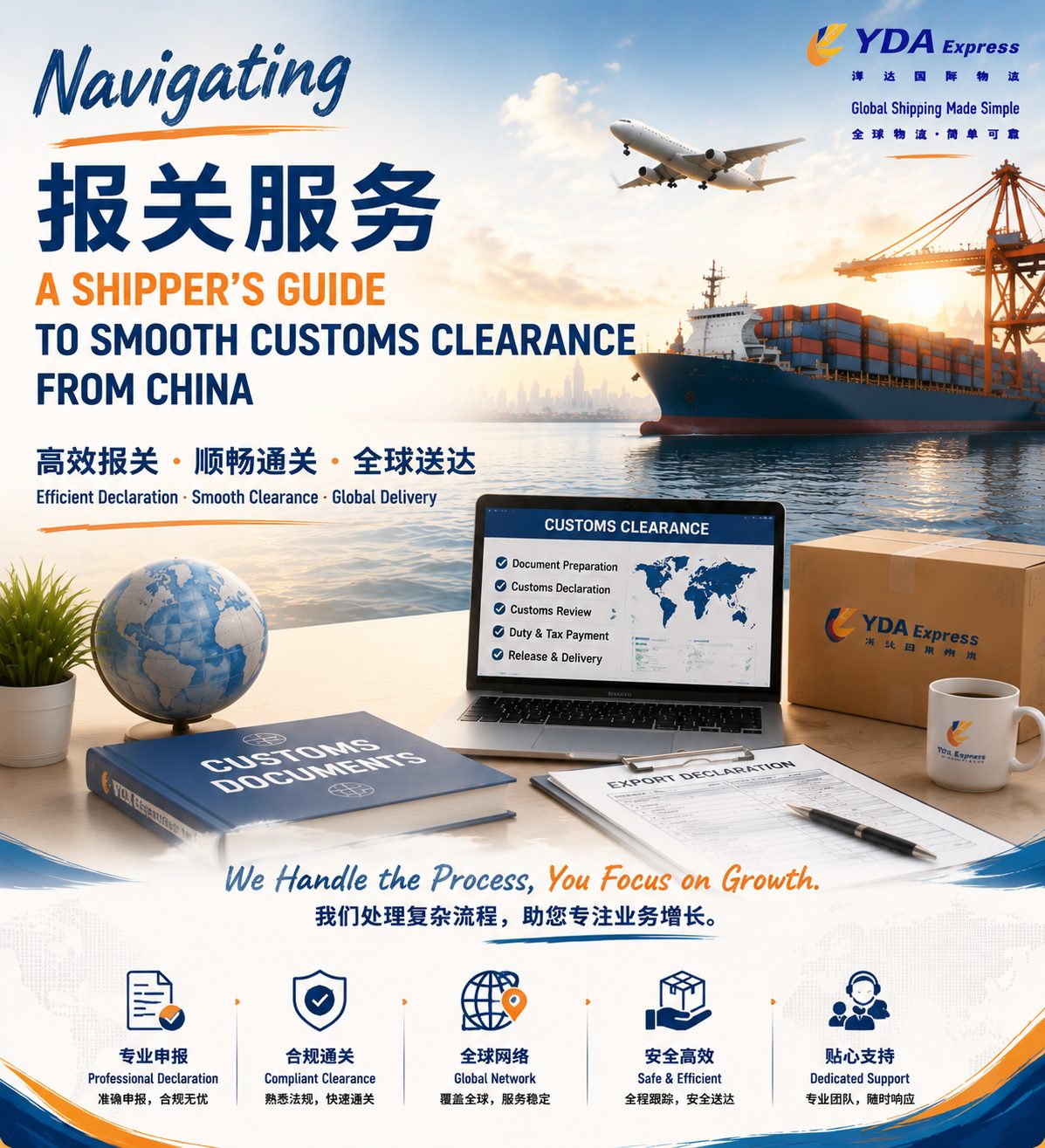
Booking a flight is easy. Customs? Not so much. If you’re buying from China, customs declaration services can make or break your shipment. This guide breaks down what it really involves, why it matters, and how to avoid common pitfalls—so your packages keep moving.
You’ve found the perfect batch of LED strip lights on 1688. The price is great, the supplier is responsive, and DHL says delivery in 4–6 days. Then, tracking suddenly stalls. “Clearance event,” it reads. No update for three days. Then a letter from customs: the declared value doesn’t match commercial standards, a formal entry is required, and storage charges are already piling up.
If this feels familiar, you’re not alone. International shipping is full of tiny friction points, but the biggest one—the one that stops packages cold—is customs. And right at the heart of it sits customs declaration services (bàoguān fúwù): customs declaration services.
What exactly is customs declaration services?
In simple terms, customs declaration services is the process of preparing and submitting the documents that customs authorities need to clear your goods for import or export. Think of it as your package’s passport control. Without a properly stamped declaration, nothing crosses the border.
The Chinese phrase breaks down like this:
- Declaration: the information submitted about the goods.
- Customs: the authority that reviews the shipment.
- Service: the agreed assistance with preparing and submitting information.
So it’s literally the service of reporting to customs. But behind those two characters is a world of HS codes, valuation rules, and paperwork that can trip up even experienced buyers. A dedicated customs declaration service provider handles all of that on your behalf—or your forwarder does it as part of a broader shipping package.
Why it matters more than you think
Casual buyers often assume the shipping carrier “takes care of customs.” And that’s partly true. DHL, FedEx, and UPS all offer in-house brokerage for many shipments. But there’s a catch: their system is automated and optimized for standard, low-value, dutiable-under-de-minimis parcels. When something deviates—say, a high-value consignment, a product that attracts anti-dumping duties, or a vaguely described item—the automated process spits it out for manual review. That’s when delays and fees start adding up.
A proper customs declaration services, on the other hand, means a human professional reviews your paperwork before submission. They check the HS code, ensure the declared value aligns with commercial expectations, and include any required certificates or permits. That upfront check can save you from a $150 CBP examination fee, a week of demurrage charges, or even a shipment being returned to sender.
The core elements of a customs declaration
Let’s look at what actually goes into a declaration. You don’t need to become an expert, but understanding the backbone helps you provide better information to whoever handles your customs declaration services.
1. Commercial Invoice This isn’t just a sales receipt. It must show the seller and buyer’s full names and addresses, a clear description of the goods, quantity, unit value, total value, currency, and terms of sale (Incoterms like FOB or CIF). A common mistake: using generic descriptions like “gift” or “samples.” Customs officers see that every day and often flag it for inspection or re-valuation. Instead, be specific: “100% cotton women’s knitted sweater, HS code 6110.20.”
2. Packing List Weight, dimensions, number of packages, and a breakdown of contents per carton. For consolidated shipments (multiple orders repacked into one box), a detailed packing list becomes essential. If your forwarder offers repacking, a good packing list helps customs see exactly what’s inside, lowering the chance of a random inspection.
3. HS Code (Harmonized System Code) Every product has a numeric code that determines the duty rate and any restrictions. Guessing the HS code is risky. For instance, a “Bluetooth speaker” might fall under 8518.21 (single loudspeakers) with 0% duty, or 8518.22 (multiple loudspeakers) with a different rate, depending on configuration. The wrong code could mean underpaid duties and penalties later. A reliable customs declaration service will verify the code before filing.
4. Value Declaration This is where things get sticky. Customs agencies compare declared values against reference databases. Undervaluing to save on duty is illegal everywhere and can lead to seizure. But even honest mistakes—like forgetting to include shipping charges in the CIF value for a DDP shipment—can trigger a costly hold. Experienced customs declaration service providers know which value thresholds trigger additional scrutiny and can advise accordingly.
5. Additional Documents Depending on the product, you might need CE certificates, FDA approvals, CITES permits, or a fumigation certificate for wooden packaging. A forwarder that includes customs declaration services in its package will flag these requirements early, so you don’t scramble when the shipment is already on a plane.
DIY customs vs. using a forwarder’s customs declaration services
You essentially have three choices when importing from China:
Handle customs yourself. This is legal but heavy. You register as an importer (if required), obtain a customs bond, classify your goods, file the entry, and pay duties directly. For one-off personal shipments, it’s almost never worth the time.
Rely on the carrier’s brokerage. As mentioned, carriers like DHL or FedEx can act as your customs broker. They charge a disbursement fee (often around 2–3% of the duty/tax or a minimum of $10–$15) and handle the basics. For low-value, straightforward parcels under the de minimis threshold (which in the US is $800), this works fine. But for anything else, the carrier’s automated system is a blunt instrument.
Use a dedicated customs declaration service. This often comes bundled when you ship through a freight forwarder like YdaExpress. The forwarder doesn’t just move boxes; they manage the entire clearance process. Their team knows the quirks of Chinese exports (like which carriers are strict about battery documentation) and the import rules of your destination country. They can pre-clear customs electronically in some cases, so your parcel arrives with duties already settled.
At YdaExpress, we often see small business owners start by using carrier brokerage for their first few shipments, then switch to our full-service forwarding after a single $200 surprise clearance fee. The difference isn’t just cost—it’s predictability.
How a freight forwarder handles customs declaration services in practice
Imagine you’ve bought five packages from different Taobao sellers: a bag, two phone cases, a watch, and a small kitchen gadget. They arrive separately at our warehouse. We consolidate them into one box, saving you international shipping fees. But more importantly, during consolidation, our team creates a unified commercial invoice and packing list that accurately reflects the combined shipment. We assign the correct HS codes, note the country of origin (crucial for any duties under trade agreements or for goods from sanctioned regions), and file the export declaration with Chinese customs. The export side is often overlooked—China requires an export declaration for most commercial packages, and without it, your goods can’t leave legally.
Once cleared for export, the package flies to, say, Germany. Our partner network or the designated carrier then handles the import declaration in Germany. But because we’ve prepared the documentation properly, the import clearance usually goes smoothly. If there’s a question—say, a customs officer wants proof of the purchase price—we provide the Taobao order screenshots and payment receipts to back up the declared value. That level of hands-on support is something a general carrier brokerage rarely offers.
Three real-world scenarios where customs declaration services saves the day
Scenario 1: The “electronic device” confusion. A customer shipped a smart watch and declared it as “watch.” Customs flagged it because “watch” could mean a quartz analog watch (no special regulation) or a smart watch with a radio transmitter (which needs FCC or CE certification and a specific HS code). The shipment was held for two weeks. After that, we always ensure smart watches are declared with the correct HS code (8517.62.94 for short-range devices in the US) and include a test report if needed.
Scenario 2: Seasonal surge and tariff changes. During the pandemic, we saw a spike in imports of disposable masks. Many countries temporarily reduced duties or waived requirements for medical devices, but the rules changed by the week. A customer using self-service customs would have struggled to keep up. Our team tracked the changes, reclassified the masks under the correct temporary tariff code, and saved the importer over $300 in duties on a single consignment.
Scenario 3: Consolidated shipments and value thresholds. A customer combined ten small orders into one DHL shipment. The total declared value was $950, just above the US de minimis of $800. DHL’s system automatically generated a formal entry, attracting a $30 brokerage fee plus duties. We suggested splitting into two shipments, each staying under $800, and both cleared duty-free within days. That’s the kind of foresight that comes from handling volume every day.
Practical tips for a smooth customs clearance
You don’t need to memorize every HS code. But you can make life much easier for your customs service provider—and yourself—by following a few habits:
- Provide exact product details. Don’t write “clothing” when you can write “women’s polyester running shorts, unlined.” The more precise, the better.
- Use the actual transaction value. Include PayPal fees, local shipping in China, and any extra charges you paid. An honest audit trail prevents headaches.
- Check restricted items before ordering. Animal products, laser pointers, certain batteries. A quick message to your forwarder can prevent a package being rejected at Chinese export customs.
- Ask about the destination country’s de minimis threshold. For the US it’s $800, for Canada CAD$20 (yes, that low), for the EU generally €150 for goods but €0 for VAT. Knowing this helps you decide whether to split shipments or accept duties.
- Keep all purchase records. If customs asks for proof of value, you want the original order page, payment slip, and any correspondence. Screenshots are fine.
Is customs declaration services worth the cost?
For shippers moving more than a handful of parcels a year, the answer is almost always yes. Many freight forwarders include basic customs declaration as part of their service for a small per-shipment fee or even free for consolidated shipments. When you consider that a single customs delay can cost $50–$150 in storage fees, plus lost sales if you’re an ecommerce seller, the value becomes obvious.
But even for personal shoppers, having a dedicated point of contact who knows why your Gucci bag was flagged and how to provide the proof of authenticity—well, that’s peace of mind that a carrier’s 1-800 number rarely delivers.
At YdaExpress, we’ve built our entire workflow around making customs clearance feel invisible. You shop, your packages arrive at our warehouse, and we take care of the rest. We’re not just moving boxes; we’re managing the paperwork, the codes, and the conversations with customs officers so you don’t have to. Because honestly, you’d rather spend your time finding the next great product than deciphering a CBP 7553 form.
Ready to ship without the customs headaches?
If you’re tired of guessing duties or babysitting stuck parcels, let’s talk. At YdaExpress, we combine warehouse consolidation, purchasing assistance, and professional customs declaration services into one straightforward service. Whether you’re ordering a single sample or building a small brand, we’ll help your packages cross borders as smoothly as a domestic parcel.
Get a quote or ask a question via WhatsApp at +8616666169028, or visit YdaExpress.com to see how we simplify shipping from China. Your next shipment doesn’t have to be a surprise—make it routine.
📦 China Parcel Forwarding & International Shipping Already placed your order? Send your purchases to our China warehouse for parcel receiving, photo inspection, up to 180 days of free storage, package consolidation, international shipping, and real-time tracking.
📲 Download the YDA Express App One app for shopping, purchasing assistance, package management, consolidation, international shipping, and worldwide delivery.
🌍 More Helpful Guides Explore practical guides on shopping from China, parcel forwarding, shipping costs, and customs clearance.