Port logistics can make or break your sea freight shipments. This guide breaks down how port operations work, where delays creep in, and what importers can do to avoid costly mistakes.
Navigating Port Logistics: What You Should Know When Importing by Sea
Maybe you’ve just placed your first order on Alibaba for a batch of custom products. Or you’re an eBay seller who’s finally scaling up to a full container load from a supplier in Shenzhen. The goods are ready, the factory is efficient, and the price is right. Then you hit the wall that catches so many newcomers: port logistics.
I’ve seen it happen time and again. A shipment leaves the factory on schedule, only to sit at the port for a week unexpected. Or a container gets held up in customs because of one wrong document. Suddenly your perfect inventory plan is in tatters and your customers are emailing “where’s my order?”
Consider a recent shipment of camping gear from Ningbo to Seattle. The factory packed and delivered to the port on time. But the vessel was delayed by two days due to fog, so it missed its original berthing window. Then a random customs exam added five more days. Storage fees piled up—nearly $800 before the container even got released. That’s port logistics in action, and without a plan, it can slash your profit margin.
Port logistics is the backbone of global trade, but for small importers and individual shippers it often feels like a black box. The truth is, understanding how ports work—and where the trouble spots are—can save you thousands of dollars and a lot of stress. Let’s walk through the reality of port logistics, from the moment your goods hit the dock to when they finally reach your warehouse.
What Exactly Is Port Logistics?
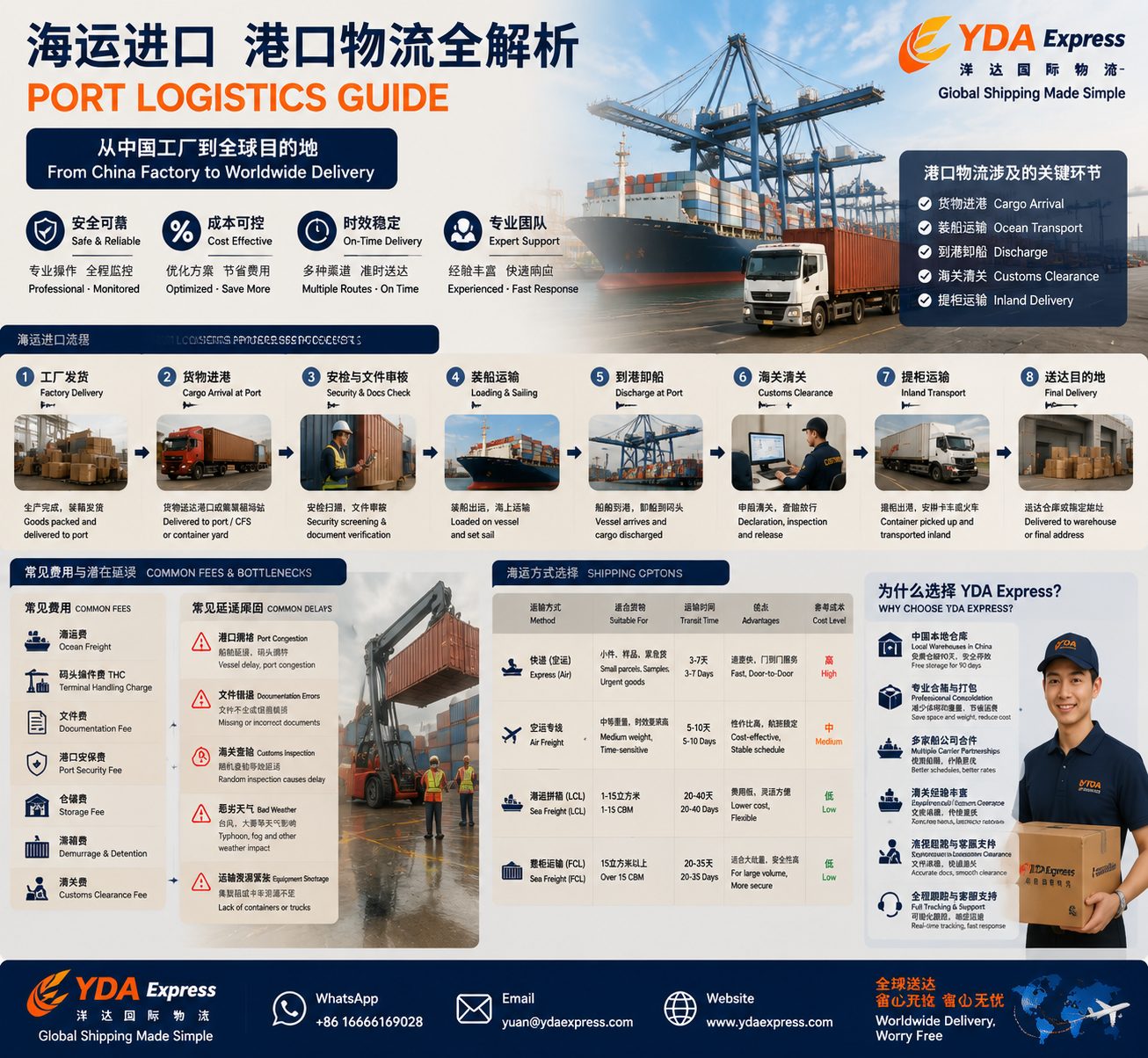
Put simply, port logistics covers every process that happens to your cargo while it’s at a seaport. That includes unloading a container from a truck, stacking it in a yard, loading it onto a vessel, discharging it at the other end, passing through customs inspection, and finally releasing it for delivery inland.
But it’s never as linear as it sounds. Ports are chaotic places. Vessels can arrive early or late. Cranes break down. Customs officers flag random shipments. A surge in holiday imports can clog up the whole system. Your freight forwarder might tell you “it’s in transit” but what you really need to know is whether it’s actually moving or just sitting at the terminal incurring storage fees.
The Journey: Loading Port, Transit, Destination Port
For most importers bringing goods from China, the journey looks like this:
Pre-shipment at origin: Your supplier books a freight forwarder or you arrange one yourself. The cargo is delivered to a Container Freight Station (CFS) for consolidation if it’s less-than-container-load (LCL), or stuffed into a full container (FCL) at the factory. From there it trucks to the port of loading.
At the loading port: The container is received by the terminal and stacked in the yard. The shipping line verifies documents, and then the container is loaded onto the vessel. Normally this stage takes 1–3 days if everything goes smoothly. But cut-offs for export documentation can be rigid; miss one and your container misses the boat.
At sea: The actual transit. China to the US West Coast takes about 12–16 days; to the UK it’s roughly 30 days. While at sea, the vessel operator updates the arrival time. Port congestion can already be factored in: some ships slow down if the destination port is too busy.
At the destination port: This is where things get interesting. The vessel docks—or sometimes anchors off and waits, more on that later. The container is discharged and moved to a holding area. Now it awaits customs clearance. Once released, it’s available for pickup by truck or rail.
The whole process involves layers of parties: terminal operators, customs brokers, trucking companies, shipping lines. Each handoff is a potential delay.
Common Bottlenecks and How to Avoid Them
Port Congestion
Honestly, port congestion has become the new normal in many places. Los Angeles/Long Beach, Rotterdam, Felixstowe—they all experience spikes. When demand surges, terminals run out of space and labor. Ships can’t unload, so they wait at anchor for days or even weeks. Even after discharge, your container might sit for days before a gate slot opens for pickup.
What can you do? Build buffer time into your delivery promises. If you’re selling on Amazon FBA, don’t cut your shipping window too tightly. I’ve seen sellers lose their Buy Box because their inventory was stuck at the port two weeks longer than planned. Also, consider routing through alternative ports. If Long Beach is backed up, maybe a Pacific Northwest port like Tacoma or an East Coast routing via the Panama Canal works better for your timeline. It might add a few days of sailing but avoid weeks of waiting.
Customs Delays
Customs is a beast of its own. In the US, CBP (Customs and Border Protection) uses automated targeting systems to flag shipments for exam. Random exams happen even with perfect paperwork. However, many holds are due to avoidable errors: incorrect HS codes, undervalued goods, missing certificates. A good customs broker is worth every penny. They’ll make sure your documents are tight and respond quickly to any requests for additional information.
One tip from experience: if you’re importing something unusual, like a new electronic gadget or organic material, check beforehand if it needs any special permits. I’ve had clients whose shipments of bamboo toothbrushes got held up because CBP required a USDA phytosanitary certificate. Nobody told them until it was too late.
Understanding Port Charges and Extra Fees
Beyond demurrage and detention, there are other fees that newcomers overlook. Terminal Handling Charges (THC) are what the terminal charges for moving your container around—loading it onto the vessel, off the vessel, stacking it. These are included in the ocean freight quote from some carriers but not others; always confirm. Port Security Fees, often a per-container charge for security measures, are another. In the US, the Harbor Maintenance Fee is assessed on the value of the cargo. These fees are usually paid by the consignee, so they’ll appear on your final invoice from the broker or forwarder.
You might also encounter a Chassis Usage Fee if you need a chassis at the destination port. Some terminals charge a split fee if your container needs to be moved from one stack to another because of customs inspection. It’s tedious, but you can ask your forwarder for a breakdown of all estimated destination charges before you book. Surprise invoices are never fun.
Demurrage and Detention Fees
Here’s the part that really stings. Demurrage is the fee a terminal charges when your container sits on port property beyond the free time—usually 3–5 days. Detention is when you keep the carrier’s container outside the port beyond the allowed period. These fees can add up fast—$100 to $200 per day per container is common. I’ve seen bills of several thousand dollars because a small shipment got overlooked.
The fix is simple in theory: clear customs and pick up the container as soon as possible. In practice, it requires coordination. Have your customs broker file the entry before the vessel arrives if possible. Book your trucker in advance. And if something goes wrong, negotiate. Some terminals have a process for waiver requests if the delay was beyond your control.
LCL vs FCL: Which One Keeps Port Logistics Simpler?
For smaller shipments, LCL (Less than Container Load) seems cheaper at first. You pay only for the space you use. But LCL comes with extra handling: your cargo gets consolidated at a CFS in China, then deconsolidated at a CFS near the destination port. That means more touches, more documentation, and more chances for delay. At the destination, you might have to wait until all the other consignees’ goods in the same container clear customs.
FCL gives you a full container. It’s sealed at the factory and opened only by you or customs. There’s less handling, so fewer delays and less risk of damage. The downside is you pay for the whole container even if you only half-fill it. If your shipment is over 10–12 cubic meters, FCL often makes more sense on a total-cost basis once you factor in LCL consolidation fees, higher per-unit freight, and destination CFS charges. And from a port logistics standpoint, FCL is usually smoother, with fewer people involved.
Paperwork You Can’t Afford to Get Wrong
The documents that flow around a port are just as important as the cargo. For a standard import, you’ll need:
- Commercial Invoice: Shows the value, description, buyer, and seller.
- Packing List: Details how the goods are packed—weights, dimensions, number of pieces.
- Bill of Lading (B/L): The contract between shipper and carrier; it’s also the title document.
- Arrival Notice: Sent by the carrier to the consignee (or their agent) when the cargo arrives.
- Customs Entry: Filed by your broker with the authorities.
If your name on the bill of lading doesn’t exactly match your importer of record, you’ll have trouble getting the container released. If the commercial invoice uses a vague description like “gifts” or “electronics” instead of specifics, expect a customs hold. Accuracy is everything. One wrong digit in the HS code can reclassify your product and change the duty rate significantly.
Inland Transportation: The Last Mile from Port
Port logistics doesn’t end at the terminal gate. You need a way to get the container to your warehouse. Trucking is the most common. But here’s a curveball: in many countries, the trucking company needs an appointment to pick up at the terminal. Those appointments can be scarce during peak periods. Some ports have chassis shortages too—chassis are the wheeled frames containers sit on. No chassis, no pickup. This isn’t something a shipper usually thinks about, but it can strand your container for days.
Rail is another option for longer hauls. Many ports have on-dock rail, meaning the container goes directly from ship to train, bypassing truck gates entirely. For example, the port of Los Angeles has on-dock rail that takes containers to the Midwest in a fraction of the time a truck would take. If your destination is far inland, rail might be cheaper and more reliable—but check the rail carrier’s transit times and any transloading requirements.
How a Good Freight Forwarder Smooths the Process
Freight forwarders are the conductors of the port logistics orchestra. They book the ocean freight, arrange customs brokerage, coordinate trucking, and handle all the paperwork. A forwarder with a strong presence in both China and your destination country is gold. They can anticipate problems, like port labor strikes or upcoming holiday closures, and reroute shipments accordingly.
For importers sourcing from China, at YDA Express we’ve seen how a forwarder that also handles the purchasing side can cut out a lot of confusion. Instead of juggling a factory, a Chinese trucker, a shipping line, and a US broker, you have one point of contact who manages the entire chain. That means fewer emails, fewer surprises, and a much cleaner port logistics experience.
Real Talk: Expect the Unexpected
Every port has its own personality. The Port of Shanghai might be ruthlessly efficient but go by the book on documentation. The Port of New York and New Jersey has great infrastructure but notorious winter weather delays. Rotterdam handles massive volumes but sometimes struggles with labor shortages. Your routing decisions should consider not just transit time but port reliability scores.
Even in perfect conditions, plan for 2–3 days of buffer at each port, on top of the vessel schedule. If you’re shipping a rush order, pay extra for priority handling or carrier guaranteed delivery services. And always, always track your container online. Most shipping lines give you a container number you can plug into their tracking tool. Seeing your container “discharged” is a beautiful moment. Seeing it “on hold” three days later is a prompt to start calling.
Bringing It All Together
Port logistics can feel overwhelming because there are so many moving parts, often in different time zones and languages. But once you grasp the basic flow—origin terminal, vessel, destination terminal, customs, interchange, final delivery—it becomes manageable. You start to see patterns, ask the right questions, and avoid the painful mistakes.
If you’re new to importing, start small. Try an LCL shipment or a shared container to test the waters. Work with a forwarder who’s willing to explain the process, not just send an invoice. And give yourself patience; the first shipment is always the hardest.
For anyone sourcing products from China, whether you’re a small business owner or an individual shopper consolidating goods from Taobao and 1688, having a logistics partner who understands port logistics from both ends makes all the difference. At YDA Express, we help clients navigate every step—from purchasing the items to warehousing, consolidation, shipping, and customs clearance—so that their goods arrive safely and on time. If you’re planning your next import and want to skip the port headaches, reach out on WhatsApp at +86 16666169028 or email yuan@ydaexpress.com. You can also visit https://www.ydaexpress.com to see how our services can simplify your international shipping.
📦 China Parcel Forwarding & International Shipping Already placed your order? Send your purchases to our China warehouse for parcel receiving, photo inspection, up to 180 days of free storage, package consolidation, international shipping, and real-time tracking.
📲 Download the YDA Express App One app for shopping, purchasing assistance, package management, consolidation, international shipping, and worldwide delivery.
🌍 More Helpful Guides Explore practical guides on shopping from China, parcel forwarding, shipping costs, and customs clearance.