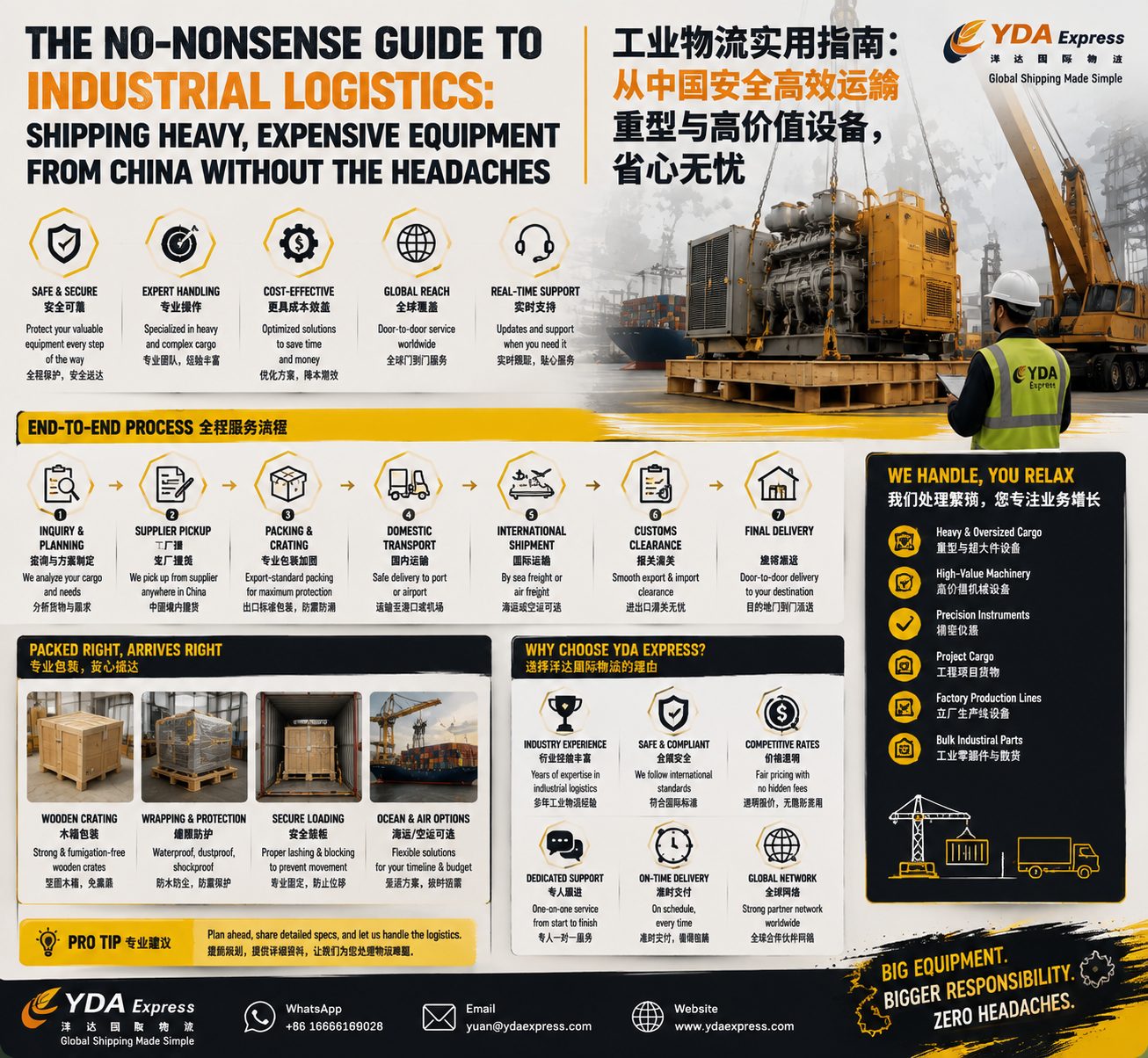
Shipping bulky industrial machinery from China involves more than just booking freight. This guide breaks down packaging, customs, insurance, and mode choices so you can avoid costly mistakes and keep your supply chain running smoothly.
If you've ever tried to move a 2-ton CNC mill from Guangdong to a workshop in Manchester, you already know industrial logistics isn't like sending a parcel. One wrong pallet decision, a missing HS code, and you're staring at a container stuck in customs for three weeks—and a very unhappy production manager on your back.
Here's the thing: most guides talk about industrial logistics like it's a simple flow chart. It isn't. It's messy, heavy, and full of gotchas that can turn a $50,000 machine into a $50,000 paperweight if you cut corners.
But once you understand the basics, you can plan shipments that actually arrive on time, in one piece, without doubling your budget. This is what we do every day at YDA Express, and I'll walk you through exactly what matters.
What's Different About Industrial Logistics?
When you're dealing with a package that fits in a mail sack, you can use FedEx or DHL and call it done. Industrial goods break that model. We're talking CNC machines, injection molding presses, generator sets, steel fabrication lines, construction equipment—stuff that weighs anywhere from 200 kilos to 20 tons. Dimensions can be awkward, like a 4-meter-long pipe threading machine that won't fit in a standard container without dismantling.
These shipments don't just need a truck. They need crating that can survive an ocean crossing, loading ramps that can handle the weight, and documentation that makes customs officers nod instead of frown. The freight forwarder you pick has to understand the difference between a "wooden box" and ISPM 15 heat-treated timber, and they need to know how to negotiate a shipping line's special equipment surcharge for an open-top container.
Honestly, most express couriers won't even touch anything over 70 kg per piece. That's the first reality check: you're now in the world of freight forwarding, where you book space on a ship or a cargo plane by the cubic meter or the ton.
The Real-World Challenges (and How to Handle Them)
Size and Weight Are Just the Start
A 5-ton hydraulic press isn't heavy just to move—it's heavy to load, to secure inside a container, and to handle at the destination port. If you put it in a standard 20-foot container, you'll need to consider the floor load capacity. An old trick: spread the weight with steel plates underneath the machine.
But it's not just about the numbers. Some ports have weight limits for trucks coming out of the terminal. We once shipped a 12-ton CNC lathe to a customer in Los Angeles. The port terminal could handle it fine, but the trucking company on the US side needed a lowboy trailer with special permits. That took an extra four days and cost $800 more than the customer expected. If you don't plan for that, your "on-time delivery" becomes a warehouse storage bill.
Documentation That Actually Works
Customs is where shippers lose sleep. For industrial machinery, you typically need:
- A commercial invoice with a realistic unit price (not a lowball figure that triggers a valuation dispute).
- A packing list that itemizes every crate, its contents, and its weight—down to the kilo.
- The correct HS code. Many machines have multiple parts that might fall under different codes. For example, a CNC router might be classified under 8465.10 for the machine itself, but the control unit could be 8537.10. The whole shipment can get flagged if the codes don't match the invoice.
- A certificate of origin if you want preferential duty rates under trade agreements.
- For used equipment: a fumigation certificate and possibly a detailed condition report.
A single missing comma on the invoice can delay clearance by a week. I've seen it. That's why we at YDA Express review every document before it hits the shipper's system.
Packaging Isn't Just a Box
Your factory might wrap a machine in plastic wrap and call it "export packaging." That's fine for a truck ride across town, not for a three-week sea voyage with salt spray and crane handling. Proper industrial packaging means:
- Vapor-barrier bags with desiccants to prevent rust inside the crate.
- Shock indicators and tilt indicators on the outside so you know if the box was handled roughly.
- Bolting the equipment to a heavy-duty pallet with sufficient forklift pockets.
- Using plywood crates with internal bracing; no one wants to receive a machine that shifted and punched through the crate wall.
If you're shipping something sensitive like medical imaging equipment, you might even need a climate-controlled container. That costs more but beats replacing a $200,000 MRI coil.
Modes: Air vs. Ocean vs. Rail
Let's cut through the marketing speak. Here's what each mode looks like for industrial gear.
Ocean Freight (FCL / LCL) This is the default for most heavy machinery. A 20-foot container can hold up to 28 tons of cargo. If you fill the whole container, that's FCL (full container load). If you only have a few crates, you can share a container with other cargo—that's LCL (less than container load).
- Transit time: Shenzhen to Hamburg, about 28–35 days port-to-port. Add 5–7 days for inland trucking on each end.
- Cost: For a 20-foot container from China to Rotterdam, you're looking at around $1,500–$2,500 depending on the season, plus surcharges. LCL works on a cubic-meter basis; you might pay $200–$400 per cubic meter, but with extra consolidation delays.
Air Freight When you need a spare part yesterday, air is the only way. It's charged by volume weight or gross weight, whichever is higher. For dense machinery, you often pay by weight.
- A 500 kg pump sent from Guangzhou to Chicago by air might cost $3–$5 per kilo. That's $1,500–$2,500 total. It arrives in 3–5 days. Compare that to ocean, where the same weight would cost maybe $200–$400 but take 25 days. The math is obvious: only use air for urgent, high-value items or when downtime costs more than the freight.
Rail Freight (China–Europe) The "New Silk Road" is a solid middle ground. From Xi'an or Chongqing to Duisburg, transit time is 14–18 days. Cost is about 40–60% of air freight. It's good for machinery going to Kazakhstan, Poland, or Germany. But rail has strict weight and dimension limits per wagon, so it's not always possible for oversized equipment.
Insurance: Don't Learn the Hard Way
General cargo insurance from a shipping line covers maybe $500 per container—a joke when you're shipping a $20,000 compressor. You need marine cargo insurance, ideally with an "all risks" clause. That covers total loss, partial damage, rust, and even mishandling during loading. A typical premium is 0.3–0.5% of the insured value. So for a $10,000 shipment, you'd pay $30–$50. That's a no-brainer.
Here's a real story: a client imported five electric motors from Wenzhou to Durban. One motor arrived with a bent shaft—the crate had been dropped. The insurance adjuster inspected it at the port and paid out the repair cost within two weeks. Without that policy, the client would have been out $4,000 and three weeks of delay.
The Case for Using a Local Chinese Forwarder
You can book freight with a global 3PL based in your own country. But when you're sourcing from China, having someone on the ground who speaks the language and knows the factory already saves layers of communication headache.
At YDA Express, we pick up the machinery directly from the supplier, inspect it at our warehouse in Yangjiang, repack if needed, and manage the export declaration. That way, you're not relying on a factory that may have never shipped overseas before. We once had a client sending a large injection molding machine to Brazil. The factory's original wooden crate was made from untreated pine—not only a customs violation but also too flimsy for ocean travel. Our team rebuilt it with ISPM 15-certified plywood, added internal bracing, and the machine arrived without a scratch.
A good forwarder also catches mistakes like undervaluing the invoice or forgetting the port of discharge on the bill of lading—small things that cause huge delays.
Planning Your Shipment: A Practical Checklist
Because you don't want to learn this on the fly, here's what to lock down before you even book:
- Know the exact weight and dims. Not estimates. Have the supplier send photos with a tape measure and a scale. Overweight surcharges come from guessing.
- Classify the HS code correctly. The importer of record (that's you or your buyer) is legally responsible. Use your country's tariff tool to find the right code.
- Check destination port capabilities. Not every port has a crane for 20-ton lifts. Confirm with a local agent.
- Plan for last-mile delivery. Will the machine fit through the warehouse door? Do you need a forklift on site, or a crane truck? Arrange it before the container arrives.
- Prepare documents in advance. Invoice, packing list, bill of lading, certificate of origin, insurance certificate. Have digital copies and originals where needed.
- Insure from factory to delivery. Not just port-to-port. A truck accident on the highway between Guangzhou and Shenzhen port happens more often than you'd think.
Why "Cheapest" Often Isn't
It's tempting to grab the lowest online quote. But industrial logistics is full of hidden charges: port congestion surcharges, chassis usage fees in the US, customs exam fees if your container gets flagged for X-ray. A reputable forwarder builds those into the quote or warns you. The cheap guy? You find out when the container is already sitting in Long Beach.
Also, transit time matters. A vessel that transships three times might be $200 cheaper but adds 10 days. If your factory is idle waiting for that press, those 10 days cost far more in lost production.
The Bottom Line
Industrial logistics isn't rocket science, but it isn't parcel delivery either. It's about heavy things, long distances, and paper trails that require attention to detail. Get the basics right—packaging, documentation, mode choice, insurance—and you'll sleep fine. Ignore them, and you'll have an expensive lesson.
If you're sourcing equipment from China, don't go it alone. Reach out to us at YDA Express. We handle everything from factory pickup to final delivery, with transparent pricing and real-time tracking. Visit ydaexpress.com, email yuan@ydaexpress.com, or WhatsApp +86 16666169028. We'll make sure your machinery arrives where it needs to be, when it needs to be there.
📦 China Parcel Forwarding & International Shipping Already placed your order? Send your purchases to our China warehouse for parcel receiving, photo inspection, up to 180 days of free storage, package consolidation, international shipping, and real-time tracking.
📲 Download the YDA Express App One app for shopping, purchasing assistance, package management, consolidation, international shipping, and worldwide delivery.
🌍 More Helpful Guides Explore practical guides on shopping from China, parcel forwarding, shipping costs, and customs clearance.