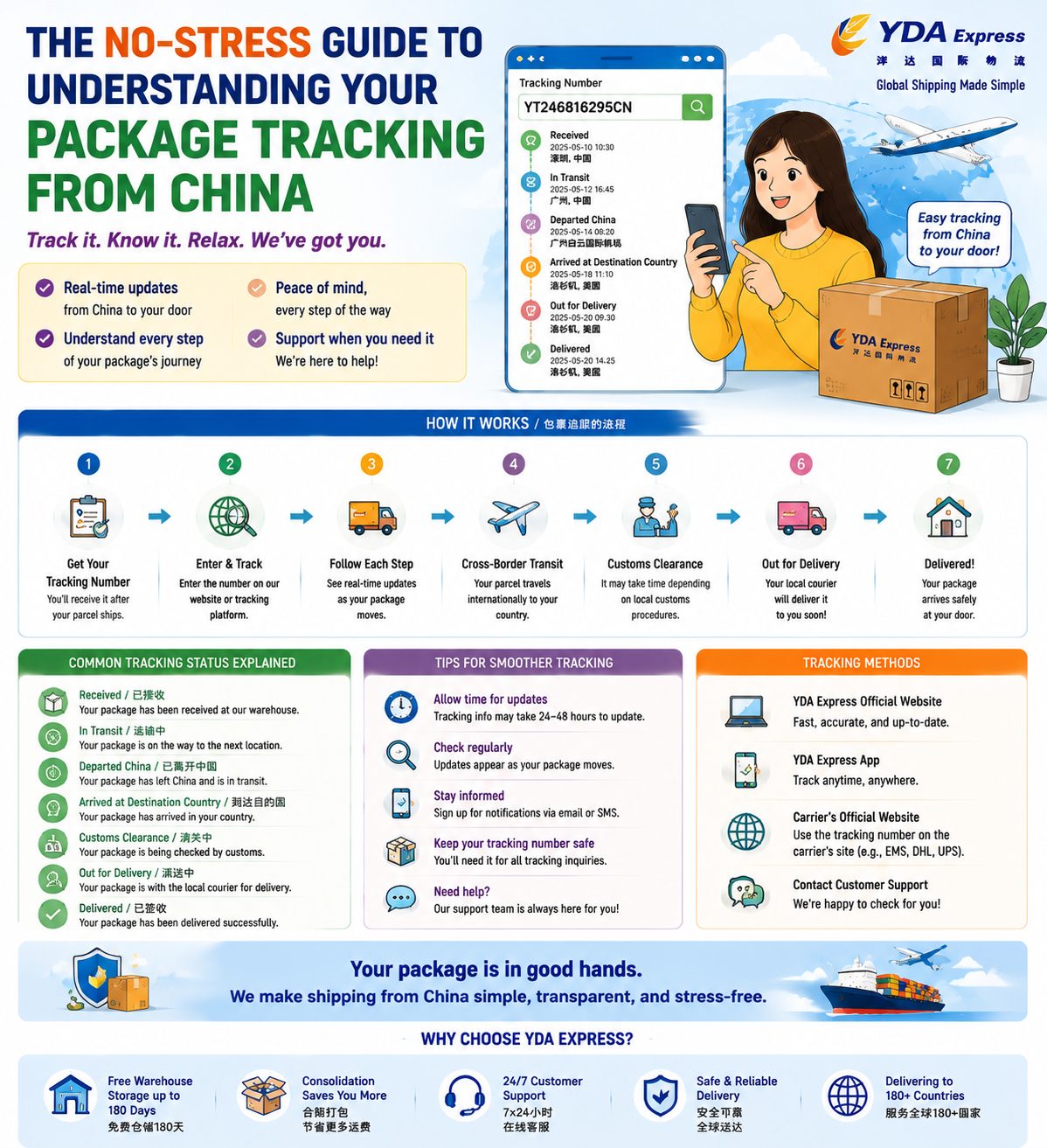
Confused by tracking updates or stuck on 'Shipment in transit'? This guide breaks down how package tracking works for international shipments from China, what common statuses mean, and how to avoid worrying unnecessarily. Plus, see how YDA Express helps you stay informed.
You’ve just placed an order from a Chinese supplier or online store, and the excitement is real. Then the waiting begins. You find yourself refreshing the tracking page at 2 a.m., trying to decode messages like 'Departed from airport' or 'Held at customs.' Sound familiar? You’re not alone. Package tracking is supposed to give peace of mind, but too often it raises more questions than it answers.
Here’s the thing: tracking a shipment from China isn’t always as straightforward as following a domestic Amazon order. It goes through multiple hands, crosses borders, and sometimes the updates feel like they’re in a foreign language—literally and figuratively. But once you understand how the system works and how to read between the lines, you’ll save yourself a lot of anxiety.
What is Package Tracking, Really?
At its simplest, package tracking is a series of checkpoints recorded as your parcel moves from the sender to you. Every time a label is scanned—at a warehouse, on a truck, through customs—the event gets logged in a database, and that’s what you see when you punch your tracking number into a website.
But here’s where it gets tricky: not all scans are created equal. Some are physical scans by a handler with a barcode scanner. Others are logical scans that get generated automatically when a batch of packages is expected to arrive somewhere. That’s why you might see an update like "Arrived at destination airport" when your package might still be sitting in a container waiting to be unloaded. The tracking system is showing you what’s supposed to happen almost as often as what’s actually happening.
The Chain of Custody in International Shipping
When you ship from China, your package typically moves through this sequence:
- Pickup – The courier collects the parcel from the seller or warehouse.
- Origin processing – It gets weighed, sorted, and loaded onto a truck or plane at a local hub. In China, this often happens in Shenzhen, Guangzhou, or Hong Kong.
- Export customs – Chinese customs authorities clear the package for departure. This can be a quick scan or a more detailed inspection if the contents look suspicious.
- Transit – The parcel flies or sails to the destination country. During this time, you’ll often see a generic "In transit" or no update at all.
- Import customs – The package arrives in your country and must clear local customs. Duties, taxes, and item restrictions get checked here.
- Last-mile delivery – Once released, it’s handed off to a local carrier like USPS, Royal Mail, DHL, or FedEx for final delivery to your door.
Each of these steps might generate one or more tracking entries. But if any single scan gets missed, you’ll have a gap. That’s normal.
Common Tracking Statuses and What They Actually Mean
Ever stared at a status update and wondered if something’s wrong? Let’s demystify a few of the most common messages you’ll see.
"Shipment information received" or "Electronic information submitted" This means the courier has received the digital shipping label data from the sender, but hasn’t yet taken physical possession of the package. It could be a few hours or a couple of days before the next scan. If it stays on this status for more than three business days, the seller might be dragging their feet. A quick nudge is fair.
"Departed from facility" or "Departed from airport" Your package is on the move. This is a good sign—except when it isn’t. For air freight, "departed from airport" often means the shipping container has been loaded onto a plane, but the plane might not take off for hours. In some cases, the status appears when the container is sealed, and the actual departure happens much later. So don’t panic if it doesn’t arrive in your country immediately.
"Arrived at destination airport" or "Arrived at facility" The parcel has landed. Now comes the waiting game with customs. This status doesn’t mean it’s cleared; it’s just in the country. Realistically, you’ll see a delay here of anywhere from a few hours to a week, depending on the local customs workload.
"Customs clearance" or "Held in customs" This one scares people the most. "Held" doesn’t necessarily mean seized. It just means customs officers are reviewing the shipment. They might check the declared value, the contents, or any required documentation. Most packages clear within a day or two, especially if the paperwork is right. But if you see "Customs retention" or "Awaiting additional documentation," that’s when you might need to get involved.
"Out for delivery" The golden hour. Your package is on the truck and should reach you by the end of the day. With international shipments, this status only appears once the local carrier has it and is actively delivering. If you see this, you can stop refreshing—at least until tomorrow if it doesn’t show up.
Why Your Tracking Goes Silent (And When to Worry)
From the moment your package leaves China until it gets scanned into your country’s system, you might see nothing. That silence can last 5 to 15 days for air freight, or 30 to 60 days for sea freight. And honestly, that’s typical. Here’s why:
- Bulk scanning – Airline freight containers hold hundreds of parcels. They might get scanned as a single unit, not individually. Your item’s tracking won’t update until the container is opened at the destination hub.
- Handoffs between carriers – When your package transfers from China Post to USPS, or from a freight forwarder to FedEx, the tracking numbers sometimes don’t sync immediately. You might have to use a different tracking system to bridge the gap.
- Weekends and holidays – Customs offices and carriers don’t work 24/7. A package that arrives Friday evening might sit until Monday morning.
- Remote destinations – If you’re in a smaller town or island nation, scanning infrastructure might be less frequent, so updates come slower.
So when should you genuinely worry? If 30 days have passed since the last scan for an air shipment, or 90 days for sea, it’s time to investigate. Missing or incomplete addresses, customs holds due to prohibited items, or carrier losses aren’t common, but they happen. At that point, contacting your shipper or freight forwarder is the right move.
How Different Carriers Handle Tracking
Not all carriers are equal when it comes to tracking quality. DHL, FedEx, and UPS are the gold standard: detailed, nearly real-time updates from pickup to delivery. But they’re expensive. Many Chinese ecommerce sellers and smaller forwarders use economy services like China Post Registered Air Mail, Yanwen, or 4PX. These give you a string of numbers that may only show a handful of scans—often just acceptance and delivery, with a long blank stretch in between.
Then there’s the world of freight forwarders. A forwarder like YDA Express consolidates packages from different clients and books space on air or sea freight under their own account. They’ll issue you a tracking number, but the actual tracking might happen on their system or through a partner carrier’s site. It’s not uncommon to see one tracking number work on a Chinese tracking site like 17TRACK and then switch to a different number once the package reaches the US or Europe. This is normal—it’s called a “master/child” tracking relationship, where the forwarder’s tracking is the master and the local carrier’s tracking is the child. The key is that your shipper should tell you both numbers up front.
How YDA Express Makes Tracking Easier
At YDA Express, we know tracking anxiety is real. You’re spending your hard-earned money and trusting us to deliver, so we take visibility seriously. When your package enters our warehouse in Yangjiang, China, you receive a tracking number immediately—not just an order confirmation. That number stays active right through our consolidation process, export booking, and handoff to the airline or shipping line. And because we work with multiple carrier partners, we always provide the secondary tracking number once it’s generated, so you’re never left guessing where your package is.
We also do something that most automated systems can’t: we watch over your shipment personally. Our team monitors every package’s journey, and if something looks off—like a customs hold or an address exception—we ping you via WhatsApp or email before you even have to ask. Honestly, having someone who can call the local logistics depot in Chinese and get real-time info is a huge relief for customers overseas. It’s the difference between waiting helplessly and knowing exactly what’s happening.
Practical Tips for Tracking Your Shipment
Here’s how to track smarter, not harder:
- Use a multi-carrier tracking tool. Sites like 17TRACK, Aftership, or Parcel Monitor let you plug in one number and they’ll automatically pull updates from dozens of carriers. This is a lifesaver when your package switches hands.
- Sign up for notifications. Most carrier websites and apps offer email or SMS alerts. Get them, so you’re not refreshing constantly. They’ll tell you about delays or delivery attempts.
- Understand the timeline before you panic. An express package from China to the US via DHL might take 3-7 days total. An economy airmail package could take 15-30 days. Sea freight is 30-45 days. If you’re on day 10 of an economy shipment and the tracking is quiet, that’s exactly what you should expect.
- Check the holiday calendar. Chinese New Year shuts down most of China for two weeks, and many Asian countries have Golden Week or other public holidays that affect logistics. If your package goes silent around these times, patience is the only option.
- Download the carrier’s app. DHL, FedEx, and UPS apps give richer tracking detail than the mobile web. They also let you set delivery preferences, which can prevent missed deliveries.
Don’t Let Tracking Stress You Out
Here’s the bottom line: package tracking from China is more of a rough guide than a precise minute-by-minute log. It’s normal to see gaps, confusing statuses, and even temporary reversals (like a package “arriving” twice at the same facility). Most of the time, your parcel is moving along just fine, even if the system hasn’t told you about it yet.
When you choose a reliable freight forwarder or carrier, you stack the odds in your favor. They’ll not only get your goods shipped safely but also help you decode the tracking when things get murky. At YDA Express, we’ve seen just about every tracking scenario—from packages that seemed lost only to get delivered the next day, to ones that needed a quick push at customs. We’re here to make sure you’re never left in the dark.
Got a shipment coming from China and want a tracking experience that actually makes sense? Reach out to us on WhatsApp at +86 16666169028, email yuan@ydaexpress.com, or visit ydaexpress.com. We’ll get you a quote, answer your tracking questions, and show you how smooth cross-border shipping can be.
📦 China Parcel Forwarding & International Shipping Already placed your order? Send your purchases to our China warehouse for parcel receiving, photo inspection, up to 180 days of free storage, package consolidation, international shipping, and real-time tracking.
📲 Download the YDA Express App One app for shopping, purchasing assistance, package management, consolidation, international shipping, and worldwide delivery.
🌍 More Helpful Guides Explore practical guides on shopping from China, parcel forwarding, shipping costs, and customs clearance.