Learn how parcel consolidation works when buying from China, why it saves you money on international shipping, and how YdaExpress simplifies the process with secure storage and reliable delivery.
So you've just bought five pairs of sneakers from different sellers on Taobao, a couple of gadgets from 1688, and a few custom phone cases from JD. Each seller is asking a separate shipping fee, and the total would make anyone wince. Now DHL wants $45 to ship that one 300g package, and you've got seven more like it. This is the moment every international shopper hits — the shipping cost is swallowing the deal.
That's where parcel consolidation comes in. Also known as freight consolidation or less-than-container-load (LCL) shipping, it's the most straightforward way to turn a chaotic pile of small packages into one sensible, affordable shipment. And honestly, once you understand how it works, you'll wonder why you ever paid retail shipping rates.
What Parcel Consolidation Actually Means
Parcel consolidation is basically combining multiple orders from different sellers into one box before shipping internationally. Instead of forwarding each little package on its own, a service provider holds them in a warehouse, waits until everything arrives, then repacks them together.
For most shoppers buying from China, this changes the game. Individual small parcels incur high minimum charges and per-unit handling fees. A 500g package shipped via FedEx from Guangzhou to New York might cost $25, while a 5kg consolidated shipment often costs $60. That's not a linear saving — it's geometric. The more you combine, the lower the per-kilogram rate tends to go.
The industry calls this "LCL" for sea freight or "consolidation" for air cargo, but you don't need a logistics degree to use it. The concept is the same: group small shipments to get bulk pricing without actually buying bulk quantities of a single product. For the everyday shopper, it's simply a smarter way to ship.
Why You Need It (And Why It's Not Just About Saving Cash)
Cost reduction gets all the attention, and for good reason. But consolidation does more than trim your shipping bill.
Lower customs hassle. One combined shipment means one commercial invoice, one customs entry, and (usually) one clearance fee. If you ship seven separate parcels, customs might flag each one, and you'll pay multiple administrative fees. Consolidated shipments often clear faster because they're fewer, larger pieces.
Better packaging protection. Sellers on Taobao or 1688 often use minimal packaging. When a forwarder consolidates, they repack using appropriate boxes, cushioning, and void fill. That means your ceramic mug arrives in one piece, not seven.
Fewer missed deliveries. One tracking number. One delivery. Not chasing down seven different packages with different carriers across different days.
Real inventory control. If you buy consistently — say you're a small eBay seller sourcing from China — keeping items in a forwarder's warehouse and shipping consolidated batches every two weeks simplifies your stock management.
My team at YdaExpress sees this pattern daily. A client buys 20 items across 10 suppliers over two weeks. We store them free for up to 30 days, then one Friday, we consolidate and ship. The client pays roughly 40% less than if they'd forwarded each item individually. That's not a theoretical number; it's the average we track.
How It Works, Step by Step
You don't need to be a logistics expert. The process is surprisingly simple.
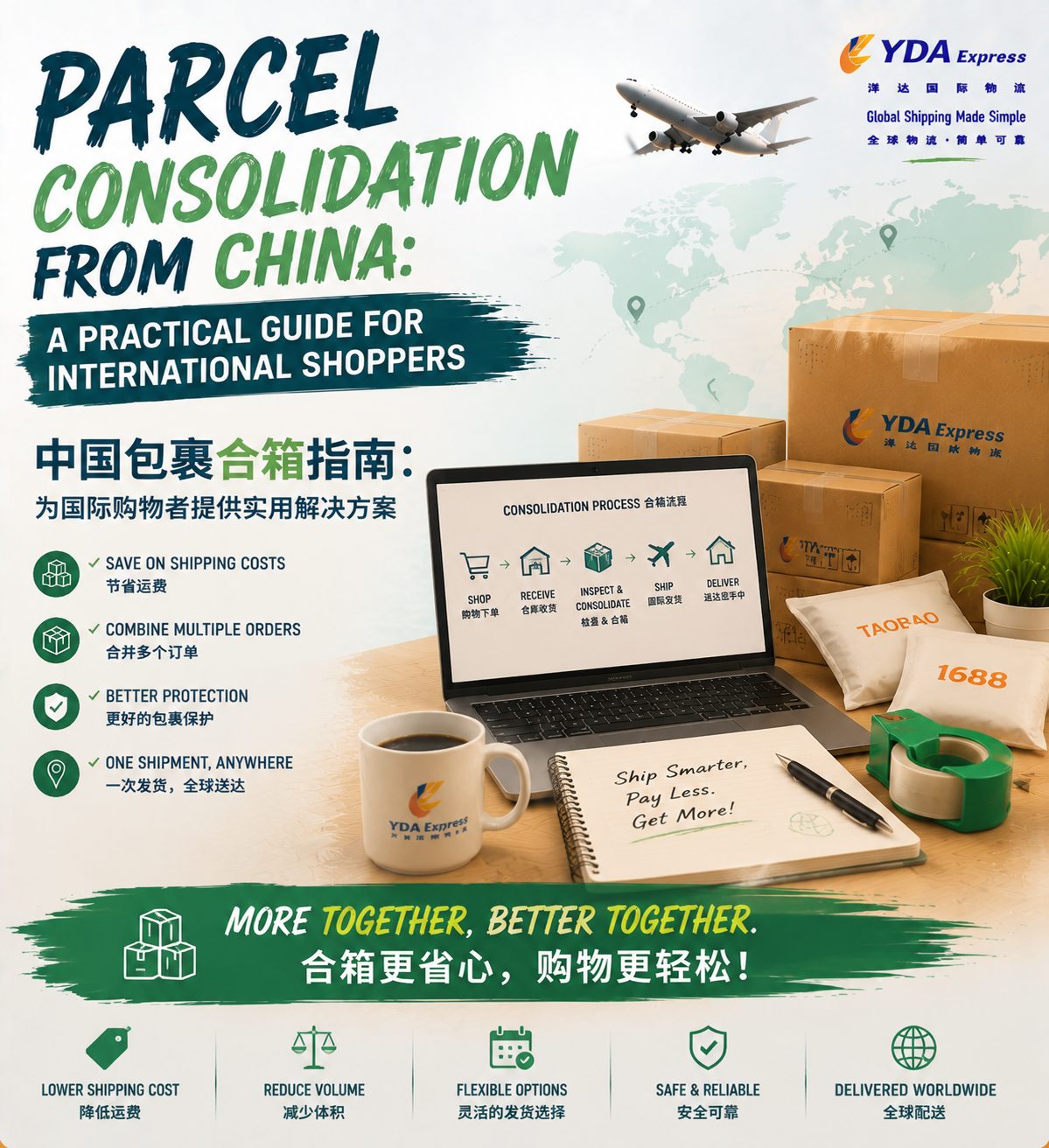
- Get a Chinese warehouse address. Sign up with a consolidation service. You'll receive a unique customer ID and a warehouse address in China — usually in a logistics hub like Shenzhen or Guangzhou. This becomes your shipping address for all your purchases.
- Shop as usual. Buy from Taobao, 1688, JD, Pinduoduo, or even direct from factories. At checkout, enter the warehouse address. Most sellers ship domestically within China for free or a small fee.
- Track arrivals. A decent forwarder will have a system that shows you when each parcel lands. You'll see the merchant name, tracking number, weight, and often a photo of the package. At YdaExpress, our online dashboard updates in real time — no guessing.
- Submit a consolidation request. Once everything you want in this batch is in the warehouse, you tell the forwarder, "Ship these 8 parcels together." You can pick your carrier: DHL for speed, air freight for balance, sea freight for cost.
- Optional extra services. Many forwarders offer things like photo inspection (they'll open the package and snap a picture so you know the seller sent the right item), repacking, fragile labeling, or even basic QC checks. Some charge a small fee; others include it.
- They consolidate and dispatch. The team pulls all your parcels, opens them (with your permission, usually called "repacking"), combines the items into a single sturdy box, weighs the new package, and ships it out with one tracking number.
- Receive your shipment. It arrives at your doorstep, you pay duties if applicable (which are now one-time), and you unpack like it's Christmas.
What You Need to Know About Costs
Transparency here matters. Consolidation isn't free — you're paying for storage, labor, packaging materials, and the international shipping label. But the cost difference versus individual forwarding is stark.
Let's break down a real-world comparison. Say you buy five items:
- T-shirt: 0.2kg
- Sneakers: 0.8kg
- Phone case: 0.1kg
- Small toy: 0.3kg
- Watch: 0.2kg
Individually via DHL Express from China to the US, each would trigger a base charge of about $15-20 plus a per-kg rate around $8-10. Total: easily $100+
Now consolidate. Combined weight after repacking might be 1.8kg (you save on packaging weight). Via air freight consolidation, the rate might be $8 per kg all-in, with a $5 handling fee. Total: $19.40. Add storage (often free up to 30 days). You just pocketed $80.
Sea freight gives even larger margins on bulkier items. A 25kg LCL shipment from Shenzhen to Los Angeles could run $2.50-3.00 per kg, depending on the forwarder. That same 25kg split into 10 small express packages would be astronomically higher.
Watch out for hidden fees. Some forwarders charge by "volumetric weight" (size of box rather than actual weight). Always ask how they calculate. Reputable ones like YdaExpress use whichever is lower for small shipments, but for larger boxes, it's standard to use dimensional weight. The key is knowing before you ship.
The Hidden Art of Repacking
Repacking is the secret sauce. Without it, consolidation is just a box of boxes. With it, you can cut weight and volume by 20-40%.
Chinese sellers wrap things in excessive amounts of tape, manufacturer packaging, and cardboard. Inside a single item, you might have a retail box, a bubble wrap layer, and a poly mailer. Multiply that by ten and you're shipping a lot of air and cardboard. A good consolidation service strips the unnecessary layers, removes duplicate packaging, and packs everything tightly.
At YdaExpress, our warehouse team routinely reduces a 4kg shipment (as measured when individual boxes are just tossed together) to 2.8kg after proper repacking. That directly lowers your freight cost. And if you're shipping shoes? They might wrap the shoes in plastic and flatten the shoeboxes separately, allowing more items to fit.
One tip: if you want original packaging kept, just tell them. Some shoppers resell and need pristine boxes. Others don't care. Communication is everything.
Sea Freight vs Air Freight vs Express for Consolidated Shipments
When you consolidate, you get to choose the international leg. The right mode depends on urgency and weight.
Express (DHL, FedEx, UPS) is for speed. Good for consolidated shipments under 30kg. Delivery in 3-7 business days globally. Cost: $6-10 per kg typical for Asia-US/Europe routes. Pro: door-to-door, simple customs. Con: not ideal for heavy shipments over 50kg because dimensional weight charges can jump.
Air freight consolidation is a middle ground. Your shipment flies on a cargo carrier, often to a regional hub, then last-mile by a local courier. Transit: 7-15 days. Cost: $3-6 per kg. Works great for 20kg-100kg consolidated batches. You'll need a customs broker at destination unless the forwarder includes that.
Sea freight LCL is the king of cost for larger, non-urgent goods. 0.5 cubic meter minimum, or around 100kg+. Transit: 25-40 days port-to-port or door-to-door via agent. Rates are stunningly low: $1.50-3 per kg all-in from China to major ports like Los Angeles, Hamburg, or Sydney. But palletization and customs clearance add steps. Only worth it if you can wait.
For the typical international shopper buying clothing, shoes, accessories, and small electronics, express consolidation of 5-15 kg parcels is the sweet spot. You get fast delivery and serious savings.
Common Mistakes When Consolidating (And How to Avoid Them)
Even seasoned buyers mess this up sometimes. Here's what I see go wrong and how to sidestep it.
Not checking item eligibility. Some items can't be shipped together: lithium batteries, liquids, powders, or branded goods (counterfeit risk). If you consolidate and one item is prohibition, the whole shipment gets held. Always classify your goods honestly and check with your forwarder. At YdaExpress, our team pre-screens hundreds of items weekly and flags risky SKUs before consolidation.
Ignoring dimensional weight. That huge but lightweight lampshade you bought? It'll be charged as 10kg volumetric even though it weighs only 2kg. Repacking helps, but don't consolidate oddly shaped items without asking for a dimensional quote.
Rushing the consolidation. Letting parcels accumulate over two weeks gives more savings. Consolidating after one day yields minimal benefit. Most warehouses offer free storage for 30 days; use that window.
Misunderstanding customs value. If you consolidate, the declared value is the sum of all items. That might push you over de minimis thresholds (e.g., $800 for US, €150 for EU). That means duties and taxes. Plan accordingly — maybe split into two consolidate shipments if you're near the limit.
Not checking for repacking quality. If a forwarder just throws boxes into a bigger box without padding, damage happens. Look for providers that show photos of the consolidated box before shipping, or those known for careful handling.
How to Choose a Consolidation Service from China
There are dozens of companies offering this. Some are Taobao registered agents, others independent forwarders. The differences come down to three things.
Transparency of fees. No hidden charges. You should see the exact weight, dimensions, and shipping cost before paying. Good providers have online calculators or instant quotes.
Communication. If you send a message and wait 48 hours for a reply, walk away. The best services have responsive WhatsApp, WeChat, or live chat. YdaExpress, for example, assigns a personal customer rep who speaks English and understands the anxiety of international shipping.
Service extras. Free photo inspection, free consolidation, free storage (up to a point), and free packaging materials are hallmarks of a customer-first forwarder. Small fees for special requests are fine, but the baseline shouldn't nickel-and-dime you.
Carrier relationships. A forwarder with strong contracts with DHL, FedEx, and major air/sea lines can offer better rates than you'd ever get walking in. They're passing on volume discounts, and that matters.
The Bottom Line
Parcel consolidation from China isn't some hack for extreme couponers. It's a standard logistics strategy that turns an expensive mess into a predictable, affordable system. For anyone buying multiple items across different Chinese platforms — whether you're a sneaker collector in London, a small Amazon seller in Melbourne, or just someone who loves AliExpress deals — consolidation makes the math work.
Start by testing with a small batch of 3-5 parcels. Use a forwarder with clear pricing, repacking options, and a storage window that fits your shopping rhythm. Not all consolidation services are equal. You want one that treats your packages like their own and doesn't go silent when something goes sideways.
If you're ready to stop hemorrhaging cash on individual shipping fees, YdaExpress has been doing precisely this for years. We offer secure warehouse storage in Guangdong, free 30-day holding, thorough repacking, and transparent international rates through DHL, FedEx, UPS, air cargo, and sea freight. Our team monitors each consolidation and handles customs documentation, so you don't have to learn the hard way.
Visit https://www.ydaexpress.com to start, or message our team on WhatsApp at +8616666169028. One box. One bill. Way smarter shipping.
📦 China Parcel Forwarding & International Shipping Already placed your order? Send your purchases to our China warehouse for parcel receiving, photo inspection, up to 180 days of free storage, package consolidation, international shipping, and real-time tracking.
📲 Download the YDA Express App One app for shopping, purchasing assistance, package management, consolidation, international shipping, and worldwide delivery.
🌍 More Helpful Guides Explore practical guides on shopping from China, parcel forwarding, shipping costs, and customs clearance.