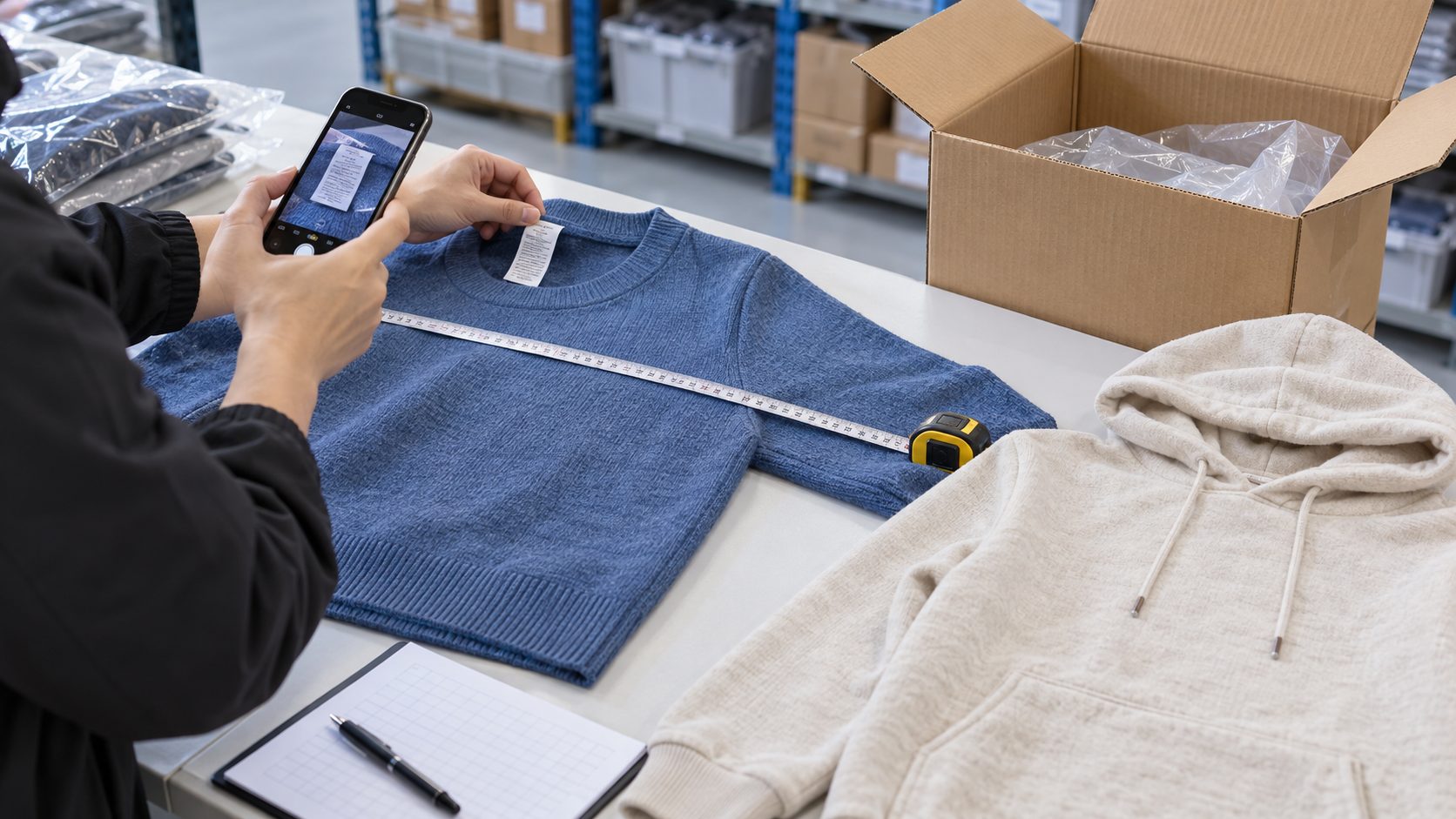
Before shipping Pinduoduo clothes to Czechia, verify measurements, fabric labels, visible condition and import value. Use this keep, exchange or return decision plan while the parcel is still in China.
Pinduoduo clothing can be worth ordering to Czechia, but the safest moment to decide is not after the parcel arrives in Europe. It is while the item is still in China and a return or exchange may still be practical. Before international dispatch, compare the listing with the received garment, verify real measurements, check the fibre label and decide whether each item should be kept, exchanged or returned.
This guide is for personal buyers in Czechia who have already found clothing or shoes on Pinduoduo and want a sensible release decision. It does not promise product quality, authenticity, a particular tax result or customs clearance.
The decision you need before international shipping
Do not ask only, “Did the seller send something?” Ask four more useful questions:
- Is it the ordered model, colour and quantity?
- Do the measured dimensions fit the intended wearer?
- Does the material and finish match the reason you chose it?
- Is it still worth importing after packing and Czech import charges are considered?
The output should be one of four decisions: release, ask for more evidence, request an exchange, or return in China. That is more useful than collecting dozens of warehouse photos without a decision rule.
First gate: does the item match the listing?
Save the product-page screenshots before paying. Listings may change or disappear, and a screenshot gives the warehouse team a clear reference. Keep the selected colour, size, model, quantity and any option notes together.
For a basic arrival check, request evidence that can answer a specific question:
- one full front view and one full back view;
- close-ups of the size and fibre labels;
- the selected colour beside neutral lighting;
- the sole and size marking for shoes;
- visible defects, stains, loose stitching or damage to closures;
- the number of pieces received.
A photo confirms visible condition only. It does not prove fibre composition, colour fastness, durability, brand authenticity, chemical compliance or how the garment will feel after washing. If the purchase depends on one of those qualities, ask the seller for supporting information before ordering or choose a lower-risk item.
If the seller photos show a luxury logo, famous character or protected design at an implausibly low price, do not treat warehouse photos as authentication. A forwarding service cannot turn an uncertain product into an authorised one.
Second gate: will it actually fit?
A tag marked M or XL is not a measurement standard. Compare centimetres, not letters.
For tops and jackets, record:
- chest width laid flat;
- shoulder width;
- sleeve length;
- total back length.
For trousers and skirts, record:
- waistband width without stretching;
- rise;
- hip width;
- inseam and total length.
For shoes, prioritize internal length or the seller’s stated foot-length range. EU shoe size alone may not be enough, especially when the last is narrow or the lining is thick.
Use a well-fitting garment you already own as the reference. Measure it in the same way and allow for intended style: a fitted shirt, oversized hoodie and winter coat should not share the same tolerance.
A practical rule:
- Release when the measured dimensions fall within your accepted range.
- Ask for a second measurement when the result is close to the limit or the tape position is unclear.
- Exchange when the correct product arrived but the usable size is wrong and the seller still accepts exchanges.
- Return when the mismatch is material and international shipping would only make the mistake more expensive.
This is the main difference between checking in China and discovering the problem in Czechia. Once international postage, customs processing and return transport are involved, a low-cost garment can become uneconomic to send back.
Third gate: does the material match the purchase reason?
The material label matters because it changes comfort, care, warmth and resale obligations. Photograph both the composition label and care label. Compare the label with the listing rather than assuming a seller description is exact.
The EU Textile Regulation requires textile products placed on the EU market to carry fibre-composition information, generally using recognised fibre names and percentages. The European Commission explains that the rules apply through the supply chain and that many textile products containing at least 80% textile fibres fall within scope. Ordinary textile products do not require CE marking merely because they are textiles, although other rules may apply to protective clothing, toys or medical products. See the European Commission textile-labelling guidance.
For a personal-use order, the label is still useful evidence about what you are buying. For commercial resale in Czechia, do not rely on a marketplace screenshot as proof of compliance. The importer or seller may have additional product-safety, language, traceability and market-surveillance responsibilities.
Red flags that justify pausing the parcel include:
- the listing says wool but the sewn label shows mainly polyester;
- the garment has no size or composition label and the material was a major purchase criterion;
- the selected lined version arrived without lining;
- the shoe upper or sole material differs from the ordered option;
- the seller refuses to clarify a material claim that affects value.
Fourth gate: does the parcel still make sense for Czechia?
A cheap shopping cart is not the same as a cheap imported parcel. Before release, group the items by real product type, check the declared transaction value and keep payment evidence.
The Czech Customs Administration states that imports from outside the EU generally require an electronic customs declaration and VAT, subject to stated exceptions. Its guidance published in August 2026 says qualifying consumer e-commerce consignments not exceeding EUR 150 may face a EUR 3 duty per customs item, while tariff duty applies in other cases such as consignments above EUR 150 or business shipments. It defines one customs item as one or more units of the same kind classifiable under the same commodity code. VAT is generally charged, commonly at 21%, with exceptions. Read the current Czech Customs e-commerce guidance before dispatch because rules and implementation can change.
That item-based structure changes how you should review a mixed clothing parcel. Three identical T-shirts may form one customs item; a T-shirt, shoes and a handbag may be three different items. Do not alter descriptions or combine unlike goods merely to reduce charges. Instead, ask whether every low-value item is still worth keeping once it adds another product category, packing volume or declaration line.
Keep:
- order confirmation;
- actual payment record;
- seller invoice or transaction details when available;
- product links or screenshots;
- an accurate description of each product type;
- quantities and material information;
- international freight and insurance records.
YDA Express can help organise parcel information, but the importer and customs authority determine the final classification, tax and release result.
Keep, exchange or return: a compact release matrix
Release now
Release when the visible item matches, measurements are acceptable, materials are plausible, no unresolved restriction appears and the estimated delivered cost still makes sense.
Ask for more evidence
Pause when a second photo, label close-up or repeated measurement can resolve the uncertainty. Give one clear request rather than “check quality.” For example: “Measure chest width flat from armpit to armpit and photograph the tape.”
Exchange in China
Exchange when the item is correct in principle but the selected size, colour or option is wrong and the seller’s window is still open. Confirm who pays domestic return freight and whether the replacement restarts the seller’s processing time.
Return in China
Return when the received product is materially different, damaged, clearly unsuitable or no longer worth importing. Preserve photos and seller messages. A warehouse can document visible issues and assist with communication, but acceptance and refund timing remain subject to the seller and platform.
How to build a lower-risk first clothing parcel
Start with a small test order rather than repeating one uncertain size across many pieces. Choose items whose value does not depend on brand authentication or specialist testing. Avoid mixing clothing with liquids, loose batteries or other goods that could complicate the transport route.
For parcel planning, use the existing Pinduoduo clothing and shoes consolidation guide after the keep/return decision. If the shipment is already moving, use the China package tracking and status guide to interpret scans without assuming that a quiet period means a parcel is lost.
What YDA Express can and cannot check
Depending on the agreed service and item, YDA Express may assist with purchasing communication, China warehouse receipt, parcel records, available photos, basic visible checks, domestic return communication, consolidation, repacking and transport-option comparison.
A basic warehouse check is not laboratory testing, professional authentication, safety certification or a guarantee of seller quality. YDA Express does not decide the final HS code, issue an import approval, guarantee Czech customs clearance, guarantee taxes or promise a delivery date. Tell the team which measurable issue matters before the parcel is packed.
Final pre-dispatch release note
Send one short release note for the whole order:
- items approved for international shipping;
- items waiting for a measurement or label photo;
- items to exchange or return;
- the declared product descriptions and quantities;
- any fragile or moisture-sensitive packing request;
- the Czech recipient and contact details to verify;
- the chosen transport option after restrictions are checked.
A good purchase is not simply the cheapest cart. It is a cart whose size, material, visible condition and import cost have been checked while there is still time to change the decision.
Frequently asked questions
Can a warehouse guarantee that Pinduoduo clothing is good quality?
No. It can document visible details and agreed measurements. It cannot reliably test durability, chemical content, colour fastness or long-term wear through a basic inspection.
Should I remove all original packaging to reduce volume?
Not automatically. Removing excess packaging can reduce volume, but labels, hygiene seals, shoe boxes or protective packing may be useful. Decide item by item.
Can I declare all garments as one item?
Only accurate customs descriptions should be used. Czech Customs explains that the item concept depends on goods of the same kind and commodity classification. Do not group unlike products or use vague descriptions to lower charges.
Is this guide for commercial clothing imports?
Its main audience is personal buyers. Commercial resale can bring additional textile labelling, product-safety, traceability, importer and customs responsibilities. Obtain professional compliance advice before ordering stock.
📲 Download the YDA Express App
Use the YDA Express App to place China purchasing orders, view product check photos, manage packages, and arrange consolidation and international forwarding.