Use centimetre measurements—not S, M or L alone—to choose Pinduoduo clothing and shoes for Malaysia. Compare a garment that fits, question the seller, set a sample gate and request measurable warehouse checks.
Pinduoduo Clothing Sizes for Malaysia: A Measurement-First Buying Checklist
Pinduoduo clothing and shoes can look inexpensive until the wrong size reaches Malaysia. The most useful question is not “Am I usually M or L?” It is: Which centimetre measurements does this exact listing use, and how do they compare with an item that already fits me?
This guide is a pre-checkout decision system for Malaysian buyers. It does not promise that a label will match an international standard. It helps you turn a vague size choice into a documented purchase decision before payment.
Why S, M and L are not enough
Letter sizes are seller labels, not universal measurements. Two listings can both call an item “L” while using different garment dimensions. A seller may also show body recommendations in one chart and finished-garment measurements in another.
Before choosing a variant, identify which type of chart you are reading:
- Body measurement chart: the seller recommends a size for a body measurement range.
- Garment measurement chart: the seller lists the actual dimensions of the finished item.
- Mixed chart: the table combines recommendations and garment dimensions.
- Label-only chart: it shows S/M/L or shoe numbers without usable centimetres.
A label-only chart is a warning to ask for more information. Do not solve missing data by guessing a larger size.
Start with an item that already fits
The most reliable baseline is not a generic conversion table. It is a garment or pair of shoes you already wear comfortably.
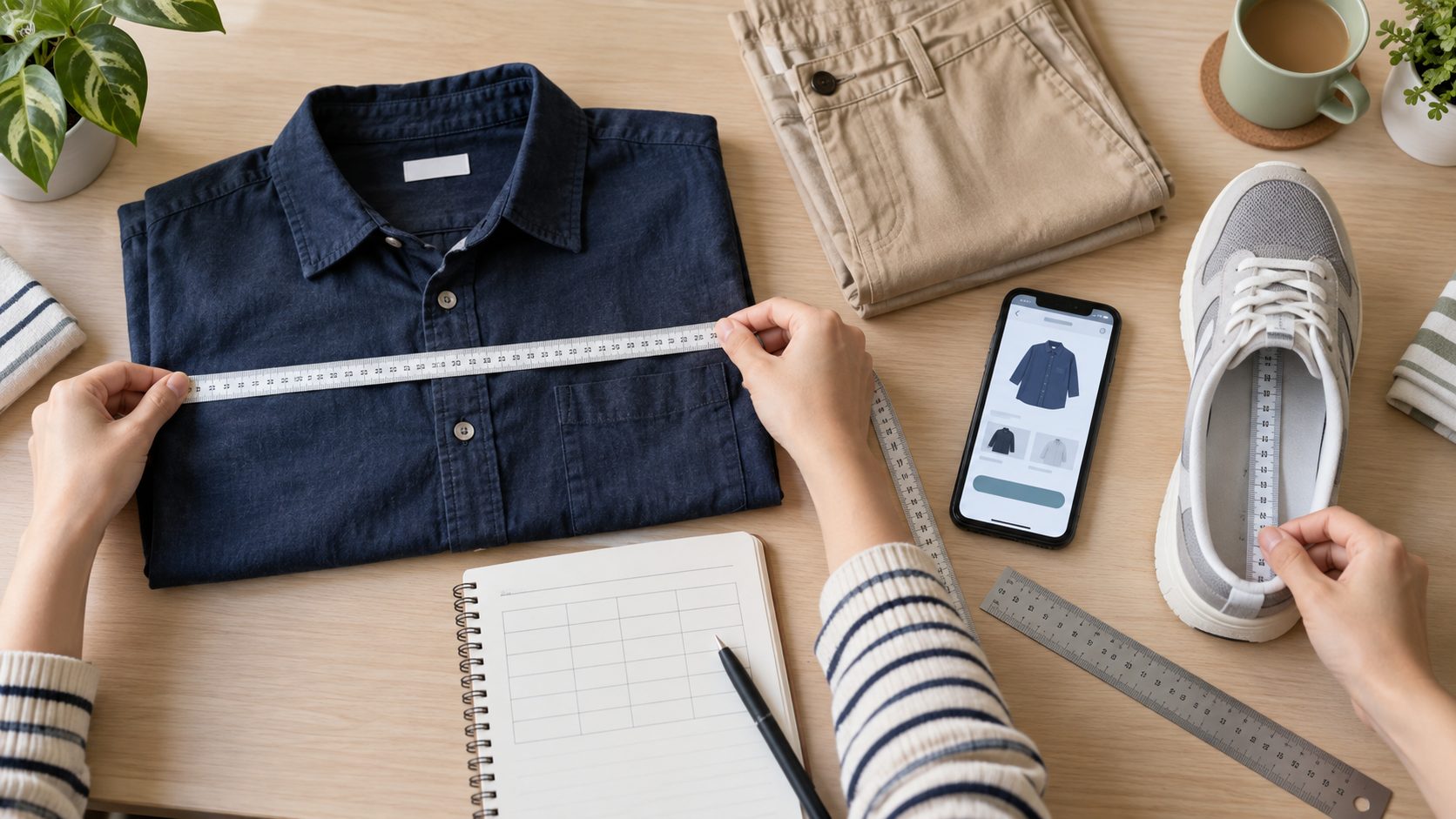
Lay a garment flat without stretching it. Measure with a soft tape and record centimetres. Use the same measuring method the seller describes. If the seller does not explain the method, ask whether measurements are taken flat and whether chest or waist numbers represent the full circumference or half width.
For shoes, stand on paper wearing the type of socks you expect to use. Mark heel and longest toe, then measure both feet. Use the longer foot. Also record the widest point. A foot-length number and a shoe’s internal length are not the same thing.
Clothing measurement worksheet
Use only the fields relevant to the item:
| Item type | Measurements to record |
|---|---|
| T-shirt or shirt | Shoulder, pit-to-pit chest, garment length, sleeve length |
| Jacket | Shoulder, chest, back length, sleeve, cuff; note planned inner layers |
| Trousers | Waist, hip, front rise, back rise, thigh, inseam, outseam |
| Dress | Shoulder, bust, waist, hip, total length |
| Skirt | Waist, hip, total length |
| Stretch item | Unstretched measurement, maximum stated stretch and fabric description |
Write down the measurement of your reference garment, the seller’s stated measurement and the difference. That difference is your ease allowance. A tight sports top and a loose overshirt should not use the same allowance.
If the chart lists body measurements, compare it with your body. If it lists garment measurements, compare it with a garment. Mixing those two baselines produces misleading results.
Shoe measurement worksheet
For shoes, ask for more than a regional size number:
- recommended foot length in centimetres;
- internal shoe length, if the seller can provide it;
- width or fit description;
- whether the toe shape is narrow, round or pointed;
- whether the lining or removable insole changes usable space;
- the seller’s suggested allowance;
- any manufacturing tolerance.
Avoid treating EU, UK, US and Chinese size numbers as automatic equivalents. Conversion charts are useful only as a starting point because last shape, lining and seller labelling differ.
For children’s shoes, remeasure before each order. Do not add an arbitrary amount for growth without considering heel hold and walking stability.
The five-question seller message
Before payment, send one message that asks:
- Is this chart based on body measurements or finished-garment measurements?
- Are chest, waist and hip values full circumference or flat width?
- What measuring tolerance should I expect?
- Can you confirm the exact centimetre measurements for my selected colour and size?
- If the received label differs from the ordered variant, what evidence is required?
Keep the reply with the order record. A seller’s answer does not guarantee fit, but it gives you a clearer comparison and better evidence if the wrong variant is sent.
A simple stop-or-buy rule
Proceed only when all four conditions are true:
- the selected variant is linked to a clear chart;
- the chart uses centimetres and states what is being measured;
- the difference from your reference item is acceptable for the intended fit;
- you understand the tolerance and return limitation.
Pause if the listing uses only height and weight, if separate images show conflicting charts, or if the seller refuses to confirm the selected variant. Height-and-weight recommendations may be useful context, but they do not replace chest, waist, hip, inseam or foot measurements.
Buying several units: use a sample gate
For uniforms, resale stock, family orders or multiple colours, do not multiply an uncertain size decision. Buy one sample of the exact seller, product and variant combination when practical.
Use the sample to check:
- actual measurements against the promised chart;
- shrinkage risk stated on the care label;
- visible stitching and finishing;
- colour and material description;
- packaging volume for the next shipment.
A sample from one seller does not validate another seller’s listing. Product links, factories, batches and variants can change.
What a China warehouse check can and cannot prove
A warehouse may be able to photograph the visible size label, selected colour, quantity and key measurements if you request those checks before the package is consolidated. Confirm the scope and any charge in advance.
A warehouse check cannot prove:
- how the item will fit your body;
- long-term comfort or durability;
- exact fibre composition without laboratory testing;
- authenticity or brand authorization;
- colour accuracy across screens;
- performance after washing;
- whether a shoe last suits your foot shape.
Ask for measurable, visible checks. “Please confirm pit-to-pit width is approximately 54 cm” is actionable. “Please confirm it fits me” is not.
Malaysia cost checkpoint after the size decision
Do the size check before calculating the final landed cost. A cheap item becomes expensive when an unusable size is shipped internationally.
Malaysia’s Low Value Goods framework covers goods sold online with a sales value not exceeding RM500, while import procedures and product controls still apply. The treatment of a shipment depends on the transaction, seller, product and declaration data. Keep line-item records for each seller and variant, especially when several orders are consolidated.
Useful records include:
- real product description;
- seller and product link;
- colour, size and quantity;
- unit price and order total;
- material description shown by the seller;
- payment record;
- any LVG information displayed at checkout.
See the official Royal Malaysian Customs LVG guide. Policy checked on 29 September 2026.
Once the size decision is complete, plan consolidation and chargeable weight using our guide to consolidating Pinduoduo clothing and shoes. Check the Pinduoduo shipping restrictions guide before buying items containing batteries, liquids, magnets, branded goods or other controlled components.
How YDA Express can help
YDA Express can receive packages in China, record visible information within the agreed inspection scope, provide requested photos, consolidate parcels and arrange international shipping. If you need a specific measurement checked, submit the exact point and expected centimetre range before consolidation.
YDA Express does not manufacture the item, determine how it fits, guarantee material composition, authenticate brands or replace a laboratory or product-safety assessment. Customs and other authorities make final decisions on admissibility, classification and taxes.
One-page checklist before checkout
Copy this into your order notes:
- Product link and seller:
- Selected colour and size:
- Chart type: body or garment:
- Reference item measurements:
- Seller measurement in cm:
- Expected ease or allowance:
- Seller tolerance:
- Foot length and width, if shoes:
- Question answered in writing:
- Sample required before quantity order:
- Warehouse check requested:
- Stop condition:
Final decision
Buy when the listing gives measurable information that matches an item you already know fits. Pause when the choice depends only on a letter size, a generic conversion chart or an unverified height-and-weight recommendation.
The goal is not to eliminate every fit risk. It is to make the risk visible before payment, preserve the evidence and prevent one uncertain size choice from becoming a multi-item international-shipping problem.
📲 Download the YDA Express App
Use the YDA Express app to place China shopping orders, review product inspection photos, manage packages, and arrange consolidation and international shipping. 🍎 Download on the App Store 🤖 Get it on Google Play 🌐 Read more China shopping and international shipping guides