Understand import taxes, duties, and customs fees when ordering from China. Learn how to avoid surprise charges and save money with practical tips from a real logistics provider.
You know that sinking feeling when a package you ordered from China arrives with a surprise bill for taxes and fees? It happens more often than you’d think. One minute you’re excited about your new electronics or bulk clothing order, the next you’re staring at a customs charge that rivals the item’s value. The term taxes and fees covers exactly these taxes and fees – and they’re the bane of many international shoppers.
But here’s the thing: once you understand how they work, they become manageable. They’re not some mysterious punishment. They’re just normal import costs that every country charges, and with a bit of know-how, you can budget for them or even reduce what you owe.
What exactly are import taxes and fees?
When you bring goods into a country, the government often wants a slice. That slice comes in a few forms:
- Customs duty – a percentage of the item’s value, based on its product category. A cotton T-shirt might have a 16.5% duty rate in the US, while leather shoes could be 8.5%. Varies wildly.
- Value‑added tax (VAT) or sales tax – charged on the total value including duty and shipping. In the UK and EU, this is often 20%. Australia applies 10% GST. The US doesn’t levy a federal VAT, but states may charge sales tax on imports (though enforcement is patchy).
- Customs processing or brokerage fees – what the carrier charges to file the paperwork. FedEx and DHL are notorious for this: a $15–$30 handling fee per shipment on top of the taxes. Postal services like USPS or Royal Mail usually charge less, around £8–£12 in the UK, or sometimes nothing for low‑value items.
You also have de minimis thresholds – the value below which no taxes or fees apply at all. These differ by country. The US threshold is $800 (a very friendly limit). The UK’s is £135. In the EU, since July 2021, the €22 de minimis for VAT was removed, meaning even small orders now attract VAT unless the seller uses the IOSS scheme. Australia’s threshold is A$1000, but only for duty; GST applies from the first dollar on low‑value imports.
Where people get stung is when they don’t realise the threshold applies per shipment, not per item. If you place five separate orders that each stay under the limit, but the forwarder consolidates them into one box, the combined value might push you over. At YdaExpress, we often see this – a customer has three packages worth $200 each, US‑bound. Individually they’re duty‑free. Consolidated into one $600 shipment, still tax‑free because it’s under $800. But if that consolidation went to a country with a lower threshold, it could trigger charges. The rule: know your country’s limit.
How are duties and taxes calculated?
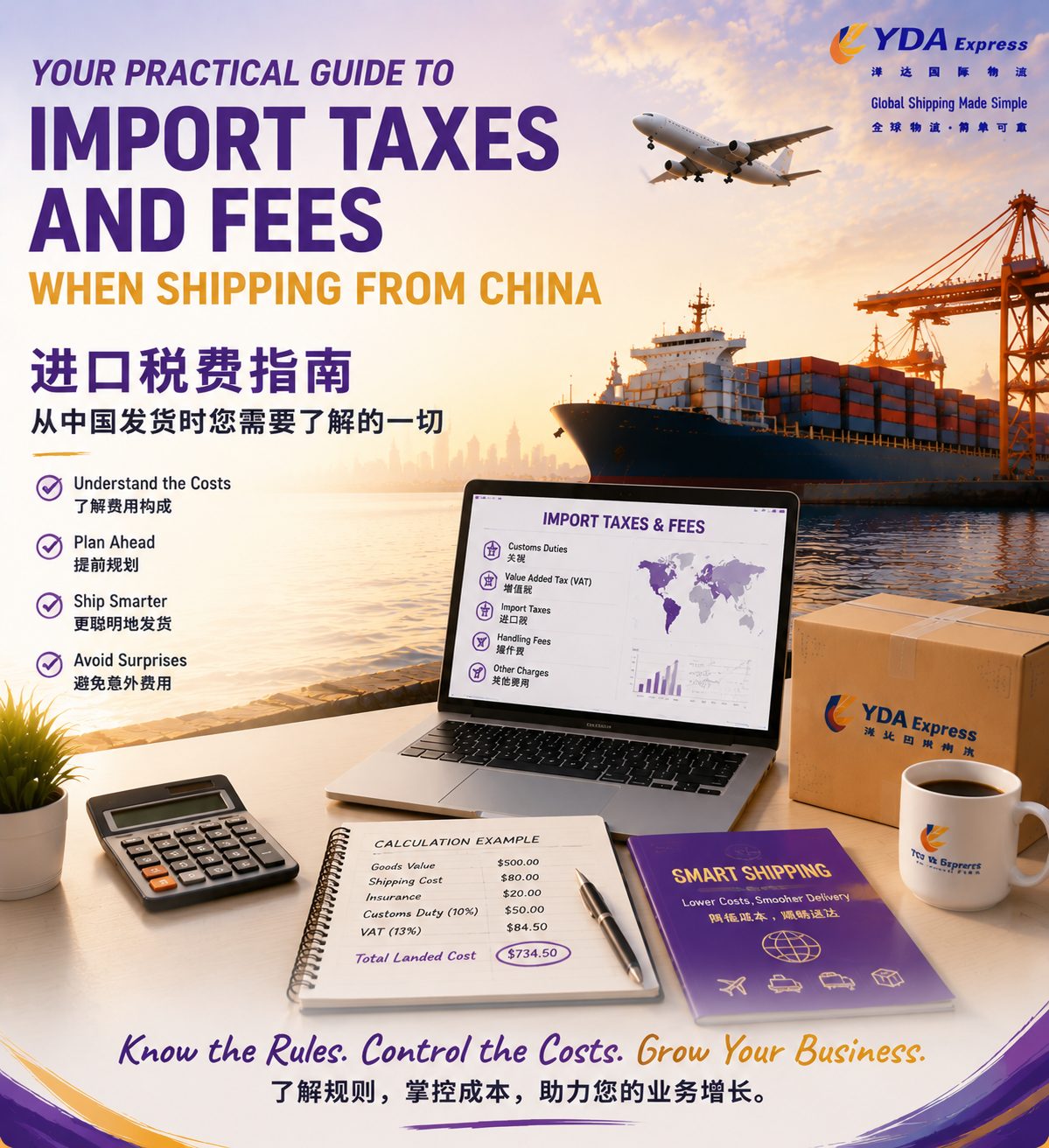
This is where things get numeric. Imagine you’re shipping a batch of Bluetooth speakers from China to the UK.
- Invoice value: £300
- International shipping: £50 (yes, shipping cost is included in the taxable value in most countries)
- Insurance: £10
- Customs valuation (CIF) : £360 Now apply the duty rate. For speakers, the HS code might fall under 8518.21, attracting a duty of 4.5%.
- Duty = 4.5% of £360 = £16.20 Next, VAT. UK VAT is 20%, and it’s charged on (CIF + duty).
- VAT base: £360 + £16.20 = £376.20
- VAT = 20% of £376.20 = £75.24 Carrier handling: Royal Mail would charge £8.
- Total import cost: £16.20 + £75.24 + £8 = £99.44, on top of what you already paid.
Now you see why that £100 speaker set suddenly costs an extra 33%.
The duty rate is everything. HS codes (Harmonized System) classify goods. A wrong code can mean a 0% rate becomes 12%. Honest mistakes happen, but couriers will often assign the safest (read: highest) code if they’re unsure. That’s why having accurate product descriptions and working with a forwarder who double‑checks these things can save real money.
The carrier makes a difference
DHL, FedEx, UPS – great for speed, but they act as customs brokers automatically. They’ll clear your package and send you an invoice later. That brokerage fee? Added every time. If you’re ordering a single high‑value item, fine. But if you split an order into multiple shipments, you could end up paying that processing fee multiple times.
Postal networks are slower but cheaper on fees. USPS/Canada Post/Royal Mail often charge a flat fee only when taxes are due. Some EU postal operators charge nothing extra – you just pay the VAT and duty.
Then there’s the option of using a dedicated parcel forwarder like YdaExpress. We consolidate multiple purchases into one box, which means one customs declaration, one set of fees. And because we handle shipments daily, we know how to fill out paperwork to minimise delays and unwelcome surprises. For example, when a customer is buying from multiple Taobao stores, we’ll hold everything in our warehouse, repack to avoid dimensional weight charges, and ship as a single package. That alone can cut the brokerage fees from three courier‑handled shipments down to one.
Avoiding common pitfalls
Honestly, the biggest pitfall is being unaware. People assume the price they see on AliExpress or Taobao is the final cost. It’s not – unless the seller prepays taxes (like with IOSS in the EU). Here are a few things you can do:
- Check your country’s de minimis value first. If your total (items + shipping) stays under it, you likely owe nothing. The US $800 limit is generous; many European countries now tax from €0.
- Consolidate intelligently. If you’re close to the limit, consolidating could push you over. But if you’re already over, one consolidated shipment usually costs less in brokerage fees than multiple small ones.
- Don’t undervalue or mislabel. Customs officers aren’t stupid. Declaring a $500 phone as a $20 “gift” might get your package seized or cause a fine – and we’ve seen shipments delayed for weeks while investigations happen. At YdaExpress, we refuse to falsify invoices. It’s just not worth the risk.
- Use correct HS codes. If you can provide the 6‑digit code, you help the forwarder classify accurately. We assist customers with this daily, especially for common categories like apparel, electronics, and accessories.
- Consider shipping methods. Slower postal services can be a money‑saver for low‑value orders. For higher‑value or time‑sensitive shipments, express couriers are fine – just factor in the brokerage fee.
How YdaExpress helps manage taxes and fees
We’re not a customs consultant, but after years of shipping from China, we’ve seen almost every scenario. Here’s where we step in:
- Consolidation done right – we warehouse your orders (free for up to 180 days), combine them, and ship when you’re ready. One package, one customs entry.
- Paperwork that makes sense – we generate commercial invoices with clear, accurate descriptions and values. Customs officers appreciate a clean invoice; it reduces the chance they’ll pull your package for inspection.
- Shipping line selection – for some countries and values, we’ll recommend a specific carrier because we know their brokerage fees are lower or their customs clearance is smoother. For instance, to Australia, we often suggest a particular air freight route that avoids the $50 DHL brokerage fee, leaning on a local courier for final delivery instead.
- Transparency – we won’t hide fees. The shipping quote you see doesn’t include destination taxes (those are your responsibility), but we’ll tell you roughly what to expect before you ship.
I’ll share a real‑world example. A customer in Canada was ordering clothing samples from five different suppliers – total value about C$400. Canadian de minimis is C$20 for duties (yes, embarrassingly low), but C$150 for GST-free import. With five separate shipments, each would face potential duties and brokerage fees averaging C$20 per package. By consolidating through our warehouse into one box, they paid duty once, one brokerage fee, and saved over C$80. They also got faster delivery because all items came together.
What about returns or refunds?
If you return an item to the seller, you might be able to reclaim the import taxes you paid. Most countries have a duty drawback or VAT refund process, but it’s paperwork‑heavy. For the UK, you’d need form C285 and proof of re‑export. For the US, it’s a complicated drawback claim. So unless the value is significant, many people just absorb the loss. Another reason to get it right the first time.
Final thoughts – and a practical next step
Import taxes and fees aren’t going away. But they’re not a big bad wolf if you plan for them. Budgeting an extra 20–30% on top of your purchase price is a safe rule of thumb for most countries, and then any savings below that feel like a win.
If you’re buying from China regularly, having a forwarder that understands the customs landscape makes life simpler. YdaExpress can store your purchases, repackage them, and ship using the method that balances speed and fees best for your destination. We’ve been doing this long enough that many customers just tell us their country and order value, and we do the rest – including suggesting the right declaration approach.
Visit YdaExpress.com to explore our services, or drop us a message on WhatsApp at +8616666169028. Ask us anything about shipping from China – we’re happy to walk you through the tax picture for your specific order.
📦 China Parcel Forwarding & International Shipping Already placed your order? Send your purchases to our China warehouse for parcel receiving, photo inspection, up to 180 days of free storage, package consolidation, international shipping, and real-time tracking.
📲 Download the YDA Express App One app for shopping, purchasing assistance, package management, consolidation, international shipping, and worldwide delivery.
🌍 More Helpful Guides Explore practical guides on shopping from China, parcel forwarding, shipping costs, and customs clearance.