Learn how railway logistics works for shipping from China to Europe and beyond. This practical guide covers rail freight costs, transit times, packing tips, and how YdaExpress simplifies cross-border rail shipping.
If you’ve been shipping from China for a while, you’ve probably wrestled with the classic dilemma: speed versus cost. Air freight is fast but expensive. Sea freight is cheap but slow. And for many small parcels—especially those bound for Europe or Central Asia—there’s a middle ground that too many shippers overlook: railway logistics.
I’m not talking about sending a container train from your hometown. In international trade, railway logistics means moving goods by rail as part of a longer journey—typically from Chinese manufacturing hubs to inland destinations in Europe, Russia, or along the New Silk Road. It’s a mode that’s grown dramatically over the past decade, and honestly, for the right shipment, it can save you a bundle without making your customer wait two months.
At YdaExpress, we help small businesses and individual shoppers consolidate parcels and book rail freight from China to dozens of countries. The process is simpler than you might think, and in this guide I’ll break down how railway logistics works, what it costs, how to pack for it, and when it beats the other options.
What Exactly Is Railway Logistics?
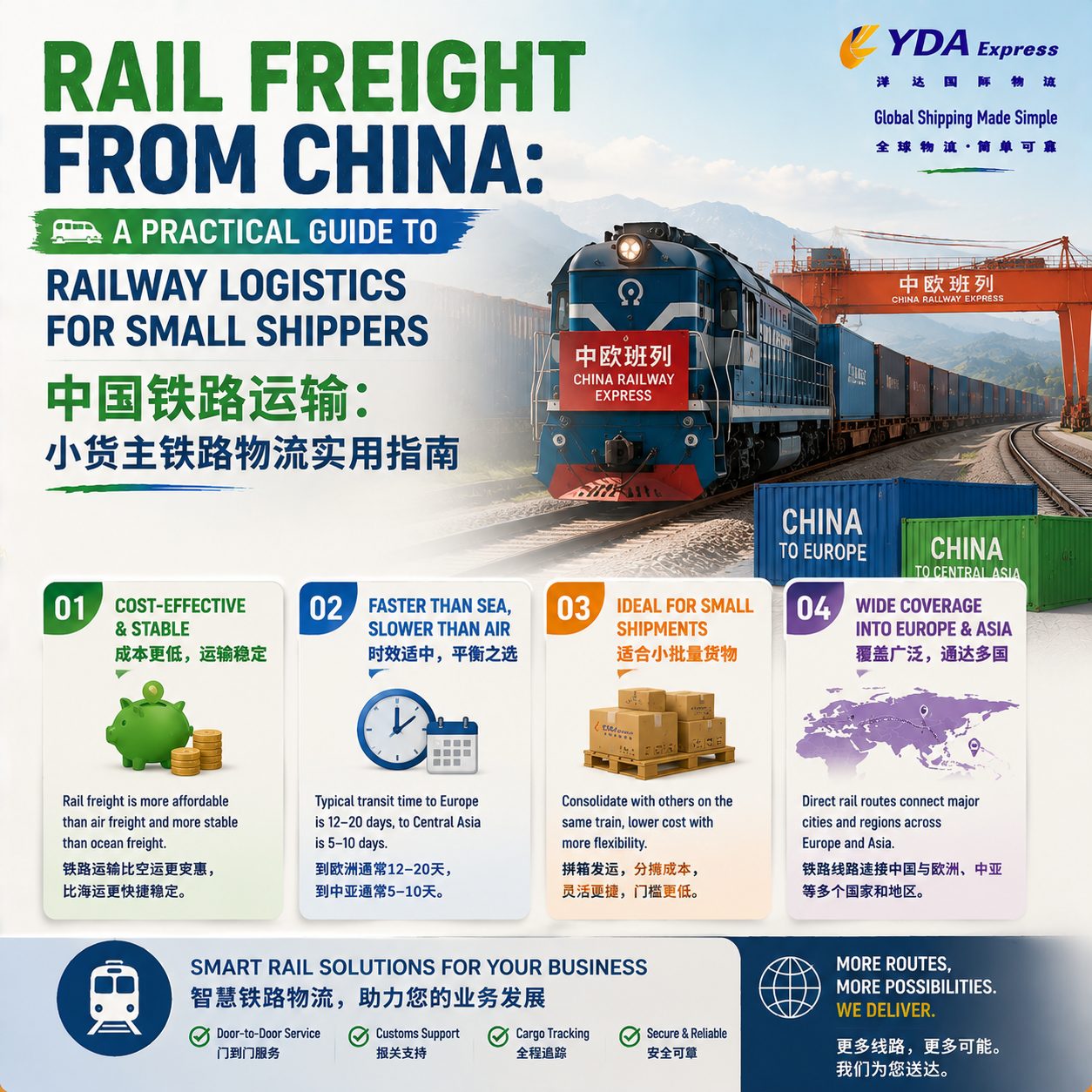
Let’s clear up a common confusion. When people hear “rail freight,” they picture a heavy bulk commodity—coal, ore, grain—lurching across a continent. But for cross-border ecommerce and parcel forwarding, railway logistics is different. It’s about using rail to bridge the gap between air and sea: faster than a ship, cheaper than a plane.
From China, the main rail network is the China-Europe Railway Express (sometimes called the New Silk Road). Trains run regularly from cities like Chongqing, Chengdu, Zhengzhou, Wuhan, Suzhou, and Yiwu to destinations in Germany (Duisburg, Hamburg), Poland (Warsaw, Malaszewicze), the Netherlands (Tilburg), Spain (Madrid), and many points in between. There are also routes into Russia, Belarus, Kazakhstan, and Mongolia.
Your shipment doesn’t need to be a full container. Through freight forwarders and consolidation services, you can send anything from a couple of boxes to a pallet or two. The cargo is loaded into a container along with other people’s goods, and the train takes care of the long-haul segment. At the arrival hub, parcels are unloaded, cleared through customs, and handed off to local delivery networks—DHL, UPS, national postal services—for the final mile.
The Real Benefits of Rail Freight for Everyday Shippers
Most of the shippers we talk to at YdaExpress are either individuals buying from Taobao or small business owners ordering inventory from Alibaba or 1688. They’re shipping products like clothing, accessories, electronics, household items, or machinery parts. For these kinds of goods, rail offers three main advantages.
1. Balanced cost and speed.
Air freight from China to Germany might cost $6–$10 per kilogram and arrive in 5–7 days. Sea freight might cost $1–$3 per kilogram but take 30–40 days (and that’s not counting the extra time for port congestion or trucking from the port to an inland destination). Rail freight typically lands around $3–$5 per kilogram and delivers in 15–20 days door-to-door. So you’re paying roughly half the cost of air and cutting sea transit time in half. For a 20 kg parcel of shoes, the savings can be substantial—often $60–$100 compared to air.
2. Predictable schedules.
Trains run on fixed timetables. Unlike sea freight, which can be thrown off by weather, port strikes, or blank sailings, rail departures are reliable. Once your shipment is on the train, the transit time is fairly steady. This makes inventory planning easier.
3. Environmental angle.
Rail transport generates far less CO2 per ton-kilometer than air freight. If your customers care about sustainability, offering a rail-shipped option can be a selling point. Some European buyers actively prefer it.
How Rail Freight from China Works in Practice
Here’s a step-by-step look at a typical rail shipment with a forwarding service like YdaExpress.
Step 1: Your goods arrive at our warehouse.
Whether you’re ordering from online stores or sending manufactured products, the parcels are delivered to our consolidation hub in China. We check them, repack if needed, and store them until you’re ready to ship.
Step 2: We consolidate and prepare documents.
Once you’ve gathered a batch of orders, we combine them into a single shipment. Proper documentation is key for rail: commercial invoices, packing lists, and sometimes certificates of origin. Our team handles the paperwork so customs clearance goes smoothly.
Step 3: The rail journey begins.
Your consolidated shipment is loaded onto a train, usually in a shared container. The train crosses China’s western border—often through Alashankou or Khorgos into Kazakhstan—and then traverses Russia, Belarus, and into Europe. The entire rail leg takes about 12–16 days to reach the European border.
Step 4: Customs clearance and final delivery.
At the destination hub (say, a logistics park in Duisburg), the container is unloaded. Customs clearance is handled locally, and normally duties and taxes are paid by the receiver, but we can arrange DDP (Delivered Duty Paid) if you want to prepay. From there, your parcel is picked up by a courier like DHL, FedEx, or a local post service and delivered to the final address in 1–3 days.
Packing for Rail: It’s Different from Air or Sea
Rail transport is generally smoother than trucking—there’s less vibration and sudden jolts—but the packaging still needs to be sturdy enough to handle loading, unloading, and the occasional temperature swing as the train passes through Central Asia (where winters are brutally cold). Here are a few tips.
- Use double-wall corrugated boxes. Don’t skimp with single-layer cardboard, especially for heavier items.
- Waterproof your goods. Place items in sealed plastic bags inside the box. While containers are sealed, condensation can happen.
- Cushion well. Use foam, bubble wrap, or air pillows generously. Train journeys are long, and packages may be stacked.
- Label clearly. English labels are fine for European destinations, but if you’re shipping to Russia or Central Asia, we can add Cyrillic labels if needed.
- For fragile electronics, consider wooden crates or extra bracing. It adds a bit of weight and cost but prevents damage.
Real Costs and Transit Times: Examples
Let’s get concrete. Here are a few examples based on shipments we’ve handled at YdaExpress. (Prices vary with fuel surcharges and seasonal demand, but these are realistic ranges.)
Example 1: 10 kg of clothing from Guangzhou to Berlin
- Rail: $38 total, transit 18 days door-to-door.
- Air: $80, transit 6 days.
- Sea: $25, transit 35–45 days.
Example 2: 30 kg of electronic accessories from Shenzhen to Warsaw
- Rail: $95, transit 20 days.
- Air: $210, 7 days.
- Sea: $55, 40 days (plus inland trucking from Gdansk cost $30, so effectively $85 and 45 days).
Example 3: 5 kg sample shipment from Yiwu to Madrid
- Rail: $22, transit 22 days.
- Air: $50, 5 days.
- Sea: $15, 45 days.
Notice that for smaller weights, the rail cost advantage over air may be slim, but the transit time penalty over sea is huge. So rail really shines for shipments in the 10–100 kg range, especially when the destination is inland—where sea freight would require an expensive and slow last-mile truck leg.
When Railway Logistics Makes Sense (and When It Doesn’t)
Rail isn’t a one-size-fits-all solution. Here’s a quick mental checklist.
Choose rail if:
- Your shipment weighs between 10 and 500 kg.
- You’re sending goods to Europe (especially Germany, Poland, France, Spain, UK—though UK rail is trickier post-Brexit, we can route via sea from the continent).
- Your products are not extremely time-sensitive. Two-to-three weeks is acceptable.
- You value a middle price point and steady transit.
- You want to avoid the hassle of port delays.
Stick with air freight if:
- The shipment is under 5 kg and shipping cost difference is negligible.
- You absolutely must have it within a week.
- Goods are perishable or need constant temperature control (rail containers can include temperature-controlled units, but availability is limited).
Stick with sea freight if:
- You’re shipping a full container load (FCL) of large, heavy items—rail pricing for FCL can be competitive, but sea is usually cheaper for bulk.
- You’re shipping to a coastal city with a good port connection and time isn’t critical.
Common Pitfalls and How to Avoid Them
Even with a good forwarder, things can go sideways. The most frequent issues we see:
1. Customs holds due to inaccurate paperwork.
Rail customs procedures are stricter than air in some countries because of the number of borders the train crosses. Make sure commercial invoices are precise, HS codes are correct, and values aren’t suspiciously low. We double-check all docs before shipping.
2. Last-mile delivery surprises.
Not all couriers in Eastern Europe deliver to remote addresses. Always confirm the service area with your forwarder. Rural addresses might incur surcharges.
3. Size and weight restrictions.
Rail containers have weight limits and dimensional constraints. Oversized items might need special handling. Share exact dimensions when requesting a quote.
4. Peak season congestion.
Just like air and sea, rail can get busy around Chinese holidays and before Christmas. Book a week or two early to secure space and better rates.
How YdaExpress Simplifies Railway Logistics
I might be biased, but after seeing how many small shippers struggle with the complexity of international logistics, I can say that having a partner who knows the ins and outs of rail makes a world of difference. At YdaExpress, we don’t just book a slot on a train; we manage the entire chain. Our warehouse in China receives your purchases, we consolidate and repack to reduce volume, handle all export and import documentation, and arrange the best rail route for your destination. Once the train arrives, we work with reliable local carriers to get your parcel to the doorstep. And if any hiccup occurs—a customs query, a delay—you have a single point of contact who speaks your language and can sort it out.
We also offer insurance options, so you’re covered against loss or damage during the journey. Rail is very safe, but peace of mind is worth a few extra dollars.
Getting Started with Rail Freight from China
If you’re new to rail shipping, the first step is simply to request a quote. Provide the approximate weight, dimensions, origin (usually your supplier’s city), and destination country. We’ll give you a transparent price and estimated transit time. From there, you can ship your goods to our warehouse, and we’ll take it from there.
Here’s a pro tip: if you frequently order from Chinese online stores like Taobao, 1688, or JD.com, consider consolidating multiple orders into one rail shipment. You’ll save a lot compared to shipping each parcel individually by air. Our warehouse provides free storage for up to 30 days, so you can build up a batch.
Railway logistics isn’t flashy, but it’s quietly become the smart choice for thousands of shippers who need a reliable, cost-effective way to move goods from China to Europe and beyond. It’s faster than sea, cheaper than air, and remarkably consistent. If you’ve never tried it, you might be leaving money on the table.
Ready to give rail freight a shot? Reach out to our team. We’re on WhatsApp at +8616666169028, or visit ydaexpress.com to get a free quote and chat about your shipping needs. No jargon, no hard sell—just practical advice from folks who move boxes every day.
📦 China Parcel Forwarding & International Shipping Already placed your order? Send your purchases to our China warehouse for parcel receiving, photo inspection, up to 180 days of free storage, package consolidation, international shipping, and real-time tracking.
📲 Download the YDA Express App One app for shopping, purchasing assistance, package management, consolidation, international shipping, and worldwide delivery.
🌍 More Helpful Guides Explore practical guides on shopping from China, parcel forwarding, shipping costs, and customs clearance.