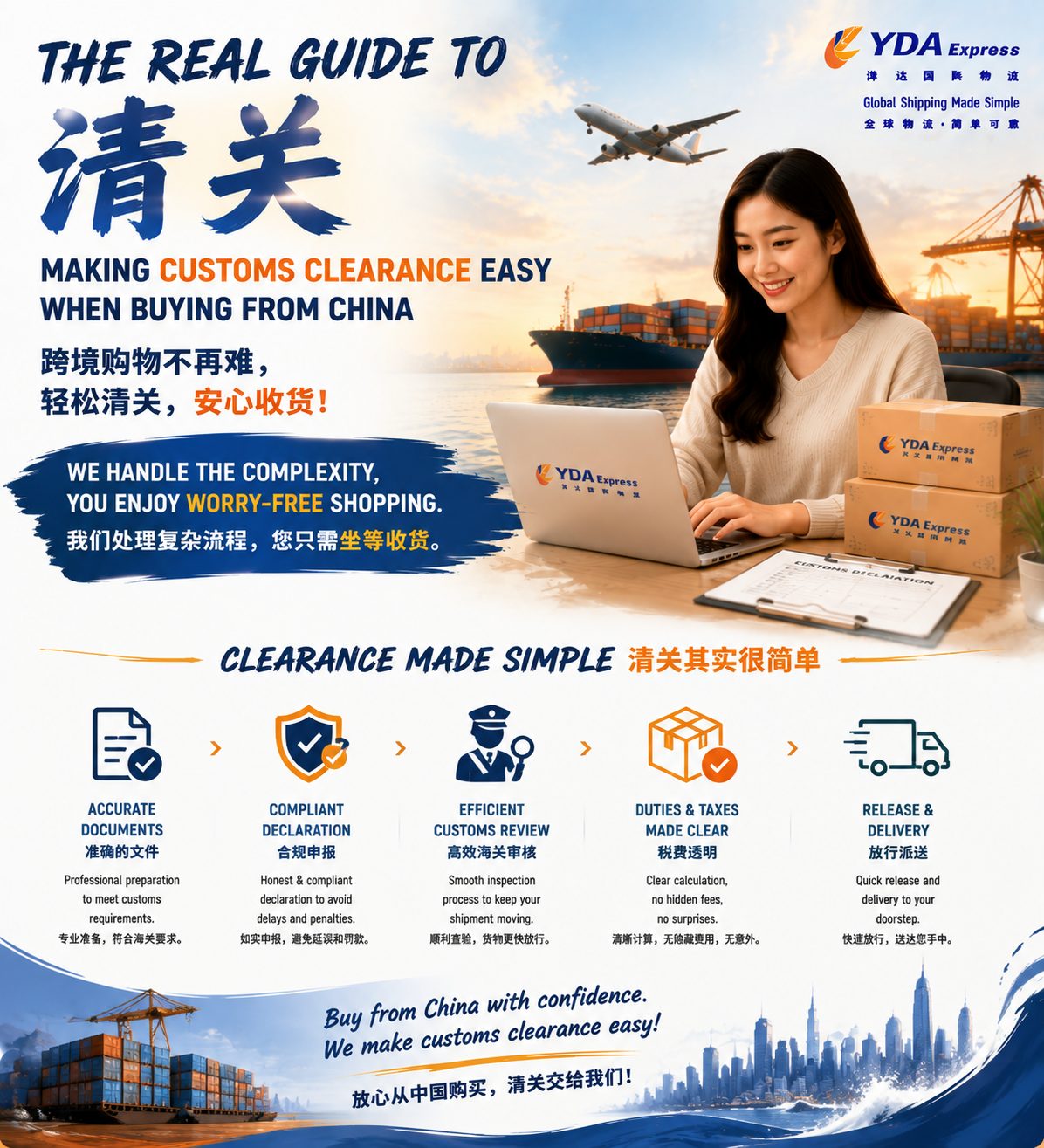
Learn what customs clearance really means for your order from China. Practical tips on duties, paperwork, and avoiding delays, plus how YdaExpress streamlines the process.
You’ve found the perfect item on Taobao. The price is right, the seller seems reliable, and you’re already picturing it in your hands. But then that little voice pipes up: What about customs? Maybe you’ve heard horror stories about packages held for weeks, unexpected fees, or even goods being returned. That’s where customs clearance (qīngguān) – customs clearance – comes in. And honestly, it doesn’t have to be a nightmare.
I’ve spent years helping overseas shoppers and small businesses get their stuff out of China. At YdaExpress, we process thousands of packages every month, so I’ve seen what makes customs go smoothly – and what trips people up. This guide will walk you through exactly what customs clearance involves, why it sometimes gets stuck, and how to handle it like a pro when you’re buying from China.
What Actually Happens During customs clearance
Customs clearance is the process of getting your package across a border legally. When you order something from China and have it shipped to, say, the US, UK, or Australia, that parcel has to pass through customs in the destination country. Customs officers check what’s inside, make sure it’s allowed, verify its value, and decide if any duties or taxes apply.
Here’s the basic flow: Your shipment moves from the Chinese warehouse to an international carrier – maybe DHL, FedEx, or an air freight line. It arrives at a port of entry, like Los Angeles International Airport or London Heathrow. Then the carrier submits an electronic manifest to customs. The officers review the details and either release it, hold it for inspection, or flag it for missing information.
Most packages, especially smaller ones, clear without a fuss. For example, if you’re a private buyer in the US, the de minimis threshold – the value under which you pay no duty – is $800. So a $200 dress from a boutique on 1688? No tax, as long as the paperwork matches. But get close to that limit or import something like cosmetics or electronics, and you might need to file a formal entry, which means more paperwork and possible fees.
Why customs clearance Causes Headaches (and How to Avoid Them)
The biggest pain points usually boil down to three things: documentation errors, product restrictions, and undervaluation. Let’s dig into each.
Paperwork That Gets Lost in Translation
Customs forms have to be exact. If the sender writes “gift” but the invoice shows a commercial value, or if the product description is too vague – “clothing” instead of “women’s cotton blouse” – the package can be stopped for manual review. Always make sure your supplier or forwarding agent provides a clear, truthfully valued commercial invoice. At YdaExpress, we double-check descriptions and values because we know a US CBP officer isn’t going to chase down a Chinese seller for clarification.
Yes, That Item Might Be Prohibited
Every country has its own list of no-go items. Food, seeds, liquids, batteries, luxury replica goods – many things that are easy to buy inside China can cause big trouble at the border. I’ve seen shipments of electric scooters seized because the lithium battery didn’t have proper UN38.3 certification. Before you buy, check your country’s customs website. If you’re unsure, a good forwarding service can advise you.
The Temptation to Underdeclare Value
Sellers may offer to mark a lower value “to help you save on tax.” Don’t. If customs suspects undervaluation, they can delay the parcel, fine you, or even confiscate the goods. The small savings aren’t worth the risk. Play it straight.
Inside the customs clearance Decision: From Inspection to Release
Once the paperwork is submitted, customs can do one of several things:
- Release: The electronic manifest checks out; the package goes on to the carrier for delivery.
- Document review: They want extra paperwork – maybe a more detailed invoice or proof of payment.
- Physical inspection: An officer opens the box to verify contents against the declaration. This can add days.
- Seizure or detention: If something is off, they might hold it pending payment of duties or even confiscate it.
How do you stay out of the inspection pile? Accurate data helps. So does shipping with a carrier that has a good working relationship with customs. DHL and FedEx, for instance, are Known Consignors under many security programs, which can speed things up. But even with the best carrier, the data quality is what keeps your package moving.
Duties and Taxes: The customs clearance “Surprise”
Nobody likes getting a bill when they pick up a parcel. Here’s how it works:
- Import duty is a percentage of the product’s value, set by your country’s tariff schedule. For example, clothing into the EU might be 12%, while electronics into the US are often 0%.
- VAT/GST is a value-added tax applied to the total landed cost (product + shipping + duty). In the UK, that’s 20%; in Australia, 10%.
- Brokerage fees – the carrier often charges for handling the customs entry. This can be a flat fee or a percentage, and it’s separate from duty.
Small packages below the de minimis threshold escape all this. But if your order crosses it, you’ll need to pay. The carrier usually contacts you before delivery. You can pay online and they’ll release the package.
Pro tip: If you’re buying multiple items from different sellers, consolidating them into one larger package with a forwarding service can sometimes push you over the threshold and trigger fees you could have avoided with separate shipments. We help customers break up consolidations when it makes financial sense.
customs clearance for Different Types of Shipments
Express vs. Air Freight vs. Sea Freight
- Express (DHL, FedEx, UPS): Usually the smoothest because the carriers are very strict about documentation. They act as the customs broker and include brokerage in their shipping fee. Good for small, valuable items under 150 lbs.
- Air freight: A bit more hands-on. You might need a separate broker, although some forwarders can arrange it. Used for larger shipments up to a few hundred kilos.
- Sea freight: The most complex. Requires a full set of documents (bill of lading, packing list, certificate of origin, etc.), and customs often takes longer. But for heavy, low-value goods, it’s much cheaper.
Buying from Chinese E-commerce Platforms
Platforms like AliExpress and DHgate often handle customs clearance for you through their logistics arms (like AliExpress Standard Shipping). They collect any taxes at checkout under programs like the EU’s IOSS, so your package arrives without extra fees. That’s convenient, but you’re stuck with their shipping speeds and packaging. When you use a forwarding service like us, you get more control – better packaging, faster lines, and someone who answers your messages about customs status.
Practical Tips from Our Warehouse to Your Door
- Know your country’s limits. Write down your de minimis value and common duty rates for things you buy often. Bookmark the HS code lookup tool.
- Never lie on the paperwork. Customs agencies share data. If you’re caught undervaluing once, every future package may get inspected.
- Ask for clear photos before shipping. If a customs officer sees a detailed picture of what’s inside the box attached to the outside, it can reduce the urge to open it. We do this routinely at YdaExpress.
- Consider shipping to a friend in the UK? No, that’s not how it works. The addressee is the importer of record and responsible for duties.
- Batch small items. If you’re buying a load of cheap accessories, group them into a single clearly described “assorted hair accessories” line instead of listing 20 separate $1 items. Fewer lines, less scrutiny.
When customs clearance Goes Wrong – A Real Scenario
Last month, a customer bought a gaming headset and a power bank on 1688. The seller shipped them together with a generic “electronics” label. The US CPB scanned it, saw “electronics,” and flagged it because power banks have special handling rules. The parcel sat for two weeks while we scrambled to provide the MSDS (safety sheet) for the battery. It got through, but the delay was avoidable. Had we known about the power bank, we would have shipped it separately with the right documentation from the start.
This is why working with a forwarder that understands both Chinese suppliers and destination customs makes a difference. We see the whole picture.
YdaExpress Takes the Fear Out of customs clearance
We built our service to address exactly these headaches. When you use our purchasing agent or forwarding service, here’s what happens:
- We check your items as they arrive at our Chinese warehouse and flag any potential customs issues.
- We prepare a detailed, honest commercial invoice with proper HS codes.
- We choose the best shipping line based on what you’re sending – DHL for a laptop, a dedicated tax-free line for EU clothing, or sea freight for bulky home goods.
- We watch the tracking and can intervene if customs asks for something extra.
I’m not saying we can make customs disappear. But we make it boring – and that’s the goal. Packages that just show up.
Ready to Ship from China Without the customs clearance Stress?
Customs clearance doesn’t have to be the scary part of buying from China. With a little know-how and the right support, your goods can cross borders as easily as they cross provinces. If you’re looking to consolidate orders, source products, or just get your Taobao haul home without a pile of extra fees, reach out to us.
Visit YdaExpress.com or message us on WhatsApp at +8616666169028. Tell us what you’re buying, and we’ll help you map out the smoothest route from China to your doorstep.
📦 China Parcel Forwarding & International Shipping Already placed your order? Send your purchases to our China warehouse for parcel receiving, photo inspection, up to 180 days of free storage, package consolidation, international shipping, and real-time tracking.
📲 Download the YDA Express App One app for shopping, purchasing assistance, package management, consolidation, international shipping, and worldwide delivery.
🌍 More Helpful Guides Explore practical guides on shopping from China, parcel forwarding, shipping costs, and customs clearance.