
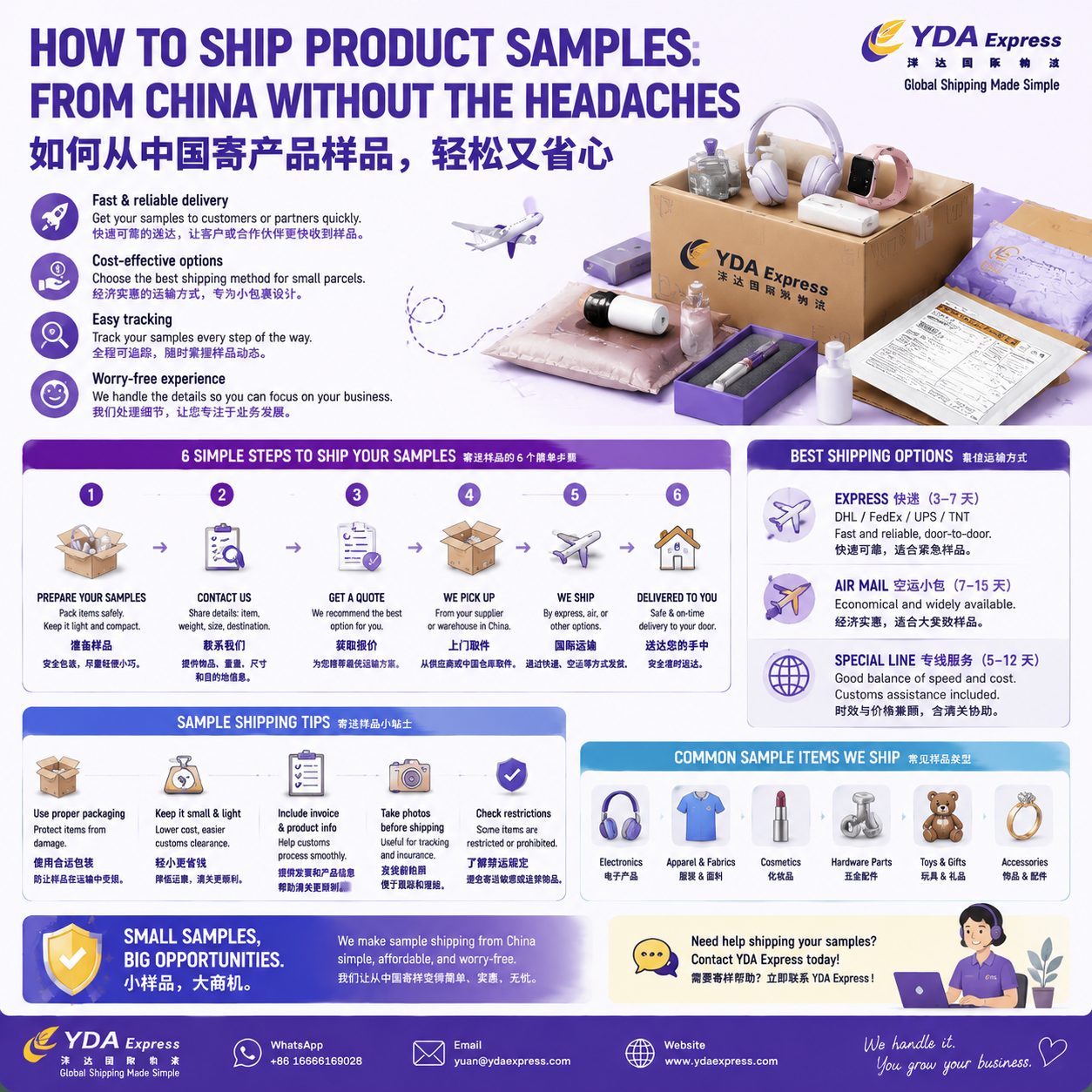
Learn how to organise, inspect, consolidate and ship product samples from multiple Chinese suppliers. Use clear sample references, consistent checks, protective packaging, accurate customs documents and a realistic approval timeline before placing a bulk order.
Ordering samples is not only about seeing whether a product looks good. A useful sample shipment should help you compare suppliers, verify specifications, record revisions and decide whether a larger order is worth the risk.
Problems appear when samples from different Chinese factories arrive without clear identification. One supplier labels a colour differently, another sends an unapproved material, and a third changes the packaging without mentioning it. After everything is consolidated, the buyer may no longer know which product came from which source.
A successful sample shipment therefore begins with version control and acceptance criteria—not with choosing the fastest courier.
Define what each sample must prove
Before asking a supplier to send anything, write down the decision the sample is meant to support.
A sample may be used to check:
- overall appearance;
- dimensions and weight;
- material;
- colour;
- workmanship;
- fit or assembly;
- packaging;
- label placement;
- printed artwork;
- compatibility with another product;
- basic function;
- comparison between suppliers;
- readiness for mass production.
Do not ask only for “one sample.” State the model, colour, material, size and revision required.
If you are comparing ceramic mugs, for example, record the capacity, dimensions, glaze colour, logo position, packaging and any tolerance that matters to the final order. The warehouse and supplier cannot evaluate the sample correctly if the acceptance standard exists only in your head.
Give every supplier and sample a unique reference
When several suppliers send similar products to one China warehouse, names such as “blue sample” or “new version” quickly become confusing.
Create a simple reference system before ordering. Each sample record should include:
- project name;
- supplier name;
- product reference;
- version number;
- order date;
- expected quantity;
- domestic tracking number;
- required checks;
- status.
A useful reference might look like:
Project: Reusable Bottle
Supplier: Supplier B
Version: V2
Colour: Dark Green
Change: Revised lid seal
Required check: Photograph lid, measure height and confirm label position
Ask the supplier to place the reference on the domestic parcel or include it inside the package. Add the domestic tracking number to your warehouse account so the delivery can be matched correctly.
Verify the supplier before paying for samples
A well-presented sample does not prove that a supplier can reproduce the same result consistently at scale. Before paying, confirm:
- supplier identity;
- product category and operating history;
- whether the supplier is a manufacturer or trader;
- sample cost;
- domestic shipping cost;
- production lead time;
- sample refund or credit terms;
- ownership of tooling or artwork;
- mass-production minimum quantity;
- expected bulk price;
- ability to provide required documents.
Avoid moving payment outside the agreed process without understanding the loss of platform or payment protection.
If the project begins on 1688, use the supplier verification checklist to review the business, product evidence, order terms and inspection plan before committing to a larger purchase.
Decide whether you need purchasing assistance
Some buyers can communicate with suppliers and pay directly. Others need local purchasing assistance to confirm variants, make payment in China, follow the order or handle a domestic return.
When requesting purchasing assistance, provide:
- product link;
- selected specification;
- quantity;
- price limit;
- sample reference;
- changes agreed with the supplier;
- acceptable alternatives;
- action to take if the price or specification changes.
New YDA Express customers pay no purchasing service fee on their first order. Contact customer service before placing the order to request the offer. Existing customers may ask about available exclusive discounts or coupons.
Keep the supplier’s technical discussions and approvals in writing. A purchasing agent can help execute the order, but the buyer should remain responsible for defining the product requirements.
Receive samples at one China warehouse
When samples come from several cities or suppliers, sending every parcel internationally on its own can create repeated minimum charges and fragmented tracking.
A China warehouse can receive each domestic parcel, register it and hold the samples until the planned comparison batch is complete.
YDA Express provides eligible registered customers with up to 180 days of free storage at its warehouse in Yangjiang, China. Review the conditions in the free warehouse storage policy.
Use the storage period to:
- wait for planned suppliers;
- identify every parcel;
- review arrival photographs;
- resolve missing samples;
- request corrections;
- organise samples by project;
- prepare one coordinated shipment.
Do not delay the review of a defective or incorrect sample merely because storage is available. Supplier return and correction periods may be much shorter.
Request checks that support the buying decision
“Please inspect the samples” is too vague. Ask for evidence linked to your acceptance criteria.
Depending on the product, useful checks may include:
- photograph from specified angles;
- visible quantity;
- colour label;
- model number;
- dimensions;
- gross or unit weight;
- logo position;
- packaging condition;
- included accessories;
- visible workmanship;
- obvious damage;
- basic power-on confirmation, if available and appropriate.
For comparison projects, ask for the same photographs and measurements for every supplier. Consistent evidence makes differences easier to evaluate.
A basic warehouse inspection does not replace:
- laboratory testing;
- material verification;
- regulatory certification;
- professional authentication;
- endurance testing;
- electrical safety testing;
- complete functional testing;
- pre-shipment inspection of mass production.
If a test affects safety, compliance or a major purchase decision, use a qualified testing or inspection provider.
Build a sample comparison sheet
Do not rely on memory after the samples arrive. Create one comparison sheet with the same fields for each supplier.
| Check | Supplier A | Supplier B | Supplier C |
|---|---|---|---|
| Correct model | |||
| Dimensions | |||
| Material claimed | |||
| Visible finish | |||
| Logo placement | |||
| Packaging | |||
| Missing parts | |||
| Sample cost | |||
| Estimated bulk terms | |||
| Documents available | |||
| Decision |
Photographs should use the sample reference so they can be linked to the correct supplier and version.
If a revised sample is requested, do not overwrite the earlier record. Mark the new item as a separate version and state what changed.
Decide when to consolidate and when to ship separately
Consolidation is useful when the samples can travel together safely and the buyer wants to compare them at the same time.
Consider consolidating when:
- all samples belong to one approval stage;
- their deadlines are similar;
- the same route accepts every product;
- the products are physically compatible;
- waiting for the remaining samples will not delay the project excessively.
Consider separate shipments when:
- one sample is urgently needed;
- a product requires a special route;
- heavy goods could damage fragile samples;
- a leaking product could contaminate others;
- a delayed supplier would hold back the entire decision;
- customs documentation differs significantly;
- replacement samples must arrive before a meeting or production deadline.
The package consolidation guide explains how to compare one shipment with several packages before approving dispatch.
Package samples for evaluation, not only delivery
A sample that arrives damaged cannot support a reliable supplier decision. Packaging should preserve the features you intend to inspect.
Examples include:
- protecting ceramic edges and handles individually;
- preventing polished surfaces from rubbing;
- supporting screens and controls;
- separating heavy components;
- keeping labels and artwork flat;
- using moisture protection for textiles or paper;
- retaining retail packaging when packaging is part of the evaluation;
- securing small accessories in labelled bags.
If you need to evaluate the supplier’s original packaging, do not allow the warehouse to discard it. Instead, place the supplier package inside stronger transport protection.
If the original packaging is not being evaluated, unnecessary outer cartons may be removed when doing so will not damage the sample or destroy important identification.
The international packaging materials guide explains how cartons, cushioning, dividers and sealing materials perform different protective roles.
Prepare customs information for samples correctly
Writing “sample” on an invoice does not remove customs requirements. A free sample may still have a production cost or a reasonable value for customs purposes.
Prepare:
- specific product description;
- material or composition;
- quantity;
- reasonable unit and total value;
- currency;
- country of origin;
- intended sample use;
- shipper and consignee details;
- tariff code when required;
- supporting permits or certificates when applicable.
Avoid declaring only “samples of no commercial value.” That phrase may explain the commercial purpose, but it does not replace the actual product description or value.
For example, “two plastic bottle samples for product evaluation, not for resale” is clearer than “free samples.”
Food, cosmetics, electronics, batteries, medical products, toys and other regulated categories may require additional checks before purchase. The destination importer should confirm local requirements rather than relying only on the supplier.
The import customs clearance guide explains what documents and recipient information may be needed before dispatch.
Choose a route based on the sample decision deadline
The correct route depends on when the buyer needs to make a decision, not simply on the lowest price.
Compare:
- packed weight and dimensions;
- actual and volumetric weight;
- product restrictions;
- tracking;
- customs handling;
- delivery scope;
- compensation terms;
- estimated handling and transit range;
- latest useful arrival date.
Work backwards from the date when the sample must be tested, presented or approved. Include time for domestic delivery, warehouse checks, repacking, customs and final delivery.
A faster route may be justified when production cannot begin without approval. A slower route may be suitable when several non-urgent samples are being compared and the schedule includes sufficient buffer.
Do not treat the fastest possible transit estimate as a guaranteed delivery date.
Record the decision after the samples arrive
Sample logistics should end with a documented result.
For each sample, record:
- approved;
- rejected;
- approved with changes;
- replacement required;
- additional testing required;
- retained as reference;
- returned or disposed of.
If a sample becomes the approved production standard, label and store it carefully. Record its version, date and agreed specifications so that it can later be compared with mass-production goods.
Do not approve a bulk order solely because one sample looks acceptable. Confirm that the supplier has accepted the final specifications, tolerances, packaging and quality-control requirements in writing.
Final sample-shipping checklist
Before dispatch, confirm that:
- every sample has a unique reference;
- supplier and version are identifiable;
- expected parcels have arrived;
- required photographs and measurements are complete;
- incorrect samples were corrected or excluded;
- original packaging is retained when needed;
- fragile samples have appropriate protection;
- incompatible products are separated;
- consolidation will not delay a critical decision;
- final weight and dimensions are available;
- the selected route accepts all products;
- customs descriptions and values are accurate;
- the recipient’s details are complete;
- the approval deadline includes a realistic buffer;
- sample records are ready for comparison.
A sample shipment creates value only when the buyer can identify, compare and act on what arrives. Good logistics keeps the products protected, but good sample management keeps the purchasing decision reliable.
YDA Express can assist with purchasing, parcel receiving, inspection photographs, eligible free warehouse storage, sample consolidation, protective repacking and international shipping. This allows buyers to organise samples from multiple Chinese suppliers into a clear approval batch before moving toward mass production.
📲 Download the YDA Express App
Use the YDA Express App to shop from China, place purchasing orders, receive product inspection photos, manage packages, consolidate shipments, and arrange worldwide delivery—all in one place.
🎁 New customers pay no purchasing service fee on their first order.