A down-to-earth guide on cross-border ecommerce from China, covering supplier sourcing, shipping methods, customs, and how a reliable parcel forwarder can save you time and money.
You’re scrolling through a Chinese marketplace, maybe Taobao or 1688, and you find exactly the product your customers would love. The price is a fraction of what you’d pay locally. But then you hit the wall: the seller doesn’t ship to your country. Or the shipping cost is three times the product price. Or the whole process feels like a puzzle you can’t solve without speaking Chinese.
That’s the messy reality of cross-border ecommerce from China. It’s full of opportunity but also full of friction. I’ve been on the logistics side of this for years, and I’ve seen what works and what doesn’t. This article isn’t theory—it’s the stuff you need to know if you actually want to source goods from China and get them into your customers’ hands without blowing your budget or your sanity.
What Exactly is Cross-Border Ecommerce?
In plain English, cross-border ecommerce just means buying and selling across national borders. For most English-speaking readers, it’s either importing products to resell—think an eBay or Amazon seller buying phone cases from Shenzhen—or simply an individual overseas shopper who wants a dress from a Chinese boutique that doesn’t ship internationally.
Technically, it covers everything from a single parcel to a shipping container. But the real heartbeat for small businesses and consumers is the small-to-medium parcel game: orders that are too small for a full container but too many or too heavy to stuff into a flat-rate postal box.
The China Advantage—and Its Headaches
Why China? Price and variety, mostly. You can find almost anything, from electronics to home decor, at factory-gate prices. But here’s the thing: the platforms that make sourcing easy often make shipping impossible. Taobao, 1688, JD, Pinduoduo—these marketplaces are built for domestic Chinese buyers. Many sellers don’t want to deal with international logistics, customs forms, or foreign returns.
So you end up with a product you love and no cheap, reliable way to get it out of China. This is where most people either give up or pay through the nose for direct express shipping and hope for the best.
Finding the Right Products (and Sellers)
First, figure out where to look. Here’s the quick map:
- Taobao – China’s massive C2C and B2C platform. Great for unique items, fashion, small-batch goods. But expect a language barrier and spotty international shipping.
- 1688 – The wholesale arm of Alibaba, aimed at domestic trade. Prices are lower than AliExpress, but almost no seller ships overseas directly.
- JD.com – More premium, brand-conscious, often faster domestic delivery. International shipping is limited.
- Pinduoduo – Budget-friendly, group-buy style, but notoriously domestic-only.
If the seller won’t ship to you, you need a local address in China. That’s step one. A parcel forwarder gives you exactly that: a Chinese warehouse address where your orders get delivered. More on that soon.
The Shipping Puzzle: From China to Your Door
Once you’ve bought the goods, you have to move them. Here’s the real-world breakdown of your options:
Express Couriers (DHL, FedEx, UPS)
Fast, reliable, door-to-door. For a 1kg package to the US, expect to pay $20–$30 if you’re shipping directly with the carrier. But if a seller arranges it, they might tack on handling fees. Express is great for urgent, high-value, or very small shipments. The downside? Cost scales up fast with weight and volume.
Postal Services (China Post, ePacket)
Epacket used to be the sweet spot for small ecommerce packets—affordable and trackable up to 2kg. Rates have crept up, but it’s still viable for very light items. Slower than express, with delivery in 1–3 weeks. Customs processing can be unpredictable.
Air Freight
Not the same as express. Air freight means your cargo goes on a commercial airline pallet. You pay per kilogram, but the minimum charge often kicks in around 45kg. Transit time is about 5–10 days gate-to-gate, plus customs clearance and last-mile delivery. If you’re shipping 20kg to 100kg, air freight consolidated through a forwarder can slash your per-kilo cost by 40–60% compared to express.
Sea Freight
The cheapest per-unit cost, but slow: 25–40 days from a Chinese port to LA or Long Beach, then customs and inland trucking. Sea freight makes sense when you’re moving over a cubic meter or 150kg. Small businesses often use LCL (less than container load) services, where your goods share a container with others.
The Smart Move: Consolidation
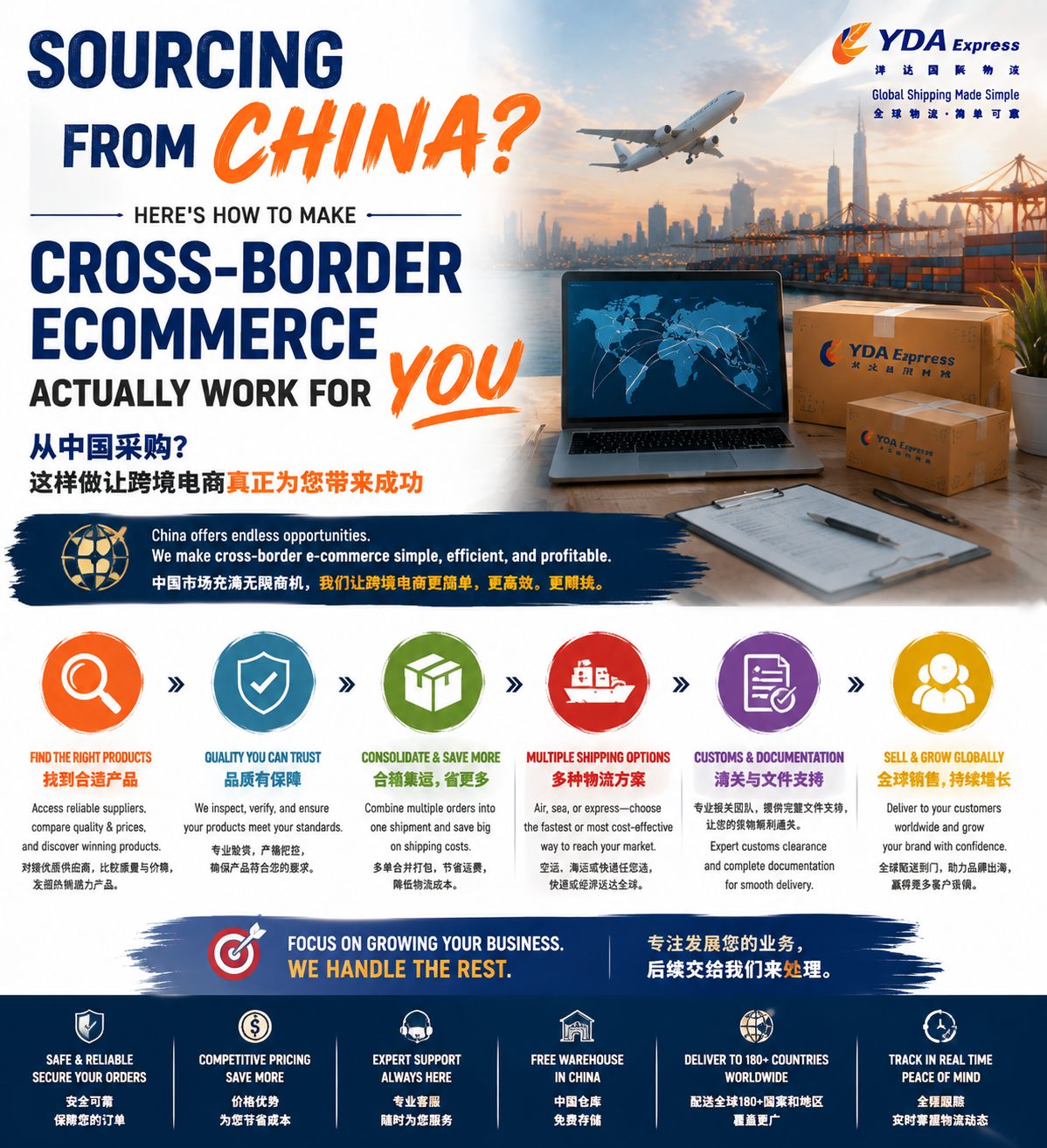
Here’s where it gets interesting. Let’s say you buy from five different sellers on 1688—some phone cases, some cables, a few accessories. If you ship each order separately by express, you’ll pay a fortune. Instead, a forwarder receives all your packages at their China warehouse, checks them for obvious damage, repacks them into one neat carton, and ships that single box to you. This is consolidation. You pay one international shipping fee instead of five, and you can choose the method (express, air, sea) that fits your timeline and budget.
Customs: The Necessary Evil
Customs is where many small shippers lose their nerve. But honestly, it’s rarely as scary as it seems—if you’re prepared. Every country has a de minimis threshold: the value below which no duty or tax applies. In the US, it’s $800. In the UK, it’s £135 (but VAT may still apply). Australia is AUD $1,000. Canada is CAD $20, which is laughably low, but in practice, shipments under $150 often slip through.
A good forwarder will help you declare a reasonable value and use HS codes that don’t raise red flags. “Gift” declarations are a known red flag and can get your package inspected. Also, certain items attract extra scrutiny: branded goods (counterfeit risk), electronics with batteries, and anything that looks like it might need FDA or FCC approval.
Pro tip: don’t try to cheat customs with absurdly low values. If your box is 20kg and declared at $10, you’re asking for a delay and possibly a fine. A reliable forwarder will advise on customs-friendly labeling and help you understand duties upfront.
How a Good Parcel Forwarder Changes the Game
At YdaExpress, we’ve seen the whole spectrum. Some clients come to us after a disastrous first attempt—lost packages, surprise bills, three-week delays. Others are pros who just want a better rate. The core idea is simple: you shop, we receive, we ship. But the details make the difference.
A forwarder should offer:
- Free warehouse storage (at least 30 days) so you can collect orders over time.
- Free package inspection and consolidation.
- Repacking to reduce volumetric weight—sometimes a bigger box makes you pay for empty space.
- Multiple carrier choices so you can balance speed and cost.
- Clear, upfront pricing without hidden fuel surcharges.
And if you need purchasing help—because a seller won’t accept your foreign card, or you don’t speak Chinese—some forwarders act as a buying agent for a small fee. You send a product link, they pay in RMB, and the parcel goes straight to their warehouse.
Real-World Example: Saving Money with Consolidation
Take a small eBay seller in the UK sourcing from 1688. They want 50 phone cases, 20 screen protectors, and 10 chargers from three separate sellers. Each parcel weighs about 1kg. If the sellers shipped individually via DHL (direct quote from the seller: $25 per parcel), that’s $75 total in shipping. Using a forwarder, they consolidate all three into a single 3kg package. With an express consolidated rate, the shipping might be $35. That’s a 53% saving. If they switch to a slower air freight service and bundle with other clients, the cost could drop even further. The seller can then offer free shipping on their eBay listing and still make a healthy margin.
This isn’t hypothetical—it’s the kind of math that makes or breaks a small business.
Common Pitfalls (and How to Dodge Them)
- Ignoring Incoterms: If a supplier quotes you “FOB Shanghai,” that means the price covers goods delivered to the port—you handle everything from there. Know what you’re paying for.
- Underestimating volumetric weight: Carriers charge for the space your package takes up, not just its actual weight. A fluffy duvet can cost more than a heavy book. Repacking can fix this.
- Not checking item restrictions: Batteries, liquids, powders—many carriers have strict rules. Check with your forwarder before you buy.
- Assuming the seller will handle everything: Chinese domestic sellers are great at making products, not exporting them. You need someone on your side who knows the export drill.
Making It Work: A Simple Plan
So, how do you put this into practice? Here’s a straightforward approach:
- Pick your platform and product. Start small—maybe a sample order from 1688.
- Get a China address. Sign up with a forwarder. You’ll get a warehouse address and a unique ID to put on your packages.
- Buy and ship domestically. Send your orders to that address. Most Chinese domestic shipping is cheap and fast.
- Consolidate and choose a shipping method. Once everything arrives, your forwarder will check and repack. Pick express, air, or sea based on urgency and budget.
- Pay and track. You’ll get a tracking number and, if all goes well, a friendly knock on your door in a week or two.
Let YdaExpress Handle the Heavy Lifting
Whether you’re a one-time shopper or a growing business, the right logistics partner turns a tangled mess into a smooth process. At YdaExpress, we offer exactly that: free warehouse storage, smart consolidation, repacking, and a range of shipping options from DHL to sea freight. We’ll even buy the items for you if you don’t want to deal with Chinese sellers directly.
Our goal is to make shipping from China simple, reliable, and affordable—and we’ll talk you through customs concerns, too.
Ready to stop wrestling with shipping estimates and start scaling your sourcing? Visit ydaexpress.com to get a free quote, or message us directly on WhatsApp at +8616666169028. Let’s get your goods moving.
📦 China Parcel Forwarding & International Shipping Already placed your order? Send your purchases to our China warehouse for parcel receiving, photo inspection, up to 180 days of free storage, package consolidation, international shipping, and real-time tracking.
📲 Download the YDA Express App One app for shopping, purchasing assistance, package management, consolidation, international shipping, and worldwide delivery.
🌍 More Helpful Guides Explore practical guides on shopping from China, parcel forwarding, shipping costs, and customs clearance.