
A practical, jargon-free guide to tracking numbers for anyone shipping from China. Learn what those numbers mean, how tracking really works, common hiccups, and why a reliable forwarder makes all the difference.
You just clicked “confirm order” on that perfect gadget from a Chinese supplier, and within hours—sometimes days—you get a message with a long string of letters and numbers. That’s your tracking number. If you’re like most overseas shoppers, you’ll plug it into some website and stare at a status like “Shipment information received” for what feels like forever. But what actually is a tracking number? Why do some look like a random jumble while others are purely numeric? And most importantly, how do you use it to know when your package will actually land on your doorstep?
After years in the logistics business, I can tell you: a tracking number is a lot more than a receipt. It’s a living log of your parcel’s journey, a lifeline when things go sideways, and honestly, the best tool you have to keep a seller honest. Let’s break it down, piece by piece, without the confusing carrier jargon.
What Exactly Is a Tracking Number?
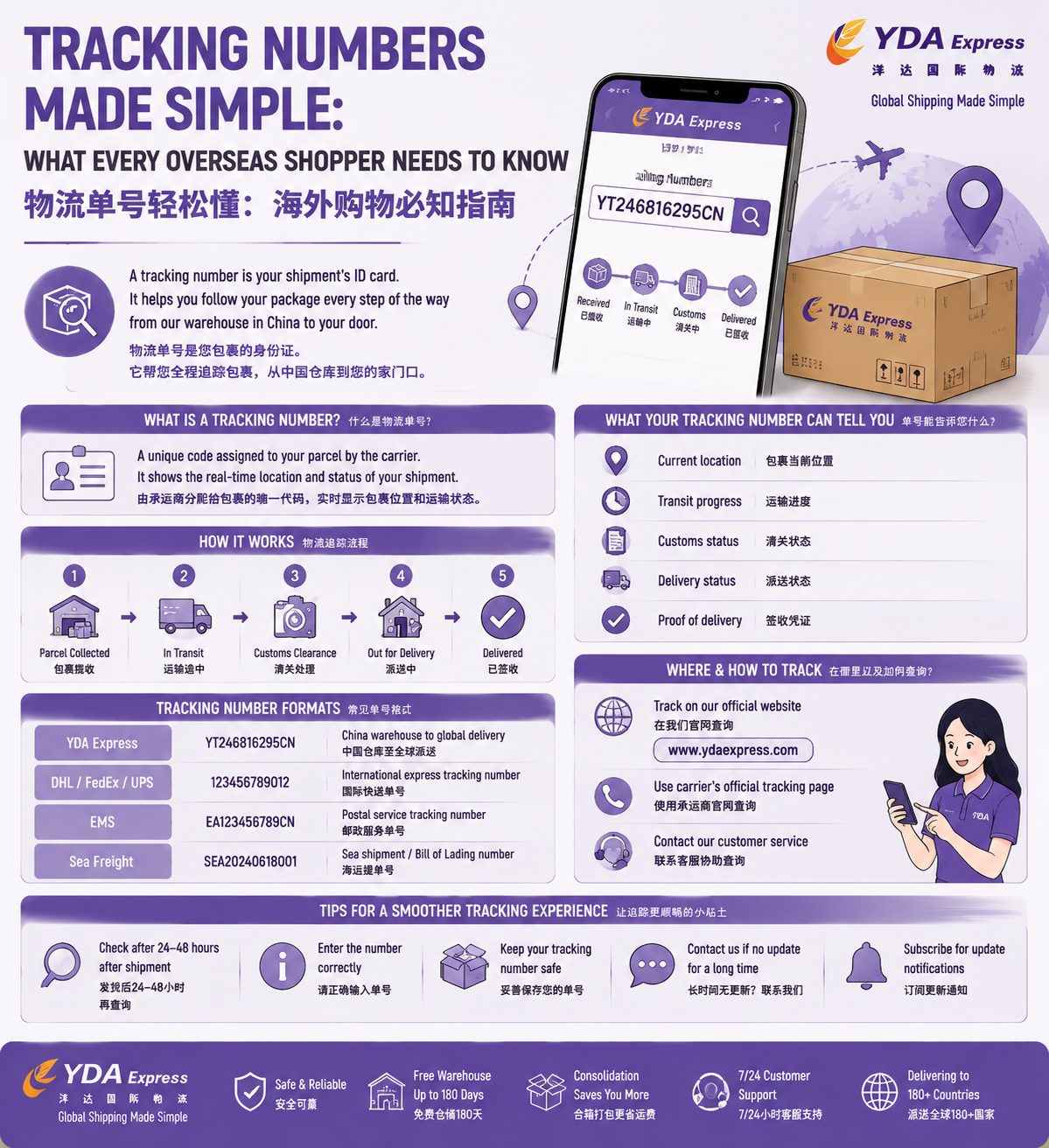
A tracking number—sometimes called a waybill number or consignment number—is a unique identifier assigned to your shipment. Think of it like a social security number for your package. No two active shipments should ever share the same one. Carriers use it to record every scan, every handoff, and every status update from origin to destination.
Formats vary wildly depending on who’s doing the hauling. Here are a few you’ll bump into when buying from China:
- USPS: Starts with a 9 or a letter, often 20–22 digits long (e.g., 9400 1100 0000 0000 0000 00).
- UPS: Begins with “1Z” followed by 16 more characters (e.g., 1Z 999 AA1 01 2345 6784).
- FedEx: Usually 12 digits (e.g., 1234 5678 9012) or 15 if it’s an older format.
- DHL: 10 numeric digits (e.g., 1234567890).
- China Post / ePacket: A mix starting with a letter, then 9 digits, ending with “CN” (e.g., LX123456789CN).
- SF Express: 12 digits, sometimes with “SF” in front.
When you order through a China-based forwarder or purchasing agent like YDA Express, you might first get a local Chinese carrier’s tracking number (say, from ZTO or YTO), which later gets updated to a final international carrier number once the package clears Chinese customs and is handed off to DHL, FedEx, or whoever’s flying it overseas. That’s totally normal. If you only got one number and it’s not showing movement for a week, check with your agent—they probably have a second number for you.
How Tracking Actually Works
Pop behind the scenes and you’ll see that tracking isn’t GPS. It’s a chain of scans at specific checkpoints. Every time your package passes through a facility, a barcode gets scanned. The scanner records the time, location, and what happened: “Picked up,” “Arrived at sort facility,” “Departed,” “Held at customs,” “Out for delivery,” and so on.
For a standard air freight shipment from China to the US or Europe, the typical scan trail looks something like this:
- Pickup scan – The courier collects the parcel from the sender’s warehouse.
- Origin facility scan – Arrives at a sorting center in, say, Shenzhen or Guangzhou.
- Export customs scan – It’s processed for export; sometimes you’ll see “Customs clearance completed.”
- Departure scan – On the plane or handed to the airline. Here’s where things often go quiet for a few days.
- Arrival scan – Lands at the destination country’s hub. For the US, often Los Angeles, Cincinnati, or Memphis; for Europe, Leipzig or Amsterdam.
- Import customs scan – The package clears local customs. This can be lightning fast or a multi-day headache.
- Local facility scan – Transferred to a domestic carrier like USPS or Royal Mail.
- Out for delivery – The last scan you really care about.
Here’s the thing: not all shipping methods show every step. Economy lines like ePacket or China Post Registered Air Mail might only give you three or four scans: pickup, departure from China, arrival in destination country, and delivery. That’s why you can go a week without an update and still have everything be fine.
Why Tracking Numbers Matter More Than You Think
Sure, it’s nice to watch your parcel bounce across the globe, but the practical value runs deeper. For one, a tracking number is proof the seller actually shipped something. A common scam: the seller gives a fake or reused tracking number that shows “delivered” to a different address in your city. Without it, you’d have no evidence. With it, you can check the delivery details and file a dispute if needed.
For small businesses importing from China, tracking numbers are also professional necessities. You can forward the number to your own customers, reducing “where’s my order?” emails. It helps with inventory planning, too—if you know a container is stuck at customs, you can adjust your restock dates.
At YDA Express, we treat tracking transparency as a baseline, not a bonus. When we consolidate your Taobao orders or handle your wholesale shipment, we assign a master tracking number to your entire consignment and keep you updated through our system. No hounding us for updates; you’ll see them in real time.
Common Hiccups (and What to Do About Them)
Even the best tracking number can give you a headache. Here are real situations you’ll encounter and how to handle them, taken straight from what we see daily:
- “Not found” – You just got the number, but the carrier’s website says it doesn’t exist. Don’t panic. It may take 24–48 hours after label creation for the system to register. If it’s still dead after two business days, ask your sender to double-check.
- Stuck on “Departure” for days – Welcome to international logistics. Flights get delayed, or the package might be waiting for a plane with open space. Economy lines can wait up to a week just to board. As long as there’s no “Abnormal” status, patience usually works.
- Stuck in customs – This can mean missing paperwork, dutiable value issues, or just random inspection. If it’s been more than 5 business days, contact the carrier and ask what documentation they need. Often, your sender or forwarder can provide a commercial invoice.
- “Delivered” but nothing at your door – First, check with household members and neighbors. Then look at the tracking details: what time and where was the delivery scan? If it says “left at front door” and you have a common porch, it might be gone. File a claim with the carrier and notify the seller. Having the tracking number makes the claim process smoother.
- Multiple tracking numbers for one order – This is actually a good sign when using a freight forwarder. YDA Express, for instance, may give you a ZTO number that covers the China domestic leg, then switch to a FedEx or DHL number for the international leg. We’ll provide both so there’s no gap.
For a parcel in Germany, an actual request for documents needs a response even if tracking has not changed. Follow the deadline in the notice and use the German customs-notice guide to distinguish a carrier request from a local Zollamt notice and prepare the right purchase records.
How to Use Tracking Like a Seasoned Importer
You don’t need fancy software. Start with the carrier’s official website. DHL, FedEx, and UPS have the most detailed updates in our experience. If your parcel is sent via a smaller line, try an aggregator like 17TRACK or Aftership. They pull data from hundreds of carriers and often translate Chinese statuses into English.
Sign up for email or SMS alerts. Almost every carrier offers them, and they save you from constantly refreshing a page. If you’re managing multiple shipments, a simple spreadsheet with the tracking number, carrier, and expected delivery date works wonders.
One more tip: know your country’s customs procedures. For example, if you’re in the US and the package goes through USPS, sign up for Informed Delivery—it’ll show incoming packages linked to your address automatically. In the UK, Royal Mail’s app does something similar.
Why YDA Express Makes Tracking Transparent
Too many China-based forwarders hand you a tracking number and go silent. At YDA Express, we believe you should know exactly where your goods are at all times. When you use our purchasing and consolidation service, we:
- Provide a photo of your parcel with the shipping label before it leaves our warehouse.
- Assign a clear, trackable number the moment it’s processed.
- Monitor the shipment and alert you if there’s any unusual delay.
- Support you through customs hiccups with the right paperwork.
We’ve seen cases where customers received a tracking number from a random agent, only to realize three weeks later that it was a recycled number from a year-old delivery. That doesn’t fly with us. Every shipment gets a fresh, live number that we test before handing it over.
The Bottom Line
A tracking number is your window into the messy, complicated world of international logistics. It won’t make a plane fly faster, but it will tell you when your package is lounging in a warehouse waiting for the next leg. For anyone buying from China—whether you’re a once-a-year shopper or a growing e‑commerce brand—understanding how to read and act on tracking updates is a skill worth having.
If you’re tired of guessing where your Chinese purchases are, give us a try. YDA Express makes cross‑border shipping simple, reliable, and affordable. Need a quote or just have a quick question? Reach out on WhatsApp at +86 16666169028, drop us an email at yuan@ydaexpress.com, or visit https://www.ydaexpress.com. We’ll help you keep tabs on your cargo from Guangdong to your front door.
📦 China Parcel Forwarding & International Shipping Already placed your order? Send your purchases to our China warehouse for parcel receiving, photo inspection, up to 180 days of free storage, package consolidation, international shipping, and real-time tracking.
📲 Download the YDA Express App One app for shopping, purchasing assistance, package management, consolidation, international shipping, and worldwide delivery.
🌍 More Helpful Guides Explore practical guides on shopping from China, parcel forwarding, shipping costs, and customs clearance.