A clear explanation of how Value Added Tax (VAT) applies when you import goods from China, with practical tips for shoppers and small businesses to avoid unexpected costs.
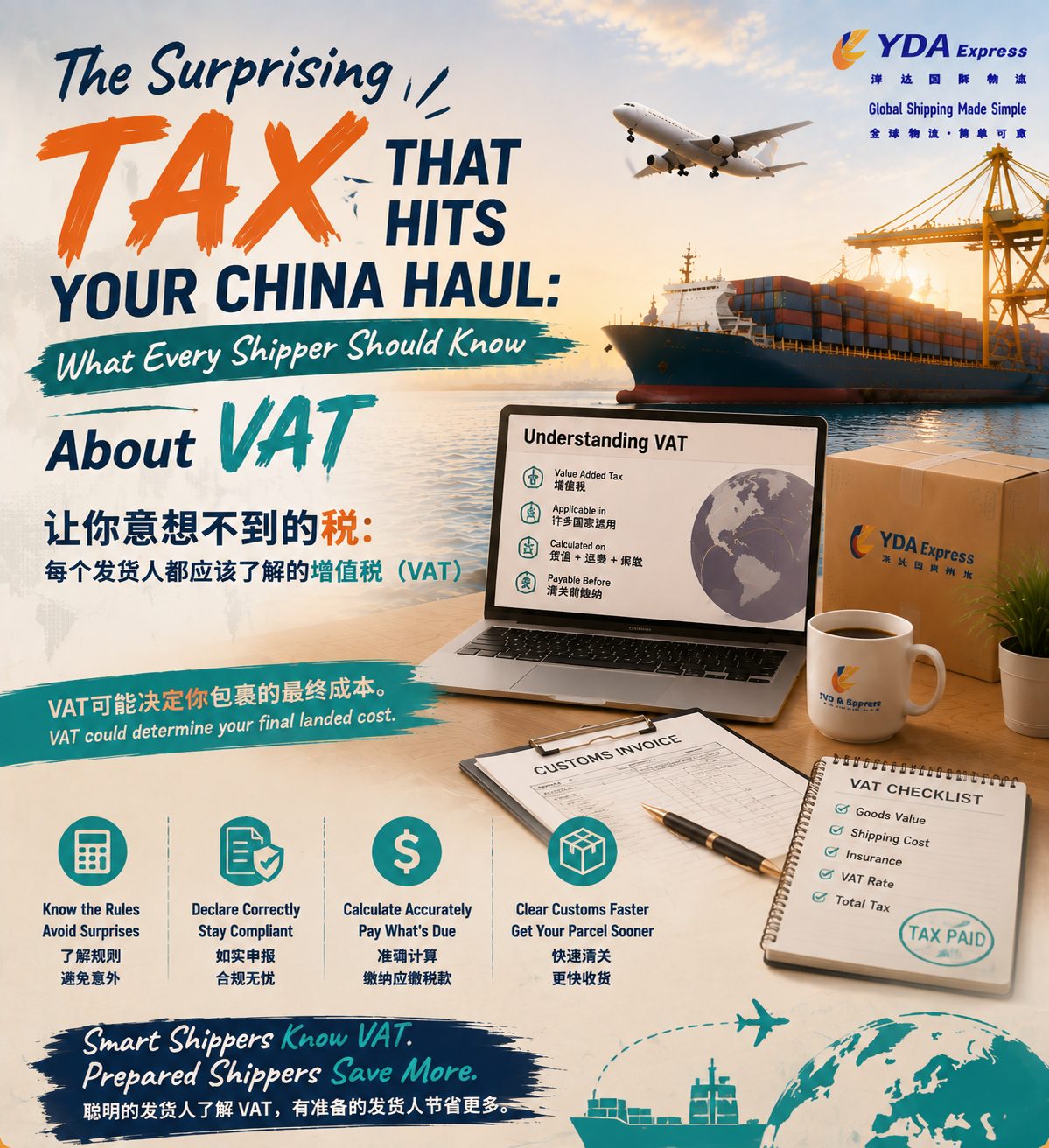
The Surprising Tax That Hits Your China Haul: What Every Shipper Should Know About VAT
You’ve spent weeks curating the perfect haul from Taobao, 1688, or JD.com. The prices were unbeatable, the styles unique, and after some back-and-forth with a purchasing agent, your order is finally on its way. Then, a few days later, you get a text from DHL: your package is held at customs, and you owe an extra £18 in “taxes and fees.” Sound familiar?
That little surprise is often Value Added Tax — VAT for short. It’s one of those things that can turn a great deal into a headache if you aren’t prepared. But once you understand how it works, it’s easy to budget for and even minimize. Here’s what every overseas shopper and small business owner should know about VAT when importing from China.
What Exactly Is VAT, Anyway?
VAT is a consumption tax added at each stage of production and distribution. As the end buyer, you pay the final VAT when you purchase the item. In a domestic setting, it’s baked into the price you see on the shelf. But cross-border shopping does something odd: the price you pay in a foreign country often excludes that country’s VAT, but your own country will want its cut when the goods land.
In practice, when you buy from China, the seller or platform might not charge you any sales tax upfront. That means the tax authority in your home country sees the import as a taxable event. They’ll assess VAT based on the item’s value (plus shipping and insurance, often), and it’s your job to pay it before the package is released.
Where Does VAT Actually Show Up in an Import?
There’s a common confusion: “But China already has a VAT, right?” Yes, China has its own VAT system — and that’s why many exported goods are actually cheaper: Chinese exporters can get a VAT rebate when they ship goods overseas. Basically, the Chinese government refunds the VAT that was paid during manufacturing, so the exporter can sell at a lower price. That’s partly why you get such great bargains.
The tax that hits you as the importer is your own country’s Import VAT. It’s calculated on the total landed cost: price of goods + international shipping + insurance + any customs duties. So if you buy a dress on Pinduoduo for £40 and pay £15 shipping to the UK, VAT at 20% will be applied to £55, so £11. Add customs duty if applicable (which depends on the item type and value), and you might also face a handling fee from the courier — more on that later.
How Much VAT Are We Talking About?
Here’s the thing: every country sets its own rate and threshold. As a shipper, you need to know your local rules. A quick snapshot:
- United Kingdom: 20% standard VAT. For goods valued at £135 or less, the seller should collect VAT at checkout if they’re registered under the UK’s rules for online marketplaces. For items over £135, you pay import VAT upon arrival. Gifts under £39 may be exempt, but commercial goods aren’t.
- European Union: Rates vary — Germany 19%, France 20%, Netherlands 21%, Spain 21%, etc. For parcels under €150, the EU’s Import One-Stop Shop (IOSS) might apply: if the seller is IOSS-registered, you pay VAT at checkout. Otherwise, customs will collect it. For items above €150, expect import VAT plus duty.
- United States: The US doesn’t have a federal VAT; instead, it uses sales tax, which is rarely enforced on imports under a de minimis of $800. So most individual shipments from China slip through tax-free unless you’re a high-volume importer or the goods are subject to special tariffs. But for business shipments, things get more complicated.
- Australia: GST of 10% applies to most imports, with a A$1000 threshold for duty-free entry, but the GST is often collected by the seller if they’re registered.
- Canada: GST/HST varies by province, but generally, imports under C$20 are tax-free, while those over C$40 rarely escape notice. A brokerage fee from the carrier often applies too.
If you’re a small business bringing in samples or stock, these numbers matter. For example, a US-based boutique owner ordering 50 handbags from 1688 might find the total value over $800, triggering a formal entry and potential duties. But for that one-off Taobao sweater, it’s usually smooth sailing.
The Hidden Bite: Courier Handling Fees
This one catches first-timers off guard. Even when you’re prepared to pay the VAT, the courier will often add a “disbursement” or “advancement” fee for fronting the customs payment on your behalf. DHL, FedEx, and UPS are notorious for this. In the UK, Royal Mail charges a flat £8 fee; DHL might charge 2% of the tax amount or a minimum of £10-15. It’s a frustrating add-on that can make a small order suddenly very expensive.
How to dodge it? Use a shipping method that lets you pay duties and taxes directly to customs yourself before the package arrives, or choose a forwarder that offers DDP (Delivered Duty Paid) where all fees are settled upfront. YdaExpress offers just that kind of transparent DDP shipping option, so you know the total cost before the package even leaves China. No surprise fees when the doorbell rings.
The Shipper’s Secret Weapon: Declared Value and HS Codes
Now, let’s talk about something that matters a lot in the real world of logistics: how the parcel’s value is declared on the customs form. This is not about evading taxes — it’s about being accurate and smart. Customs relies on the declared value to calculate VAT and duty. If you paid $100 for a product, but the invoice says $20, you might be asking for trouble. Customs officials see thousands of packages and know when something looks off. An unrealistic value can trigger an inspection, delays, and even fines.
What you want is a clear, honest declaration with a proper HS (Harmonized System) code. HS codes classify products — a cotton T-shirt gets a different code than a silk dress, and duty rates differ. Your freight forwarder should help you pick the right code. At YdaExpress, we often see customers who used the wrong code and got hit with higher duty or had their package stuck for weeks. A few minutes of checking can save days of worry.
Consolidation: A Smart Way to Reduce VAT Hassles
If you shop on multiple Chinese platforms — a little from Taobao, a gadget from JD, some stationery from 1688 — you’ll end up with multiple packages. Each tiny parcel, if shipped alone, might fall under the tax threshold, but you’ll pay multiple shipping fees. Consolidation solves this: a forwarding partner like YdaExpress collects all your orders in their warehouse, repacks them into one box, and sends that single shipment. Consolidation can lower your per-item shipping cost dramatically, and it also means you deal with customs only once. You can also request a realistic combined value declaration, which might keep you under certain thresholds if the total remains low enough. But be careful: combining many items might push the total value above a threshold, so work out the math. Often, the savings in shipping outweigh any added VAT.
For Business Buyers: Reclaiming VAT
If you’re importing for resale, you’re likely VAT-registered in your own country. That means you can claim back the import VAT you pay. In the UK, for example, you get an import VAT certificate (C79) from HMRC, which lets you recover the VAT through your usual return. But you need your EORI number (Economic Operators Registration and Identification) to clear the goods. Without it, the parcel gets stuck. Your forwarder can put your EORI on the customs paperwork so you can claim it back. Just make sure your invoices match up.
Real-World Example: A Package from Shenzhen to London
Let’s put it all together. Imagine you’re in London, and you buy a single high-end laptop sleeve from a Shenzhen seller for £25, plus £10 shipping. Total landed cost: £35. In the UK, for consignments valued under £135, the seller should have charged you VAT at the point of sale if they’re registered on the online marketplace rules. But if they didn’t, and the package comes via air freight, customs will hold it. You’ll get a notice to pay 20% VAT on £35 (£7), plus a Royal Mail handling fee of £8. So your £35 purchase now costs £50. Ouch.
Now, suppose you use YdaExpress’s consolidation service. You order five items from different sellers: total goods value £120, combined shipping through consolidation costs £25. You ask for DDP shipping where the customs charges are prepaid based on the full £145 value. YdaExpress calculates the VAT and any duty, you pay it upfront, and the package clears customs without delay. You skip the courier handling fee altogether. And because it’s all pre-calculated, you can price your resale items accurately.
How YdaExpress Makes VAT Less Painful
We’ve been in the parcel forwarding business long enough to know that taxes are a major pain point. That’s why we focus on transparent, customs-friendly shipping. Here’s what you can expect from our team:
- Honest declared values: We work with you to set values that match commercial invoices and your payment records. No fudging, no unrealistic numbers that invite audits.
- Expert HS code guidance: Our staff can suggest codes based on your product photos or descriptions. This helps prevent overpayment of duties and reduces hold-ups.
- DDP services: For the UK, EU, and many other destinations, we can arrange tax-inclusive shipping. You pay everything beforehand, and we handle the customs clearance on your end.
- Warehouse consolidation: Our China warehouse accepts packages from any online store, and we can hold items for up to 90 days free of charge. You can build your shipment when it makes sense.
- Carrier flexibility: We partner with DHL, FedEx, UPS, and specialized lines that offer lower handling fees or simple customs clearance.
If you’re not sure which method works best, just send us a message. We’ll look at your items, their values, and your destination, then lay out the cheapest and fastest options — with all taxes estimated clearly.
A Final Word from the Shipping Floor
Honestly, the only way to get burned by VAT is to not think about it until it’s too late. Before you click “buy” on that 1688 order or hand your list to a purchasing agent, take five minutes to check your country’s import threshold and VAT rate. Then ask your forwarder one simple question: “Can you give me an all-in cost with duties and taxes?” If they say yes, you’re in safe hands.
At YdaExpress, we answer that question every day — for hobby shoppers and growing businesses alike. Because when shipping from China, there shouldn’t be any surprises. Just good deals and packages that show up on time.
Ready to ship without the tax headaches? Visit our website at https://www.ydaexpress.com or reach out on WhatsApp at +8616666169028. Let’s get your next haul home — smoothly.
📦 China Parcel Forwarding & International Shipping Already placed your order? Send your purchases to our China warehouse for parcel receiving, photo inspection, up to 180 days of free storage, package consolidation, international shipping, and real-time tracking.
📲 Download the YDA Express App One app for shopping, purchasing assistance, package management, consolidation, international shipping, and worldwide delivery.
🌍 More Helpful Guides Explore practical guides on shopping from China, parcel forwarding, shipping costs, and customs clearance.