Aprende a manejar la logística de artículos de gran tamaño desde China hacia España y Latinoamérica. Consejos prácticos sobre embalaje, transporte marítimo, aduanas y más.
¿Te has planteado alguna vez comprar un sofá por internet directamente a un fabricante en China? ¿O esas máquinas de gimnasio que tanto te gustan pero que aquí cuestan el triple? Pedir artículos voluminosos desde el gigante asiático puede parecer una locura logística, pero la realidad es que cada vez más particulares y negocios lo hacen. Y no es para tanto, si sabes cómo.
Vamos al grano: enviar un paquete grande no es lo mismo que mandar una caja de zapatos. Aquí no valen las tarifas planas del típico "envío estándar". Hablamos de palés, de metros cúbicos, de peso volumétrico y de aduanas que pueden complicarse si no llevas los papeles bien atados. Pero con un poco de información, el proceso se vuelve mucho más sencillo y, sobre todo, rentable.
¿Qué se considera un envío voluminoso?
En logística, no solo importa el peso. De hecho, el peso físico puede ser engañoso. Una caja enorme con espuma puede pesar apenas 10 kg, pero ocupar un espacio desproporcionado en un avión o un contenedor. Por eso las empresas de transporte calculan el peso volumétrico. La fórmula típica es largo × ancho × alto (en cm) dividido entre 5.000 (para transporte aéreo) o entre 6.000 (para marítimo). Si ese resultado supera al peso real, se aplica la tarifa sobre el volumen.
Así que, a efectos prácticos, un envío voluminoso puede ser desde una bicicleta eléctrica hasta una máquina de coser industrial, un mueble desmontado, varias cajas de cerámica o incluso una escultura. Si el bulto mide más de 120 cm en algún lado o el volumen te dispara el precio, ya entras en esta categoría.
En el comercio electrónico transfronterizo, muchos compradores se sorprenden cuando el "envío gratis" de un producto grande solo cubre dentro de China, y el transporte internacional les sale más caro que el propio artículo. Conocer cómo se tarifan estos envíos es el primer paso para no llevarse sustos.
Los retos reales de la paquetería grande
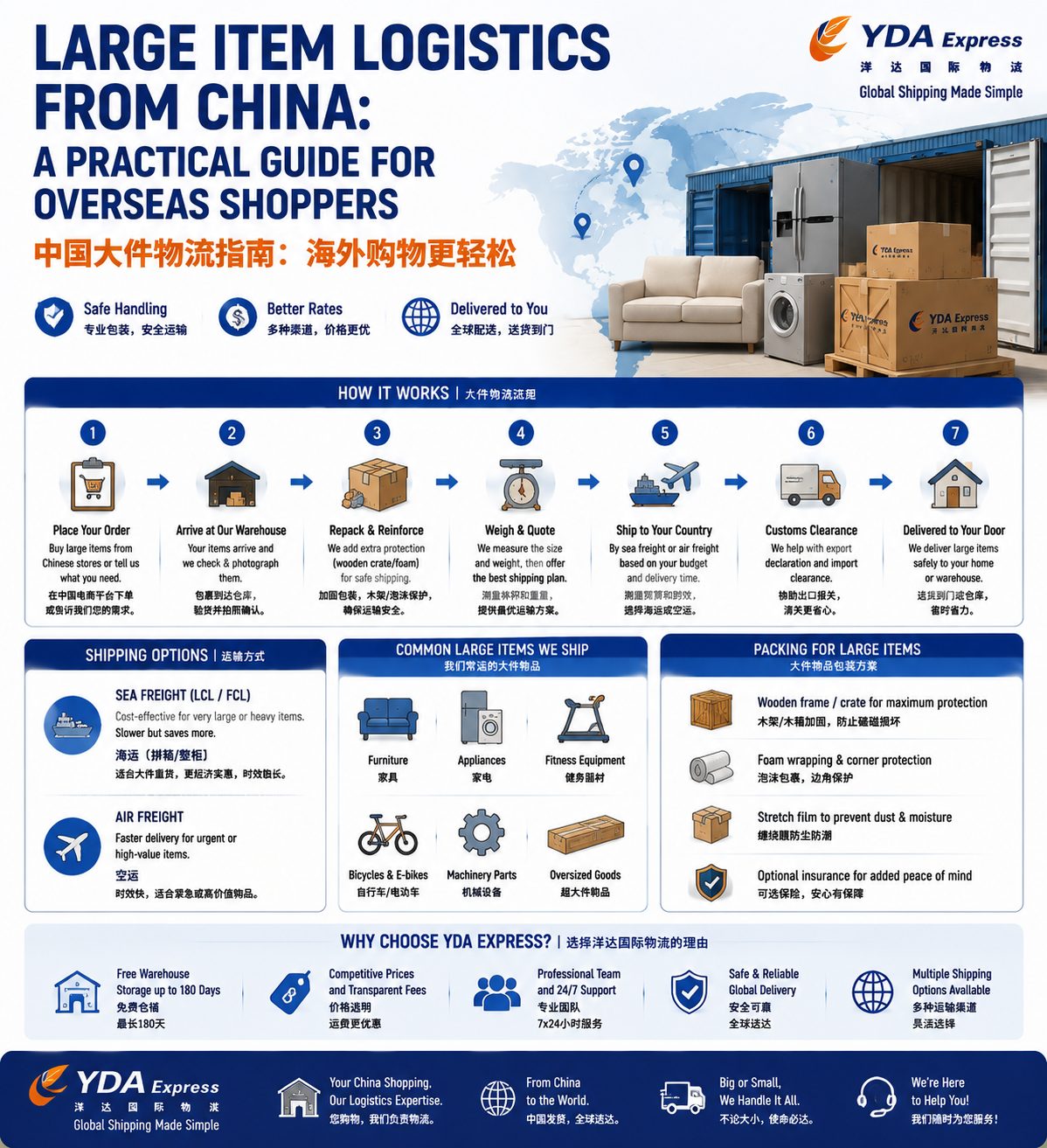
Aquí no hay secretos: mover objetos de gran tamaño desde China hasta tu casa en España o Latinoamérica implica superar varios obstáculos. Los principales son:
- Costos elevados. El transporte marítimo es más barato que el aéreo, pero puede tardar semanas. El aéreo es rápido, pero carísimo para volúmenes grandes.
- Riesgo de daños. Manipular un palé o una caja de 50 kg en varios almacenes aumenta las posibilidades de golpes. Un buen embalaje no es opcional.
- Tiempos de tránsito. Un envío marítimo puerta a puerta puede llevar entre 30 y 50 días, dependiendo del destino. Si tienes prisa, olvídate del barco.
- Trámites aduaneros. Cualquier mercancía que supere los 150 euros de valor (en la UE) paga IVA y, si corresponde, aranceles. Además, necesitas factura comercial, packing list y, a veces, certificados específicos (como para productos eléctricos o de madera).
- Logística de última milla. Una cosa es que tu palé llegue al puerto de Barcelona, y otra muy distinta que una empresa te lo entregue en un quinto piso sin ascensor. Hay que coordinar bien la entrega local.
Dicho esto, no son problemas insalvables. Miles de importadores pequeños y particulares lo hacen a diario. La clave está en planificar bien y contar con un operador logístico que conozca el terreno.
Opciones de transporte: marítimo vs. aéreo vs. ferrocarril
Cuando hablamos de envíos voluminosos, el avión casi siempre queda descartado por precio. Solo merece la pena si el producto es muy caro y ligero, o si la urgencia justifica pagar fácilmente diez veces más. El transporte marítimo es el rey indiscutible para muebles, maquinaria y mercancía paletizada.
Transporte marítimo
Es la opción más económica para grandes volúmenes. Se contrata por contenedor completo (FCL) o por agrupación de carga (LCL), donde compartes contenedor con otros importadores. El LCL suele ser ideal para envíos de entre 1 y 15 metros cúbicos. Los puertos principales de entrada en España son Barcelona, Valencia y Algeciras; en Latinoamérica, destacan Veracruz (México), Callao (Perú) o San Antonio (Chile). Los tiempos de tránsito desde puertos chinos como Shanghai o Shenzhen hasta España rondan los 30-35 días; a América Latina, entre 35 y 45.
Ojo con los costos adicionales: el flete marítimo base es solo una parte. Luego vienen gastos portuarios, THC (Terminal Handling Charges), despacho aduanero, transporte interior... Es imprescindible pedir una cotización desglosada con todos los conceptos.
Transporte aéreo
Para envíos voluminosos, el aéreo solo es viable si la densidad es baja y el valor alto. Por ejemplo, componentes electrónicos ligeros pero voluminosos. Un palé de 200 kg y 1,5 m³ puede costar entre 2 y 5 euros por kg, mientras que por mar quizá no llegue a 1 euro por kg. Además, las aerolíneas aplican recargos por combustible y seguridad. Pero si el producto es perecedero o necesitas reponer stock urgente, puede ser la única salida.
Ferrocarril (tren de mercancías)
Cada vez más opciones unen China con Europa a través de la Ruta de la Seda ferroviaria. Es más rápido que el barco (unos 18-22 días hasta Madrid) y más barato que el avión. Sin embargo, la capacidad para cargas muy voluminosas está limitada por el gálibo de los contenedores y las estaciones. Para envíos a España, el tren llega hasta la terminal de Abroñigal en Madrid o Barcelona Morrot. No es tan común para grandes volúmenes como el marítimo, pero es una alternativa interesante para mercancía de tamaño medio.
Cómo preparar un envío voluminoso desde China
La preparación empieza en origen. Muchos compradores confían ciegamente en que el vendedor chino empaquetará bien el producto. Grave error. Los estándares de embalaje para exportación no son los mismos que para el mercado interno. Aquí van algunas recomendaciones prácticas:
1. Embalaje reforzado. Cajas de cartón doble o triple, madera contrachapada para artículos pesados, espuma de alta densidad y protectores de esquinas. Si el artículo lleva patas o salientes, desmóntalos si es posible.
2. Paletizado. Siempre que puedas, agrupa la mercancía en un palé europeo (120 × 80 cm) o americano (120 × 100 cm). Así se manipula con transpaletas y carretillas, reduciendo el riesgo de caídas. Además, algunos transportistas ofrecen tarifas por palé en lugar de por peso/volumen.
3. Etiquetado claro. Cada bulto debe llevar etiquetas con destinatario, remitente, dirección completa, teléfono, y símbolos de manipulación ("frágil", "no apilar", "proteger de la humedad").
4. Documentación comercial. Factura proforma o comercial, lista de contenido detallada (packing list), y si es necesario, certificado de origen o documentos específicos (declaración de conformidad CE para productos eléctricos, por ejemplo). Cuanto más claro, menos parones en aduanas.
5. Seguro de transporte. No es obligatorio, pero sí muy recomendable. Asegura la mercancía al 100% de su valor real. Las coberturas básicas suelen ser ridículas (unos pocos dólares por kg), y si tu sofá de 500 euros sufre un rasgón, no recibirás casi nada.
Aduanas e impuestos en España y América Latina
Cada país tiene sus reglas. En la Unión Europea, cualquier envío procedente de fuera de la UE con valor superior a 150 euros (o 22 euros para envíos comerciales antiguos, pero desde julio de 2021 se eliminó la exención para todo) debe pagar IVA y posibles aranceles. El tipo de IVA aplicable es el del país de recepción (en España, el 21% general). Además, según la naturaleza de la mercancía, puede haber aranceles (por ejemplo, muebles de madera suelen tener un 0%, pero ciertos textiles pueden rondar el 12%).
En Latinoamérica la situación varía bastante. Países como México, Colombia o Chile aplican impuestos de importación y IVA con mínimos exentos muy bajos. En México, por ejemplo, las compras por internet de menos de 50 dólares antes estaban exentas, pero ahora casi todas pagan el 16% de IVA más aranceles según el caso. En Chile, todo pago superior a 30 dólares tributa. Además, hay que contar con los trámites de la DIAN en Colombia, la SUNAT en Perú, etc. La burocracia puede ser densa, pero un buen agente de aduanas o un transitario con experiencia en el país de destino te ahorrará muchos dolores de cabeza.
Un consejo: nunca declares un valor inferior al real para "ahorrar" impuestos. Las aduanas tienen referencias de precios y, si detectan infravaloración, pueden imponer multas y retener la mercancía durante semanas. Además, el seguro solo te cubrirá el valor declarado, así que si mientes, te perjudicas.
Consejos para reducir costos sin jugártela
- Consolidación de carga. Si compras a varios proveedores, haz que toda la mercancía se envíe a un almacén en China y luego se agrupe en un solo envío. Así pagarás un único flete y una sola gestión aduanera. Esto es lo que se conoce como groupage o LCL.
- Elegir el puerto de llegada más cercano. Parece obvio, pero a veces salir de un puerto chino con conexión directa al tuyo reduce semanas y evita trasbordos. Pregunta siempre por las rutas directas.
- Negociar con varios transitarios. No te quedes con la primera cotización. Pide al menos tres, compara no solo el precio, sino los servicios incluidos (despacho, entrega, seguro).
- Evitar prisas. Si no tienes urgencia, el marítimo LCL te permite enviar volúmenes medios a un costo razonable. Planifica con antelación para no tener que recurrir al aéreo.
- Reutilizar materiales. Si importas periódicamente, invierte en embalajes reutilizables. A la larga, sale más barato y reduce residuos.
La experiencia de YDA Express en envíos voluminosos
En YDA Express llevamos años gestionando envíos de todo tipo desde China hasta prácticamente cualquier rincón del mundo. Hemos visto de todo: desde motosierras industriales hasta esculturas de jardín de dos metros. Y si algo hemos aprendido es que cada envío voluminoso es un caso único, pero con patrones repetibles. La clave está en la comunicación fluida con el cliente, el asesoramiento sobre el mejor medio de transporte y, sobre todo, la transparencia en los costes.
Trabajamos con las principales navieras y transitarios locales, tanto en origen como en destino. Podemos recepcionar tu mercancía directamente de fábricas o marketplaces chinos (Alibaba, 1688, Taobao), consolidarla en nuestro almacén, revisar el estado, embalarla correctamente y enviártela por mar, aire o tren. En destino, colaboramos con agentes de aduanas de confianza para que el despacho sea ágil y sin sorpresas.
Empieza tu envío hoy mismo
Si estás pensando en traerte ese mueble que tanto te gusta, esa maquinaria para tu taller o un lote de productos para tu negocio, no dejes que el tamaño te intimide. Con la información adecuada y el apoyo de profesionales, la logística de paquetería grande puede ser más sencilla de lo que imaginas.
Ponte en contacto con nosotros a través de WhatsApp al +86 16666169028 o escríbenos a yuan@ydaexpress.com. También puedes visitar nuestra web www.ydaexpress.com para conocer todos nuestros servicios. Te ayudaremos a que tu envío llegue a casa sin contratiempos.
🛍️ Compra en China en un solo lugar No necesitas comprar por separado en Taobao, 1688, JD.com, Tmall o Pinduoduo. Con YDA Express puedes buscar productos, realizar pedidos, solicitar inspecciones con fotos, disfrutar de hasta 180 días de almacenamiento gratuito, consolidar paquetes y enviarlos a cualquier parte del mundo.
👉 Empieza a comprar 📦 Reenvío de paquetes y envíos internacionales ¿Ya realizaste tu compra? Envía tus productos a nuestro almacén en China. Ofrecemos recepción de paquetes, inspección con fotos, hasta 180 días de almacenamiento gratuito, consolidación, envíos internacionales y seguimiento en tiempo real.
👉 Explora todos nuestros servicios 📲 Descarga la app de YDA Express Una sola app para comprar en China, gestionar pedidos y paquetes, consolidar envíos, organizar el transporte internacional y seguir tus compras.
🌍 Más guías útiles Descubre consejos prácticos sobre compras en China, reenvío de paquetes, costes de envío y trámites aduaneros.