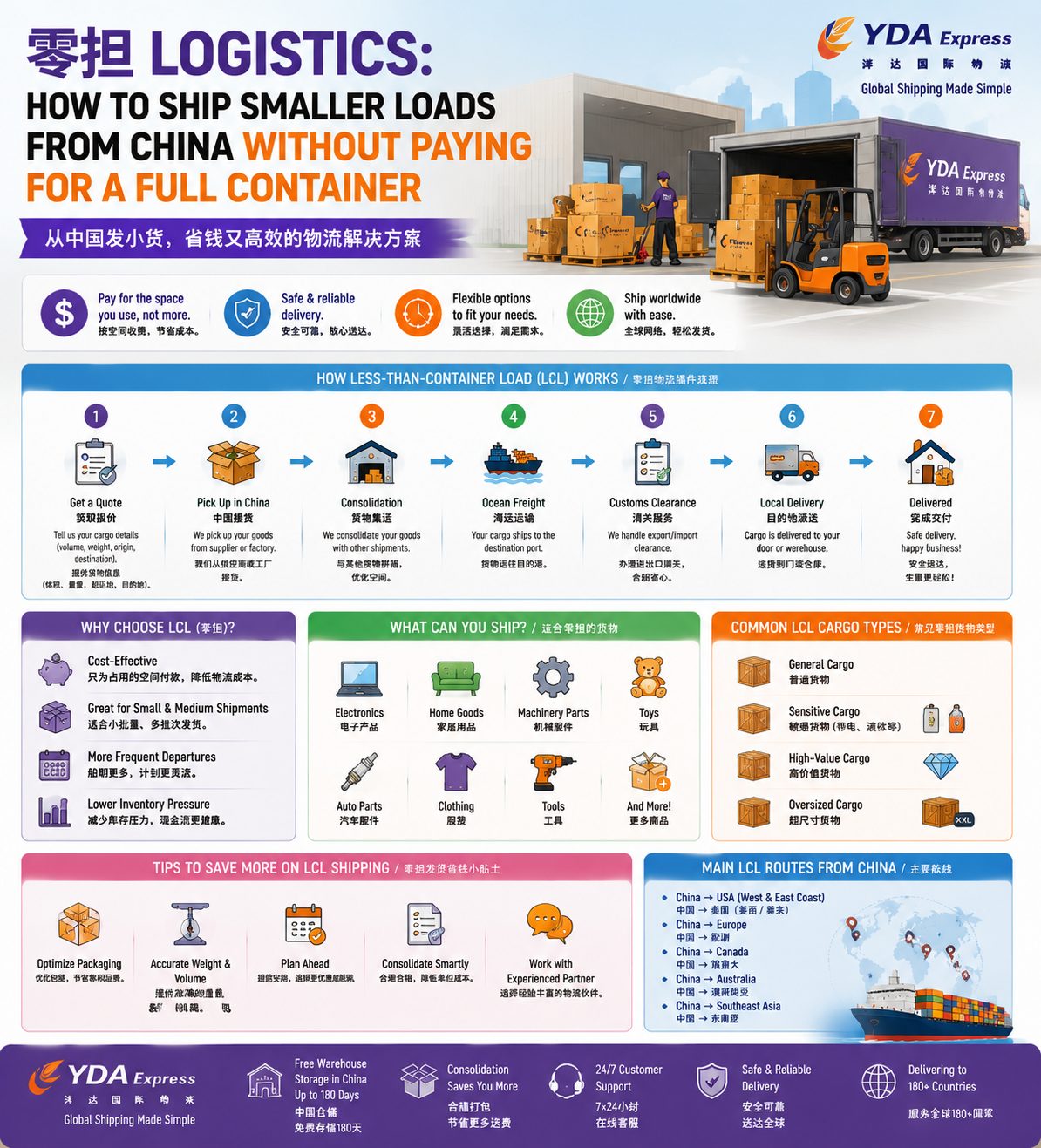
La logística de carga fraccionada (LTL) permite a pequeños importadores y particulares enviar mercancía desde China sin pagar un contenedor completo. Explicamos qué es, cómo funciona y cuándo conviene utilizar este servicio para ahorrar costes y tiempo.
Si alguna vez has querido traer mercancía de China pero te has asustado con los precios del flete marítimo o aéreo para un contenedor entero, la carga fraccionada —también conocida como grupaje o LTL (Less Than Truckload)— puede ser justo lo que necesitas. No es un concepto nuevo, pero muchos pequeños emprendedores y particulares en España y Latinoamérica aún no lo aprovechan tanto como podrían.
La idea es sencilla: en lugar de pagar por un espacio que no llenas, compartes el contenedor (o el camión) con otros importadores y solo pagas por el volumen y peso que realmente ocupas. Al final, es como comprar un billete de tren en lugar de alquilar todo el vagón. Pero ojo, no es magia: hay que entender cómo funciona para no llevarse sorpresas con las tarifas o los tiempos de tránsito.
¿Qué es exactamente la carga fraccionada o LTL?
LTL significa “menos de un camión completo” (Less Than Truckload). En logística internacional, se refiere a envíos que no llenan un contenedor marítimo de 20 o 40 pies. En lugar de esperar a tener suficiente mercancía para consolidar un contenedor completo, el transitario o agente de carga combina varios envíos pequeños de distintos clientes en un mismo contenedor. Cada cliente paga solo por su parte.
En España, muchos lo conocen como “grupaje marítimo” o simplemente “consolidación de carga”. En China, los agentes suelen llamarlo “LCL” (Less than Container Load) para el transporte marítimo, y “LTL” para el terrestre. Para los envíos aéreos, aunque técnicamente es carga consolidada, se suele hablar simplemente de “carga aérea”.
Aquí hay una confusión habitual: LTL y LCL no son exactamente lo mismo. LTL se usa más en transporte terrestre dentro de un país; LCL es el equivalente marítimo. Pero en la práctica, muchos transitarios usan “LTL” como término genérico para cualquier envío pequeño, ya sea por mar, tierra o aire. A efectos prácticos, cuando hables con un agente chino, si dices “necesito enviar 2 metros cúbicos por grupaje”, te entenderán perfectamente.
¿Cuándo conviene utilizar el grupaje?
La regla de oro es: si tu mercancía ocupa menos de 15 metros cúbicos, casi siempre te saldrá más barato el grupaje que un contenedor completo. A partir de 15–20 m³, ya empieza a ser interesante comparar precios con el contenedor de 20 pies (que tiene unos 28 m³ de capacidad).
He visto casos de clientes que traen solo 1 o 2 palés desde Yiwu o Guangzhou y pagan una fracción del coste de un contenedor. También es ideal para quienes están probando un producto nuevo y no quieren arriesgarse a llenar un contenedor sin saber si se venderá. O para tiendas online que reponen inventario poco a poco.
Sin embargo, el grupaje tiene sus desventajas: el tiempo de tránsito suele ser mayor. Necesita más manipulación (carga y descarga en almacenes intermedios), y además está sujeto a la disponibilidad de espacio en la ruta elegida. Si hay mucha demanda, tu carga puede quedarse esperando en el puerto de origen hasta que se complete un contenedor. Eso puede añadir una semana o más al tiempo total.
Cómo funciona el proceso, paso a paso
- Preparación en origen: Tú compras la mercancía a un proveedor chino o envías tus productos a un almacén de consolidación. Aquí es donde un agente como YDA Express puede ayudarte: recibimos tus bultos, verificamos cantidades, tomamos fotos y preparamos todo para el envío.
- Consolidación: El transitario agrupa tu carga con la de otros clientes destino al mismo puerto o ciudad. Se cargan en palés o en un contenedor compartido. Es fundamental que el embalaje sea resistente, porque va a compartir espacio y movimiento con otras mercancías.
- Transporte principal: El contenedor viaja por mar (lo más común) o por aire si es urgente. Los tiempos desde China a España suelen ser de 25–35 días para grupaje marítimo, dependiendo del puerto. A México o Colombia, unos 30–40 días. Si eliges la opción aérea, puedes recibirlo en 5–10 días, pero el coste se dispara.
- Desconsolidación: Al llegar al puerto de destino, el almacén logístico separa los envíos y notifica a cada importador o a su agente de aduanas. Aquí empieza el despacho aduanero y el pago de impuestos locales.
- Entrega final: Una vez liberado, se coordina el transporte terrestre hasta la dirección final. Puede ser un envío paletizado o repartido en paquetería, según el volumen.
Lo que nadie te cuenta sobre los costes ocultos
El precio por metro cúbico o por kilogramo que ves en la cotización inicial no siempre es el coste final. En el grupaje intervienen muchos actores, y cada uno cobra su parte. A continuación, los cargos más comunes que deberías preguntar antes de confirmar:
- Gastos de manipulación en origen (handling): Cobro por recibir, paletizar y cargar tu mercancía.
- Gastos de consolidación: Tarifa que aplica el transitario por agrupar envíos.
- BL o AWB fee: Emisión del conocimiento de embarque (Bill of Lading) o guía aérea.
- Gastos de aduana en destino: Puede incluir el despacho, reconocimiento físico, almacenaje si se demora, etc.
- Gastos de desconsolidación en puerto: Manipulación para separar tu carga del resto.
- Tarifa de seguridad o ISPS: Relacionada con la seguridad portuaria.
- Transporte terrestre final: Portes desde el puerto o aeropuerto hasta tu domicilio.
En YDA Express siempre recomendamos pedir una cotización “puerta a puerta” con todos los gastos incluidos en destino (DDP). Así evitas sorpresas con gastos que no dependen de ti, como los recargos del puerto de Barcelona por congestión.
¿Marítimo o aéreo? Una decisión clave
Para cargas fraccionadas de menos de 500 kg o volúmenes pequeños, el aéreo puede ser sorprendentemente competitivo si sumas todos los costes ocultos del marítimo. Por ejemplo, traer 100 kg en avión desde China a Madrid puede costar unos 3–4 €/kg, mientras que por mar, entre tantos extras, a veces el precio final se acerca a los 2–2,5 €/kg con tiempos mucho más largos. Para cargas de mayor volumen, el marítimo sigue siendo imbatible.
Un conocido error es calcular solo el flete marítimo por metro cúbico (por ejemplo, 100 USD/m³) y olvidar que en destino puedes pagar otros 150–200 € de gastos fijos. Para un envío de 1 m³, esos fijos se diluyen menos, y el coste total puede rondar los 300–400 €. Si en lugar de eso envías 5 m³, los fijos se reparten mejor. Por eso es tan importante consolidar bien.
Consejos prácticos para ahorrar en tus envíos LTL
- Consolida al máximo: Si puedes, junta varios pedidos de distintos proveedores en un mismo envío. El almacén de origen te cobrará por recepción, pero ahorrarás en fletes al tener un solo envío mayor.
- Asegura la carga: Aunque los transitarios tienen seguros básicos, no cubren pérdida total o daños en muchos casos. Contrata un seguro adicional si la mercancía tiene valor.
- Etiqueta y documenta: Cada bulto debe llevar etiqueta con tu nombre, destino y número de referencia. Además, la factura comercial y packing list deben coincidir con el contenido real. Un error aquí puede retrasar la aduana semanas.
- Elige bien el puerto de destino: No es lo mismo Valencia que Vigo. Cada puerto tiene tiempos de espera y conexiones distintas. Infórmate con tu agente cuál es el más rápido para tu ruta.
- Prepárate para impuestos: Si importas a España desde fuera de la UE, pagarás el IVA (21% generalmente más el arancel correspondiente). El DUA de importación es obligatorio. Si usas un agente de aduanas, te ayudará, pero tiene un coste. Algunos transitarios ofrecen el despacho incluido en el precio DDP.
El papel del transitario en el grupaje
Los transitarios son los verdaderos artesanos del grupaje. Ellos negocian tarifas con navieras, gestionan las consolidaciones y se encargan de la documentación. Para el pequeño importador, un buen transitario puede marcar la diferencia entre una experiencia fluida y un quebradero de cabeza.
En España hay muchas agencias de transporte que ofrecen grupaje nacional, pero cuando se trata de importación marítima desde China, lo mejor es buscar un transitario internacional con presencia en origen y destino. YDA Express, por ejemplo, cuenta con almacenes propios en las principales ciudades chinas (Shenzhen, Guangzhou, Yiwu) y colaboradores en toda España y Latinoamérica, lo que permite gestionar todo el proceso bajo un mismo paraguas.
Un detalle que muchos pasan por alto: pide siempre que te indiquen si el precio incluye el “THC” (Terminal Handling Charges) en origen y destino. Es un cargo habitual que puede llegar a los 100–200 € por contenedor (que se reparte entre los cargadores). Si no está incluido, te lo cobrarán aparte.
¿Qué mercancías son aptas para LTL?
Casi cualquier producto que no requiera condiciones especiales de temperatura o manejo extremo puede viajar en grupaje. Los más comunes son:
- Componentes electrónicos.
- Textiles y calzado.
- Repuestos de maquinaria.
- Muebles en kit.
- Productos de papelería.
- Juguetes.
- Artículos de bazar.
Las mercancías peligrosas (pilas de litio, aerosoles, líquidos inflamables) requieren un tratamiento especial y no todos los transitarios de grupaje las aceptan. Si tu producto incluye algo de esto, coméntalo desde el primer momento.
Cómo contratar un servicio de grupaje desde China
- Solicita cotización: Indica peso, volumen, origen y destino exacto. No te olvides de mencionar si necesitas recogida en fábrica o solo entrega en puerto.
- Compara: Pide al menos dos o tres presupuestos detallados con todos los conceptos. Desconfía de los precios demasiado bajos, pueden esconder recargos posteriores.
- Prepara la documentación: Factura comercial, packing list y, si es necesario, certificados de origen o cumplimiento de normativas (por ejemplo, marcado CE para electrónica).
- Coordina el envío a almacén: Tu agente te dará una dirección de almacén en China y, a veces, una referencia de cliente. Asegúrate de que el proveedor la incluya en el albarán de entrega.
- Seguimiento: Durante el tránsito, te proporcionarán un número de seguimiento o referencia (BL master). No tendrás visibilidad en tiempo real como con un paquete de mensajería, pero sí podrás saber la fecha estimada de llegada al puerto.
¿Vale la pena el LTL para envíos pequeños desde China?
Si tienes menos de 100 kg, a veces las empresas de mensajería internacional (DHL, FedEx, UPS) ofrecen tarifas competitivas para importación, sobre todo si negocias descuentos por volumen. Pero en cuanto tu carga supera los 150–200 kg, el grupaje marítimo o aéreo suele ganar por goleada.
He visto a emprendedores con envíos de 500 kg gastar la mitad usando LCL en lugar de mensajería exprés. Solo hay que asumir que el tiempo de tránsito será mayor y que necesitas un mínimo de planificación. Si tu negocio funciona con inventario just in time, quizás prefieras pagar más para tenerlo rápido.
Errores frecuentes al empezar con el grupaje
- No aclarar los Incoterms: Si compras al proveedor en FOB, tú te encargas del flete y el seguro desde que la mercancía está a bordo. Si es EXW, tienes que pagar el transporte local en China y la carga al barco. Muchos novatos creen que el precio del producto ya incluye el envío hasta su puerta.
- Ignorar la estacionalidad: En los meses previos al Año Nuevo Chino (enero-febrero) los precios de los fletes suben y hay congestión. Planifica con antelación si tu fecha de entrega es cerca de esas fechas.
- Embalaje deficiente: La mercancía va a moverse, apilarse y posiblemente mojarse. Invierte en palés de calidad, film estirable y cantoneras. Un palé mal montado puede llegar a destino destrozado.
- Desconocer las restricciones del país de destino: Cada país tiene sus propias normativas. México, por ejemplo, exige una NOM para ciertos productos electrónicos o textiles. Chile pide certificación para algunos alimentos o juguetes. Infórmate antes de comprar.
La experiencia de YDA Express con la carga fraccionada
En YDA Express llevamos años gestionando envíos LCL y LTL para clientes de habla hispana en todo el mundo. Muchos de ellos son pequeños negocios que empezaron trayendo unos pocos palés desde 1688 o AliExpress y hoy repiten cada mes. Nuestra ventaja es que ofrecemos un servicio integral: nos encargamos de la compra a proveedores chinos si no quieres tratar tú directamente, consolidamos en nuestros almacenes, preparamos la documentación y coordinamos el despacho de aduanas en destino. Al tener volumen constante, negociamos tarifas competitivas que luego trasladamos a nuestros clientes.
Si estás pensando en importar desde China y no sabes por dónde empezar, escríbenos. Te ayudamos a calcular volúmenes, elegir el modo de transporte y evitar los errores más comunes. Nuestro equipo habla español y chino, así que nos entiendes perfectamente.
¿Listo para ahorrar en tus importaciones?
Contacta con YDA Express hoy mismo:
- WhatsApp: +86 16666169028
- Email: yuan@ydaexpress.com
- Web: https://www.ydaexpress.com
Pide una cotización sin compromiso y descubre cómo la carga fraccionada puede hacer crecer tu negocio.
🛍️ Compra en China en un solo lugar No necesitas comprar por separado en Taobao, 1688, JD.com, Tmall o Pinduoduo. Con YDA Express puedes buscar productos, realizar pedidos, solicitar inspecciones con fotos, disfrutar de hasta 180 días de almacenamiento gratuito, consolidar paquetes y enviarlos a cualquier parte del mundo.
👉 Empieza a comprar 📦 Reenvío de paquetes y envíos internacionales ¿Ya realizaste tu compra? Envía tus productos a nuestro almacén en China. Ofrecemos recepción de paquetes, inspección con fotos, hasta 180 días de almacenamiento gratuito, consolidación, envíos internacionales y seguimiento en tiempo real.
👉 Explora todos nuestros servicios 📲 Descarga la app de YDA Express Una sola app para comprar en China, gestionar pedidos y paquetes, consolidar envíos, organizar el transporte internacional y seguir tus compras.
🌍 Más guías útiles Descubre consejos prácticos sobre compras en China, reenvío de paquetes, costes de envío y trámites aduaneros.