From Check-In to Cargo Hold: Understanding Airport Logistics for Your International Shipments

管理员
2026年8月1日
22 阅读
0 喜欢

Discover how airport logistics work and learn practical tips to streamline your international shipments. From customs clearance to carrier choices, this guide breaks down the process for everyday shippers.

You’ve probably stood at an airport terminal, watching bags disappear behind rubber flaps, and wondered where they go. But have you ever thought about what happens when it’s not luggage—it’s a box of electronics, a sample order, or a consignment of ceramic mugs headed halfway across the world? That’s where airport logistics really comes into play.

Airport logistics covers everything that happens from the moment cargo arrives at an airport facility until it’s loaded onto a plane and, eventually, delivered to its final destination. It’s a process most shippers never see, yet it determines whether your package arrives on time, in one piece, and without a surprise bill.

If you’re sending goods via international express, air freight, or even consolidating personal shopping hauls from China, understanding the basics of airport logistics can save you money, stress, and a lot of tracking-page refreshing. So let’s walk through what actually happens behind those airside gates.

What Airport Logistics Really Means

When people talk about “airport logistics,” they usually mean the movement and handling of freight through an airport’s cargo terminal. Not the passenger terminal—the one with the carousels and duty-free shops—but the dedicated cargo area where pallets, containers, and loose cartons are sorted, screened, and loaded onto aircraft.

For a small parcel shipped through DHL, FedEx, or SF International, airport logistics might involve just a few hours at a hub. For a large freight consignment, it could mean days of warehousing, customs clearance, and coordination between multiple parties. Either way, the airport is a critical node in your shipment’s journey.

A lot of people assume that “air shipping” means the package goes directly onto a plane and flies to the destination in one hop. In reality, it often travels through multiple airports, especially if you’re using a cost-effective air freight service rather than an express integrator. Your box of phone cases from Shenzhen might fly via Hong Kong to Liège, get trucked to Frankfurt, then go through a regional distribution center before a local carrier finally drops it at a door in London. That’s airport logistics in action.

The Journey of an Air Shipment: A Closer Look

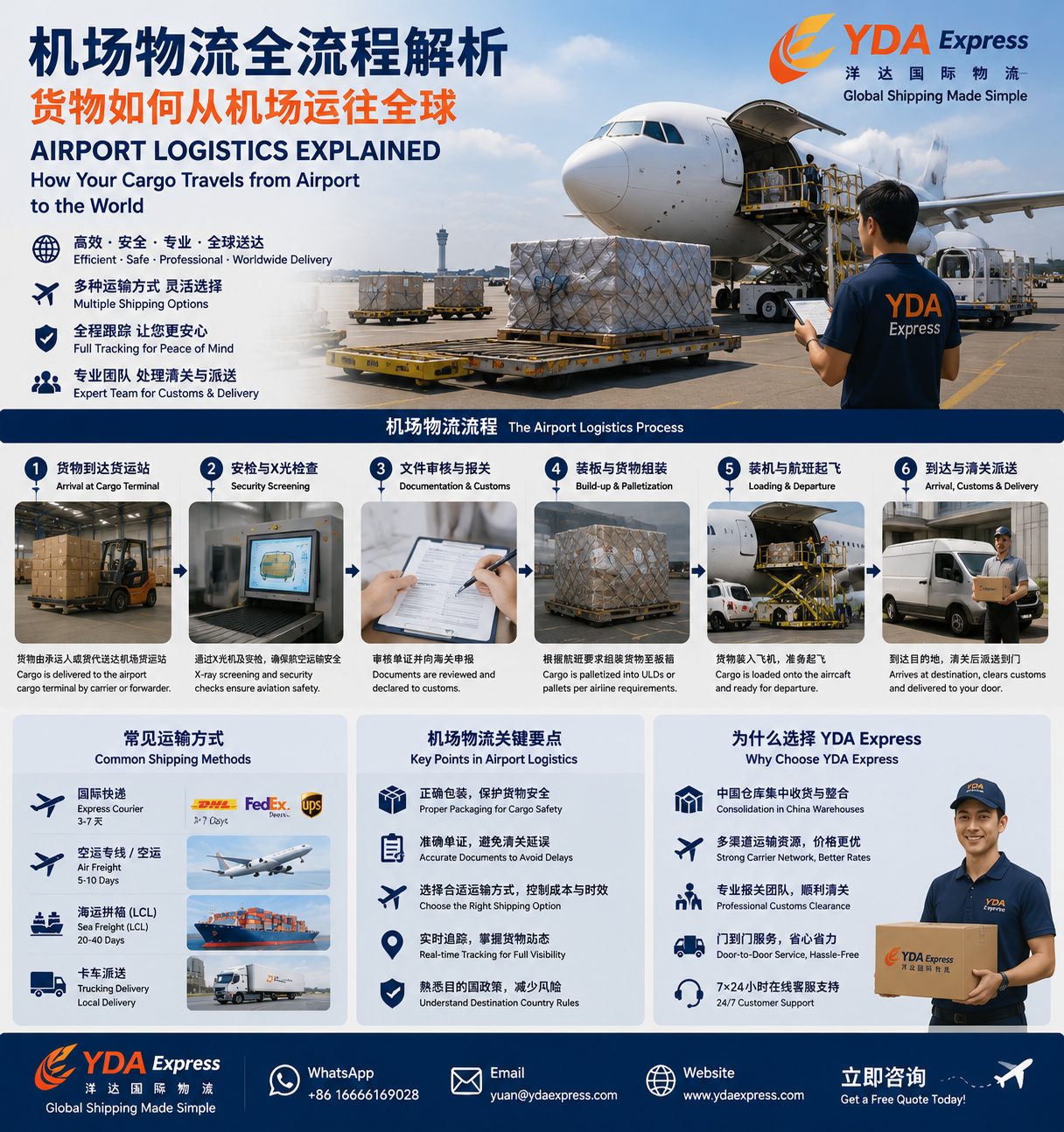
1. Arrival at the Cargo Terminal

Your shipment—whether it’s a single carton or a full pallet—gets dropped at an airport cargo terminal by a freight forwarder or courier. If you’ve used a consolidation service like YDA Express, your goods are already combined with other packages in a sturdy master carton, properly labeled, and accompanied by a master air waybill (AWB). That step alone can prevent a lot of airport headaches.

At the terminal, the cargo goes through a security check. This might be X-ray screening, canine inspection, or physical search. Certain items—liquids, batteries, powders—are subject to strict rules. For example, lithium-ion batteries shipped alone (UN3480) are generally banned from passenger aircraft and must go on cargo-only planes. A good logistics agent knows these regulations and ensures your shipment is correctly declared and packed.

2. Building the Load

Air cargo isn’t tossed loosely into a plane. It’s built into Unit Load Devices (ULDs)—those silver aluminium containers you see sitting on the tarmac—or secured onto pallets that fit a specific aircraft type. The loading must account for weight distribution, hazardous material segregation, and flight priorities. Express shipments often get loaded onto the first available flight, while general cargo might wait for a planned freighter service.

Freight forwarders book space on airlines days or even weeks ahead, especially during peak seasons like Chinese New Year or the holiday rush. If you’re shipping near the end of a quarter, you’ve probably noticed rates spike and space become scarce. That’s the airport logistics manager juggling demand against limited belly capacity on passenger flights or limited freighter schedules.

3. Customs and Documentation

Customs clearance happens either at the export airport or at a remote location before the cargo even arrives at the airport. Most international airports have a dedicated customs office that reviews digital manifests and sometimes inspects cargo. The paperwork—commercial invoice, packing list, certificate of origin—must match what’s in the box. An incorrect HS code or a missing declaration can delay your shipment by days.

Small, low-value packages often clear through simplified procedures, but that doesn’t mean you can ignore details. For instance, if you ship samples to the U.S. and mark them “gift” to avoid duty, customs might seize them. At YDA Express, we see countless incidents where a well-meaning shipper tries to cut corners on paperwork, only to end up paying more for storage and re-clearance.

4. Transit and Transshipment

Once airborne, your shipment might transit through a major cargo hub. Think Hong Kong International (HKG), Shanghai Pudong (PVG), Incheon (ICN), or Dubai (DXB). At these hubs, ULDs are broken down, cargo is re-screened, and parcels are re-routed onto connecting flights. A package moving from Guangzhou to São Paulo might travel via Doha or Dubai, while a cheaper option could route through Paris then onto a truck to final destination.

Tracking updates often get sparse during these transshipment windows. That’s normal. The AWB number is your key; it’s linked through the IATA Cargo-XML messaging system that airlines use to update statuses. If you’ve got a decent forwarder, they’ll monitor these statuses for you and alert you to any anomalies.

5. Arrival and Last-Mile Delivery

When the shipment lands at the destination airport, it goes through import customs clearance. If everything is in order, the cargo is released to a local agent or courier. For express shipments, carriers like UPS or DHL have their own in-house clearance and delivery networks, so the process is relatively seamless. For air freight, you might need to hire a customs broker to handle clearance, and then arrange a truck to pick up the goods.

The last mile can be trickier than the flight itself. Remote addresses, failed delivery attempts, or customs duties unpaid can result in your package sitting in a warehouse. This is why service-level choices matter: express services usually include door-to-door delivery with duties paid, while economy air freight often leaves the final delivery to you or a local partner.

Common Pitfalls in Airport Logistics (And How to Avoid Them)

Underestimating Transit Times

Air shipping is fast, but it’s not instant. A “3-5 day” express service usually means business days, not calendar days, and it starts from the day the carrier acknowledges receipt—not the day you order something online. Weekends, public holidays, and customs delays can add days. During peak seasons, even premium services slow down because aircraft are full.

Packaging That Can’t Survive the Journey

Airport cargo handlers aren’t gentle. Cartons get stacked, ULDs vibrate, and packages can be exposed to pressure changes and temperature swings during flight. A flimsy box with minimal padding might arrive crushed. International air shipping requires double-wall corrugated boxes, internal cushioning, and—if you’re sending heavy items—strapping or shrink-wrapping on a pallet. Experienced shippers use waterproof wrapping for sea-air combined routes because condensation can be an issue.

Ignoring Carrier Restrictions

Not all airlines accept all types of cargo. Some budget carriers refuse electronics with batteries. Others have embargoes on certain commodities to specific destinations. If your forwarder books cargo on an airline without checking these restrictions, your shipment gets left on the ground. A knowledgeable logistics company will pre-screen your goods against airline requirements before booking.

Mishandled Documentation

The commercial invoice needs to be accurate and complete. It should state the consignee’s full name and address, a goods description that’s not vague (“gift” or “samples” isn’t a description), the HS code, value, currency, and incoterms. For European Union imports, you’ll also need an EORI number for the consignee. Missing any of this can mean a shipment gets held at the airport and incurs storage fees.

Choosing the Right Airport Logistics Approach

Your shipping profile dictates how you should use airport logistics. Here’s a quick breakdown:

  • Small parcels under 30 kg: Express courier services like DHL, FedEx, or SF International are straightforward. The package gets handed to the courier, who handles airport logistics end-to-end. You get door-to-door tracking and predictable delivery times.
  • Larger, less urgent shipments (30–200 kg): Air freight consolidation through a forwarder can be more economical. Your goods share a ULD with other shipments, and you pay for the weight you use. Transit time might be a few days longer than express, but you can save 30–50% on freight costs.
  • Heavy or bulky cargo (200+ kg): Full air freight on a cargo-only airline becomes viable. You might book a dedicated pallet or container and handle last-mile logistics at the destination yourself.
  • Combining orders from multiple Chinese suppliers: This is where consolidation or “buy-for-me” services shine. Instead of dealing with multiple small shipments from different airports, a company like YDA Express receives all your purchases, inspects them, consolidates them into one shipment, and books the most suitable air route. That way, you pay one air waybill, deal with one customs entry, and get one delivery.

How YDA Express Streamlines Airport Logistics for You

Seeing the complexity up close, it’s clear why having a partner who knows the ins and outs of airport logistics can make a massive difference. YDA Express has spent years building relationships with air carriers and handling everything from toys to industrial parts. Our China-based warehouses in key cities like Yangjiang and Guangzhou allow us to receive goods directly, reduce domestic transit to the airport, and consolidate smarter.

What that means for you: we catch documentation errors before they become airport delays. We pack like someone who’s seen how many times a package can get dropped. And we choose routes based on real-world conditions—not just what booking platforms say. For example, during the COVID-era disruption, we shifted shipments from passenger-belly routes to cargo-only charters when demand spiked, keeping our customers’ supply chains moving.

Whether you’re a small business sourcing from 1688 or an individual shipping a care package home, the airport logistics piece should feel effortless. Get in touch to see how we can tailor a plan to your specific shipments, destinations, and budgets. Our team is available on WhatsApp at +86 16666169028 or through email at yuan@ydaexpress.com. You can also visit https://www.ydaexpress.com to calculate rates or start a shipment.

Airport logistics might look like a black box from the outside, but a bit of know-how and the right partner turns it into a predictable, reliable part of your international shipping. And honestly, there’s nothing quite like watching a tracking status change to “out for delivery” when you know exactly the journey it just took.