A customs declaration form is the single most important document when shipping goods from China. Get it wrong and your parcel may be delayed, returned, or hit with unexpected fees. This guide explains exactly what a customs declaration is, how to complete it correctly, and the common mistakes overseas shoppers and small businesses should avoid.
If you’ve ever ordered something from China, you’ve probably come across a customs declaration form. Maybe you barely glanced at it before clicking “confirm.” Maybe a seller filled it out for you and you never even saw it. But here’s the thing: that little form can make or break your shipment.
Picture this. You’ve just bought a new phone case, some LED lights, and a Bluetooth speaker from three different Taobao sellers. You’ve got a forwarding address in Shenzhen and you’re ready to combine everything into one box. The warehouse asks you to fill out a declaration. What do you write? “Electronics”? “Gifts”? A vague description? That’s where things go wrong.
At YdaExpress, we see hundreds of parcels held up every month because of sloppy paperwork. And to be fair, customs forms can feel like bureaucratic nonsense. But once you understand what they’re for and how to use them properly, they become just another step in a smooth shipping process.
What exactly is a customs declaration?
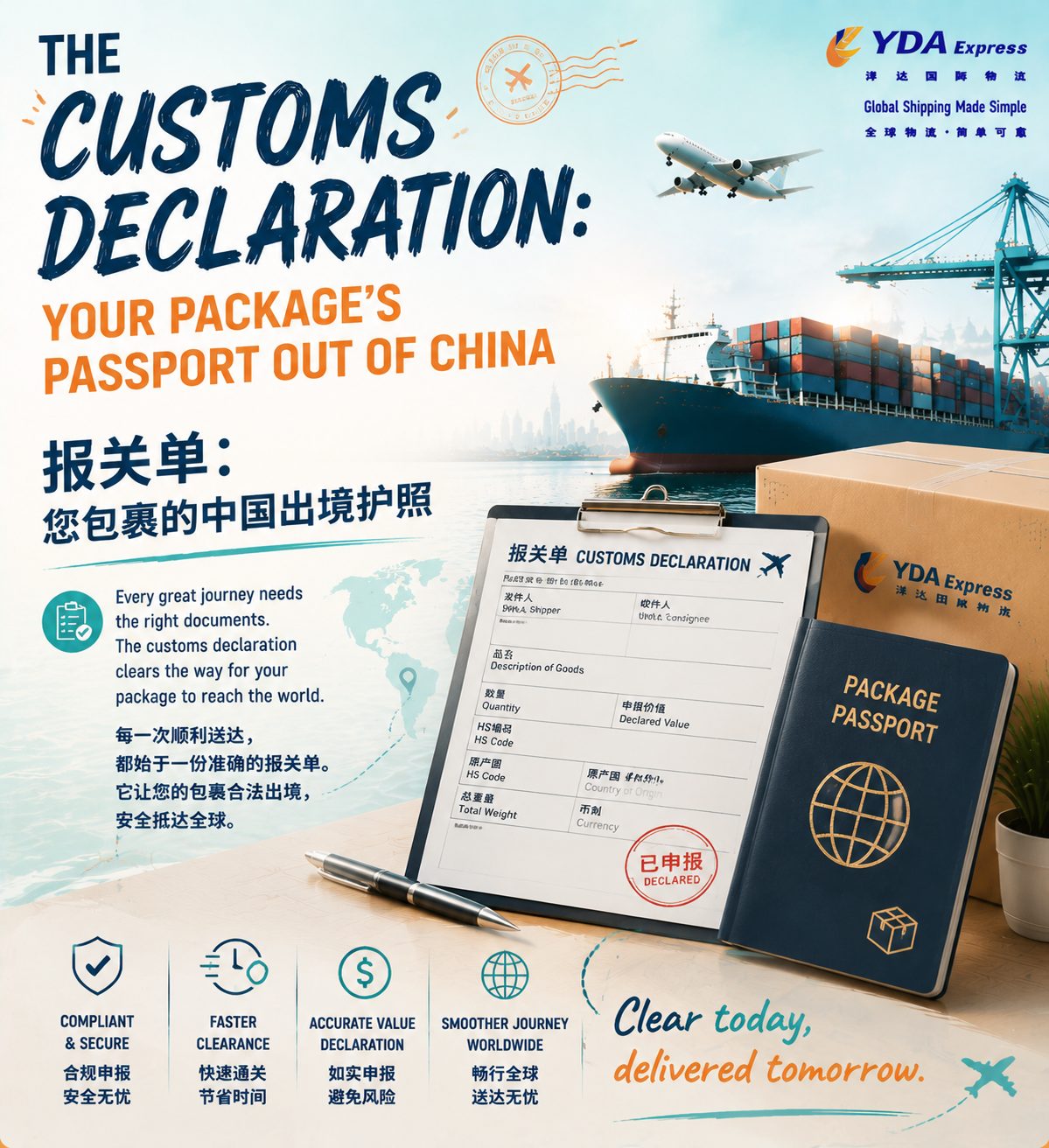
In plain English, a customs declaration is a statement that tells border authorities what’s inside your package, what it’s worth, and why it’s being sent. Every country uses these forms to assess duties and taxes, enforce import restrictions, and screen for prohibited items. If you ship from China to the UK, US, Germany, Australia, or anywhere else, a declaration is required.
For small parcels and personal shipments, the most common formats are the CN22 and CN23 labels. CN22 is a small green sticker used for packages up to 300 SDR (roughly 400 USD) in value and under 2 kg. CN23 is a larger form for packages exceeding those limits. Both ask for sender and receiver details, a list of contents with quantities and values, and a total weight.
For commercial shipments—especially those going through DHL, FedEx, or UPS—you’ll often encounter a commercial invoice that serves as the declaration. It includes HS codes (harmonized system codes) that classify each item for customs. If you’re a small business buying from 1688 to resell on Etsy, you’ll need to get comfortable with these.
Why sloppy declarations cost you money
Customs officers aren’t mind readers. If your declaration says “gift” and the X-ray shows a box full of phone accessories, they’ll flag it. If the declared value is suspiciously low, they’ll question it. And rightly so—they’re protecting their country’s revenue and security.
Common issues we see at YdaExpress:
- Vague item descriptions. Writing “clothes” is useless. Be specific: “men’s cotton T-shirts” or “children’s polyester dresses.”
- Undervaluation. When a package marked $15 contains a smartphone, you’re asking for a fine. Customs officers know the market value of goods.
- Missing or incorrect HS codes. These six- to ten-digit codes determine duty rates. Guessing wrong can trigger audits or extra fees.
- Unrealistic weights. A declaration that says 0.5 kg when the box clearly weighs 2 kg is a red flag.
And the consequences? Your package gets held. You waste days or weeks going back and forth with the carrier. You might pay storage fees. You might even face penalties. In the worst case, the goods get seized.
The difference between personal and commercial shipments
Customs rules depend heavily on whether the package is considered personal or commercial. If you’re an everyday shopper buying stuff for yourself, a simple CN22 with accurate info will usually do the job. But if you’re buying inventory—even just a few dozen phone cases—you cross into commercial territory. That means proper invoices, possibly an EORI number (in the EU), and paying duties.
Mistaking one for the other is a classic pitfall. A buyer in the US orders 50 pairs of earrings from a supplier on 1688 and asks the forwarder to declare them as “gift, value $20.” Customs takes one look and knows it’s commercial. The package gets bounced back or the buyer gets a nasty duty bill before release.
Filling out a declaration: a practical walkthrough
Let’s say you’re shipping a consolidated package through YdaExpress. You have three items: a hoodie, a phone case, and a set of kitchen knives. Here’s how you should approach the form.
- Sender and receiver: Full name, complete address, and a working phone number. Don’t use nicknames or half addresses. Carriers like DHL will call if there’s an issue.
- Item descriptions: Be painfully specific. “Men’s cotton blend hoodie,” “Silicone phone case for iPhone 15,” “Stainless steel kitchen knife set, 5 pieces.” Include the material and intended use.
- HS codes: If you have them, great. For the hoodie, it might be 6110.20; for the knives, 8211.92. If you’re unsure, a good forwarder can help assign them.
- Quantities and values: For each line, list how many and the price you paid (not the retail price you might sell at). Use the same currency, usually USD.
- Country of origin: China, obviously, since the goods were made there.
- Total weight and value: Add everything up. This should match the physical package weight and the commercial invoice.
That’s the basics. But there’s an art to minimizing friction. For example, if your knives are subject to high duties in the destination country, a broken-down description (“stainless steel kitchen knives” not just “knives”) can help the officer classify them correctly and avoid misapplied high rates. A good forwarder knows these tricks.
How YdaExpress handles customs paperwork
We’re not just a storage and forwarding service. When you ship through YdaExpress, our team reviews your declarations before the package leaves our warehouse. If something looks off—a vague description, a mismatched value—we’ll flag it and help you fix it. We want your parcel to clear customs as smoothly as possible.
For commercial clients, we offer HS code lookup and invoice preparation. We also help decide the best shipping channel: DHL, FedEx, UPS, or air freight, depending on the goods and urgency. Sometimes the fastest route isn’t the cheapest, but the one least likely to get stuck in customs.
And if a package does get held? You won’t be left guessing. Our support team knows how to interpret the customs hold messages and what additional info to provide. Often it’s a simple clarification that gets the clearance moving again.
Real-world scenarios
Scenario 1: The mystery box A customer consolidated three orders from Taobao: plush toys, stickers, and a phone charger. He declared everything as “toys.” Customs stopped the package because the X-ray showed electronics. After a week of back‑and‑forth with the carrier, he had to submit a corrected declaration with complete item details. The delay cost him two weeks.
Scenario 2: The undervalued handbag A shopper bought a branded handbag from a Chinese supplier and asked us to declare it at $50 (actual cost: $300). Our team warned her that undervaluation could lead to seizure and fines. She insisted. Two weeks later, the bag was seized by European customs for fraud. She lost the bag and was banned from using that carrier.
Scenario 3: Getting it right A small business owner buys phone accessories from 1688. He ships 200 pieces, properly listed with HS codes, accurate values, and a commercial invoice. Duties are calculated and paid online through DHL’s portal. The package arrives in three days with no holdups. That’s how you do it.
The dark side: prohibited and restricted items
Customs declarations also help enforce what you can and can’t send. Lithium batteries, liquids, powders, counterfeit goods, weapons, or items with strict import controls (like food or medicines) require extra documentation or are outright banned.
If you’re shipping from China, always check the destination country’s rules. The US has import bans on certain Chinese goods due to intellectual property concerns. The EU has strict rules on electronics with batteries. Australia is notoriously tough on wooden products and seeds.
A reliable forwarder will tell you upfront if your items are risky. We at YdaExpress maintain an updated list of prohibited items by country and can suggest alternatives—like splitting shipments or using special battery channels.
The human factor
Honestly, most delays come down to carelessness. People rush. They copy-paste generic descriptions. They guess values. And they figure, “It’s just a form, who reads it?” Customs officers read it. Carriers read it. Automated systems scan for anomalies.
Taking ten extra minutes to get the declaration right saves days later. If you’re using a forwarding service, lean on their experience. Ask: “What should I write for this?” A good agent will walk you through it.
Wrapping up
So, next time you’re staring at that customs declaration form, don’t treat it as an afterthought. It’s your package’s passport. Give it the right information and it sails through. Cut corners and it ends up in a warehouse cage.
If you’re shipping from China and want peace of mind, our team at YdaExpress can handle the paperwork for you. From our warehouse in Shenzhen, we’ll consolidate your orders, review your declarations, and send your parcels out via the most appropriate carrier. Whether you’re a solo shopper or a growing business, we make the process straightforward.
Ready to ship? Reach us on WhatsApp at +8613078354343 or visit ydaexpress.com to get started. We’ll get your goods out of China without the customs headache.
