Customs Policies Demystified: What Overseas Shoppers Must Know Before Shipping from China

管理员
2026年7月5日
14 阅读
0 喜欢

A practical overview of how customs policies shape the shipping experience from China, with tips on duties, documentation, and avoiding delays.

You’ve found the perfect item on Taobao, paid for it, and now it’s sitting in a warehouse in China. The next step? Getting it through customs. That’s where the real journey begins—and where many first-time shippers hit a wall.

Customs policies aren’t just bureaucratic fine print. They’re the reason your package sails through in three days or gets stuck for three weeks. They determine whether you’ll pay extra fees, need to provide more paperwork, or—in the worst case—have your goods seized. Yet for all their importance, customs policies are often misunderstood or ignored until something goes wrong.

I’ve seen packages delayed because the sender used a vague description like “gift” instead of listing the actual contents. I’ve watched customers get hit with surprise bills because they didn’t know their country had lowered the duty-free threshold. At YdaExpress, we handle thousands of shipments every month, and the ones that move fastest are always the ones where the sender respects the rules—not necessarily the ones with the highest declared value.

So let’s break this down into something useful. No jargon, no scare tactics—just the key parts of customs policy that affect your shipments from China, and how to work with them instead of against them.

What exactly is a customs policy?

A customs policy is the set of rules a country uses to control what comes in, how it’s taxed, and whether it’s allowed at all. Every country has its own version, but they all revolve around a few core principles: collecting revenue, protecting local industries, and keeping out dangerous or illegal items.

When you ship something from China to the US, the UK, or anywhere else, that package doesn’t just land and get delivered. It goes through a customs checkpoint where officers apply their country’s policy. They’ll look at the declared value, the description of the goods, the country of origin, and the intended use. Based on that, they decide if duties or taxes apply, if the item needs inspection, or if it should be sent back.

Here’s the thing: customs policies aren’t static. Thresholds change, restricted lists get updated, and enforcement priorities shift. What sailed through last year might get flagged this year. That’s why a working knowledge of the basics pays off.

The three pillars that actually impact your shipment

Not all parts of customs policy matter to you as an individual shipper. Forget the trade-agreement fine print. Focus on these three:

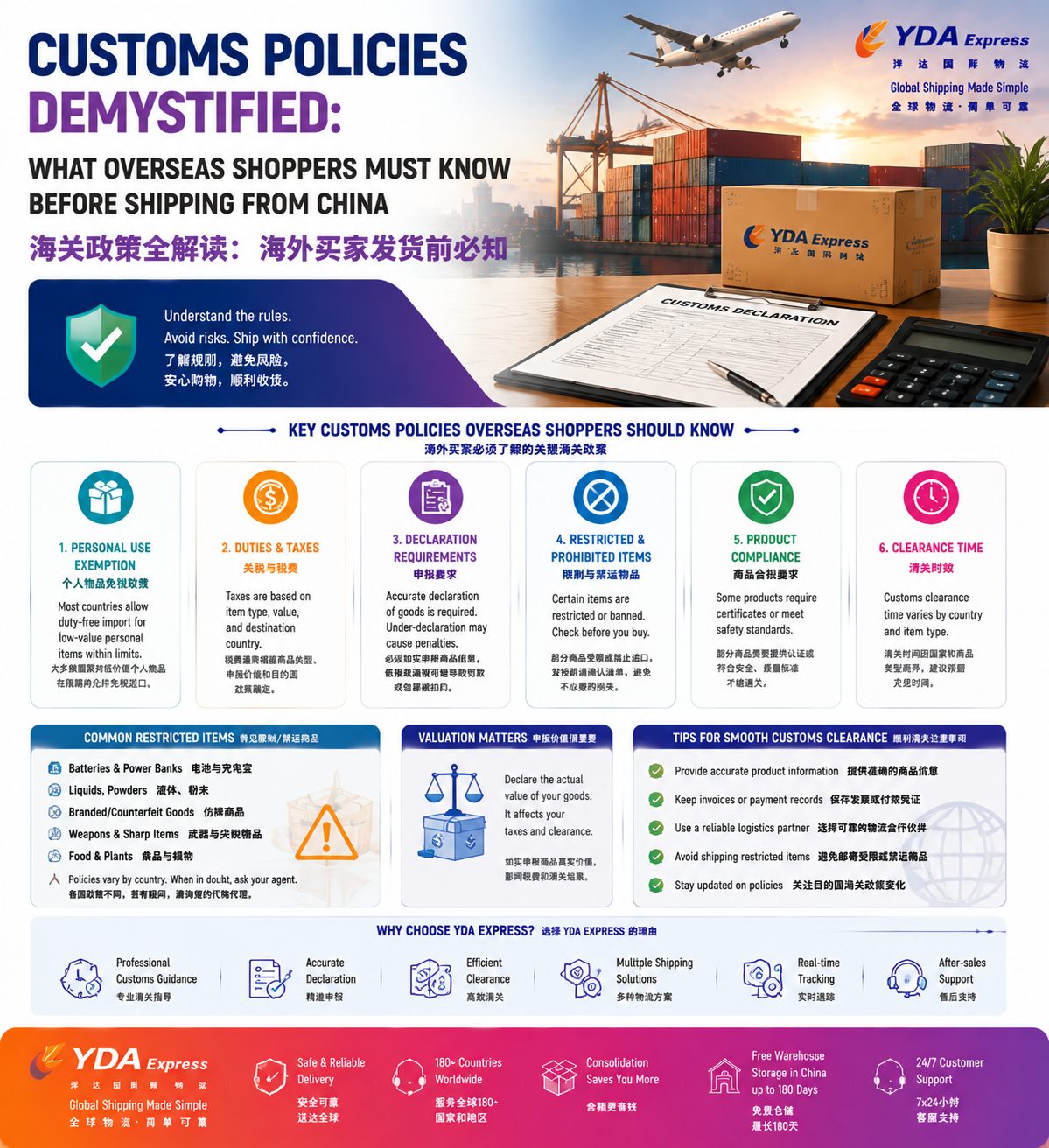
1. HS codes and duty rates

The Harmonized System (HS) code is a six-to-ten-digit number that classifies your product. Almost every country uses the same first six digits. A silk scarf and a polyester one have different codes, and that difference can mean paying 5% duty instead of 0%.

If you’re shipping multiple items, each one technically needs its own HS code on the commercial invoice. In practice, for personal shopping, many couriers will accept a simpler description—but if you undervalue or miscategorize, you risk a dispute. At YdaExpress, we often see packages flagged because the invoice says “clothing” when the X-ray shows something with batteries. Customs officers aren’t stupid.

How do you find the right HS code? You can search your country’s tariff database, but honestly, for most everyday items, your forwarder should be able to assign a reasonable code. What matters is that the code matches the item, and the value matches reality.

2. De minimis thresholds and tax rules

“De minimis” is the value below which a country waives duties and sometimes taxes. It’s the reason you can order a $10 phone case and not get billed. But thresholds vary wildly:

  • United States: $800 per shipment (Section 321). No duty or tax below that, but it’s under review and could drop.
  • European Union: No duty below €150, but VAT is charged on everything, even a €1 item, since July 2021.
  • United Kingdom: Goods under £135 have VAT collected at the point of sale by the retailer or marketplace. For gifts over £39, duty may apply.
  • Canada: C$20 for duty, C$40 for tax? Actually, Canada charges tax on everything over C$20, and duty over C$150. It’s messy.
  • Australia: A$1,000 for duty and GST, but GST is now collected on low-value imports by platforms like eBay.

Notice a pattern? Even when duty is zero, tax often isn’t. And the EU’s move to scrap the low-value VAT exemption surprised many shoppers. If you’re not sure, check your country’s current threshold before shipping. A $200 coat might trigger a $40 duty bill you didn’t expect.

To be fair, some forwarders offer “tax-free” lines for certain countries. These are not magic—they use legal loopholes like routing through countries with favorable trade agreements or bulk-clearance programs. They work, but they have limitations on product type and value. Always ask what the line actually covers.

3. Prohibited and restricted items

Every country has a list of things you simply cannot import, or can only import with special permits. The obvious ones—weapons, drugs, endangered species—aren’t your problem. The ones that catch people out are the everyday items:

  • Lithium batteries: Many countries restrict standalone batteries or require special labeling. Power banks, hoverboards, and some electronics fall into this.
  • Cosmetics and food: The EU has strict rules on ingredients. US FDA can seize shipments without prior notice. Australia’s biosecurity won’t let a wooden toy through if it hasn’t been treated.
  • Counterfeit goods: Even one fake handbag can get your entire shipment confiscated and you might get fined. Customs actively watch for brands.
  • Used goods: Some countries restrict used clothing or electronics without fumigation certificates.

Before you buy anything off 1688 or Pinduoduo, ask yourself: could this item raise a red flag? If you’re not sure, ask your forwarder. A good agent will know the current hot spots. At YdaExpress, we maintain a running list of items that gave our customers trouble, and we’ll flag risky purchases before they leave the warehouse.

Why customs delays happen (and it’s not always the policy’s fault)

Packages get held up for a handful of reasons, and they’re surprisingly consistent.

The most common trigger: incomplete or inconsistent paperwork. The commercial invoice needs a clear, specific description. “Clothes” is asking for trouble. “3 x men’s cotton T-shirts” is much better. Include the country of origin, the value per item, and the currency. If the invoice says $50 but the package looks like a $500 coat, expect a reassessment.

Random inspections are another factor. Even perfect paperwork can’t stop a random scan, and if your box is picked, it adds a day or three. Consolidated shipments—where your items are packed with others’—can slow things further if one person’s goods cause the whole batch to be inspected.

The destination country’s current focus also plays a role. Australia might be cracking down on undeclared wood, Canada on undervalued textiles. These enforcement waves aren’t always public, but experienced forwarders notice patterns.

How to stay ahead of customs policy headaches

You don’t need a law degree to clear customs. A few habits make a huge difference:

Declare accurately and consistently. Don’t ask your forwarder to lower the value to save tax. Customs officers use valuation databases, and undervaluation can lead to fines, seizure, or blacklisting. If you’re a small business, that record can hurt future shipments.

Ship with proper packaging and labeling. Lithium batteries need the right labels. Cosmetics need ingredient lists. If the package is damaged, customs might open it for inspection just to check contents.

Know your country’s de minimis and use it wisely. If you’re under the threshold, you might save money by splitting orders. If you’re over, ask your forwarder about tax-efficient shipping lines. Don’t just guess.

Work with a forwarder who understands your destination. A provider that ships everywhere is fine, but one that regularly handles shipments to your country will know the unwritten rules. For example, some EU countries strictly enforce CE marking for electronics; others are lenient. A good China-based forwarder will have current feedback from customers.

The YdaExpress approach to customs-friendly shipping

At our warehouse, we treat customs readiness as part of the service, not an afterthought. When you consolidate multiple orders from Taobao, JD, or 1688, we don’t just stuff everything into a box. We check the items against known restricted lists, label batteries clearly, and generate a commercial invoice that uses the right descriptions and values.

We also give you a choice of shipping lines. If you’re sending a low-value personal gift to the US, we might recommend a line that takes advantage of the $800 de minimis. If you’re shipping a small batch of samples to Germany, we can suggest a tax-paid route that avoids the recipient getting a surprise VAT bill. And if you’re unsure whether your item will clear, just ask—we’d rather spend two minutes checking than watch a package bounce back from customs.

The bottom line

Customs policy sounds intimidating, but it’s really just a set of predictable rules. Learn the basics—HS codes, your country’s threshold, and what can’t be shipped—and you’ll avoid 90% of problems. The other 10% you can sidestep by teaming up with a forwarder that treats customs as a priority, not an afterthought.

Ready to ship your next batch of goodies from China? Get a free quote or just talk through your situation. Our team at YdaExpress is here to make cross-border shipping as smooth as it should be.

Visit YdaExpress or reach us on WhatsApp at +8613078354343.