How the 代购系统 Simplifies Shopping from China (Even If You Don’t Speak Chinese)

管理员
2026年7月11日
20 阅读
0 喜欢

A practical look at how a 代购系统 (purchasing agent system) works, covering the process from order to delivery, consolidation savings, shipping options, and tips for finding a reliable China agent.

You find the perfect pair of sneakers on a Chinese marketplace. The price is half what it'd cost back home. But then reality hits: the site is in Mandarin, payment requires a local bank card, and the seller won't ship internationally. Frustrating, right? That's where a 代购系统, or purchasing agent system, steps in.

This isn't just another middleman. It's a full-service bridge that lets overseas buyers shop from China like a local, without the headaches. And once you see how the pieces fit together, it might change the way you source everything from gadgets to home goods.

So, what exactly is a 代购系统?

Think of it as a personal shopper, warehouse, and shipping department rolled into one. A 代购系统—daigou system, in pinyin—is a service that buys items on your behalf, receives them at a Chinese address, and then forwards the package to your door overseas.

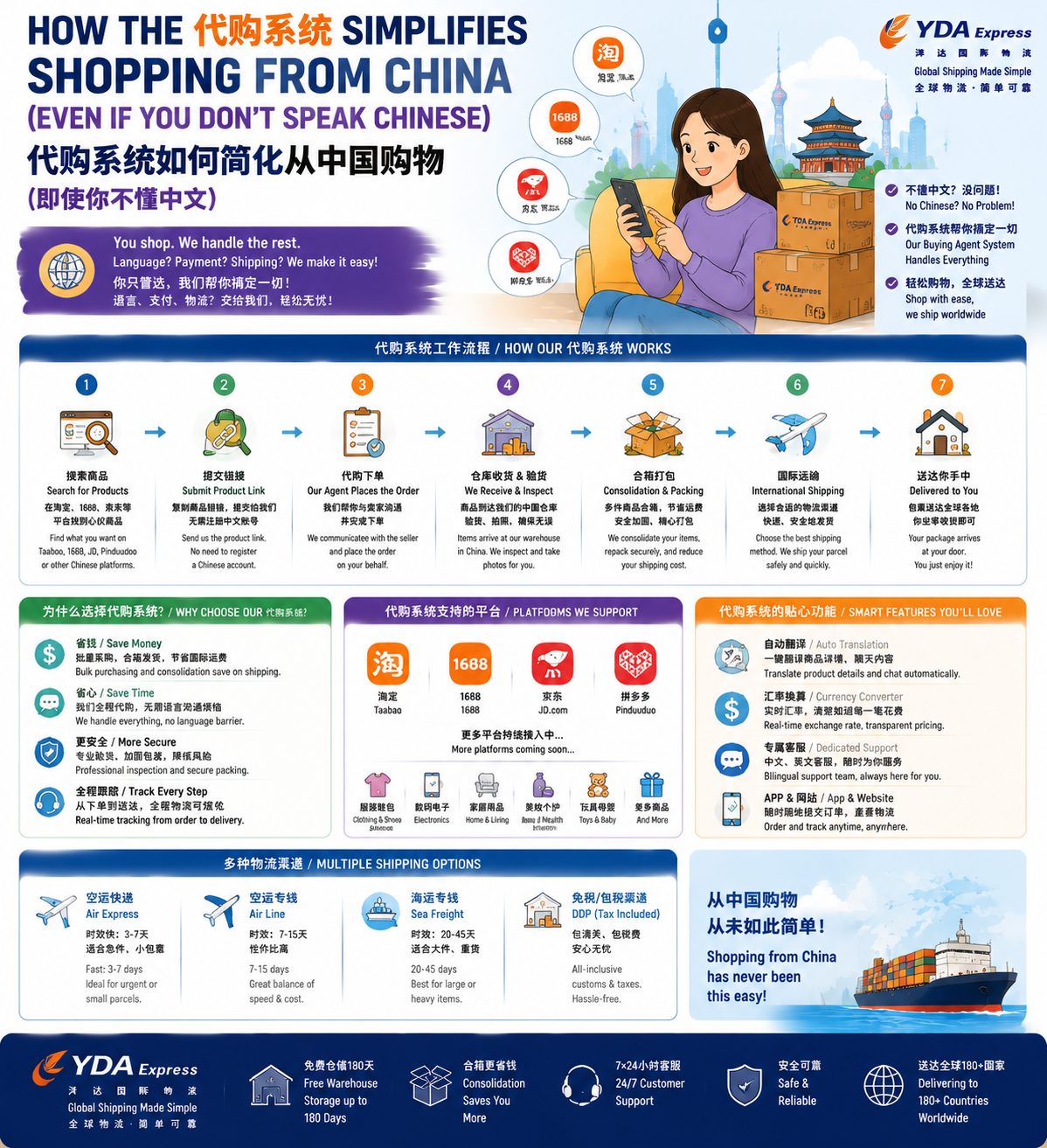
Here's the typical flow:

  1. You provide the product links. Maybe you've browsed Taobao, 1688, or JD and copied the URLs of the items you want.
  2. The agent checks and purchases. They confirm stock, verify prices, and buy the goods using their local payment methods.
  3. Goods arrive at their warehouse. The agent inspects items for obvious damage, sometimes sends photos, and stores them for free or a small fee.
  4. You pick a shipping method. Consolidate multiple orders into one box, choose between air freight, express couriers like DHL or FedEx, or economy lines.
  5. International delivery. The system handles export paperwork, then the parcel travels from the warehouse to your doorstep.

Throughout this, a good agent keeps you updated via a dashboard or messaging. It’s not just buying stuff; it’s logistics, documentation, and local know-how bundled into one.

Why not just ship directly from a Chinese store?

Some platforms now offer direct international shipping. But that often comes with limits: only certain items qualify, fees are opaque, and you have zero control over consolidation. If you buy from three different sellers, you get three separate shipments—and three shipping bills.

A 代购系统 changes that. Here’s what you gain:

  • Consolidation saves money. Combine a lightweight scarf with a heavy pair of boots into one box. International courier pricing is based on weight and volume, so one larger parcel is almost always cheaper than multiple small ones. At YdaExpress, we regularly see customers cut shipping costs by 30–50% through smart consolidation.
  • You can shop at stores that don’t export. Many Taobao sellers simply won't deal with overseas customers. A local agent removes that barrier.
  • Quality checks before dispatch. The agent can photograph items on arrival, so if the seller sent the wrong color or a damaged product, you can return it before it leaves China.
  • Customs paperwork support. Export declarations and commercial invoices can be tricky. An experienced agent knows how to describe goods and assign HS codes to minimize delays.

The logistics pipeline: how your stuff actually moves

Once the items are in the warehouse, you're not just clicking "ship." You're choosing a route based on speed, cost, and risk tolerance. Here's a quick breakdown of typical channels:

Method Typical Transit to US/UK Best For
Express (DHL, FedEx, UPS) 3–7 business days Urgent, high-value orders; good door-to-door tracking
Air freight + local courier 7–14 days Medium parcels where you want a balance of speed and price
Economy sea freight 25–45 days Large, heavy, or non-urgent goods; very low cost per kg

A good 代购系统 will show you real quotes for each. You might see that shipping a 5 kg box to California via DHL Express costs around $65, while an air freight line could be $35 with a week’s extra wait. For a small batch of t-shirts, sea freight might drop the rate under $10/kg. The system pulls from multiple carriers to give you those choices.

One detail many first-timers miss: volumetric weight. Carriers charge for the space your box occupies, not just its actual weight. So if you order a bulky but light item (like a down jacket), the system should help you decide whether to squeeze it into a smaller box or keep it separate. That’s the kind of practical advice a human agent—or a smart system—can nudge you toward.

Real-life scenarios: who’s actually using a 代购系统?

It’s not just individuals grabbing bargains. I’ll give you two common profiles we see:

The e‑commerce starter. Someone in Australia wants to test a new product idea—say, eco-friendly phone cases from 1688. They order 50 units for $1.50 each. The agent receives, inspects, photographs, and repacks them tightly. Shipping via FedEx Economy takes 10 days and costs $4 per unit. Total landed cost: about $5.50 per case, which they’ll retail at $19.99. Without an agent, they’d be gambling on quality and drowning in paperwork.

The overseas collector. A sneaker enthusiast in Germany spots a limited release on a Chinese boutique site. The seller won’t ship beyond China. The agent buys it at retail price, receives it, ensures the box is pristine, and forwards it via DHL with full insurance. The extra fee for the agent’s service? Maybe 10% of the item cost. Considering the resale value, it’s a no‑brainer.

Both scenarios rely on trust and transparency—which brings up a fair question.

How to pick a reliable 代购系统

Not all agents are equal. Some hide fees, others are slow to communicate. Here’s what to look for:

  • Clear fee structure. The service charge should be a stated percentage (often 5–10%) or a flat fee per order. Shipping quotes should come from live courier APIs, not guesstimates.
  • Warehouse perks. Do they offer 30–90 days of free storage? Long storage gives you time to collect multiple orders before shipping one consolidated box.
  • Quality inspection options. Can you request detailed photos or even a video check? Some agents charge a small fee, but it’s worth the peace of mind.
  • English-speaking support. Not just a translation app—actual staff who understand both languages and logistics. It makes a huge difference when something goes sideways with a seller.
  • Payment methods. Look for a system that accepts PayPal, credit card, or local bank transfers, so you’re not stuck trying to load a Chinese wallet.

One detail that often gets overlooked: return handling. If a seller ships the wrong item, a good agent will return it locally for a modest fee, get your refund, and credit your account. That’s a lot more complicated if you’d shipped it all the way to the US first.

Common slip-ups to avoid

Even with a solid system, things can go off the rails if you’re not mindful. Watch out for these:

  • Ignoring the shipping calculator before buying. Check the estimated freight for your dream furniture set; that $200 couch might cost $900 to ship by sea. It could still be a deal, but do the math.
  • Forgetting about import duties. Most agents won’t prepay customs fees unless you ask. Know your country’s de minimis threshold. In the US, goods under $800 are often duty-free; the UK has much lower limits post‑Brexit.
  • Not labeling parcels. If you’re consolidating 10 items, clearly mark which orders belong to which shipment in the system. Otherwise, the warehouse might miss an item, or you’ll pay to ship something you didn’t want yet.
  • Opting for the cheapest courier every time. Some budget lines have limited tracking and insurance. If your parcel is worth $500, springing for DHL or FedEx with proper coverage is sensible.

Bringing it all together

When you boil it down, a 代购系统 solves a specific problem: the gap between Chinese sellers who don’t (or can’t) export and overseas buyers who want a straightforward way in. It’s a mix of local purchasing power, logistics infrastructure, and customer service. And while there’s no magic bullet, a well-run system makes the process feel nearly as simple as ordering locally.

If you’re tired of juggling language barriers, unknown shipping routes, and the fear of receiving a crushed box, give a professional agent a try. The right setup will show you per‑order fees, real‑time shipping quotes, and let you track everything from the moment your goods arrive at the warehouse until they land at your door.

Curious to see how it works? Reach out to YdaExpress for a consultation or a free quote. We’ll walk you through the entire process and help you decide if a 代购系统 fits your needs—no pressure, just honest advice from people who do this every day. Visit us at https://www.ydaexpress.com or WhatsApp us at +8613078354343.

Whether you’re a startup testing prototypes or a shopper after that one-of-a-kind find, the China market is wide open. A reliable purchasing agent system is your key to unlocking it.