A practical guide to understanding 代购转运 (daigou zhuanyun) — the combined purchase agent and freight forwarding service that lets you buy from Chinese online stores and have items shipped worldwide. Learn how it works, what to watch out for, and how to make your cross-border shopping easy and cost-effective.
Demystifying Daigou Zhuanyun: Your Guide to Purchase Agent and Freight Forwarding from China
You’re scrolling through Taobao and spot the perfect pair of sneakers — a limited release that costs half what resellers are charging on eBay. You add them to your cart, ready to check out, then hit a wall. The seller doesn’t ship internationally. Or maybe they do, but the shipping fee is more than the shoes themselves, and there’s a tangle of customs forms you’re not sure how to fill out. It’s frustrating, and you’re not alone.
That’s where 代购转运 — daigou zhuanyun — comes in. It’s a two-part solution that’s been helping overseas shoppers buy from China for years, but a lot of people still don’t know how it works or why it’s often the smartest way to ship from Chinese marketplaces. Let’s break it down without the jargon.
What Exactly Is 代购转运?
The term is a combination of two services: 代购 (daigou) means purchase agent or proxy buyer, and 转运 (zhuanyun) means freight forwarding or transshipment. Together, they cover the entire journey of getting something from a Chinese seller to your doorstep in another country.
A purchase agent buys items on your behalf from Chinese platforms like Taobao, Tmall, 1688, or JD.com — sites that often require a Chinese payment method, local address, or just a level of Mandarin proficiency that can be a barrier. The freight forwarder then takes care of the international leg: receiving your packages, checking them, consolidating multiple orders into one box, and shipping them out via a carrier that makes sense for your budget and timeline.
Honestly, it sounds more complicated than it is. In practice, it’s a seamless process once you’ve done it a couple of times, and the cost savings can be significant.
Why Bother With a Purchase Agent and Forwarder?
If you’ve ever tried to buy direct, you know the hurdles. Language barriers, payment hiccups, and sky-high direct shipping quotes are just the start. Here’s what a good 代购转运 service actually gives you:
- Access to more products: Many Chinese sellers don’t list on global platforms. A purchase agent opens up the entire domestic market — from unbranded phone cases to industrial parts — at wholesale or near-wholesale prices.
- Consolidation savings: Buy from five different stores? The forwarder holds all your packages in a local warehouse, repacks them into one box, and ships them together. You pay one international shipping fee instead of five. That’s often where the real savings kick in.
- Customs know-how: A reliable forwarder knows how to declare items, what information customs authorities (like US CBP or UK Border Force) want, and how to minimize the chance of delays or extra fees. They’ve seen it all.
- Quality checks: Many agents will snap photos of your items when they arrive, so you can spot a problem before it’s on a plane. Some even do basic testing for electronics.
To be fair, it’s not just about saving money. It’s about saving time and headaches. A good agent handles the tiny but critical details: making sure your package label doesn’t get smudged, adding extra tape to a flimsy box, or splitting a shipment if it’s too heavy for one carrier.
When It Makes Sense vs. Buying Direct
Not every purchase needs a purchase agent and forwarder. If you’re buying from a Chinese brand that already runs their own international site (like Xiaomi’s global store), buying direct is often fine. But for most other situations, a 代购转运 setup pays off.
You’ll benefit most when:
- You’re buying from multiple sellers and want one consolidated shipment.
- The seller doesn’t offer international shipping or charges an arm and a leg.
- You need someone to inspect items before they leave China.
- You’re ordering custom items or products that require communication with the seller (negotiating, custom sizes, etc.).
- You’re importing inventory for a small business and need reliable, repeatable logistics.
If you’re just buying a single $10 item from a seller that ships via Aliexpress Standard Shipping, a forwarder might be overkill. But even then, some agents can handle it with minimal fees, and you gain peace of mind with the extra inspection.
How the Process Actually Works
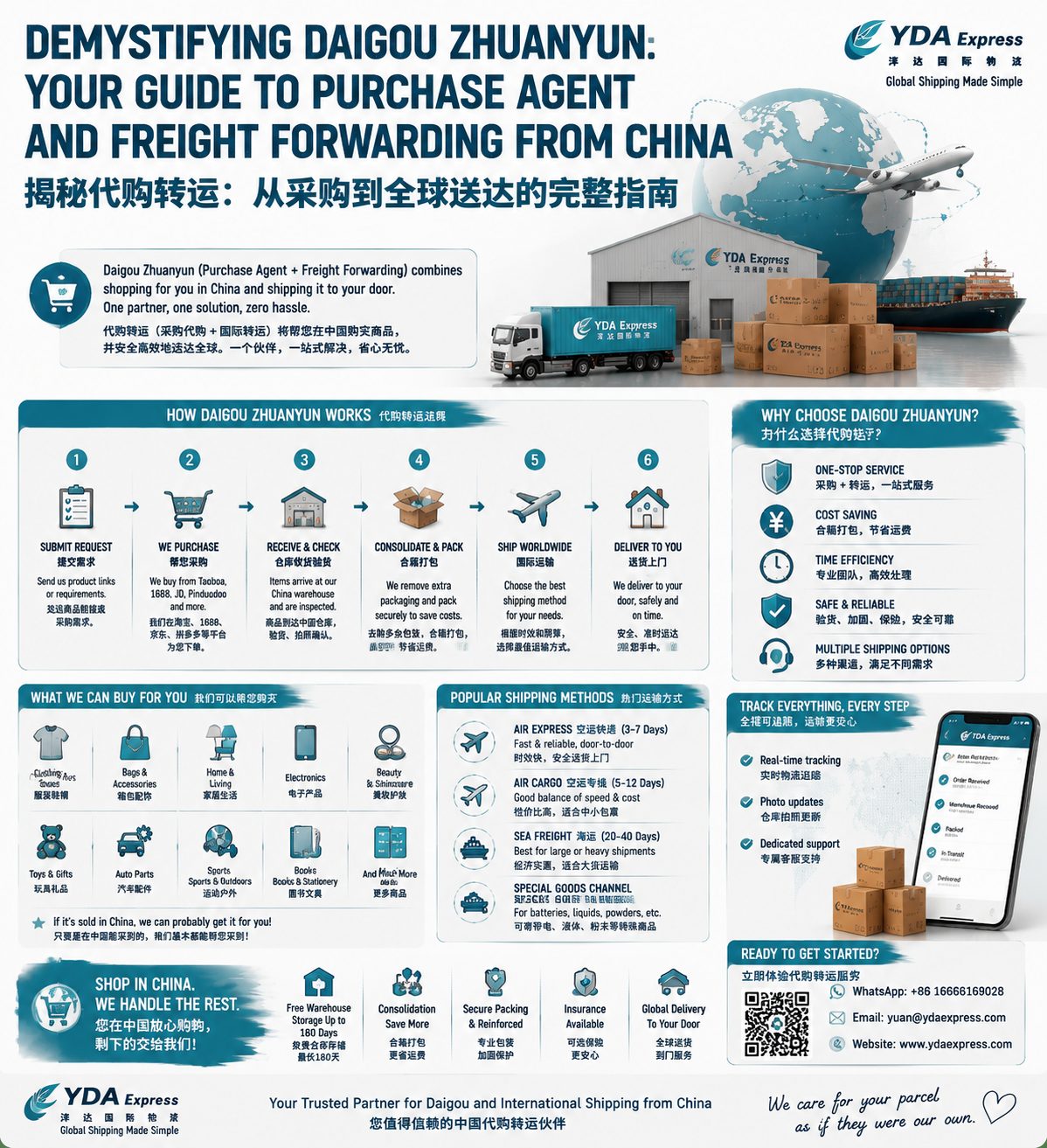
Here’s the typical flow, using a service like YdaExpress as an example. The steps are straightforward.
- Sign up and get a local Chinese address. Once you register, you’re assigned a unique warehouse ID and a physical address in China (usually in a logistics hub like Guangzhou or Shenzhen). This is where your purchases go.
- Shop and buy — or let the agent do it. If you’re comfortable using Taobao, you can order yourself, pay with Alipay (if you have it), and manually enter the forwarder’s address at checkout. If not, send the product links to your purchase agent. They’ll quote a total including item cost, domestic shipping, and a small service fee (often 3-5%), then buy it for you.
- Your items arrive at the warehouse. The forwarder receives them, logs them in, and notifies you. This is where a good service shines: you’ll get weight, dimensions, and usually photos. If something looks off, you can arrange a return or exchange right then.
- Choose your shipping method. This is the key decision. You’ll typically see options like:
- Express courier (DHL, FedEx, UPS): Fast (3-7 days), reliable, but pricier. Good for documents, small valuables, or urgent shipments.
- Air freight + last-mile delivery: A middle ground. Slower than express but faster than sea, often handled by a freight consolidator, then handed off to a local carrier like USPS or Royal Mail.
- Sea freight: Cheapest per kilo, but takes 25-45 days. Great for heavy, non-urgent items like furniture or bulk inventory.
- Dedicated lines: Some forwarders have negotiated special rates on established routes (e.g., China to US via a specific airline or ship line). These can be very cost-effective and surprisingly fast.
- Consolidation and packing. If you have multiple parcels, this is where the magic happens. The forwarder combines them, removes unnecessary packaging (if you ask), and packs everything tightly to reduce volumetric weight. They’ll also prepare the commercial invoice and label.
- Pay for shipping and track your package. Once paid, you get a tracking number. Then you just wait — and maybe refresh the tracking page more than you should.
The whole thing can move quickly. A small package might leave China within 24 hours of payment, though holidays and weekends can stretch that.
Picking a Reliable Service: What Matters
Not all 代购转运 providers are created equal. Here’s what I’d look for, based on real-world logistics experience.
Transparency in fees. Nothing worse than getting a quote and then seeing extra charges. A good agent shows item cost, domestic shipping, service fee, and international shipping separately. Watch out for hidden “handling fees” or inflated shipping weight.
Carrier options and expertise. A forwarder that only offers DHL isn’t always the best. They should have a range — maybe UPS for heavy items to the US, EMS for smaller non-urgent parcels, and a reliable sea freight partner. Ask about their shipping volume with each carrier; higher volume often means better rates.
Customer communication. Do they reply within a few hours? Can you contact them easily via WhatsApp, WeChat, or email? When a customs delay hits, you want someone who’s reachable, not an automated chatbot.
Packaging care. Some items are fragile, some are oddly shaped. A good warehouse crew will double-box electronics, use bubble wrap generously, and not just toss your three pairs of shoes into a plastic bag. If you’re worried about damage, ask about their packing standards before committing.
Return handling. If a seller sends the wrong size, can your agent return it locally? A solid purchase agent will handle domestic returns smoothly, saving you the nightmare of international reverse logistics.
Customs: The Elephant in the Room
No one likes thinking about customs, but it’s part of the deal. Here’s the reality: most packages from China arrive without issues, especially if they’re personal-use items with a reasonable declared value.
In the US, shipments under $800 generally enter duty-free under the de minimis threshold. In the UK, it’s £135, and in the EU, it’s €150, but starting from July 2021, VAT is often collected at the point of sale for goods under €150 via the IOSS system. A good forwarder will help you navigate this by correctly labeling your shipment and providing necessary invoices.
If you’re shipping commercial goods or a large quantity of one item, you might face duty. That’s when having a shipping pro matters. They can advise on HS codes, whether splitting packages makes sense, and how to avoid red flags. Honestly, a little expert guidance at the start can prevent a seized package or a big bill you weren’t expecting.
A Real Example: How a Consolidation Saves Cash
Let me walk through a typical scenario. A US customer wants three things: a smartphone case from a Shenzhen brand, a couple of graphic tees from a Hangzhou designer, and a set of desk lamps from a 1688 factory. Each item is small, but the tees seller wants $15 for shipping to the US, the phone case seller asks $20, and the factory only offers sea freight with a $50 minimum.
Using a 代购转运 service, the customer sends the links to their agent. The agent buys all three, pays minimal domestic shipping (often free or a couple of bucks within China), and sends them to the warehouse. There, the team removes the tees’ thick retail packaging, wraps the lamp carefully, and boxes everything into a corrugated carton weighing 2.5 kg. The international shipping options: express via DHL for $28 (arrives in 5 days), or a dedicated air line for $18 that takes 10 days. Customer picks the cheaper line. Total savings compared to buying direct: around $40, and they get all items in one box instead of three random deliveries.
That’s the power of consolidation. It’s not just about getting things from point A to point B; it’s about doing it intelligently.
Common Mistakes (and How to Avoid Them)
Even experienced shoppers stumble. Here are some pitfalls I’ve seen over and over.
- Ignoring volumetric weight. International carriers charge based on the larger of actual weight or dimensional weight (length × width × height ÷ 5,000 for cm). That fluffy pillow might weigh only 1 kg but take up the space of a 5 kg box. Always check estimated dimensions.
- Not asking for repacking. A forwarder might keep the original shoe box if you don’t tell them to remove it. That extra bulk can double your shipping cost. Be specific: “Please discard retail packaging, keep just the shoes, and protect them in a polybag with bubble wrap.”
- Declaring a ridiculously low value. Customs officials aren’t stupid. If your 10 kg package is declared as $5, they’ll inspect it, and you might face fines or a seized shipment. Reasonably low is fine; insultingly low is risky.
- Forgetting about batteries. Lithium batteries are restricted. They can ship, but with documentation and special handling. Your forwarder needs to know in advance, or your package gets returned.
- Not checking prohibited items. Every country has a list of what can’t be imported. Fake brands, certain food items, laser pointers — check before you buy. A good agent will warn you, but it’s your responsibility.
A Quick Note on YdaExpress
At YdaExpress, we’ve handled thousands of parcels from China to over 100 countries. We see the same challenges every day: customers who want a simple, honest service without surprise fees. That’s why we built our system around transparent pricing, free consolidation, and real people answering your questions on WhatsApp (+86 16666169028) or email (yuan@ydaexpress.com). Whether you’re buying a one-off item or restocking a small business inventory, we treat your package like our own — with careful packing, accurate declarations, and the most efficient route available.
We’re not the biggest, but we care about getting it right. From the moment your items hit our warehouse to the “delivered” notification on your phone, we’ve got it covered.
Wrapping Up (Without Actually Saying “In Conclusion”)
Daigou zhuanyun isn’t some dark art. It’s a practical, often money-saving way to access the vast Chinese market without the hassle. The key is finding a partner who communicates clearly, charges fairly, and knows international shipping inside out.
Next time you’re eyeing that gadget on JD.com or those cute stationery sets on a small Taobao shop, don’t let shipping fear stop you. Give a purchase agent and forwarder a try. Start with a small order to test the service. Once you see how smoothly it can go, you’ll wonder why you didn’t do it sooner.
Ready to make cross-border shipping simple? Visit YdaExpress at https://www.ydaexpress.com or reach out directly via WhatsApp at +86 16666169028. Let’s get your purchases moving — the easy way.
📦 China Parcel Forwarding & International Shipping Already placed your order? Send your purchases to our China warehouse for parcel receiving, photo inspection, up to 180 days of free storage, package consolidation, international shipping, and real-time tracking.
📲 Download the YDA Express App One app for shopping, purchasing assistance, package management, consolidation, international shipping, and worldwide delivery.
🌍 More Helpful Guides Explore practical guides on shopping from China, parcel forwarding, shipping costs, and customs clearance.