The Honest Guide to Daigou Quotes: What’s Really Included in Your China Shopping Agent Fees

管理员
2026年7月26日
24 阅读
0 喜欢

Learn how to read and compare daigou quotes so you don’t overpay for purchasing and shipping from China. We break down every fee you might see on a quote, show a real example, and explain why transparency matters.

If you’ve ever tried to buy something from Taobao, 1688, or JD.com from outside China, you’ve probably gotten a quote from a purchasing agent that made you squint. One agent says $45 all-in. Another says $62 for the same thing. And then a third comes back with a spreadsheet that makes your eyes glaze over.

Honestly, that confusion is normal. The phrase 代购报价 (daigou baojia) literally means “purchasing agent quotation,” but there’s no standard format. Some agents roll everything into one number. Others break it down, but use terms that don’t make sense until you’ve shipped a few parcels. As someone who’s handled thousands of packages from China to the US, UK, Australia, and Europe, I’ve seen both ends—the quotes that look too good to be true (and usually are) and the ones that seem high but actually save you money in the long run.

Here’s how to make sense of a daigou quote, compare offers honestly, and avoid getting burned.

What’s in a Daigou Quote?

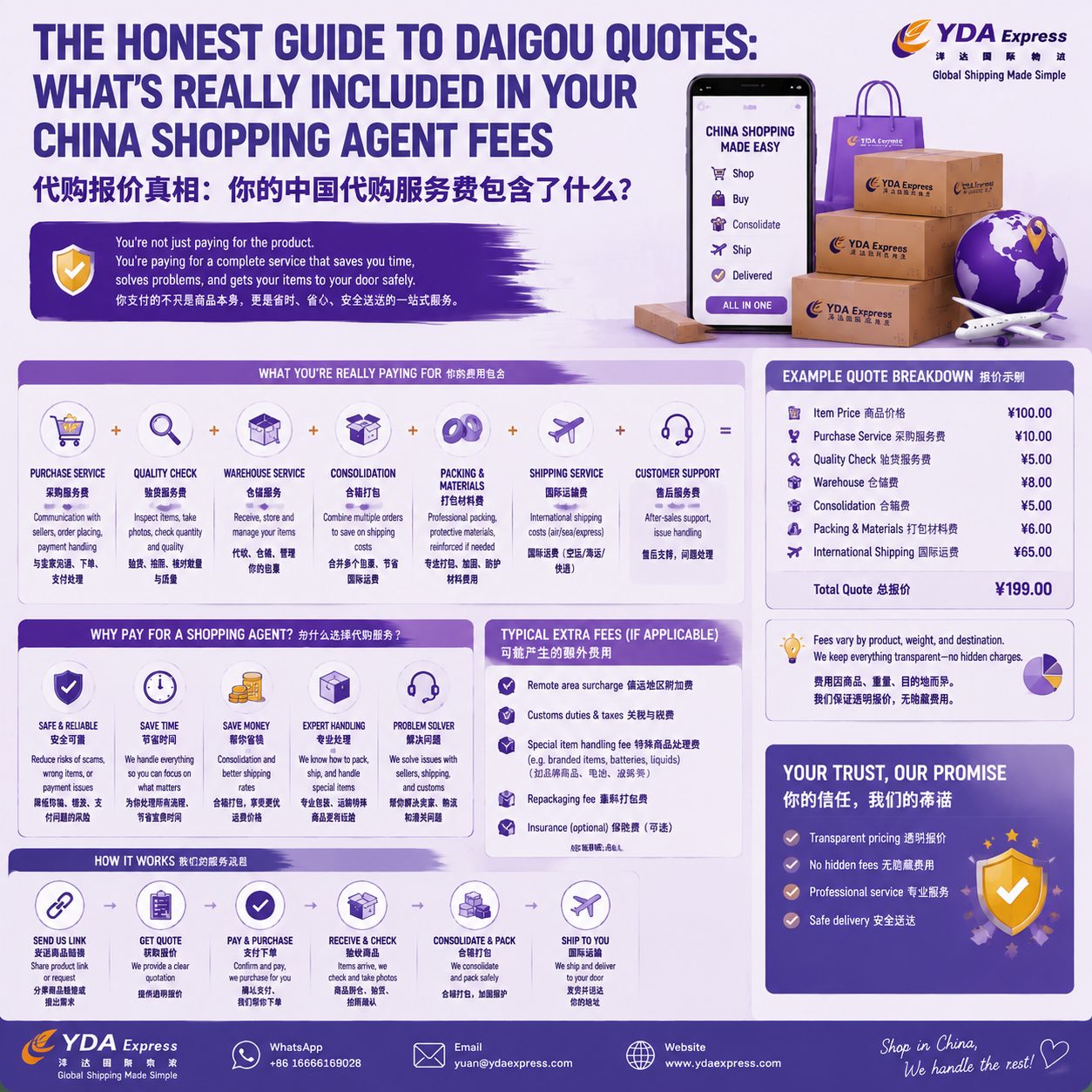
A purchasing agent quote is not just the price of the item. That’s the first thing to get straight. When an agent gives you a daigou quote, they’re typically adding up at least four or five different costs. If you only look at the bottom line, you’ll miss where the real differences lie.

1. Product cost

This is the price the agent pays the seller on Taobao, 1688, or whichever platform you’re buying from. Most agents will show you the exact listing price in RMB and the exchange rate they’re using to convert to your currency. Rates can vary; some agents use the mid-market rate, others add a small margin. A fair agent will tell you which rate they apply. If you see a quote where the product cost seems much higher than what you found on the site, ask about the exchange rate.

2. Agent service fee

This is the fee for the actual “daigou” service—the human work of placing the order, communicating with sellers, inspecting items when they arrive, and handling any returns or issues. It’s usually either a percentage of the product cost (often 5-10%) or a flat fee per order. Some agents charge both. Percentage-based fees make sense for expensive items, but flat fees can be cheaper on large orders with many low-cost items. Watch out for agents that advertise “no service fee” but then load it into a confusing shipping cost.

3. Domestic shipping (within China)

Most Chinese online sellers ship for free within mainland China, but not always. Heavy items, remote sellers, or special handling might incur a domestic shipping charge. This is usually small—maybe 10-20 RMB ($1.50–$3). A good quote will list this as a separate line, even if it’s zero, just so you know it was considered.

4. International shipping

This is the biggest variable. The cost to get your package from the agent’s warehouse in China to your door in, say, Texas or London depends on weight, dimensions, shipping method, and carrier. A detailed daigou quote should show the carrier options (DHL, FedEx, UPS, SF Express, EMS, sea freight, etc.), the estimated transit time, and the actual rate. Often agents get volume discounts that they pass on to you, so the price you see may be lower than if you walked into a DHL office.

5. Consolidation or repacking fees

If you’re buying from multiple sellers, the agent will receive several parcels and combine them into one box for international shipping. This consolidation service may be free for the first few packages, then a small fee per additional one (e.g., $1–$2 each). Some agents also offer repacking to reduce volume weight—removing shoeboxes, for instance—which can slash your shipping cost dramatically. The quote should show whether this is included.

6. Payment processing fees

Agents often shoulder transaction fees from PayPal, credit cards, or wire transfers. Some pass a portion on to you, typically 3-5%. If you’re paying in a currency other than RMB or USD, there may be an additional conversion fee. A transparent quote lists this separately.

7. Customs duties and taxes (usually not included)

Most daigou quotes do not include import duties, VAT, or customs clearance fees. That’s because these are charged by your country’s customs authority and vary wildly. A responsible agent will clearly state “duties not included” on the quote. Some offer DDP (Delivered Duty Paid) shipping lines for certain destinations—where they prepay the tax so you don’t get a surprise bill—but that’s rare and usually costs extra.

Why Daigou Quotes Can Be So Different

Now that you know the pieces, it’s easier to see why two quotes for the same item can look so far apart. One agent might quote $50 using China Post airmail (slow, no tracking) while another quotes $80 via DHL Express (fast, tracked, insured). The first quote isn’t necessarily better—it’s just a different service.

Some agents purposely hide fees to look cheaper. They’ll omit domestic shipping, underestimate the package weight, or use a made-up exchange rate. Then when your item arrives at their warehouse, the real costs surface, and you’re stuck. You can either pay up or abandon your goods. I’ve seen this happen enough times to know it’s a deliberate tactic, not an accident.

Other agents bundle everything into a single “service charge” and call it simple. That can be okay if the agent is trustworthy, but it makes it hard to know if you’re paying a fair international shipping rate. For example, a flat 12% service fee might sound reasonable until you realize it’s calculated on top of an inflated shipping cost.

How to Read and Compare Daigou Quotes (Like a Pro)

You don’t need to be a logistics expert. Just ask for three things:

  1. An itemized breakdown – Every cost on its own line: product, service fee, domestic ship, international ship, consolidation, payment fee. If they won’t give you this, walk away.
  2. The carrier and transit time for the international leg – “Express shipping” is vague. You want to know: DHL? FedEx? How many business days? Is tracking included?
  3. The weight and dimensions they’re using to calculate shipping – This is key. Packed weight can differ from product weight. Ask for the actual or estimated chargeable weight (volumetric vs. actual). If the quote is based on a weight that seems way off, ask them to recheck.

Then compare quotes side-by-side. Don’t just look at the total. See if one agent is using a faster, more reliable carrier. See if one includes insurance or free consolidation that the other charges for. See if they’re using a realistic exchange rate.

A Real-Life Example

Let’s say you want to buy a set of kitchen knives and a silk scarf from two different Taobao sellers, and ship them to Miami.

Agent A quote:

  • Knives: $28 (240 RMB at 1 RMB = 0.14 USD)
  • Scarf: $15
  • Service fee: 8% = $3.44
  • Domestic shipping: free for both
  • Consolidation: $2 (combine two packages)
  • International shipping: $22 (DHL, 3-5 days, 1.2 kg chargeable weight)
  • Payment fee: 3% = $1.23
  • Total: $71.67

Agent B quote:

  • “All-inclusive price: $65”

Which would you pick? The second one looks cheaper, but what if it’s shipped via sea freight and takes 45 days? What if they use a slow boat that doesn’t have tracking? What if they pack the knives badly and they arrive damaged with no insurance? Unless you ask, you won’t know.

Agent A’s quote gives you clarity: you’re paying for speed, tracking, and a breakdown that lets you question anything that looks off. In my experience, agents that are this detailed are usually the ones that pack well, answer messages promptly, and don’t disappear when something goes wrong.

Hidden Fees to Watch Out For

Even with a breakdown, some charges can slip under the radar. Here are a few I’ve learned to spot:

  • Storage fees – Some agents start charging if your packages sit in their warehouse more than 30 days. Check before you let items pile up.
  • Photo inspection fees – Getting photos of your items before shipping is a great service, but some agents charge per photo or per item. Reputable agents include a few free photos in their service fee.
  • Customs clearance fees – This is different from duties. If a package gets held, the agent or carrier may charge a handling fee to clear it. Ask how they handle that—do they have a customs broker on their end or is that your responsibility?
  • Remote area surcharges – If you live outside a major city, DHL/FedEx may add a surcharge. A thorough agent will check your address and warn you.

How a Good Agent Builds a Daigou Quote

At YDA Express, we’ve built our quoting system around what our customers told us they hate: vague prices, surprise fees, and slow answers. When you request a daigou quote from us, you get a line-by-line breakdown that shows the product cost in RMB and the rate we’re converting at, our service fee (a flat percentage, no funny business), and real-time shipping estimates from multiple carriers. If we see a way to cut the shipping cost—like splitting into two lighter boxes instead of one heavy one—we’ll tell you before you pay. That might sound like common sense, but you’d be surprised how many agents don’t bother.

We handle shipments to the US, UK, Canada, Australia, most of Europe, and beyond. Our team works directly with DHL, FedEx, UPS, and SF Express, and we have sea freight options for bulky items. We’ve sent everything from wedding dresses to car parts, and we know which routes tend to get stuck in customs and which sail through. That experience feeds into the quote upfront.

Should You Go for the Cheapest Daigou Quote?

I’ll be direct: almost never. The cheapest quote is often the one that leaves out something you’ll pay for later, either in cash or in stress. A quote that’s too low usually means:

  • They’re using an exchange rate that doesn’t match reality.
  • They’re underestimating the package weight.
  • They’re shipping via an unreliable service you didn’t agree to.
  • They’re not planning to inspect or repack your items properly.

That said, the most expensive quote isn’t automatically the best, either. Some agents charge a premium just because they can. The sweet spot is a quote that is detailed, uses realistic numbers, and comes from an agent who answers your questions without hesitation.

Getting Your Own Daigou Quote

If you’re ready to buy something from China and need a transparent quote, here’s what to do:

  1. Have the product links ready (Taobao, 1688, JD, etc.) with quantity, color, size.
  2. Know your destination country and postal code.
  3. Think about your timeline—do you need it fast (DHL, 3-5 days) or can you wait (sea freight, 30-40 days)?
  4. Send those details to a reliable agent and ask for an itemized daigou quote.

We’re always happy to help. At YDA Express, you can reach us on WhatsApp at +86 16666169028 or email yuan@ydaexpress.com. Tell us what you’re looking for, and we’ll send back a clear, honest quote—no hidden fees, no jargon, just the real numbers. You can also check out our website at https://www.ydaexpress.com for more on how we work.

Shipping from China shouldn’t feel like a gamble. With the right agent and a quote you can trust, it’s just simpler.