
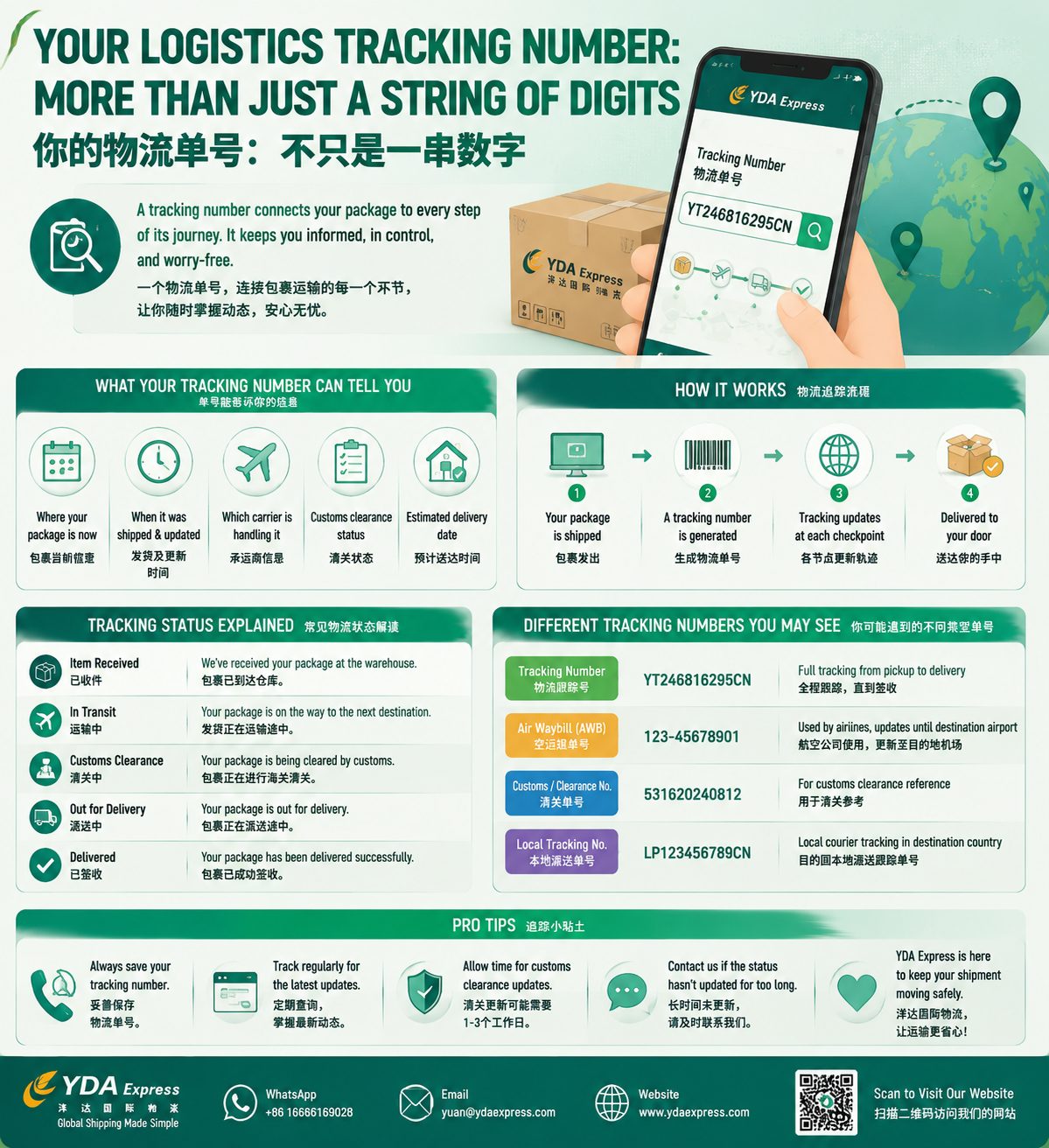
Your Logistics Tracking Number: More Than Just a String of Digits

管理员
2026年7月15日
34 阅读
0 喜欢

A tracking number is your shipment’s digital fingerprint. This guide explains how they work, what those codes mean, and what to do when a package goes off-radar—plus practical tips for cross-border shoppers and small business owners.

If you’ve ever ordered something from overseas, you know the drill: a few hours after checkout, an email lands in your inbox with a subject line that usually reads “Your order has shipped!” and a long alphanumeric code—your logistics tracking number. It might look like a random jumble, but that string of letters and numbers is actually the single most important piece of information you have once a package leaves the warehouse.

Here’s the thing: a tracking number isn’t just a receipt. It’s a live passport that gets stamped—digitally, at least—each time your parcel moves through a hub, clears customs, gets loaded onto a plane, or gets handed off to a local delivery driver. But many people treat it as a passive notification tool and then panic the moment the status hasn’t updated for 48 hours. That’s a mistake. Understanding how tracking numbers work, what different scans mean, and how to use them proactively can save you a lot of stress—and sometimes even save a package from being returned or lost.

I’m going to walk you through everything you need to know about logistics tracking numbers, from decoding the most common formats to troubleshooting when things go quiet. I’ll also throw in a few real-world tips from years of shipping experience, both as a customer and from the perspective of someone who works in logistics every day.

What Is a Tracking Number, Really?

In plain terms, a tracking number (sometimes called a waybill number, air waybill, or article ID) is a unique code assigned to a single shipment. It’s used by the carrier—and by you—to follow the package from pickup to delivery. The number itself isn’t random; most follow a standard structure defined by the carrier or by international postal agreements.

Think of it like a license plate: different carriers use different formats, and once you know the basics, you can often tell at a glance which company is handling your parcel just by the first few letters or digits. That’s useful because if your seller says “we shipped via express” but the tracking number starts with something like “LX,” you know immediately it’s probably a China Post ePacket, not a private courier.

Common Tracking Number Formats

Not all tracking numbers are created equal. Here’s a quick breakdown of some of the most common ones you’ll see when buying from China or using international forwarding services:

  • DHL Express: Usually a 10-digit numeric code (e.g., 1234567890), sometimes with a leading “GM” or “JD” in newer formats.
  • FedEx: Typically 12 digits (e.g., 123456789012) or a 15-digit code, sometimes starting with “77.”
  • UPS: Starts with “1Z” followed by a 6-character shipper number, then service level, and finally a package identifier—total of 18 characters, but you’ll often see 1Z9999999999999999 as the format.
  • USPS: Domestic starts with 9400, 9300, or 9200; international often starts with “CJ,” “LC,” “UN,” or similar two-letter prefix, followed by 9 digits and “US.”
  • China Post / ePacket / Airmail: Classic format is two letters, nine digits, and two letters (e.g., LX123456789CN). The last two letters indicate the origin country. “CN” is China, “SG” Singapore, “HK” Hong Kong.
  • SF International: 12-digit numeric (e.g., 283456789012) or sometimes starts with “SF” followed by digits.
  • Yanwen / Yunexpress / 4PX: Often use a similar two-letter prefix and numeric string, but their systems are tied into last-mile carriers like USPS or Royal Mail, so tracking might go silent after export until the local scan.

Now, when you’re using a freight forwarder like YDA Express, you’ll often receive a consolidation tracking number—a master air waybill under which multiple individual parcels travel together. Your packages still get their own final-mile tracking once they clear import and are handed off to a local carrier. This is extremely common in cross-border ecommerce because it keeps costs down. But it also means that for a stretch of several days, the main tracking might show nothing while the consolidated shipment is in transit. That’s normal, not a cause for alarm.

How to Read a Tracking Number

You don’t need to memorize formats, but a quick check can tell you a lot. If your seller says “DHL” and the number is 13 digits starting with “9,” it’s probably DHL eCommerce—slower than Express. If it’s an 18-digit UPS number but status shows “Shipment information received” for a week, it often means the label was created but the package hasn’t actually been handed to UPS yet.

A tracking number also carries information about the service level. FedEx Ground vs. FedEx International Priority? Same carrier, wildly different transit times. The number alone won’t always spell that out, but the tracking detail page will. So always click through to the carrier’s official site, not just the automated email summary.

The Tracking Lifecycle: What Each Status Means

Your package goes through several predictable stages. Knowing them helps you gauge whether things are on track:

  • Label Created / Shipment Information Received: The sender has printed a label or transmitted the data to the carrier. The package hasn’t been physically scanned yet. If this sits for more than 3 business days, ask if it was actually picked up.
  • Picked Up / Received by Carrier: The courier has the box. Now it’s moving to a local hub.
  • In Transit / Departed Facility: This can repeat multiple times as it moves through sort centers, airports, and customs.
  • Customs Clearance: The all-important step. You might see “customs clearance in progress” or “held at customs.” Delays here are common and usually due to incomplete paperwork, restricted items, or duties owed.
  • Arrived at Destination Country / Awaiting Last Mile: The consolidated shipment is broken down, and your parcel is handed to a local carrier. At this point, you may get a second tracking number (a local courier reference). Check your email or the forwarder’s portal.
  • Out for Delivery: It’s on a truck for that day.
  • Delivered: Package scanned at your doorstep or mailbox.

An important but often overlooked status is “Returned to Sender.” This happens when customs rejects the package, the address was wrong, or no one claimed it. If you see this, time is critical—contact the sender immediately to arrange reshipment before it gets lost in returns processing.

Why Did My Tracking Suddenly Stop Updating?

This is probably the most common panic trigger. A package was moving along nicely—scan after scan—then nothing for 4, 5, 6 days. Here’s what’s usually happening:

  1. Handoff between carriers: A consolidated air shipment arrives in the destination country. The master air waybill gets scanned upon arrival, but the individual parcels inside haven’t been sorted yet. It can take a day or two (more on weekends) for the local post or courier to pick up and scan each piece. During that window, tracking appears frozen.
  2. Customs: Every country’s customs is different. In the U.S., a package might sit for a day; in Brazil or Germany, five to ten days isn’t unusual. Customs scans are not always public-facing, so the tracking page simply shows no movement.
  3. Peak season backlogs: November through January, everything slows down. A package might sit in a container at a port for a week before being unloaded and scanned.
  4. The number changed: If your forwarder split the shipment or used a different local courier, the original tracking becomes a parent record and you need a child tracking number. Good forwarders provide this; cheaper ones might not.
  5. Lost or misrouted: It happens. If there’s no activity for more than 10 business days (for international) or 7 days (domestic), start a trace or claim with the carrier. Your sender can do that, and you should follow up.

At YDA Express, we often see shippers who stress after 48 hours of silence on an air freight shipment from China to the U.S. But when you know that the freight left on a Sunday night and Monday is a public holiday at the transfer hub, it makes sense. Most delays like this resolve without intervention. We advise waiting at least 5 business days after the last scan before calling it a problem.

Proactive Tracking Tips for Shoppers and Sellers

  • Save the number in multiple places: Forward the email to a dedicated folder, take a screenshot, or paste it into a notes app. Tracking links expire or get lost in inbox clutter.
  • Use official carrier tracking first, then third-party tools: Apps like AfterShip, 17TRACK, and ParcelsApp are excellent for aggregating multiple carriers, but they can lag or misinterpret statuses. If something seems off, go directly to fedex.com, dhl.com, usps.com, etc.
  • Sign up for notifications: Most carriers let you set email or SMS alerts for delivery attempts. That’s a lifesaver if you aren’t home and need to reroute or authorize release.
  • If it’s an international package, know your customs threshold: In the U.S., the de minimis value is $800. In the EU, it’s €150 (for customs duties) and €22 (for VAT, though that’s changing). If your shipment is over the threshold, expect a customs delay and possible payment request. Tracking might just say “held” until you pay.
  • Double-check the address: A single wrong digit in the zip code can send your package on a detour. If you realize the mistake, call the carrier immediately—not the sender. The sender can update the address before the package is picked up, but once it’s in the network, you need the carrier’s intercept department.

What to Do When a Package Is Lost

If your tracking hasn’t moved in, say, two weeks (international) or a week (domestic), it’s time to act.

  1. Contact the sender/forwarder and ask them to open a tracer or investigation with the carrier. They have the account relationship and can often get more information than you can as the recipient.
  2. Provide all the details: tracking number, recipient address, value, and a description of the goods. A photo of the packaging helps.
  3. Ask for a Proof of Delivery (POD) if the status says delivered but you didn’t get it. Sometimes the driver left it with a neighbor or at a back door.
  4. If the package is truly lost, the sender should file a claim. For most carriers, the claim must be filed by the shipper, not the recipient. So your relationship with the sender is key—this is where choosing a reputable forwarder pays off. If they’re unresponsive, you may have to rely on your payment method’s buyer protection.

From a forwarder’s perspective, having a consistent tracking number format and clear internal processes makes all the difference. When a package goes missing, we can trace the chain of custody: who signed for it at the warehouse, which truck it went on, which airline, and so forth. That granular detail is what sets a professional logistics company apart from a casual agent.

Why Your Forwarder’s Tracking System Matters

When you use a purchase assistance or consolidation service, you’re not just getting a tracking number—you’re getting an entire journey. At YDA Express, for example, a customer might buy five items from three different 1688 or Taobao sellers. We receive them all at our warehouse, consolidate them into one box, and ship it. The customer gets a single master tracking number for the international leg, plus individual parcel tracking within China before consolidation. That transparency lets you see when each item arrives at the warehouse, when consolidation is complete, and when the final package is handed to DHL or FedEx or a postal service.

Not all services offer this. Some give you the international tracking only, and you have no idea if a missing item was even received. So, before you place a large order, ask: “Will I get tracking for the domestic leg in China? Can I see photos before consolidation? Is the final tracking number from a major carrier, or will it go quiet for two weeks?” The answers tell you a lot about how the operation runs.

The Emotional Side of Tracking Numbers

I’ve seen people refresh a tracking page 20 times a day. Honestly, that’s not productive—statuses only update once or twice a day at most. But I get it. There’s something deeply reassuring about seeing “Out for Delivery.” It’s a small promise in a chaotic world. On the flip side, “Returned to Sender” can ruin your week. So my advice is this: Use tracking as a tool, not a tether. Set up notifications, then let it do its job. The vast majority of packages arrive, even when the tracking has a hiccup.

Tracking Numbers and Scams

A quick note on fraud: if you’re buying from an unfamiliar website and they give you a tracking number that shows “delivered” but the destination city isn’t yours, you might be a victim of scammy triangulation or a fake tracking scheme. Always check the delivery location on the carrier’s site. If you’re using a forwarder, you’re safer because the package goes to their warehouse, which you control. But still, look for consistency—if the weight shown on the tracking doesn’t match what you ordered (e.g., a sofa weighing 0.5 kg), something’s off.

A Final Word

Your logistics tracking number is the thread that ties you to your package. Knowing how to read it, when to worry, and how to act can make the difference between a smooth delivery and a frustrating loss. In cross-border ecommerce, cheap shipping often means lighter tracking—and that’s a trade-off you should make with your eyes open. If the item is valuable or time-sensitive, pay for a premium courier with end-to-end scanning. If you’re consolidating multiple orders, work with a forwarder that gives you visibility from the warehouse to your doorstep.

If you’re shipping from China and want to keep everything simple—purchasing, consolidation, reliable tracking, and clear communication—you can reach out to us at YDA Express. We’ll help you navigate the process and make sure you always know where your package is. Visit https://www.ydaexpress.com or message us on WhatsApp at +86 16666169028. Shipping shouldn’t feel like a mystery, and with the right partner, it doesn’t have to.