Overland Shipping from China: When Trucks and Trains Beat Air and Sea

管理员
2026年6月17日
20 阅读
0 喜欢

Land freight from China isn't just for domestic hauls. This guide explains how trucks and trains can be smarter than air or sea for certain routes, with practical advice on packing, customs, and working with a China parcel forwarder.

If you ship goods from China, you’ve probably debated air versus ocean a hundred times. Air is fast but expensive. Sea is cheap but sluggish. Meanwhile, land freight sits there like a wise middle child—often overlooked, sometimes misunderstood, and yet surprisingly effective for the right job.

I’m not talking about local deliveries inside China. I’m talking about international trucking across borders into Central Asia, Russia, Southeast Asia, and even rail connections that reach right into the heart of Europe. At YdaExpress, we’ve seen firsthand how many shippers never consider land until they get a quote or a timeline that flips their mind. So let’s break down what land logistics really looks like when you’re shipping from China, and where it might fit into your supply chain.

What Land Freight Actually Means in China

When someone in the logistics industry says 陆运物流, they’re usually talking about any freight that moves overland—trucks, trains, sometimes both in combination. In the context of international shipping from China, this can mean a few different things:

  • Domestic road freight: Your supplier in Yiwu ships a pallet to a consolidation warehouse in Shenzhen. That’s a land move inside China, handled by a trucking company.
  • Cross-border road freight: A truck loads up in Urumqi and drives straight across the border into Kazakhstan, or from Nanning into Vietnam. No containers, no port handling.
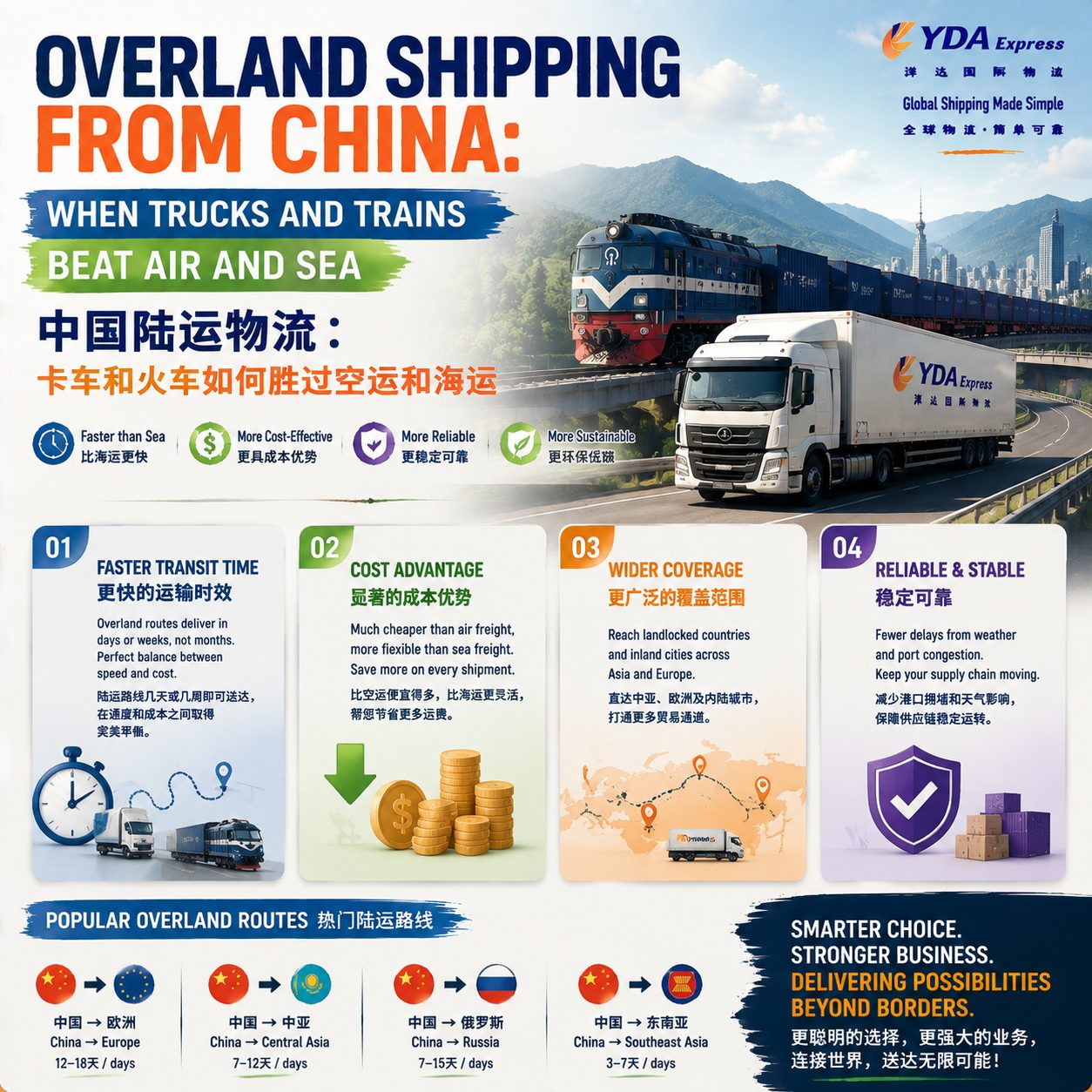
  • International rail freight: The China-Europe Railway Express runs from cities like Chengdu, Chongqing, or Zhengzhou to terminals in Duisburg, Hamburg, or Warsaw. Transit time usually ranges from 15 to 20 days—half the time of sea freight.

Here’s the thing that trips people up: the same shipment can involve multiple land legs. Your goods might travel by truck from a factory to a rail hub, then by train across multiple countries, then by truck again to the final address. A decent freight forwarder will handle all that in one booking, so you don’t have to stitch carriers together yourself.

Why Land Options Keep Winning Over Disbelievers

Let’s get tactical. The usual trade-off between air and sea is speed versus cost. Land freight rewrites that equation, especially on certain lanes.

Say you need goods from Shanghai to Moscow. Air freight might take 5–7 days door to door but cost enough to eat your entire margin. Sea freight to St. Petersburg plus inland trucking might take 45 days. A direct truck or rail option from China into Russia can deliver in 18–22 days at roughly half the air cost. That timeline works for a lot of e-commerce replenishment, promotional stock, or seasonal goods.

For shipments heading into Central Asia—places like Uzbekistan, Kazakhstan, Kyrgyzstan—sea freight isn’t even a real option because those countries are landlocked. Air is possible but usually wasteful for anything heavier than documents or samples. Road freight is the main artery, and the routes are well-established. A truck leaving from Khorgos on the China-Kazakhstan border can reach Almaty in a week or less.

The China-Europe rail network has also matured dramatically. Early days were plagued by inconsistent transit times, capacity shortages, and confusing customs. Now, scheduled trains run like clockwork, and the paperwork is predictable if you work with a forwarder who knows the corridors. We’ve seen shipments to Poland arrive in 14 days flat when everything aligns.

Another advantage: land freight avoids the extreme congestion that sometimes hits major ports. No waiting for vessel backlog in Shanghai. No container shortage panic. It’s a different set of bottlenecks—border crossings, railway capacity—but they tend to be more predictable once a route is established.

The Real-World Routes You Should Know About

Not every land route is created equal. Here are the ones that pop up most often in our daily operations at YdaExpress.

China → Russia / Belarus
Truck and rail are both common. Trucks often go through Manzhouli in the north or Suifenhe in the east. Rail uses various terminals. Transit averages 18–25 days. Customs clearance can be done en route, so the goods are released as soon as they roll into the destination country.

China → Central Asia
Almaty, Bishkek, Tashkent, Dushanbe. Trucks depart from border cities like Khorgos, Alashankou, or Torugart. Transit time 6–12 days. For smaller parcels, consolidation at a Urumqi warehouse before crossing the border keeps costs down.

China → Vietnam / Laos / Myanmar
Cross-border trucks from Pingxiang, Hekou, or Mohan handle volumes of consumer goods, electronics, and textiles. Since these countries share a land border with China, door-to-door can be as fast as 2–4 days—competitive with air once you factor in airport handling.

China-Europe rail
Chengdu–Łódź, Chongqing–Duisburg, Zhengzhou–Hamburg, and more. A standard 40-foot container runs about $5,000–$8,000 depending on the season, compared to $1,500–$3,000 for sea but often $15,000+ for air. For e-commerce sellers shipping mid-sized batches of high-value goods, this price point is golden.

How a Parcel Forwarder Makes Land Freight Easier

If you’re an overseas shopper or small business buying from Taobao, 1688, or Pinduoduo, arranging truck or rail directly with a Chinese factory is usually a dead end. Factories want to deliver locally. That’s where a China parcel forwarder becomes essential.

You buy multiple items from different sellers. Each package arrives at our warehouse. We check the contents, store them safely, then consolidate everything into one shipment. From there, we offer multiple outbound options—including land freight when it makes sense.

For a clothing boutique in Kazakhstan that orders 50 kilograms of apparel from Guangdong factories, air freight would be fast but cut too deep into profits. Sea freight is impossible because the country has no coastline. So we bundle the goods, truck them to the border, handle the cross-border customs declaration, and deliver to a shop in Almaty. The owner pays a fraction of air freight and gets realistic, trackable updates.

We also help with the slightly tricky parts: repacking for land transport, making sure the commercial invoice matches what the border officials expect, and advising on which items might face import restrictions in landlocked countries.

Packing for the Long Haul (Literally)

Land freight isn’t as rough as sea—no salty spray, no weeks of rocking in a container—but it still demands careful packing. Vibrations from rough roads, multiple loading and unloading at border stations, and temperature swings across regions all take a toll.

Here’s what we recommend and practice in-house:

  • Use double-wall corrugated boxes for anything over 10 kg. Single-wall can crush when stacked.
  • Fragile items need at least 5 centimeters of cushioning on all sides. Bubble wrap alone isn’t enough; combine with foam or air pillows.
  • Moisture protection matters, especially on routes through humid regions. Silica gel packs and a polyethylene liner add cheap insurance.
  • Pallets help tremendously. A properly strapped pallet is less likely to get tossed around and makes unloading faster, which means fewer handling incidents.

If your supplier does a poor packing job, we can repack at the warehouse. It adds a day or two but can prevent disaster.

Customs and Paperwork: The Not-So-Scary Truth

Each border crossing comes with its own set of rules. Russia has strict certification requirements for certain product categories. Kazakhstan wants invoices in Russian and exact weight per item. The Eurasian Economic Union has common tariff rules but each member state applies them differently.

A solid freight forwarder will prepare:

  • A commercial invoice listing real unit prices, not random lowball numbers that raise red flags.
  • A packing list with net and gross weights per box.
  • Any certificates of origin or conformity if needed.

For rail shipments to Europe, the CIM consignment note replaces the traditional bill of lading. It’s simpler than it sounds. Once the train leaves China, customs clearance usually happens at the entry point to the EU—say, Malaszewicze in Poland—and from there the goods move freely within the union.

We handle the paperwork end to end, but it helps when customers understand the basics. A minor invoice mistake can hold a whole container at the border for days, eating into the speed advantage you chose land for in the first place.

Tracking and Peace of Mind

Land freight tracking is not as granular as air—you won’t see 20 scans a day—but it’s reliable enough for planning. Most trucks and trains share GPS-based updates at major milestones: departure from origin warehouse, arrival at border, customs clearance completion, arrival at destination hub, out for delivery.

On the China-Europe rail, updates typically come every 1–2 days. The train doesn’t disappear into a black hole. For cross-border trucks, we can often provide the driver’s contact in case of urgent checks, although it’s rarely needed.

One of our clients shipping auto parts from Chengdu to a workshop in Warsaw regularly gets updates like, “Consolidated at Chongqing rail yard,” then “Departed on train X, ETA Dostyk border in 3 days,” and so on. It’s steady, if not flashy.

Is Land Freight Right for Your Shipment?

Land isn’t a magic bullet for every situation. Let’s look at a few scenarios:

Small packages under 2 kg — Air or express courier usually wins. The cost difference is negligible, and the speed is worth it.

Pallets or partial loads heading to inland Europe — Rail becomes very attractive. A single Euro-pallet (120 x 80 cm) can cost $300–$500 by rail, whereas air would be $1,000+.

E-commerce sellers restocking Amazon FBA in Europe — Rail may be too slow if you’re running lean; you might prefer air for top-ups and sea for base stock. But if you can plan 20 days ahead, rail saves serious cash.

Personal shoppers buying furniture or large household items from China — Often, the savings from land versus air can dwarf the extra transit time. Someone in Kazakhstan buying a sofa from a Chinese online store would be crazy to air freight it; road delivery makes it a viable deal.

Goods moving to conflict-adjacent or sanctioned regions — This gets complicated fast. Land routes can still operate when maritime lanes are disrupted, but compliance checks are stricter. Always get professional advice.

The Hidden Benefit: Simpler Routings for Landlocked Countries

Some destination countries simply don’t have a coastline. Mongolia, Nepal, Laos, Uzbekistan—if you ship to them by sea, you must use a port in a neighboring country and then arrange cross-border overland anyway. Cutting out the port leg and going direct by land eliminates a massive chunk of transit time and often customs complexity.

We’ve shipped toolkits to a mining site in rural Mongolia. Air was too expensive for the weight; sea to Tianjin plus trucking through China and across the border would have taken 40+ days and involved Chinese export customs plus Mongolian import customs. A truck from Hohhot directly to the site took 8 days, end to end. That’s the kind of scenario where land freight isn’t just a choice; it’s the only logical one.

How to Get Started Without the Headache

If you’re curious whether land freight makes sense for your next shipment from China, the fastest way is to talk to someone who actually moves goods that way every week. At YdaExpress, we consolidate parcels, handle the warehouse leg, and book the best land route for your destination—whether it’s a truck to Almaty, a train to Hamburg, or a combination to get your goods where they need to be. We manage the paperwork, the repacking, and the tracking, so you’re never left guessing.

Land logistics might not have the glamour of air or the romance of sea, but when the numbers click, there’s no smarter way to move your goods. Get a quote, ask questions, and see how much time and money you might be leaving on the table by ignoring the middle child.

Reach out on WhatsApp: +8613078354343 or visit ydaexpress.com for a custom shipping plan.