The Real Cost of a Cheap Packaging Box: Why Your International Shipments Deserve Better

管理员
2026年7月31日
16 阅读
0 喜欢

Choosing the right packaging box can mean the difference between a happy customer and a damaged shipment. This guide explains how to select, size, and source boxes that protect your goods from China to anywhere in the world, with practical tips from logistics professionals.

It’s the kind of email you never want to get. A customer sends you a photo of a shipment you packed yourself, and the outer carton looks like it went through a war zone—crushed corners, a big gash in the side, tape curling off in defeat. Inside, your products are rattling around, maybe broken, maybe just embarrassing. The culprit? A packaging box that wasn’t up to the job.

If you’re shipping from China to overseas buyers, whether it’s a single pair of sneakers or a box full of phone cases, the packaging box you choose is your shipment’s first and only line of defense. Yet too many sellers, shoppers, and small importers treat it like an afterthought. They grab whatever free carton is lying around, or they pick the cheapest box they can find on 1688 or Taobao, and hope for the best. Let’s talk about why that’s a mistake — and how to get it right.

Why Your Packaging Box Matters More Than You Think

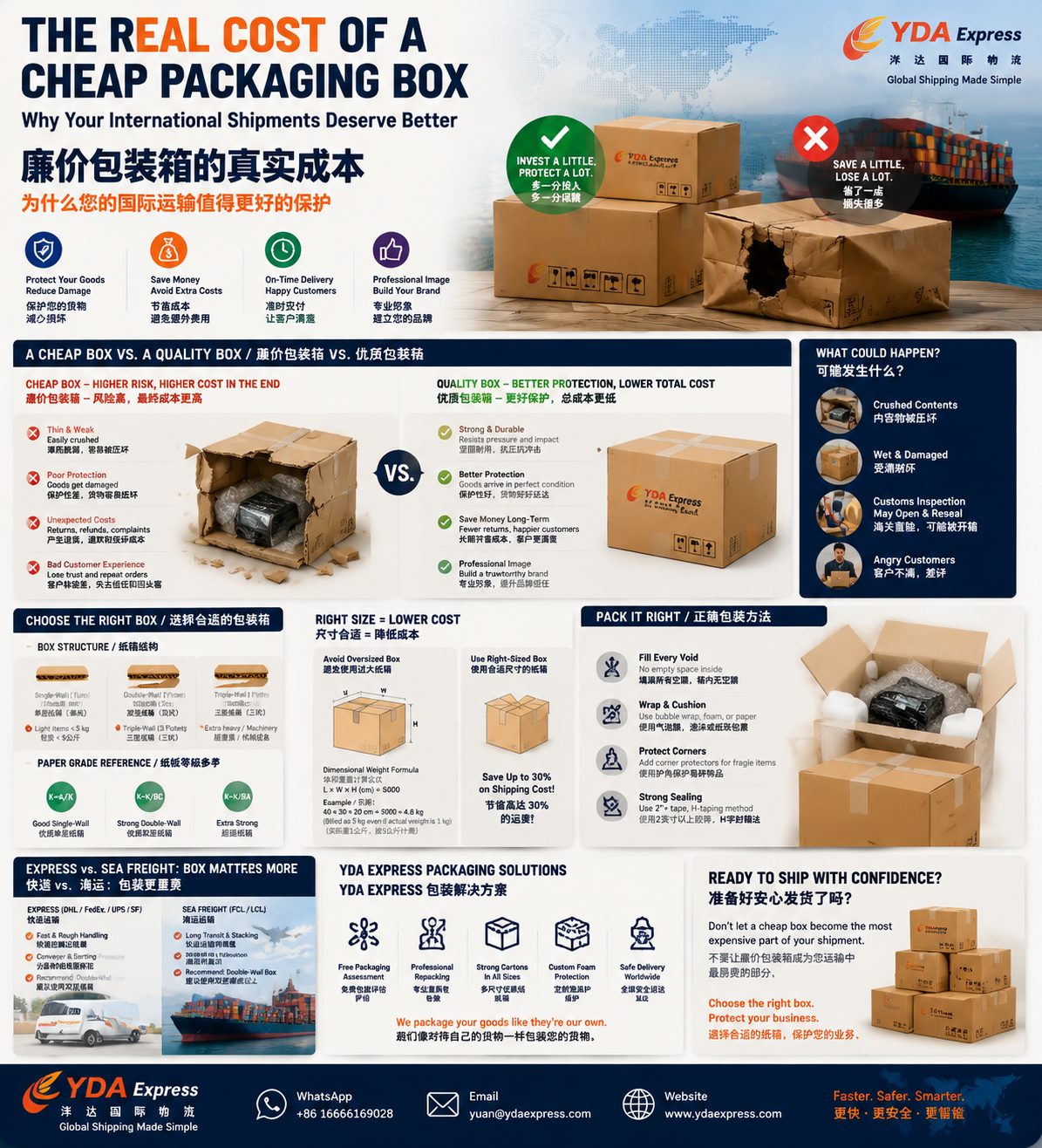
A packaging box isn’t just a box. In international logistics, it’s a critical component that affects everything from shipping cost to delivery success. Carriers like DHL, FedEx, UPS, and even sea freight consolidators are not gentle. Your box will be stacked, dropped, vibrated on conveyors, and maybe left in a hot container for weeks.

A flimsy box can lead to:

  • Product damage and customer returns.
  • Additional repacking charges by the carrier if the box bursts.
  • Customs delays if the box falls apart and items are exposed.
  • Higher shipping costs if the box is oversized for its contents (we’ll get into dimensional weight later).

Honestly, spending a little more on a proper box is one of the cheapest ways to avoid expensive problems down the line.

Understanding the Anatomy of a Good Packaging Box

Before you order a stack of boxes, it helps to know what you’re looking at. Most international shipments use regular slotted containers (RSC)—that’s your typical brown corrugated box with flaps that meet in the middle. But within that category, there’s a world of difference.

Material Matters: Single-Wall vs. Double-Wall Corrugated

Corrugated board comes in layers. A single-wall box has one fluted layer sandwiched between two liners. A double-wall box has two fluted layers and three liners. The flute type (A, B, C, E, F) also impacts strength—B-flute is common for die-cut boxes, while C-flute offers better stacking strength. For most international shipments, single-wall C-flute is fine for goods under 10 kg, provided the box is new and properly sealed.

But if you’re shipping anything heavier than 10 kg, or items with sharp edges, or if the box will be stacked at the bottom of a pallet going by sea, double-wall is practically a requirement. At YdaExpress, we often see customers who try to ship metal parts or dense electronics in single-wall boxes, and those boxes rarely survive the journey intact.

Box Style: Regular Slotted Container (RSC) and Others

The RSC is the standard, but other styles exist for specific needs. A full-overlap box (FOL) has flaps that fully overlap, adding top and bottom strength—useful for heavy items. A half-slotted container (HSC) has no top flaps, often used as a lid for a pallet box. And then there are telescoping boxes, folder boxes, and so on. For most ecommerce and small-batch shipments, a properly sized RSC will do the job, but it’s worth knowing the options.

Common Packaging Box Mistakes That Lead to Damaged Goods

Even with a strong box, how you use it matters. Here are mistakes we see all the time—and how to avoid them.

Using the Wrong Box for the Weight

Every box has a gross weight limit. Good manufacturers print the edge crush test (ECT) rating on the bottom flap—look for something like “ECT 32” or “ECT 44.” Higher ECT means better stacking strength. For a 10 kg box shipped via air freight, an ECT of 32 is usually enough, but for sea freight where boxes get stacked under others, I’d go with ECT 44 or above. Don’t guess; calculate your worst-case stack and choose accordingly.

Reusing Old Boxes (When It’s Okay and When It’s Not)

It’s tempting to reuse an old Amazon box. Sometimes that’s fine—if the box is still rigid, clean, and free of dents or tears. But reused boxes lose up to 50% of their original strength, especially if they’ve been exposed to humidity. And some carriers might reject a shipment if the box shows previous labels or barcodes. For anything going by air, I stick to new boxes. The risk of a mid-air box failure just isn’t worth the couple of yuan you save.

Overstuffing or Underfilling

A box that’s bulging at the seams puts stress on the tape and flaps; one that’s half-empty invites crushing. Both are bad. Use internal dunnage—air pillows, foam, kraft paper—to fill voids and stop items from shifting. And don’t over-tape: three strips of quality packing tape along the seams (the H-taping method) is standard, plus edge protection if needed.

Sizing Your Packaging Box for International Shipping: A Practical Guide

Here’s something many first-timers miss: carriers charge for dimensional (DIM) weight as well as actual weight. DIM weight = (length x width x height) / DIM factor. The DIM factor is usually 5,000 for cm/kg (or 139 for inches/lbs). So if you ship a large, lightweight item in a box that’s 50 cm x 40 cm x 30 cm, the DIM weight is (50x40x30)/5000 = 12 kg. If your actual weight is only 8 kg, you’ll be billed for 12 kg.

That’s why sizing your box as close to the product dimensions as possible—with just enough room for protective padding—can save you serious money. Custom die-cut inserts can help you use smaller boxes and keep items snug.

Dimensional Weight and Why Size Costs Money

To be fair, the DIM weight rule isn’t a carrier scam; it ensures they don’t lose money moving huge, light packages that take up a lot of space. But it means you need to think about box dimensions strategically. If you’re ordering boxes in bulk, consider standard sizes that fit your products without much wasted space. If you’re a YdaExpress customer, we can help you find the right box or even do the repacking for you in our China warehouse, cutting down DIM weight and saving you money.

Where to Source Reliable Packaging Boxes in China

If you’re buying goods in China and shipping them out, you have a few options for boxes.

Buying Online: Platforms and Considerations

1688.com and Taobao are the obvious places. You can find everything from tiny jewelry boxes to heavy-duty double-wall cartons. But quality varies wildly. Look for sellers who list the ECT or burst strength, and don’t be afraid to order a sample before committing to a bulk order. Prices can be as low as 1-3 yuan per box for simple single-wall cartons, while custom-printed double-wall boxes might run 5-10 yuan each, depending on quantity.

Custom Boxes for Branding and Protection

Custom-printed boxes with your logo can enhance the unboxing experience, but they also add cost and minimum order quantities. For protection, custom foam inserts or cardboard dividers can be designed to fit your product exactly. If you’re working with a sourcing agent like YdaExpress, we can coordinate with box factories to get exactly what you need, and even hold the boxes in our warehouse for future use.

How YdaExpress Helps with Packaging and Consolidation

At YdaExpress, packaging is part of what we do every day. We’ve seen hundreds of cases where a customer’s original packaging was too flimsy, too large, or just wrong for international transit. That’s why we offer repacking and consolidation services in our China warehouse.

Here’s how it works: you buy items from different suppliers; they all arrive at our facility. We check the condition, and if any box looks questionable, we either reinforce it or repack the items into a stronger box that’s properly sized. We know the carrier standards upfront—DHL wants boxes that can handle a 1.5-meter drop; sea freight demands good stacking strength—so we make sure your shipment meets those expectations.

We can also source custom boxes for you directly, saving you the hassle of communicating with manufacturers. And because we consolidate multiple orders into one box, you save on shipping costs and reduce waste.

The Bottom Line

The packaging box is not a place to cut corners. A few extra cents spent on a stronger, correctly sized box can prevent hundreds of dollars in damaged goods, returns, and lost customers. Whether you’re shipping bracelets or engine parts, the right box is an investment in your reputation.

If you’re not sure what kind of box your products need, or if you want a partner who can handle the packaging and logistics from start to finish, get in touch. At YdaExpress, we’ve helped thousands of customers ship from China without drama. Reach us on WhatsApp at +86 16666169028 or email yuan@ydaexpress.com. We’ll make sure your next shipment arrives in one piece.