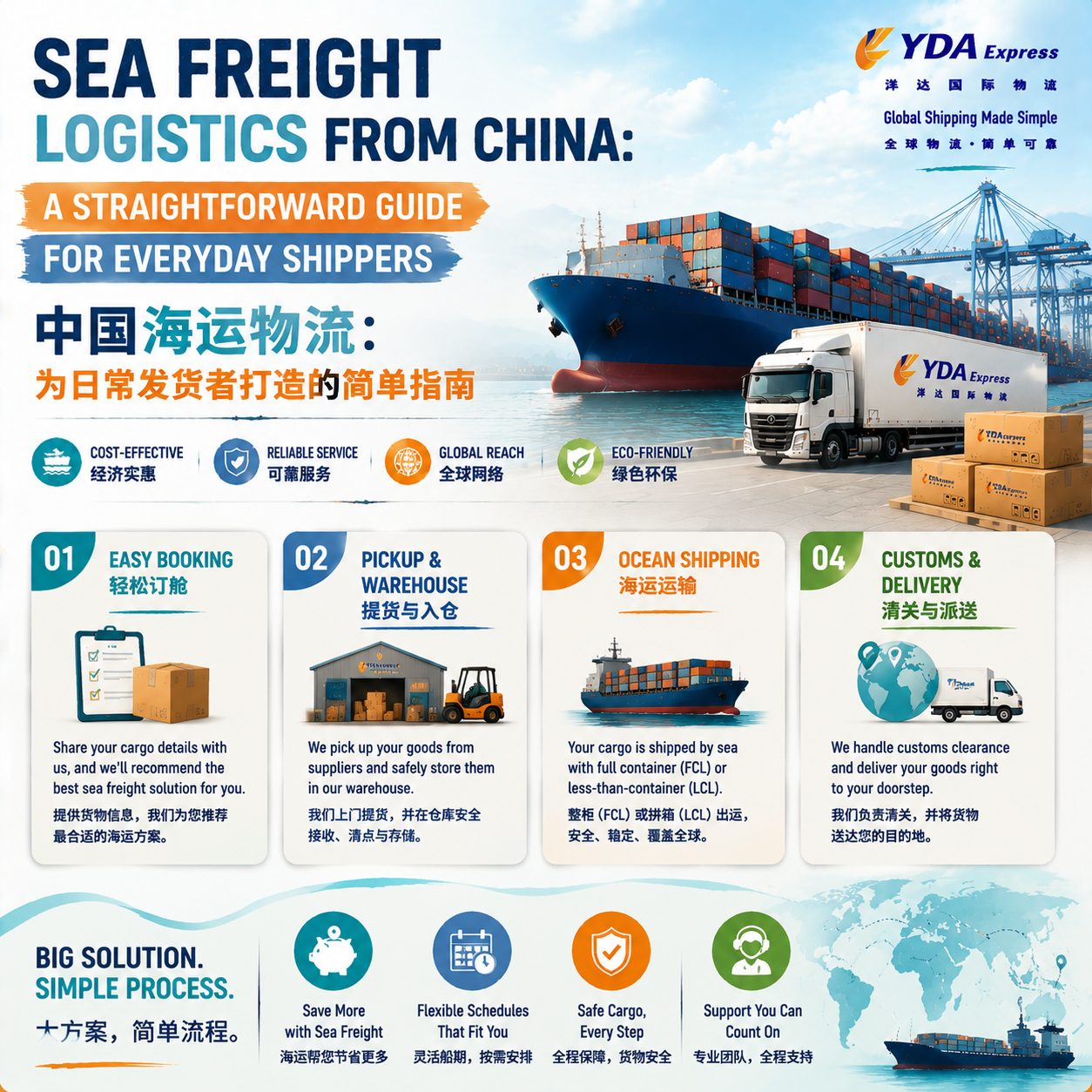
Sea Freight Logistics from China: A Straightforward Guide for Everyday Shippers

管理员
2026年6月17日
16 阅读
0 喜欢

Shipping by sea doesn't have to be complicated. This guide explains how ordinary shoppers and small businesses can use ocean freight to save money on shipments from China—covering costs, timing, packing, customs, and how to avoid common pitfalls.

If you've ever looked at the shipping cost for a parcel from China and thought there has to be a cheaper way, you’re right. Air freight and express couriers like DHL or FedEx are fast, but the price tag can sting—especially when you’re moving more than a few kilograms. That's where sea freight logistics comes in.

Ocean freight isn't just for container loads of factory equipment. It works for individual shoppers consolidating Taobao orders, small online sellers restocking inventory, and anyone shipping bulky or heavy items that aren't urgent. The catch? It’s slower and requires a bit more planning. But once you understand the process, it’s one of the most practical ways to get goods from China to your doorstep without breaking the bank.

I’ve handled hundreds of sea freight shipments for customers at YdaExpress, from solo packages to full pallets. Here’s what I’ve learned—and what you need to know before you ship.

What Actually Is Sea Freight Logistics?

At its simplest, sea freight logistics is the system of moving goods by ocean vessel from one country to another. It involves carriers (like Maersk, COSCO, MSC), port terminals, customs authorities, trucks, warehouses, and a stack of paperwork. For shippers, it boils down to two main options:

  • FCL (Full Container Load): You book an entire container—usually a 20-foot or 40-foot box—and pack it with your cargo. This makes sense if you have enough volume to fill at least half a container (typically 10–12 cubic meters or more).
  • LCL (Less than Container Load): You share container space with other people’s cargo. Your goods are consolidated at a warehouse in China, loaded with others, and then separated at the destination port. This is the go-to for smaller shipments that don't fill an entire box.

There’s also consolidation itself, which is the process of combining multiple orders from different sellers into one shipment before it leaves China. This is huge for shoppers buying from platforms like Taobao, 1688, or Pinduoduo, where a single checkout might leave you with a dozen separate parcels.

When Should You Choose Sea Freight?

Not every shipment belongs on a boat. The decision usually comes down to three things: weight, size, and urgency.

  • Weight: For anything over 10 kg, sea freight often beats air courier pricing. At 20–30 kg, the savings get dramatic. I’ve seen shipments where express would cost $200+ and LCL sea freight lands around $60–80.
  • Size (volumetric weight): If your package is large but light—like pet beds, toys, or pillows—air freight charges by dimensional weight, which can make a light box horrifically expensive. Sea freight cares more about actual volume (cubic meters), so it’s kinder to bulky items.
  • Urgency: Sea freight transit time to the US West Coast is roughly 18–26 days port-to-port; to Europe, 30–40 days; to Australia, 15–25 days. Add a week or two for consolidation and last-mile delivery. If you can wait 4–7 weeks door-to-door, the savings are often worth it. Need it next week? Stick with air.

A practical example: I had a customer in the UK who wanted a set of wheels for a wheelchair—each box 20 kg and bulky. Express would have been over £300. LCL sea freight (consolidated with other orders) came to £75, including customs clearance and delivery, arriving in 38 days. That’s the kind of math that makes ocean freight a no-brainer.

How a Shipment Moves: From Factory to Your Front Door

Here’s the path a typical consolidated sea freight shipment takes, with some real-world timeframes:

  1. Order & sourcing: You buy goods from Chinese suppliers. They ship domestically to our consolidation warehouse in China. (2–5 days)
  2. Receiving & inspection: We check for obvious damage, confirm contents, and store your items. (1–3 days depending on volume)
  3. Consolidation & booking: Once all your packages arrive, we combine them into a cohesive shipment, measure the volume, and book LCL space with a carrier. (2–4 days)
  4. Export customs: The consolidated load gets a customs declaration in China. Normally this is quick unless there’s a random inspection. (1–2 days)
  5. Ocean transit: The vessel sails. For a typical China–Los Angeles route, that’s about 18 days; to Rotterdam, around 32 days.
  6. Arrival & import clearance: After the ship docks, containers are unloaded, and your shipment goes through destination customs. This can be 1–5 days, longer if paperwork isn’t right.
  7. Deconsolidation & last-mile delivery: The cargo is separated at the destination warehouse and handed to a local carrier for final delivery. (2–5 days)

Total door-to-door: often 30–45 days to most Western countries.

The Paperwork That Keeps Customs Happy

Customs clearance is the part most people worry about, but honestly, it’s not mysterious if you have the right documents. For sea freight, you’ll need:

  • Commercial Invoice: Shows the seller, buyer, item descriptions, quantities, and value. This is the basis for duties and taxes.
  • Packing List: Details weight, dimensions, and how items are packed.
  • Bill of Lading (B/L): The contract between you and the carrier; it’s also the proof of ownership of the cargo.
  • Arrival Notice: Sent by the carrier’s agent at destination to let you know your goods have arrived and are ready for clearance.

If you’re using a forwarding service, they’ll typically prepare these for you. The key is accurate descriptions and realistic values. Undervaluing goods to save duty might trigger an inspection and penalties. In the US, shipments valued under $800 generally come in duty-free (the de minimis threshold). In the UK, the threshold is £135; in the EU, it’s €150. Above that, expect to pay VAT and possibly duty.

A pro tip: use Harmonized System (HS) codes correctly. Your forwarder can help, but spending a few minutes to look up the right code for your product saves time later. Customs officers aren’t fans of “gift” or “sample” on invoices for commercial-looking shipments.

Packing for the Open Ocean

Ocean containers bounce, tilt, and get stacked high. Your packaging should be tougher than what you’d use for air. For LCL, where your box will be loaded alongside heavy crates, double-walled cardboard is a minimum. Palletize if you can—it adds a few dollars but drastically reduces damage from forklifts. Use shrink wrap or water-resistant covers; condensation inside containers is real.

For fragile items: think about inner padding, but also brace items inside the box so they can’t shift. I’ve seen a single loose ceramic mug take out three others because a box wasn’t packed tight. If your shipment is high-value, consider official marine cargo insurance. Don’t assume the carrier’s liability covers your full loss—it usually doesn’t.

Real Costs You Should Budget For

Sea freight pricing isn’t one number; it’s a collection of charges. Here’s what you’ll typically see on a quote for LCL from China:

  • Origin charges: CFS (Container Freight Station) fee for loading your cargo, documentation, handling.
  • Ocean freight: The actual cost per cubic meter or per ton, whichever is greater.
  • Destination charges: Terminal handling, documentation, customs clearance, deconsolidation, and local delivery.

Be aware of potential add-ons: demurrage (if you take too long picking up the container at port) and detention (if you keep a container longer than allowed). For LCL, these aren't usually your problem if the forwarder manages it, but check the terms. Customs exams can also add fees if your container gets flagged.

A typical LCL shipment of 0.5 cubic meters (around 100 kg) from Shanghai to New York might run $200–350 all-in, depending on the forwarder and the season. Rates fluctuate; the past few years have shown how quickly things can change from events like the Suez Canal blockage or port congestion.

At YdaExpress: How Consolidation Saves Real Money

We see a lot of first-time shippers who’ve been buying from multiple Taobao stores and had each package sent individually via air mail. The shipping cost alone often tops the product cost. By redirecting those orders to our Chinese warehouse and consolidating them into one LCL sea freight shipment, the total delivery cost can drop by half or more.

Here’s an example from a recent client in Canada: five separate packages—clothing, phone cases, a small piece of furniture, kitchenware for a café—total weight 65 kg. Direct air shipping fees would have been around CAD 480. We consolidated everything into a single pallet, shipped LCL to Vancouver, cleared customs, and delivered to the customer’s door for CAD 190. It took 32 days, but the savings made the wait well worth it.

The process works similarly for small online businesses. Sourcing from 1688 or Alibaba? You can ship to us, we’ll consolidate and handle the export paperwork, then send it to your 3PL or directly to Amazon FBA (with the right prep).

Common Pitfalls (And How to Stay Out of Them)

  • Uncertain timelines: Sea freight has buffer—don’t promise a customer that an item will arrive in 4 weeks exactly. Add a week for delays. Port congestion in Los Angeles or Rotterdam can still happen.
  • Poor product descriptions: Customs flags vague invoices. Be specific: “women’s cotton t-shirt” not just “apparel”.
  • Forgetting to label cartons: Without clear labels and a packing list, your consolidated shipment might get mixed up at the destination warehouse. My advice: number each box and put the destination address on at least two sides.
  • Ignoring destination regulations: Some goods need extra permits (food, cosmetics, electronics with batteries). Sea freight accepts many items air won’t take, but check with your forwarder first.

So, Is Sea Freight Right for You?

If you’re shipping regularly from China—whether for personal purchases or a small business—odds are good that at least some of your volume belongs on a boat. It’s not the fastest, but for heavy, bulky, or non-urgent goods, the cost difference is unbeatable.

The trick is finding a forwarder you trust. Look for clear communication, transparent pricing, and someone who explains the process in plain English. A good forwarder will catch errors on invoices, recommend the best service for your consignment, and keep you updated during transit.

Ready to Give Sea Freight a Try?

At YdaExpress, we’ve built our service around making cross-border shipping from China simple and affordable. We handle consolidation, documentation, and delivery—so you can focus on what you’re buying, not how it gets home.

If you have goods waiting in China or are about to place an order, get in touch. We’ll walk you through the options and give you an honest cost estimate. No jargon, no surprises.

👉 Visit ydaexpress.com or message us on WhatsApp at +8613078354343. Let’s get your shipment moving.