
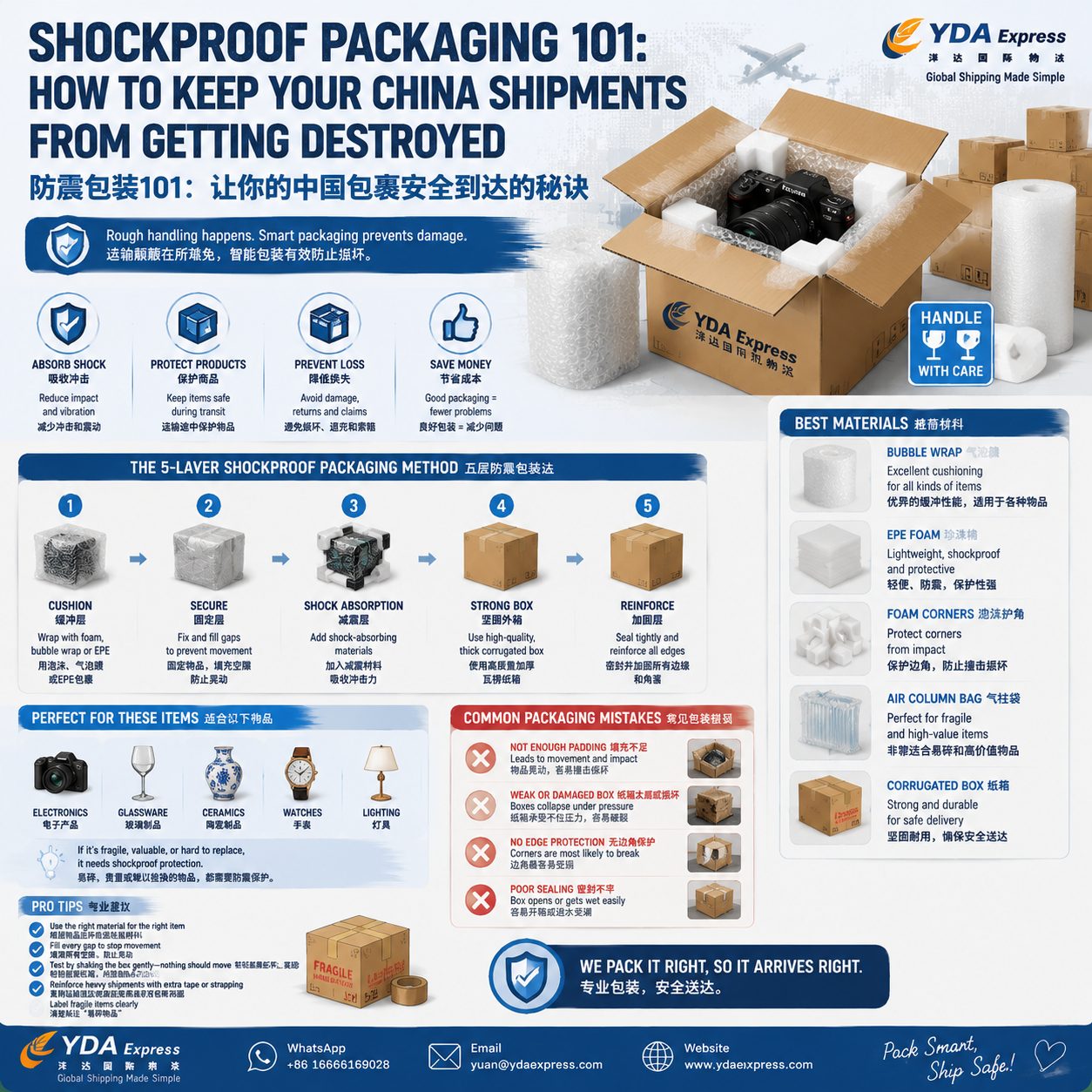
Shockproof Packaging 101: How to Keep Your China Shipments from Getting Destroyed

管理员
2026年7月26日
24 阅读
0 喜欢

A practical guide to shockproof packaging for international shipments, especially from China. Covers materials, techniques, common mistakes, and how a forwarding partner can save your fragile items from damage.

Shockproof Packaging 101: How to Keep Your China Shipments from Getting Destroyed

Imagine waiting three weeks for a custom-made ceramic mug from a seller on Taobao. You tracked the package across the ocean, through customs, and to your local delivery truck. You open the door, grab the box, and hear a terrible rattling sound inside. You open it up to find… a handful of ceramic shards and a pile of dust. The bubble wrap? It was there, but it was half-popped, and the mug had clearly been sitting directly against the box wall.

If that sounds familiar, you’re not alone. Broken parcels are one of the most common headaches in international shipping, especially when ordering from China. The culprit is almost always poor shockproof packaging. But here’s the good news: it’s an easy fix once you understand what really works.

This guide will walk you through everything you need to know about shockproof packaging—the materials, the techniques, and the sort of real-world advice that comes from watching thousands of packages pass through a forwarding warehouse.

What Is Shockproof Packaging, Really?

Shockproof packaging isn’t just wrapping something in bubble wrap. It’s a whole approach to packing that shields your items from the physical forces they’ll encounter on their journey. Think of it as a protective system that absorbs and disperses energy so your product doesn’t have to.

The goal is simple: when the box gets dropped, shaken, or crushed, the packaging material takes the hit, compresses, and springs back, isolating the item inside. A well-packed box could be kicked across a warehouse floor (yes, that happens) and the contents would still be fine.

There’s a bit of science behind it—cushion curves, G-force ratings, resonance frequencies—but you don’t need an engineering degree. You just need to know the basics, which we’ll cover.

The Three Enemies: Impact, Vibration, and Compression

All the rough treatment boils down to three types of force:

  • Impact (shock): A sudden hit, like when a courier drops your box onto a concrete floor from waist height. This delivers a massive shock in milliseconds. If your packaging can’t absorb that energy, the item cracks or shatters.
  • Vibration: Constant shaking during road transport or on a ship’s deck. Over days or weeks, vibration can loosen screws, abrade surfaces, and cause fatigue breaks in metals or plastics. It’s subtle but destructive.
  • Compression: When other boxes are stacked on top, your box might have to support 50 kg or more. If the box crumples, everything inside gets crushed. Good packaging adds structural strength and distributes the load.

International shipping from China subjects your parcel to all three—often at extreme levels. That’s why you can’t get away with the same flimsy packaging a domestic seller might use.

Why China Shipments Need Extra Protection

When you buy locally, your item takes a short ride in a van. When you buy from China, it goes through a gauntlet. A typical journey might involve:

  1. A local courier picking up from the seller and tossing it into a truck.
  2. Sorting at a regional hub where it might be dropped onto conveyors.
  3. Consolidation at a warehouse (if using a forwarder like YDA Express) where it might sit for a few days until your order is complete.
  4. International air or sea freight, with vibration, temperature changes, and potential rough handling at ports.
  5. Customs inspection, where it could be opened and repacked (not always carefully).
  6. Final delivery by your local postal service or courier.

That’s at least six touchpoints, each with potential for damage. In our warehouse, we’ve seen boxes arrive from sellers that are barely more than paper bags. A ceramic vase wrapped in a single sheet of tissue paper? We’ve seen it. A smartphone in a jiffy bag? Yep. These items would never survive the full trip without being repacked properly. That’s why a good forwarding partner or packing service is worth its weight in gold.

The Best Materials for Shockproof Packaging

Let’s go through the main materials, from the classics to some advanced options.

Bubble Wrap: The Old Faithful

Bubble wrap is still one of the best general-purpose cushioning materials. The air inside the bubbles compresses on impact, then rebounds, absorbing energy. Use it correctly: wrap the item with the bubble side facing in (so the bubbles press against the item), and apply multiple layers. For something like a delicate figurine, you want at least two to three wraps. But note: bubble wrap can lose its protective quality if stored compressed for ages, and heavy items can pop the bubbles, so for denser goods, combine it with other materials.

Foam Sheets and Rolls

Polyethylene foam offers uniform cushioning and doesn’t pop. It’s great for scratch protection and vibration damping. Thin sheets (1–2 mm) are perfect for interleaving plates or wrapping polished metal surfaces. Thicker foam (5–10 mm) can absorb more shock. Urethane foams absorb energy even better, and they’re often used in electronics cases. If you’re shipping something very high-value, consider charcoal foam or custom-cut foam inserts.

Packing Peanuts: Filling the Voids

Biodegradable starch peanuts or EPS peanuts are good for filling empty spaces and distributing force. They’re lightweight. The key is to pack them tightly—fill the box until you have to press the lid down. That prevents settling. However, for heavy items they can shift too much, so use them alongside other materials. Avoid plastic peanuts for eco reasons.

Air Pillows: Not for Heavy Lifting

Those plastic inflatable pillows are excellent void fill, but they’re primarily anti-shift, not anti-shock. Use them for light, non-fragile items. They can pop under pressure, leaving gaps. Don’t rely on them as your primary shock absorber.

Molded Pulp and Custom Inserts

Think of egg cartons or the slim profiles that hold a new laptop in its box. Molded pulp is made from recycled paper and can be engineered to crumple at a specific force, absorbing shock beautifully. Custom inserts can be made for high-value or repeat shipments. For one-off items, you can mimic this by carving a cavity in a block of EPS foam.

Corrugated Cardboard Inserts

Heavy-duty corrugated sheets can be folded into dividers, crumpled into balls, or layered to add rigidity. They’re cheap and recyclable. For heavy items, a few layers of cardboard on the bottom can stop the item from punching through. Also, double-wall corrugated sheets cut to size make excellent box stiffeners.

Crumpled Kraft Paper: Simple and Effective

When tightly wadded, kraft paper creates a springy mass that’s surprisingly good at absorbing shock. It’s especially useful for odd-shaped items where you can’t get foam to fit neatly. Use heavyweight paper (at least 50 lb basis weight) and really scrunch it up. Loosely folded newspaper is useless; tight, dense balls are effective.

Instapak Expanding Foam

For truly delicate or irregularly shaped items, expanding foam packs can be a lifesaver. You place a bag of chemical components in the box, they foam up within seconds, and the liquid foam expands to fill the empty space perfectly, forming a custom mold around your item. The foam solidifies in under a minute, and you’re left with a perfect fit. This is often used for shipping electronics, medical devices, or art. It’s more expensive but nearly foolproof.

Anti-static Materials for Electronics

If you’re shipping electronics, standard foam and bubble wrap can generate static electricity that fries circuit boards. Use pink anti-static bubble wrap or foam. You’ll also want to pack items in anti-static bags first. A little extra care here avoids your new gadget arriving as a brick.

How to Pack a Box That Survives Anything

Now, let’s get into the packing process. Here’s a reliable method.

1. Start with a Strong Box

The box is the foundation. For international shipping, use a new double-wall corrugated box rated at least 32 ECT, though 44 ECT is better for heavy or valuable items. Avoid used boxes; they lose strength. The box should be just large enough to allow 5 cm of cushioning around all sides of the item. Too much room and the item can shift; too little and you have no cushion.

2. Wrap the Item Thoroughly

Wrap your item completely in your primary cushioning material (bubble wrap, foam, etc.). Cover all surfaces, tucking in corners and edges. For items with sharp parts, pad those first with extra foam or cardboard before the main wrap. Use tape to secure the wrapping so it doesn’t come undone during transit.

3. Add a Base Cushion

Before placing the item, put a solid layer of cushioning at the bottom of the box. This could be foam peanuts, crumpled paper, a piece of foam sheet, or custom inserts. The goal: if the box is dropped, the bottom layer compresses and absorbs the shock before it reaches the item. Aim for at least 5 cm of material.

4. Center the Item and Fill Voids

Place the wrapped item in the center of the box, then fill all sides with additional cushioning. Use a mix of materials to ensure firm, even support. The item should not touch the box walls directly. When you shake the box, nothing should move. If it does, add more fill.

5. Top It Off

Add a top layer of cushioning before closing the flaps. Again, you want slight resistance when you close the lid—this means the box is fully packed and the contents are under a little compression, which prevents shifting.

6. Seal It Well

Use heavy-duty packing tape (at least 50 mm wide). Apply the tape across the center seam and along both edge seams (the “H” pattern). For heavy boxes, go around the box once with tape perpendicular to the seams. Reinforce corners if you can.

7. Label and Ship

Attach your shipping label securely. Fragile stickers can’t hurt, but don’t count on them. If the box is heavy, consider “Heavy” stickers so handlers are aware.

Common Shockproof Packaging Mistakes

I still see these regularly:

  • Skimping on material: Using one layer of small-bubble wrap for a heavy ceramic statue. It pops, the item hits the box, and you get a statue in pieces.
  • Leaving empty space: Without fill, items slide around and build up momentum until they hit a wall. A 500 gram item in a loose box can generate over 50 Gs on impact.
  • Not reinforcing edges and corners: These are the first to hit. Add corner protectors or extra padding.
  • Using the wrong box: A single-wall box for 10 kg of books will burst. Match box strength to weight.
  • Over-relying on peanuts: They settle. Always compress them firmly and use other materials to maintain position.
  • Ignoring moisture: Sea shipments can be humid. Add silica gel packs and avoid starch-based peanuts that dissolve in moisture.

Consolidation: Packing Multiple Items Without an Internal Brawl

If you’re ordering several things from different stores and using a consolidation service, you’ll end up with a number of individual packages arriving at the warehouse. Combining them into one box saves a lot on shipping, but it also introduces new risks: different shapes, weights, and fragilities all rubbing together.

The solution: treat the consolidation box as a new packaging challenge. Unwrap the items, inspect them, then repack them as a single, integrated unit. Group heavy, sturdy items at the bottom, lighter fragile ones on top. Wrap each fragile item individually, then use dividers (cardboard or foam) to separate them. Fill all gaps tightly. Use plenty of kraft paper or foam inserts to prevent any movement. At YDA Express, we do exactly this: we check each item, remove poor original packaging, and build a new, secure package that’s ready for the long haul.

Does Your Box Pass the Shake and Drop Test?

Before you seal it, give it a test. Shake the box. Hear anything moving? Add more fill. If you can feel items shifting or hitting the walls, it’s not packed tight enough.

If you’re feeling brave, you can do a drop test from about 80 cm (waist height). Your fully packed, sealed box should survive a flat drop onto a hard floor without damage. This simulates a typical courier drop. Obviously, don’t do this with truly irreplaceable items, but for many goods it’s a good sanity check.

When to Let the Pros Handle It

All this packing can be time-consuming, and if you’re ordering from China, you may not have control over the seller’s packaging. That’s when a reliable forwarding partner becomes your best friend.

At YDA Express, we receive your packages from Chinese sellers, inspect them for damage, and if the packaging isn’t up to par (it often isn’t), we repack them with proper shockproof materials. We combine orders economically, use sturdy boxes, and apply years of logistics knowledge to keep your stuff safe. Want us to double-wrap that fragile teapot you bought on JD.com? Just ask. Need photos before shipping? No problem. We work with you to get your goods home in one piece.

Pack It Like You Mean It

The takeaway is simple: don’t underestimate the journey your package will take. International shipping is tough, and shockproof packaging is your best defense. Spend a little extra on materials, take the time to pack properly, and if you’re shipping from China, work with a partner that understands the process inside and out.

Ready to ship with confidence? Visit ydaexpress.com to learn more about our forwarding and repacking services, or message us on WhatsApp at +86 16666169028. We’ll make sure your parcels arrive safe and sound—no drama, just delivery.