Small Parcel Logistics: How to Ship Lightweight Goods Internationally Without the Hefty Price Tag

管理员
2026年7月14日
12 阅读
0 喜欢

Shipping small items across borders often comes with unexpected costs and confusion. This guide breaks down everything you need to know about small parcel logistics—from choosing carriers and understanding dimensional weight to packaging tricks and customs tips. Learn how freight forwarders like YDA Express can help you save money and time.

You’ve found the perfect gadget on a Chinese e-commerce site, or maybe it’s a custom-made accessory from a Taobao seller. It’s small, lightweight, and exactly what you want. But then you hit the shipping options: an international courier that charges more than the item itself, or a seemingly cheap postal service with no tracking and a month‑long wait. Frustrating, right? That’s where small parcel logistics comes in—and honestly, it doesn’t have to be a headache.

Here’s the thing: millions of people ship small packages worldwide every day. Cross‑border e‑commerce is booming, and everyday shoppers, students abroad, and tiny online stores all need reliable ways to move lightweight goods. The trick is knowing how to balance speed, cost, and reliability. I’ve spent years in the logistics trenches, and I’ll walk you through what works.

What Exactly Is Small Parcel Logistics?

Small parcel logistics isn’t a separate industry—it’s just a practical way of describing the process of shipping individual small packages across international borders. Think of a single shoebox rather than a pallet of goods. Most couriers define a small parcel by weight and dimensions: typically anything under 2–3 kg and with a total girth (length + 2×width + 2×height) that falls within certain limits. FedEx, DHL, UPS—they all have similar brackets.

But small parcel logistics also covers how you manage those shipments. It’s about choosing the right carrier, preparing the package to avoid surcharges, handling customs forms, and sometimes bundling multiple small orders into one box to slash per‑item costs. For anyone buying from China (via Taobao, 1688, JD.com, or Pinduoduo), it’s a daily reality.

When Do You Need Small Parcel Shipping?

If you’re reading this, you probably already do. Maybe you’re a fashion boutique owner ordering a few sample dresses from Guangzhou. An international student buying textbooks and a few home comforts. A hobbyist snagging rare car parts from a Japanese seller via a proxy. Even a small business that sources unique products from overseas manufacturers a few dozen units at a time.

Common scenarios:

  • Personal shopping from Chinese platforms — you buy on Taobao or Pinduoduo, but the sellers only ship domestically. You need a forwarder to receive, consolidate, and forward your items abroad.
  • E‑commerce dropshipping or small inventory restocks — selling on Etsy or eBay and ordering small batches from suppliers.
  • Sending gifts to friends or family overseas — a lightweight package that still needs to arrive in one piece.
  • Business samples — before committing to a full container load, you test the product with a few units.

In all these cases, you’re dealing with small parcel logistics. The cost per kilogram is higher than for bulk freight, but you’re not paying for empty space you don’t need.

The Cost Puzzle: Why Small Parcels Can Be Expensive

Everyone’s been shocked by a shipping quote. You look at a 1.5 kg package and think, “It can’t be that much.” But then the courier charges you for 3 kg. Why? Because of something called dimensional weight (or volumetric weight).

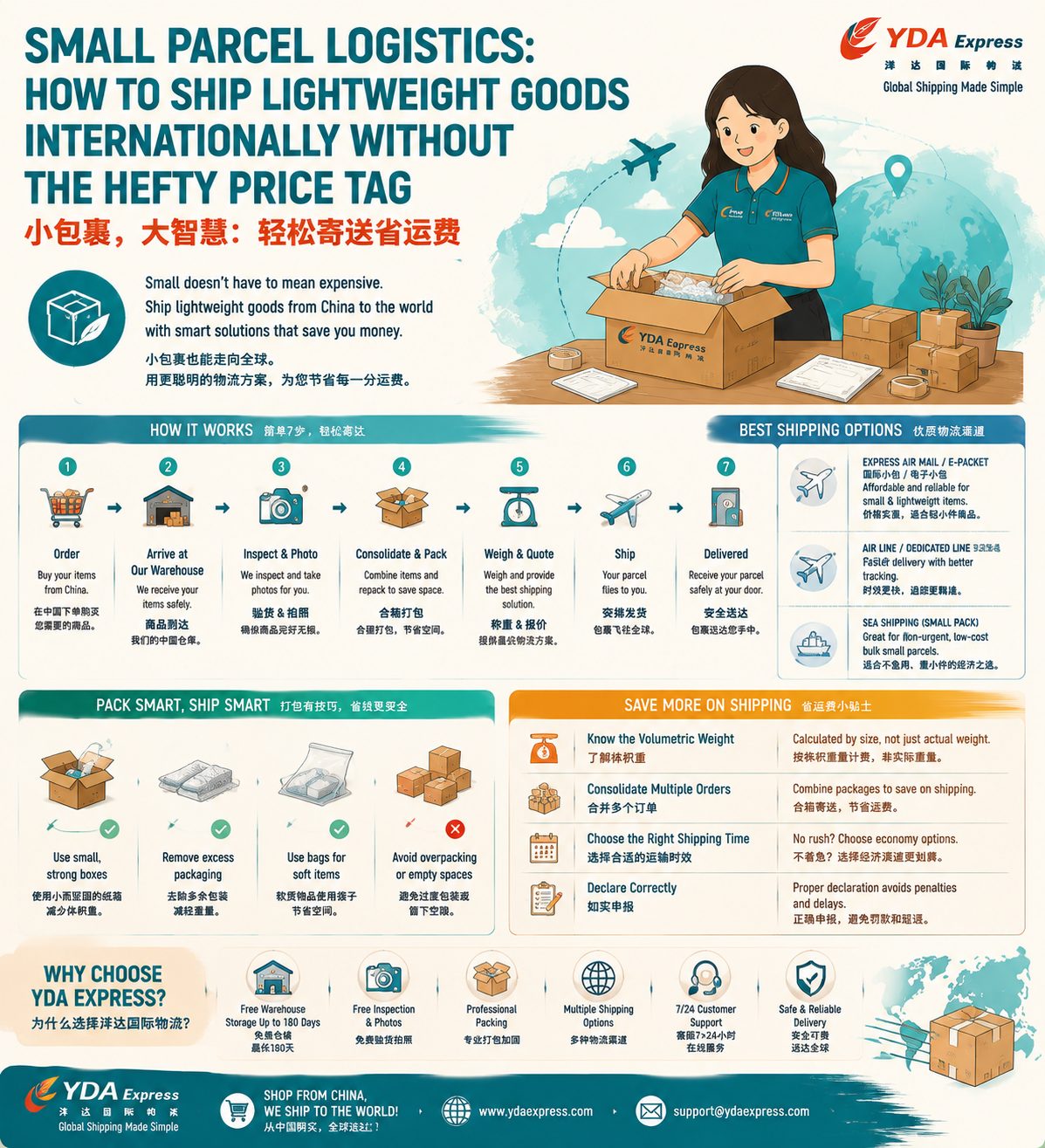
Couriers use a formula to turn your box’s size into a chargeable weight. The most common formula: (length × width × height in cm) ÷ 5000. So a box that’s 30×20×15 cm gives you 9,000 cm³ / 5,000 = 1.8 kg. If your actual weight is only 1.2 kg, they’ll bill you for 1.8 kg. That’s the volumetric weight. It protects carriers from giant boxes full of feathers.

Then you add fuel surcharges, remote area fees, and handling charges. Suddenly a $5 item costs $35 to ship. Post offices (China Post, USPS, and their partners) are cheaper but slower—often 2–6 weeks—and tracking can be spotty. To be fair, postal services work fine if you’re not in a hurry, but for anything valuable or time‑sensitive, you need more.

Choosing the Right Carrier or Service

You’ve got three basic routes for small parcel shipping:

1. International Couriers (DHL, FedEx, UPS, SF International) Fast, reliable, and expensive. Best for high‑value or urgent items. They handle customs well and offer full tracking. But their retail rates are eye‑watering. Discounts through brokers or forwarders can bring the cost down significantly.

2. Postal Services (China Post, Hong Kong Post, USPS, etc.) Cheapest option for small, non‑urgent packages. Typically 10–30 business days. Tracking varies (registered airmail has better tracking). Small parcels under 2 kg can often be sent as “small packets” at a low rate. Customs delays happen, and lost‑package claims are a hassle.

3. Freight Forwarders and Consolidators This is where things get interesting. A forwarder receives parcels from multiple sellers, consolidates them into a single box, and ships them using their own negotiated carrier rates. Because they send large volumes, they get steep discounts—and they pass some of that to you. At YDA Express, we handle this every day: customers shop on Taobao, 1688, JD.com, and send their items to our warehouse. We check the quality, repack to minimize volumetric weight, and ship via air express, air economy, or sea freight, depending on budget and deadline.

Which one is right for you? If you’re buying from one store and the item fits in a padded envelope, postal might do. If you’ve ordered from five different sellers across China, a forwarder like YDA Express will almost always save you money and headaches.

Packaging Tips to Save Money

Since volumetric weight is determined by box size, reducing even a centimeter on each side can drop the chargeable weight. Here are some field‑tested tricks:

  • Use the smallest box that fits — don’t leave dead space. Fill voids with lightweight materials (air pillows, foam sheets) rather than letting the box bulge.
  • Consider poly mailers or soft packaging for clothing, textiles, and non‑fragile items. They have virtually zero volume penalty and protect the item just fine.
  • Remove unnecessary retail packaging — that elaborate gift box might look nice, but it adds weight and bulk. If you’re not gifting it, have your forwarder discard it.
  • Watch your tape — heavy‑duty tape adds weight. It sounds trivial, but on a large consolidated box, every gram counts.
  • Double‑box fragile items — instead of oversized padding, use a smaller inner box with cushioning and then a slightly larger outer box. This often yields a lower volumetric weight than one large box stuffed with peanuts.

At our Yangjiang warehouse, the team routinely repacks packages for clients. We’ve seen shoes arrive in shoeboxes that were 40% air—remove the box, wrap the shoes in bubble wrap, and suddenly the shipping cost drops by a third.

Customs Clearance: Avoiding Surprises

Customs scares people, but for small parcels, it’s usually straightforward. Most countries have a de minimis threshold—a value under which no duties or taxes are charged. For the US, imports valued under $800 are duty‑free for most goods. The UK and EU have tightened their rules; previously some low‑value goods slipped through, but now everything is scrutinized, and VAT is often collected at checkout. Australia’s threshold is $1,000 AUD.

What you need:

  • A commercial invoice — even for gifts, you need a description, value, and reason for export. Write clearly: “Cotton t‑shirt, $15” not “Assorted textiles.”
  • Honest declared value — undervaluing might save a few bucks, but it can get the package seized or delay it. Not worth it.
  • Harmonized System (HS) codes — for business shipments, including the correct 6‑digit HS code speeds clearance. Forwarders can help with this.
  • Prohibited items — check the destination country’s rules. Lithium batteries, liquids, and certain electronics often require special handling.

If you’re consolidating several orders, a forwarder will typically prepare one combined invoice. This reduces paperwork and sometimes keeps the total value below the threshold, but it has to be transparent. At YDA Express, we guide customers on how to declare their shipments correctly, and our system auto‑generates customs‑compliant documentation.

How a Forwarder Like YDA Express Simplifies Small Parcel Shipping

Let’s consider a real scenario: Sarah, a student in London, wanted to buy a few items for her dorm room—silk pillowcases, a cute desk lamp, and some phone cases. She found them on Taobao and Pinduoduo from three different sellers. None offered international shipping. She could have asked each seller to send separately via post, but the combined postage would have been around £45, plus she’d have no quality check and three packages to track.

Instead, she used a forwarder. Here’s how it worked:

  1. Sign up for a free account and get a unique warehouse address.
  2. Shop on any Chinese site and enter the warehouse address at checkout. Sellers ship domestically to the warehouse (often free or cheap).
  3. The warehouse receives the packages and notifies Sarah. She can request photos, check for damage, and even return items if they’re wrong.
  4. Consolidation — once all her items arrived, she asked to have them packed together. The team removed bulky packaging, used a compact box, and sealed it securely.
  5. Shipping choice — she picked an air economy line (7–12 days) which cost £22. With tracking and basic insurance, she had peace of mind.

The whole process saved her over 50% on shipping, and she knew the items were correct before they left China. That’s the power of small parcel logistics done right.

We see this every day at YDA Express. Our customers range from individuals buying gifts to small online stores managing monthly restocks. The key is that we treat every small parcel with the same care a large freight shipment gets—because to the person waiting for it, it’s just as important.

Shipping small parcels internationally doesn’t have to be a guesswork of cheap and risky vs. fast and overpriced. By understanding how carriers charge, packing smart, and teaming up with a forwarder that knows the ins and outs of China‑origin shipments, you can get your goods delivered reliably and affordably. If you’re tired of surprising costs and you want someone to handle the details, reach out to us at YDA Express. You can contact our team on WhatsApp at +86 16666169028 or email yuan@ydaexpress.com, or visit https://www.ydaexpress.com for a free consultation. Let’s make small parcel logistics simple.