
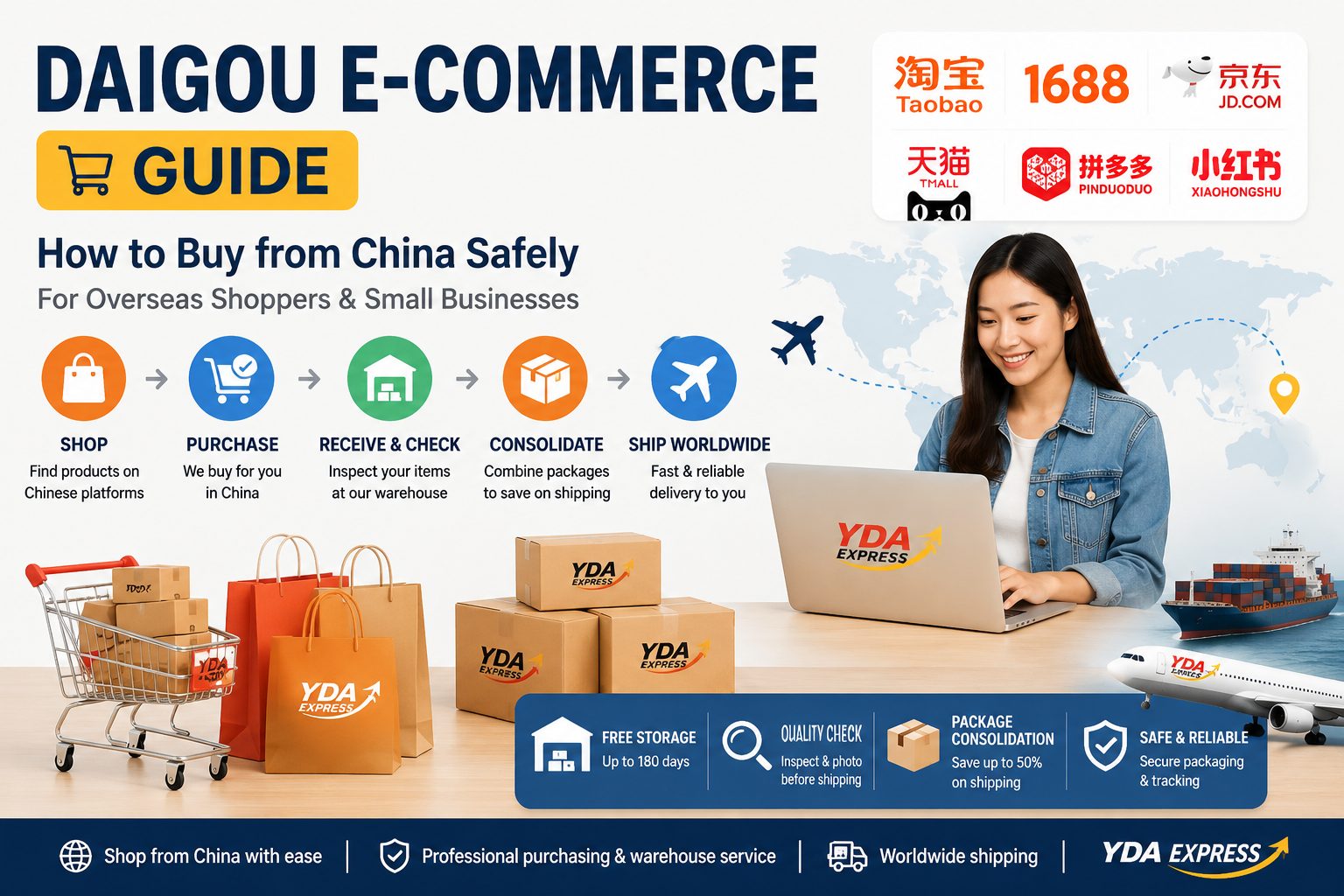
The Smart Shopper’s Guide to Daigou E-Commerce: Buying from China Made Simple

管理员
2026年7月7日
24 阅读
0 喜欢

Daigou e-commerce opens up a world of products from Chinese online stores like Taobao and 1688, even if you’re overseas. This guide explains how proxy buying works, highlights cost-saving strategies, and shows how a reliable partner like YdaExpress can handle purchasing, storage, and shipping so you get your goods without the hassle.

You spot a jacket on Taobao that costs a fraction of what you’d pay locally. Or maybe you need 500 phone cases from a 1688 supplier for your small business. The problem? Most Chinese sellers don’t ship internationally—and if they do, the rates can be wild. That’s where daigou e-commerce comes in.

Daigou—literally “buying on behalf of”—started as personal shoppers helping friends overseas, but it’s evolved into a streamlined service. Today, a good daigou partner is more of a logistics hub: they buy, receive, check, repack, and forward your items, so you can shop Chinese platforms as if you lived in Shanghai or Shenzhen.

I’ve been in this space for years, and honestly, the difference between a smooth experience and a headache usually comes down to who you work with. Here’s what you need to know to get it right.

What Exactly Is Daigou E-Commerce?

At its core, daigou e-commerce connects overseas buyers with products from Chinese online marketplaces. You find what you want on Taobao, Tmall, JD.com, Pinduoduo, or even niche platforms like Xiaohongshu. Instead of trying to navigate Chinese payment systems, language barriers, and domestic-only shipping, you hand the task to a proxy service.

That service:

  • Purchases the item for you using local Chinese payment methods.
  • Has it shipped to their domestic warehouse.
  • Checks the item upon arrival (many will send photos so you can confirm before international dispatch).
  • Consolidates multiple orders into one parcel to save on shipping.
  • Ships internationally via express, air freight, or sea freight.

This isn’t just for individuals. Small e-commerce sellers use daigou services as a sourcing arm. They might buy samples from 1688.com—China’s wholesale wonderland—then turn to the same proxy to forward larger batches once they’re ready to stock up.

Why Not Buy Directly?

Sure, some Chinese retailers offer international shipping. But here’s the thing: direct shipping often comes with higher rates and zero flexibility. Sellers may use a single carrier with no consolidation option. Returns are a nightmare. And if there’s a mistake, communicating across time zones in broken English can turn a $10 product into a week-long frustration.

A dedicated daigou service acts as your local address. You get a Chinese warehouse address to shop freely, then decide how and when to ship internationally. That middle step—the domestic leg—unlocks cheaper shipping rates because the forwarder can combine packages, repack them efficiently, and choose the best carrier based on your budget and deadline.

The Real Benefits of Using a Daigou Agent

Access to blocked platforms. Some Chinese sites geo-restrict international visitors, or certain items won’t show up if you’re browsing from an overseas IP. A local agent bypasses that.

Payment made easy. No one wants to fight with Alipay verification as a foreigner. Agents pay via WeChat Pay, Alipay, or bank transfer in RMB, and you pay them in your local currency through PayPal, credit card, or wire.

Quality checks. I can’t tell you how many times a customer orders a “genuine leather” bag only to receive a plastic knock-off. With a service that photographs your items upon arrival, you catch these issues before the package leaves China. Returns and exchanges are much simpler within the domestic network.

Customs-friendly packing. Experienced forwarders know how to label packages, declare values, and split shipments to minimize customs duties. They’ll also merge your orders so you pay for one international parcel instead of five separate ones.

Storage and patience. Maybe you’re not in a hurry. Some agents offer free storage for 30, 60, even 90 days. You can buy items over several weeks, let them pile up, then ship everything in one go.

Choosing a Reliable Daigou Partner

Not all services are equal. Here’s what I look for—and what you should too:

  • Transparent fees. Hidden costs eat into savings. A trustworthy service publishes its purchasing fee (often 3–10% of item cost), domestic shipping charges, and international freight rates upfront.
  • Clear communication. Do they respond in understandable English? Are they reachable on WhatsApp or email during your waking hours? At YdaExpress, for example, we keep a WhatsApp line active (+8613078354343) and make sure customers aren’t left guessing.
  • Reasonable warehouse rules. Some agents charge for every photo, every repack, every extra day of storage. Fair services include basic inspection, consolidation, and limited storage in the base fee.
  • Carrier options. Be wary of any agent that only offers one shipping method. DHL is fast but pricey; SF International is solid for mid-range; sea freight suits bulk orders. A good partner presents options, not a one-size-fits-all solution.

Shipping and Timing: What to Expect

Let’s talk real numbers. Express shipping (DHL, FedEx, UPS) from China to the U.S. typically takes 3–7 business days for a 1kg package and costs around $15–25. Economy air freight might be 7–15 days for $8–15. Sea freight for larger goods can take 25–40 days but drops the cost dramatically—think $3–6 per kg for heavy shipments.

YdaExpress often sees customers mixing strategies: order a sample via DHL for quick approval, then send the bulk order by sea to keep margins healthy. If you’re an individual shopper, consolidating 3–4 small Taobao orders into one express package can save 30–50% compared to shipping each separately.

Customs clearance is another factor. Most daigou parcels sail through without issue, especially to the U.S., where the de minimis threshold is $800. For higher-value shipments, under-invoicing is risky; a competent agent will advise a realistic declared value and may even pre-prepare commercial invoices.

Common Pitfalls and How to Avoid Them

Not checking item restrictions. Batteries, liquids, and branded goods often face extra scrutiny. Ask your agent before buying. Some items simply can’t fly—literally.

Ignoring weight vs. volumetric weight. Carriers charge by whichever is greater: actual weight or dimensional weight (length × width × height ÷ 5000 for cm). Those cute but bulky slippers might incur a shipping cost double their purchase price if the box is oversized. Good agents will repack to reduce volume.

Over-consolidating. Combining too many parcels can create an unwieldy box that attracts customs attention. Know when to split shipments.

Chasing the cheapest agent. If the service fee looks too low, corners are being cut somewhere. Maybe they won’t check your items, or they’ll use a dubious shipping line that leaves packages lingering in a warehouse for weeks.

A Day in the Life of a Daigou Order

Here’s a typical flow, drawn from the hundreds of shipments YdaExpress handles monthly. Suppose you’re in Australia and want three dresses from a Taobao store, and two pairs of shoes from a Pinduoduo seller.

  1. You copy the product links and send them to your daigou service via their dashboard or WhatsApp.
  2. The agent confirms prices, estimates domestic shipping, and gives you a total. You pay in AUD via PayPal.
  3. The agent buys the items. Within 2–5 days, the packages arrive at their Shenzhen warehouse.
  4. The agent photographs the dresses and shoes, checking for damage or wrong sizing. You give the green light.
  5. You request consolidation. The team removes excess packaging, wraps everything together securely, and weighs the final parcel.
  6. They present shipping options: DHL Express for $30 (4–6 days), SF Economy for $18 (10–14 days). You pick one.
  7. Once shipped, you receive a tracking number. A week and a half later, your parcel arrives in Sydney—duties rarely apply because the declared value stays modest.

Simple, right? The key is that you never need to deal with Chinese interfaces or worry about local logistics. The service translates the messy parts.

Is Daigou Just for Fashion?

Absolutely not. While clothing and cosmetics are popular, daigou e-commerce serves a wide range. Electronics enthusiasts snag Xiaomi gadgets and DJI drones that ship domestically only. Parents buy Mandarin children’s books that overseas stores mark up 200%. Hobbyists source rare model kits from Taobao. And small businesses use daigou agents as their factory connection—ordering samples from 1688, then scaling to commercial quantities with freight consolidation.

If you run a boutique and want Chinese ceramic mugs with your logo, a forwarder can receive the batch, quality-check each mug, and coordinate sea freight to your commercial address. It’s essentially a third-party logistics partnership on a smaller scale.

When You Might Not Need a Daigou Agent

To be fair, if you buy from a Chinese platform with its own international logistics (like AliExpress), a middleman adds an extra step. And some heavyweight items—furniture, large machinery—often require freight forwarders specialized in oversized cargo, not a general daigou service. But for the vast middle ground of consumer goods, apparel, accessories, and small-run business supplies, a daigou setup trumps going direct.

Also, if you speak Chinese fluently and maintain a Chinese bank account, you could theoretically self-purchase and use a simple forwarding address. Most overseas shoppers don’t fit that profile, though.

Bringing It All Together

Daigou e-commerce bridges the gap between the world’s largest manufacturing economy and global consumers who want access without the friction. The right partner handles the nitty-gritty—buying, inspecting, repacking, and shipping—so your main job is finding the products you love.

When you’re ready to give it a try, look for a service that communicates clearly, charges fairly, and offers flexible shipping routes. At YdaExpress, we’ve built our process around those principles, with a warehouse in Shenzhen and carrier relationships that keep transit times predictable and rates competitive. We help customers every day navigate cross-border shopping, whether it’s a single Taobao handbag or a bulk order of electronics accessories.

Ready to simplify your China shopping? Visit https://www.ydaexpress.com or send us a message on WhatsApp at +8613078354343. We’ll walk you through your first order and make sure you’re comfortable every step of the way.