
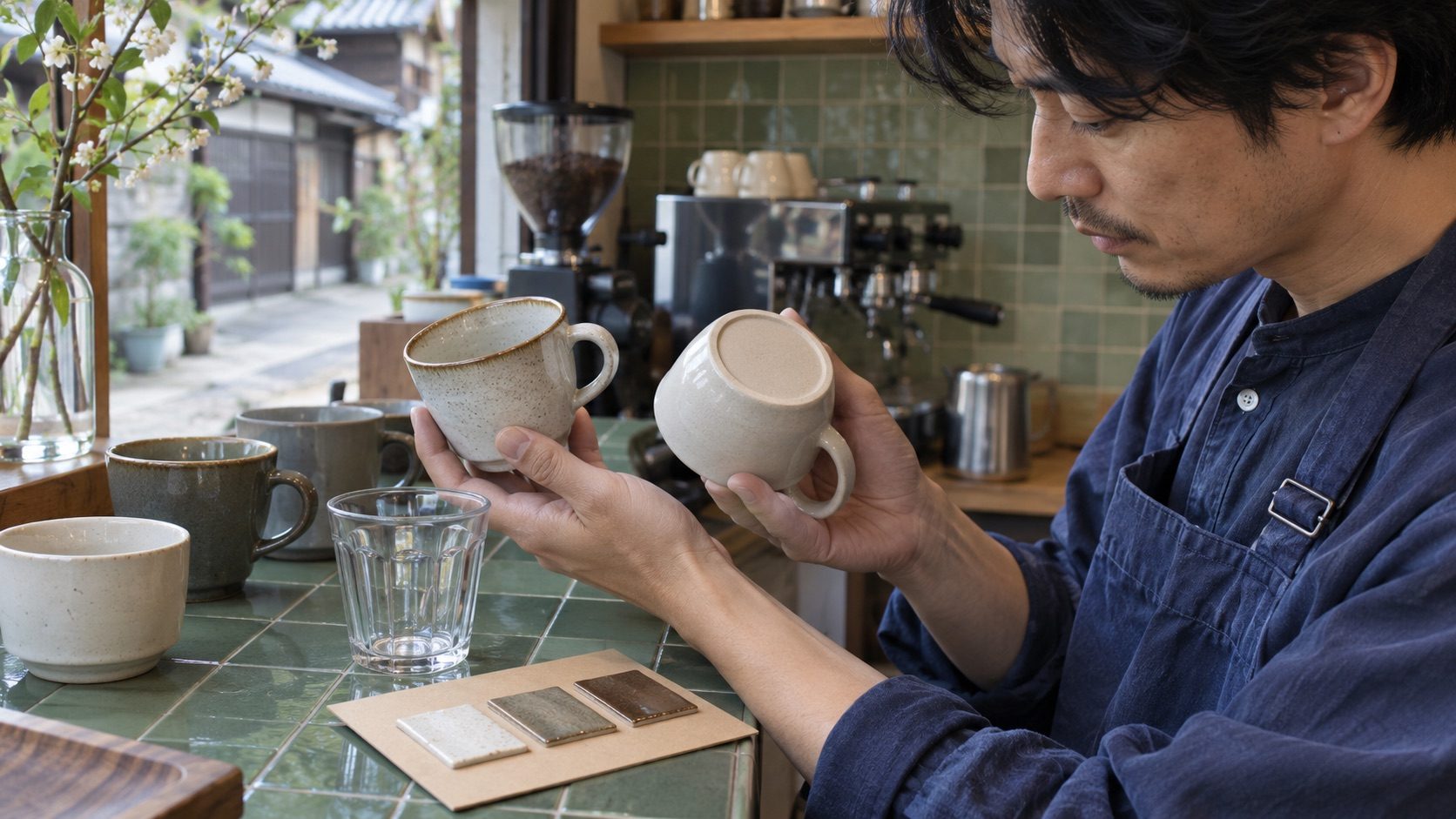
Before ordering ceramic cups for a café in Japan, connect each selected model and colour to its manufacturer, food-contact materials and relevant test records. Use that file for a quarantine-station consultation.
Before paying for ceramic cups on 1688, ask the supplier for records covering the specific factory, cup model, glaze colour and intended use. A report for another cup in the same shop does not settle whether your selection meets Japan’s food-contact requirements.
This article covers new, reusable ceramic cups for serving drinks in a café in Japan. The result is a product file you can take to the responsible quarantine station before committing to the order. Official rules checked: 2 November 2026.
Serving customers makes this business use
“We will not sell the cups” does not make them household purchases. Japan’s Ministry of Health, Labour and Welfare (MHLW) requires an import notification for food-contact utensils imported for sale or business use. Cups used to serve café customers fall within that business-use question, even when ordered in an individual owner’s name. Quantity and postal delivery do not remove the requirement. See MHLW’s import procedures.
Genuine personal household use and samples kept solely for internal evaluation are different. Tokyo Quarantine Station explains that distinction. Describe exactly how a sample will be used; do not treat a cup put into customer service as an internal sample. For the wider business-order decision, read when 1688 samples become commercial imports.
Make the supplier describe the cup you selected
Save the 1688 listing, selected variant and quotation. Ask whether the shop manufactures the cups or buys them from another factory. The shop’s business licence helps identify the seller; it does not establish who made the product. Use the supplier-verification checklist for that separate check.
Japan’s quarantine documents need a reliable connection to the goods. Tokyo’s preparation guidance calls for identifiable manufacturer information and documents traceable to their issuer. It prefers English documents on company letterhead; for other original languages, prepare the Japanese translation it requests, separately from the original.
Ask the manufacturer to supply the following for each selected version:
| Record | What it must identify |
|---|---|
| Maker and production site | Full names and physical addresses; explain a different seller |
| Cup specification | Model/SKU, ceramic material, depth, capacity and intended use |
| Food-contact surfaces | Interior, rim and relevant decoration or coating; materials and colours |
| Supporting report | Tested item, maker/site, photograph, test method and results |
Include clear colour photos showing the inside and rim. Osaka’s utensil-document checklist specifically asks for food-contact material/colour information and product photos. “Ceramic, food grade” leaves too much unidentified.
Does the report actually cover this colour and size?
Japan’s current utensil standards include lead and cadmium migration requirements for ceramic ware. The applicable category depends on characteristics such as depth, capacity and use. A supplier’s Chinese food-grade statement or an unrelated overseas standard is not, by itself, proof of meeting those Japanese requirements.
Hypothetical example: you want a small white cup and a larger blue version, but the report describes only the white one. List both versions separately. Ask the manufacturer which item was tested and what evidence supports extending that report to the other version.
Niigata Quarantine Station’s guidance says that using a report for another equivalent product requires the same colour, material and manufacturing site; glass and ceramic ware also need the same specification category, including depth, capacity and use. It describes an equivalence letter for the first such submission. Send the actual differences to the handling station rather than writing “same series” yourself.
This does not mean every colour automatically needs a new test. It means the report’s coverage must be established. For an overseas report, also check the laboratory and applicable conditions under MHLW’s foreign official laboratory system. Ask the quarantine station whether the report and test items are acceptable for this product.
Ask the quarantine station a product question
The importer submits the food/utensil import notification to the quarantine station responsible for the place of customs clearance. First-time importers can seek advice before import. Agree the intended entry point with the carrier or broker, then find the food-import desk through MHLW’s procedures and contact list.
Send a focused enquiry such as this, completed with genuine information. It is an enquiry outline, not an official form:
We plan to import the attached ceramic cup models for serving drinks in our café. The manufacturer/site and food-contact materials are identified in the attached specification. The report covers [identify the actual tested item]. Our selected versions differ in [state the differences]. Can this evidence support the notification, and which further documents or tests are needed before we order?
Keep the answer with the dated specification. Consultation is not import release. MHLW decides the need for inspection after reviewing the notification; there is no single identical testing requirement for every cup. YDA can help request supplier records within an agreed service, but it cannot issue a laboratory report or replace the Japanese importer’s responsibility.
Check the clearance cost without assuming “small means exempt”
Use the genuine business transaction value with the required additions, including freight and insurance to Japan, under Japan Customs’ valuation rules. Ordinary cups normally attract the 10% standard consumption tax, calculated on customs value plus duty and other applicable excises; they are not food qualifying for the reduced food rate. Broker and testing charges are separate. Japan Customs explains the tax base and rates.
The ¥10,000 relief concerns total customs value, subject to exclusions and aggregation rules. The separate simplified tariff for qualifying imports up to ¥200,000 lists ceramic products as duty-free, with consumption tax considered separately. Confirm the actual classification, applicable schedule and any origin preference with the declarant. Neither threshold removes the food-contact notification requirement.
Keep the documented cup unchanged through dispatch
Before ordering, resolve the missing manufacturer, material or report coverage. If the supplier cannot supply enough information for the Japanese assessment, choose another product rather than relying on a cheap freight quote.
At the China warehouse, request agreed photos and counts against the selected SKUs. A change of factory, interior colour, decoration, size or coating needs another assessment of the records. Visible checks cannot detect lead or cadmium migration. Goods that fail applicable food-sanitation standards cannot be used in the café; an available carrier does not legalise them.
Adding plastic lids, resin coatings, electrical warmers or food changes the review. Submit the exact components first; this ceramic-cup file does not approve those additions. Japan Customs prohibits IPR-infringing goods, so do not order copied branding without checking the rights. Once the product and import arrangements are settled, agree fragile-item packaging, final measurements and carrier acceptance.
Send YDA the selected variants, manufacturer file and the Japanese contact’s outstanding questions to discuss available purchasing, photo and packing assistance. Before international dispatch, recheck current standards, taxes, notification instructions and route conditions. YDA cannot guarantee compliance, tax, clearance or delivery time.
The title image is an AI-generated concept illustration, not a laboratory record or an actual customer shipment.
📲 Download the YDA Express App
Use the YDA Express App to place China purchasing orders, view product check photos, manage packages, and arrange consolidation and international forwarding.