
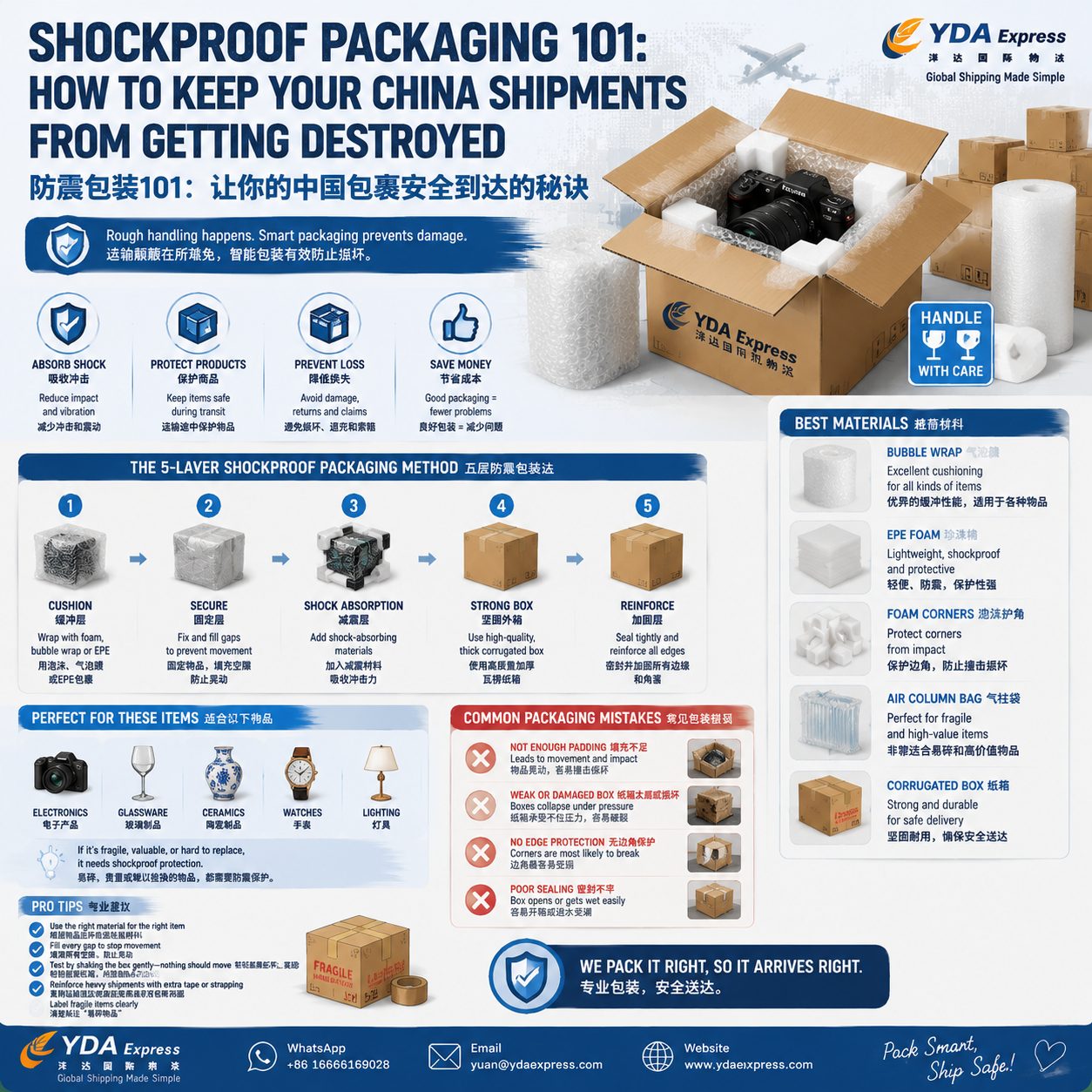
Learn how to protect fragile, electronic, heavy and soft goods when consolidating purchases from Chinese sellers. This guide covers cushioning materials, packing methods, warehouse inspection, dimensional weight and customs preparation.
A parcel can leave a Chinese seller’s warehouse looking perfectly fine and still arrive overseas with cracked ceramics, dented boxes or damaged electronics. The reason is simple: domestic packaging is usually designed for a short local delivery, while an international shipment may pass through several sorting hubs, warehouse transfers, customs inspection and final-mile delivery.
This becomes even more important when you buy from several stores on Taobao, 1688, JD.com or Pinduoduo. Each seller may use a different box, different filler and a different packing standard. Before international dispatch, those parcels need to be inspected and rebuilt as one protected shipment.
Why consolidated parcels need a new packaging plan
Consolidation is not just putting several original boxes into a larger carton. A consolidated shipment may contain clothing, shoes, glassware, electronics, metal parts or gifts in the same order. These products react differently to impact, vibration, moisture and pressure.
A heavy item placed above a fragile one can crush it. A loose accessory can move inside the box and scratch another product. An oversized retail box can increase dimensional weight without adding useful protection.
The correct process is:
- Receive and identify every parcel.
- Check visible condition and quantities.
- Separate fragile, heavy, sharp or sensitive items.
- Remove weak or unnecessary outer packaging.
- Select cushioning and dividers for each product.
- Build and seal a new international shipping carton.
You can review the main steps for receiving and inspecting parcels in a China warehouse before requesting consolidation.
The three forces your package must withstand
International transport exposes parcels to three main types of stress.
Impact happens when a carton is dropped or hits a conveyor wall. Fragile materials such as ceramic, glass and some plastics can crack instantly.
Vibration continues during truck, air and sea transport. It can loosen components, rub surfaces together and gradually weaken poorly supported products.
Compression occurs when cartons are stacked. A weak outer box may collapse even when the contents were packed correctly.
Good packaging does not promise that a parcel will never be mishandled. It creates enough separation, cushioning and structural strength to reduce the effect of normal transport shocks.
Choose cushioning according to the product
No single material works best for every shipment.
- Bubble wrap is useful for general cushioning, but heavy items can compress or burst the bubbles. Use several layers and combine it with a rigid divider when necessary.
- Foam sheets protect polished surfaces from scratches and provide consistent separation between items.
- Corrugated cardboard works well as a divider, corner protector or reinforcement layer at the bottom of a carton.
- Crumpled kraft paper fills irregular gaps and prevents movement when packed firmly.
- Air pillows are suitable for light products but should not be the only protection for heavy or fragile goods.
- Molded inserts or custom foam are appropriate for high-value products with a fixed shape.
- Anti-static bags and foam should be used for circuit boards, computer parts and other static-sensitive electronics.
- Waterproof inner bags help protect goods from condensation, minor leaks and wet handling conditions.
Packaging materials should be selected after the warehouse knows the product type, dimensions and transport method. A ceramic cup, a metal tool and a padded jacket should not be packed in the same way.
A practical packing method for fragile products
For a vase, mug, glass container or decorative item, begin by protecting handles, corners and protruding parts with foam or folded cardboard. Wrap the complete item, then place it in a rigid inner box if the product has a presentation box that must remain intact.
Use a second outer carton with cushioning on every side. The item should not touch the carton walls. Fill the gaps until the product stays in position when the box is gently moved.
For several fragile products, wrap each one separately and add dividers between them. Do not allow ceramic or glass surfaces to touch, even when both items are wrapped.
A slightly larger box is not automatically safer. Excess space allows items to gain momentum during impact. The goal is controlled separation, not empty volume.
How to pack electronics and sensitive surfaces
Electronics require protection from impact, scratches, moisture and static electricity. Keep the original product packaging when it provides a molded insert or rigid support. If that packaging is damaged or oversized, the warehouse may need to rebuild the parcel while preserving the product itself.
Place small components in sealed bags so they cannot move freely. Use anti-static materials for circuit boards and exposed electronic parts. Screens, glossy surfaces and painted panels should be separated with foam sheets rather than rough cardboard.
Do not place heavy products above electronics. If several categories are consolidated, use a layered structure: heavy and stable items at the bottom, protected electronics in the middle, and light goods at the top.
How to protect clothing, shoes and soft goods
Soft goods usually need less shock absorption, but they can still be damaged by moisture, sharp edges and excessive compression. Remove unnecessary retail packaging only after confirming that it is not needed for returns or presentation.
Shoes should be separated from metal parts, tools or hard accessories. Use inner bags to prevent dust transfer and keep pairs together. Clothing can often be folded or compressed to reduce volume, but delicate fabrics should not be compressed for long periods without checking the material.
Reducing packaging can lower dimensional weight, but removing protection simply to save space may create a larger loss if the goods are damaged. Compare the estimated international shipping cost with the value and sensitivity of the products before approving repacking.
How to build a safer consolidation box
When several parcels arrive, arrange them by weight and risk:
- Reinforce the bottom of the carton.
- Place heavy, stable products at the lowest level.
- Add dividers around fragile products.
- Keep sharp edges away from soft goods.
- Separate liquids and moisture-sensitive items.
- Fill every open space with suitable material.
- Add a top cushioning layer before closing.
- Seal the carton using the H-taping method.
Before dispatch, ask for the final weight and dimensions. Consolidation may reduce repeated handling, but a very large carton can increase dimensional weight or become difficult to handle. The best result is usually a compact, balanced box rather than the largest possible box.
For a detailed explanation of when combining parcels is worthwhile, see this guide to package consolidation from China.
Inspection before sealing the shipment
A warehouse inspection can confirm visible condition, quantity, variants, labels and obvious external damage. It cannot replace laboratory testing, product certification or a technical quality audit.
If a product arrives broken, incomplete or different from the order, identify the issue before international dispatch. Domestic communication with the seller is usually easier than returning an item from overseas.
YDA Express can receive parcels in China, provide available inspection photos, remove unsuitable outer packaging, add protection and organize eligible orders for consolidation. Storage of up to 180 days allows buyers to wait for parcels from different sellers before deciding how to ship them.
Customs information still matters
Protective packaging does not remove customs obligations. Every item in a consolidated parcel should be described accurately, with a realistic value and quantity. Avoid vague descriptions such as “goods” or “gift.”
Some products may require separate handling or may not be accepted on the same route. Check restrictions before consolidation, especially for batteries, liquids, food, cosmetics, branded products and oversized goods. This customs clearance guide explains why accurate descriptions and documents matter.
Final checklist before international dispatch
Confirm that:
- Every parcel is included in the consolidation request.
- Fragile and heavy products are separated.
- Unnecessary packaging has been removed only with approval.
- The final carton has no internal movement.
- The outer box is strong enough for its weight.
- The declared contents and values match the shipment.
- The selected route accepts all included products.
- The recipient’s name, address and phone number are correct.
- Photos, tracking details and the final shipping quote are saved.
Shockproof packaging is not about adding the maximum amount of material. It is about matching the box, cushioning, layout and transport route to the products inside. When your purchases come from several Chinese sellers, a careful warehouse inspection and a well-planned consolidation can reduce movement, avoid unnecessary volume and give fragile goods a better chance of arriving in good condition.
If you need help reviewing or repacking a shipment, contact YDA Express through WhatsApp at +86 16666169028 or visit ydaexpress.com.
📲 Download the YDA Express App
Use the YDA Express App to shop from China, place purchasing orders, receive product inspection photos, manage packages, consolidate shipments, and arrange worldwide delivery—all in one place.
🎁 New customers pay no purchasing service fee on their first order.