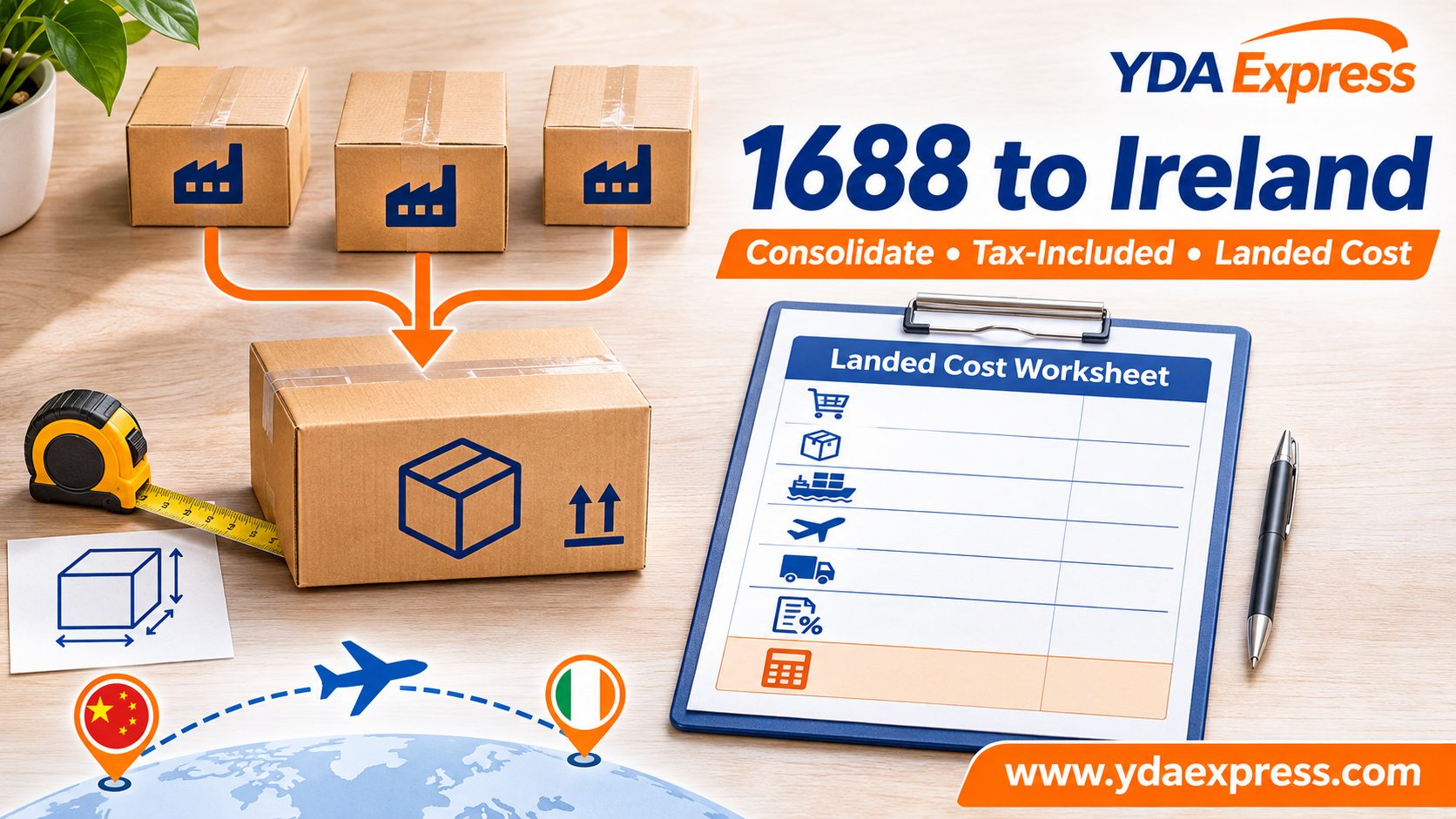
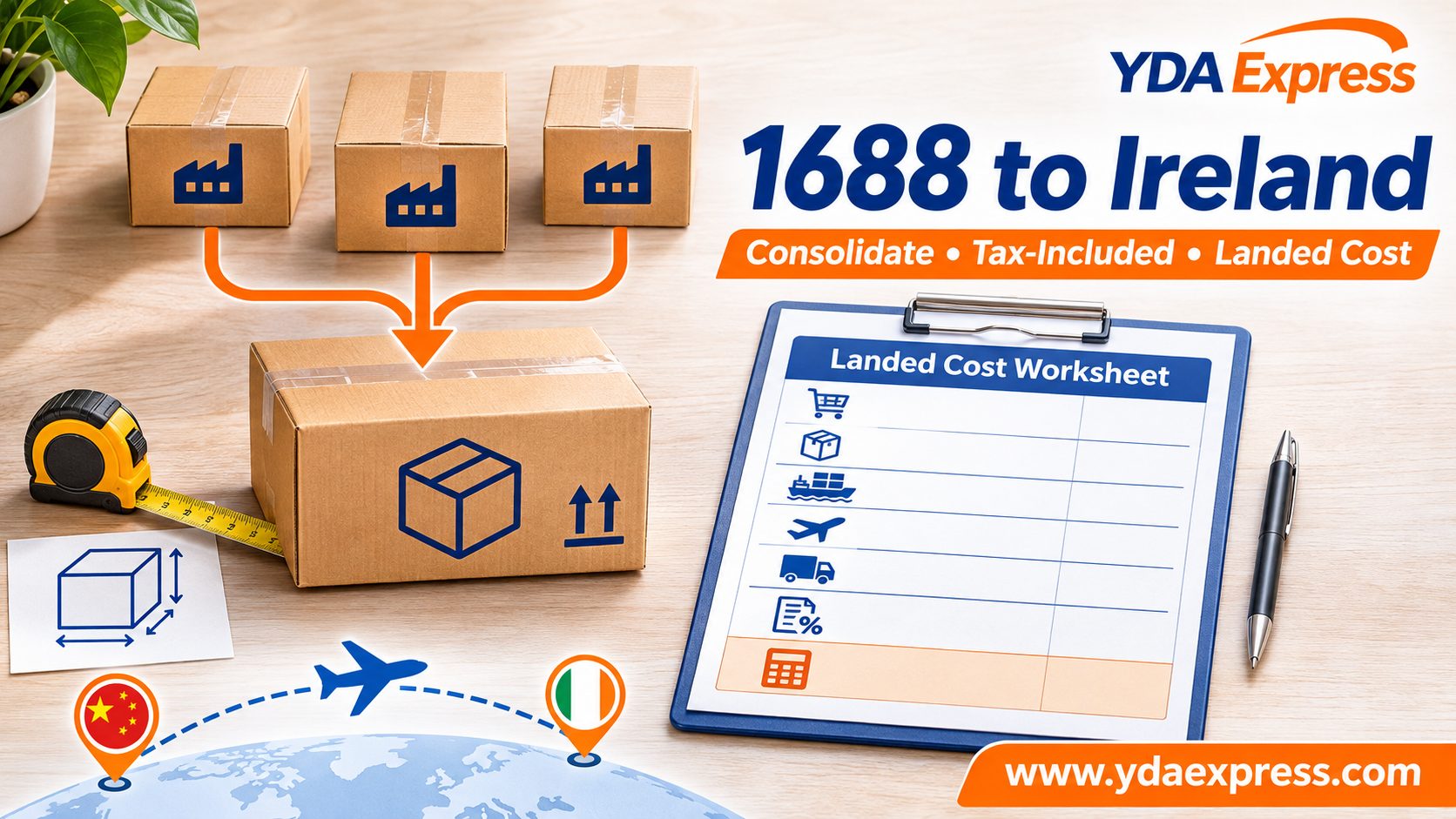
Use a supplier-by-supplier landed-cost worksheet before buying from 1688 for Ireland. Check samples, carton data, consolidation, EORI and eligible tax-included shipping.
Policy and cost check: 8 November 2026.
If you are buying from several 1688 suppliers for delivery to Ireland, the cheapest unit price is not the number to compare. Build a landed-cost worksheet before the main order: goods, China domestic delivery, purchasing and warehouse work, chargeable international freight, import charges, and any product-specific compliance cost. A tax-included route can combine eligible transport and import-charge handling into a clearer quote, but it is available only after the goods and shipment details have been reviewed.
Start with a supplier-by-supplier worksheet
Create one row for every supplier, even if the products will later share one carton. Record the supplier and link, exact specification, sample and main-order price, minimum quantity, China domestic freight, carton dimensions and weight, restricted features, production time, return deadline and documents required for Irish import or EU market placement.
Two factories may quote the same unit price while using very different packaging, materials or carton sizes. For Ireland, those differences can affect transport, classification and compliance—not just the purchase price.
Use three approval gates instead of one long process
Gate 1: sample approval
For a new supplier or custom product, order a sample first when the cost and timeline justify it. Decide in advance what the sample must prove: dimensions, colour, material, finish, function, packaging or label position. Ask for photos and specifications before payment, then compare the received sample with the agreed version.
A warehouse can photograph visible features and record measurements, but it cannot confirm chemical composition, electrical safety or regulatory compliance without appropriate specialist testing. If the product is intended for resale, identify the importer’s product-safety obligations before approving the main order.
Gate 2: production and carton approval
Before the balance is paid, request a packing list showing SKU, quantity, carton count, carton dimensions and gross weight. Confirm whether different variants are separated and labelled. If several suppliers are involved, give each incoming package a reference that the warehouse can match to your purchasing sheet.
Do not plan freight from the sample box alone. Main-order cartons may use different inner packs or protective materials. Ask the supplier for production-carton data and let the warehouse remeasure after receipt.
Gate 3: dispatch approval
Once all packages arrive, decide whether consolidation actually helps. Consolidation can reduce duplicate outer packaging and create one dispatch record. It does not automatically reduce the freight bill: a larger carton may increase volumetric or chargeable weight, and incompatible goods should not be packed together.
Approve dispatch only after you have the final carton count, dimensions, weights, product list, declared values and route eligibility. Goods with batteries, liquids, powders, magnets, food-contact claims, children’s use or other regulatory features need separate review.
Build the landed-cost calculation
Use this structure rather than guessing a percentage:
Goods cost
- China domestic freight
- purchasing/payment and agreed warehouse services
- international freight based on final chargeable weight
- import duty, VAT and applicable trade measures
- destination or compliance costs outside the quoted route
= estimated landed cost
For comparison, divide the total by the number of saleable units, not merely the number ordered. Include expected non-saleable samples or units held back for testing when that is part of the plan.
Irish Revenue states that customs value is generally based on the price paid plus transport and insurance. For goods over €150, customs duty depends on the product’s classification, while import VAT is calculated on the customs value plus applicable duty and other taxes. Revenue’s guidance for goods bought outside the EU provides the current calculation method.
From 1 July 2026, Ireland applies a €3 customs-duty charge per distinct line item to most e-commerce consignments with an intrinsic value of €150 or less from outside the EU. Do not assume that splitting a commercial purchase into small parcels removes tax or declaration obligations. The shipment’s purpose, product lines and route all matter.
Ireland’s standard VAT rate is 23% for many goods, but some categories use other rates. Revenue’s current VAT-rate table is a starting point, not a substitute for classifying the exact product. Revenue also notes that TARIC classification determines duty and shows anti-dumping or countervailing measures; use the Irish classification guidance when preparing the cost sheet.
When a tax-included route is useful
A tax-included quote is useful when you want one agreed transport figure that also covers the specified import-charge handling for an eligible shipment. It can reduce uncertainty between the China warehouse and delivery in Ireland, but only if the quote states what it covers.
Ask YDA Express to confirm:
- the exact products and quantities accepted;
- whether the quote uses actual or volumetric weight and the divisor used by the route;
- whether duty, VAT and clearance handling are included;
- the delivery scope in Ireland;
- exclusions for regulatory inspections, missing documents, storage, penalties, returns or re-delivery;
- the information required from the importer.
Tax-included shipping is not a method for undervaluing goods or avoiding import rules. Commercial buyers should retain genuine invoices, payment records, product descriptions and packing information. Irish traders importing from outside the EU generally need an EORI number; Revenue explains the requirement and registration route on its EORI page.
Product documents can change the buying decision
Before ordering, decide whether the goods are for private use, internal business use or resale. For resale, check product-specific requirements such as CE marking, traceability, instructions, safety information, labelling and an EU-based economic operator where applicable. A supplier’s “CE certificate” is not automatically sufficient; match every document to the exact model and applicable legislation.
Avoid or pause purchases that the current route cannot accept, including unverified batteries, flammable liquids, powders, certain magnets, food, medicines, plants, counterfeit goods and products requiring licences that you do not have. Legal importability and carrier acceptance are separate checks.
YDA Express can assist with purchasing communication, China domestic payment support where available, warehouse receiving, agreed photos, visible quantity checks, consolidation, repacking, shipment comparison and document preparation. It cannot certify the product, decide the final HS/TARIC code, obtain a licence or guarantee customs clearance.
If you are new to the difference between buying help and forwarding, read what a China shopping agent does. For a practical overview of combining parcels, see the China warehouse consolidation guide.
The decision this worksheet should produce
Your worksheet should end with one of three results:
- Order the main quantity: sample and documents are acceptable, cartons are understood, and the tax-included route is confirmed in writing.
- Change the order: reduce variants, alter packaging, separate restricted goods or choose another route before production.
- Stop: the supplier cannot prove the agreed specification, the landed cost no longer works, or the importer cannot meet the product obligations.
Recheck the quote after the final cartons reach the warehouse. Tax rates, tariff measures, carrier acceptance and route availability can change, so a pre-order estimate is not the final dispatch approval.
📲 Download the YDA Express App
Use the YDA Express App to place China purchasing orders, view product check photos, manage packages, and arrange consolidation and international forwarding.