Identify the party that packed your China LCL consignment, check its final packaging and connect the packing declaration with the documents for your Australian shipment.
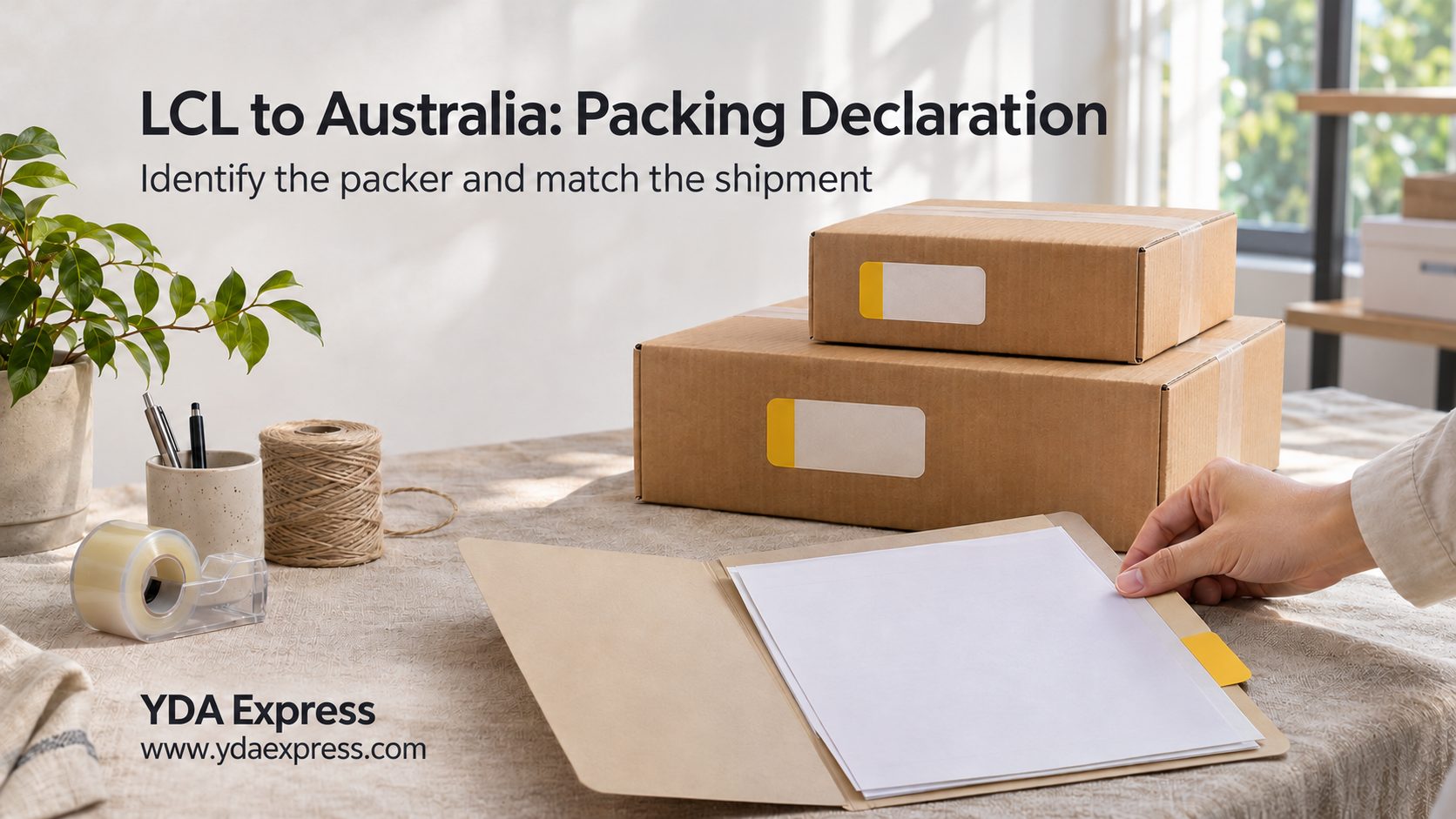
For an Australian LCL sea-freight shipment, ask who actually packed your consignment or observed it being packed before asking anyone to sign a packing declaration. A seller's invoice, a warehouse photo and a forwarder's booking each tell you something different. None should be treated as proof that a company can attest to packaging it never saw.
This guide is for a buyer combining purchases in China for an Australian less-than-container-load shipment. Its practical outcome is one checked document chain: the packing party, the final packaging and the references identifying your consignment. Official requirements checked on 7 November 2026.
Start with the packing handovers, not a blank form
Ask your forwarder to confirm that the booking is LCL. Do not choose a form merely because the shipment travels by sea. Record where the seller's cartons will go, who may unpack them, who adds a pallet or crate, and who hands the final consignment to the consolidator.
DAFF's documentation templates page ties the issuer to actual packing oversight. The relevant party may be the exporter, supplier or packer; a company name on a sales order alone does not establish that role.
For example, suppose several 1688 suppliers send cartons to a China warehouse and another operator later adds a pallet. Ask which party will cover that final packaging in the declaration. This is a hypothetical handover, not a description of a YDA shipment. Do not ask the first seller to sign for a later operation it did not observe.
Before authorising consolidation, tell the warehouse that the shipment is intended for Australian LCL sea freight and request the packing records you will need. The warehouse receiving and consolidation workflow helps distinguish receiving goods from preparing their final export packaging.
Separate the merchandise from what protects it
A wooden chair is merchandise. A timber crate around a metal lamp is packaging. They raise different questions, even when both are wood.
Use two separate entries in your working notes: what you bought, and every material used to protect or support it. For wooden merchandise, use the Australia wooden-goods biosecurity checklist to investigate the product itself. An acceptable packing declaration does not settle the product's import conditions.
The DAFF non-commodity policy distinguishes unacceptable packaging, timber/bamboo packaging and associated treatment information. Ask the packing party to identify the materials actually used, including supports hidden underneath a carton. Do not describe every wooden-looking board as solid timber, or assume a material's trade name establishes its category.
If the material is unclear, obtain its specification and close photographs before the box is closed. Ask the Australian broker or assessor what evidence is needed. Photographs help explain a question; they are not treatment certificates, and they cannot show the condition of an unseen surface.
Use the LCL questions that fit the shipment
Open the current official LCL packing declaration template as a reference. It addresses unacceptable packaging materials, timber/bamboo packaging and the relevant treatment information when that packaging is declared. Answer from the final packing facts, not from whichever boxes were ticked on a previous shipment.
Do not add a container-cleanliness declaration just to make an LCL document look more complete. DAFF's current packing-declaration FAQ says that statement is not required for LCL and asks that it not appear on an LCL packing declaration. This does not make the packaging or the goods exempt from other biosecurity requirements.
DAFF does not make its template compulsory. Use the official link as a reference rather than inventing a government form. If your forwarder proposes a different layout, have the responsible Australian party check it against the applicable requirements. Do not pre-sign an empty declaration or select “no timber” merely because a supplier originally shipped in cardboard.
Build a reference chain that identifies this consignment
Put the proposed declaration beside the invoice, packing list and transport document. Ask: can someone who was not involved in the purchase follow the references from this declaration to these goods?
DAFF's packing-declaration fact sheet explains consignment links such as bill, invoice and packing-list numbers. Its guidance relates to policy version 4.1, so read it with the current policy rather than treating it as a newer replacement.
Use this as a working checklist, not an official form:
| What to compare | Question for the responsible party |
|---|---|
| Issuing company | Does its identity match the party that packed or observed this packing? |
| Reference on the declaration | Which invoice, packing list or bill connects it to this consignment? |
| Final cartons and supports | Do the materials described match what will actually be dispatched? |
| Supporting records | Do any treatment documents concern the packaging being used? |
| Endorsement and version | Has the issuer completed the relevant name, signature and issue details? |
Under Min Docs v4.2, a reusable SKU, carton count or weight does not by itself establish the required consignment link. Do not “fix” a missing reference by copying an unrelated number. Ask the issuer and broker to establish the appropriate link. For broader commercial-document preparation, see matching invoice and shipment information before handover.
This section concerns a consignment-specific declaration. If an annual declaration is proposed, ask the Australian broker to check its importer/exporter name linkage, validity at export and coverage; do not impose a shipment-specific reference on that annual document or invent a number.
Recheck after any repacking or correction
Keep a simple change record: what changed, who changed it, which cartons were affected and which document version now describes them. Replacing a damaged carton may leave the declared materials unchanged; adding timber supports may not. Ask the issuer to reassess the declaration rather than deciding that every change is harmless—or that every change automatically requires treatment.
If a document is wrong, return it to its issuer. Do not edit another company's signed statement yourself. Have the issuer and Australian broker confirm the appropriate correction or replacement. Keep the superseded copy separate so it cannot accidentally be sent with the final pack.
Before dispatch, send the broker the final document set and ask what remains unresolved. Obtain a clear answer about which party will supply any missing evidence. A booked sailing or a completed declaration is not a release decision.
Give YDA a specific request
Send the product list, packing photos, proposed LCL route, known packing parties and unresolved document questions. Ask YDA which receiving, photographing, repacking and record-coordination tasks can be included in the agreed service. If another company performs the final packing, identify it before requesting a declaration.
YDA can assist with agreed operations and communication; it cannot attest to packing it did not perform or observe, issue another company's treatment certificate, or guarantee documentary acceptance, clearance, charges or sailing dates. Check the current Australian requirements and available service again before dispatch. Taxes and product-specific permits need their own assessment; this guide does not calculate them.
📲 Download the YDA Express App
Use the YDA Express App to place China purchasing orders, view product check photos, manage packages, and arrange consolidation and international forwarding.