Before buying wooden, bamboo or rattan home décor from Taobao for Australia, identify the material, check BICON conditions, remove contamination risks and estimate packed volume. This three-gate checklist helps you decide whether to proceed.
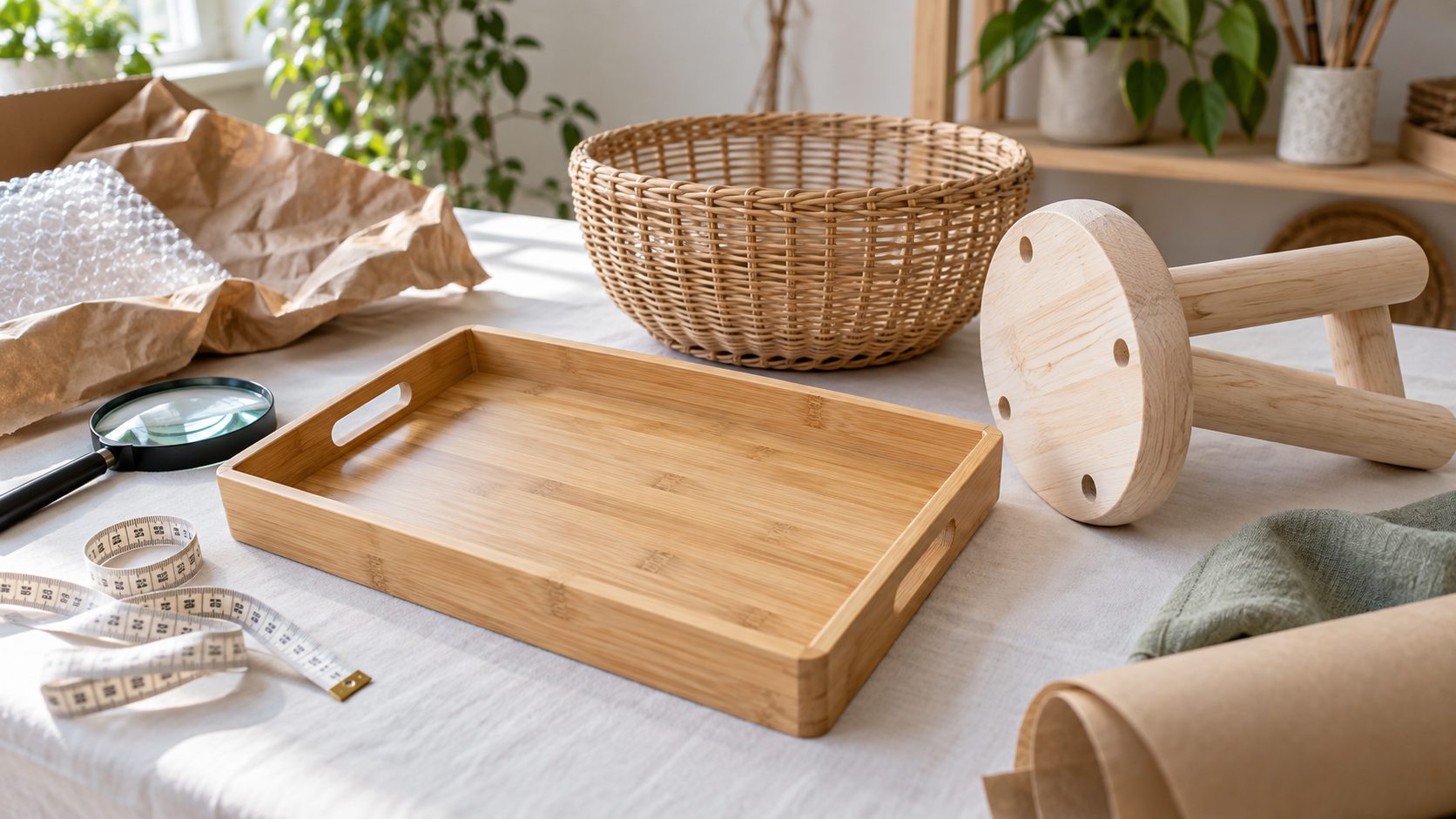
A wooden stool, bamboo tray or rattan basket may look simple on Taobao, but Australia treats plant-derived materials as a biosecurity question before it becomes a shipping question. The cheapest listing can become the expensive choice if the material is unclear, bark or contamination is present, or the packed volume makes international freight uneconomic.
Use three gates before paying:
- Material gate: can you identify what the product is made from?
- Biosecurity gate: can it meet the relevant BICON import conditions?
- Cost gate: does the packed size still make sense after freight and possible intervention?
A “yes” at one gate does not cancel a “no” at another.
Policy check: Australian Department of Agriculture, Fisheries and Forestry and Australian Border Force guidance were reviewed on 29 September 2026. BICON conditions depend on commodity, material, treatment, origin and end use, and can change.
Gate 1: identify the material, not just the style
Marketplace words such as “wood-look,” “bamboo style,” “solid timber” or “natural rattan” can describe appearance rather than the material that Australian biosecurity assesses.
Ask the seller to state:
- solid wood, plywood, MDF, particleboard, bamboo, cane, rattan or mixed material;
- species, if known;
- whether bark, seeds, husk, straw, leaves or untreated plant fibre is present;
- whether the surface is painted, varnished, laminated, heat-treated or unfinished;
- whether the item is new or used;
- whether wooden packaging or dunnage is included.
Request close photos of end grain, joints, underside, holes and unfinished edges. These photos may reveal bark, insect damage, soil or mixed materials that were hidden in listing images.
If the seller cannot identify the material, treat it as an unresolved import condition—not as “probably ordinary wood.”
Gate 2: use BICON before treating the order as shippable
Australia’s Department of Agriculture, Fisheries and Forestry states that personal and commercial imports of timber, wooden articles and bamboo must meet the conditions in BICON. Its timber, wooden articles, bamboo and related products guidance warns that non-compliant goods can be delayed and may require treatment, export or destruction at the importer’s cost.
BICON is not a single approval for all wooden products. The pathway can change with:
- exact material and species;
- manufactured versus raw condition;
- presence of bark;
- treatment and supporting evidence;
- intended use;
- country of origin and manufacturing history;
- whether other plant materials are combined in the item.
Search the current BICON pathway for the actual commodity. If you cannot confidently choose the correct pathway, obtain advice from the department or a customs/biosecurity professional before paying.
YDA Express cannot determine the final BICON pathway, certify treatment or guarantee Australian biosecurity release.
A practical proceed, ask or avoid decision
PROCEED
Proceed only when the product is new, material is identifiable, photos show clean finished surfaces, relevant BICON conditions can be met, and freight estimates remain acceptable.
ASK FOR MORE
Pause when the listing uses generic “natural material” wording, the underside is not shown, treatment claims lack documents, the item combines wood with straw or seed material, or the seller cannot confirm whether bark is present.
AVOID
Avoid the order when visible bark, soil, insect activity, untreated rough timber or unidentified plant filling is present; when required evidence cannot be supplied; or when the likely treatment, storage or return cost exceeds the value of the item.
This framework deliberately allows a “do not buy” result.
Build a seller evidence pack before payment
Save:
- product URL and selected variant;
- material statement from seller;
- species information, if available;
- close photos of unfinished surfaces;
- treatment statement and document, if relevant;
- unit dimensions and weight;
- packing method and packed carton estimate;
- quantity;
- intended personal or commercial use.
Do not ask the seller to invent a species, treatment or HS code. A confident but unsupported answer is worse than an honest “unknown.”
For help deciding whether you need only a China warehouse or full purchasing assistance, compare Taobao direct shipping, forwarding and agent options. More platform and freight topics are available in the China shopping and shipping guide library.
Gate 3: calculate the carton, not the product photo
Furniture and baskets often cost more to ship because of volume, not weight. Before buying, ask for both assembled and packed dimensions.
Compare:
- whether legs or panels can be removed;
- whether baskets can nest without damage;
- whether retail boxes may be removed;
- whether fragile surfaces need added protection;
- whether several items can share one carton;
- whether disassembly creates loose untreated wood or missing hardware risk.
A simple estimate uses chargeable weight as the greater of actual weight and the route’s volumetric-weight result. Divisors and rounding vary by carrier and route, so obtain the actual quotation method rather than assuming one formula.
Also budget for possible inspection, treatment, storage, re-export or disposal if biosecurity conditions are not met. These are risk items, not guaranteed charges.
What a China warehouse can check
A useful warehouse brief focuses on observable facts:
- count the pieces and hardware bags;
- photograph all sides, underside and unfinished edges;
- show material labels and packaging marks;
- flag visible bark, soil, mould, holes or insect activity;
- measure the packed carton;
- weigh the parcel;
- check whether seller-promised disassembly was completed;
- protect corners and surfaces according to agreed packing instructions.
Basic photos cannot reliably identify timber species, detect hidden pests, validate fumigation or certify compliance. If BICON requires treatment evidence, a warehouse photo is not a substitute.
YDA Express may assist with China purchasing, seller communication, warehouse receiving, agreed photo checks, domestic return communication, consolidation, repacking and route comparison. It does not issue phytosanitary or treatment certificates, determine HS classification, guarantee clearance, pay final import charges or guarantee delivery time.
Low-value customs treatment does not remove biosecurity rules
Australian Border Force explains in its buying online guidance that goods valued at AUD 1,000 or less are generally low-value imports, while goods over AUD 1,000 generally require an Import Declaration and may attract duties, taxes and charges. Exceptions and restricted-goods requirements remain relevant.
Biosecurity operates separately. A low purchase price does not exempt a wooden or plant-derived article from import conditions.
Use the true value and an accurate description such as “new varnished bamboo serving tray” or “new flat-packed wooden stool,” if those descriptions are factually correct. Do not describe solid timber merely as “home décor.”
Your order-release worksheet
Complete this before paying:
- Item and purpose: identified
- Material: exact / mixed / unknown
- Species: known / unknown / not required for pathway
- Surface: finished / unfinished
- Bark, soil or plant debris: absent / present / unclear
- BICON pathway: checked / needs advice
- Required treatment or documents: available / missing / not required
- Packed dimensions: confirmed / estimated
- Chargeable-weight method: confirmed / unknown
- Warehouse photo brief: saved
- Return option in China: available / expired / unclear
- Decision: proceed / ask / avoid
If material or BICON conditions remain unknown, do not release the order simply because the seller has already packed it.
📲 Download the YDA Express App
Use the YDA Express App to place China purchasing orders, view product check photos, manage packages, and arrange consolidation and international forwarding.