
Picking the right cardboard box is the difference between a happy customer and a crushed package. This guide covers box types, strength ratings, sizing, and packing techniques for international shipping from China—plus how a freight forwarder can save you money and headaches.
If you’ve ever opened a package and found the contents smashed, you already know: the box matters more than most people think. And when you’re shipping internationally from China, the journey is long. Your box might travel by truck, get sorted at a warehouse, sit on a plane or ship, clear customs, and then go through delivery vans. Each step is a chance for something to go wrong.
I’ve seen shippers try to save a few yuan by using thin, flimsy boxes—only to pay for it later with damaged goods and angry customers. At YDA Express, we handle thousands of parcels from China to destinations worldwide, and we’ve learned a few things about what works. Let’s talk cardboard boxes: not the boring kind, but the kind that keeps your shipment safe.
Why the Right Box Isn't Just a Box
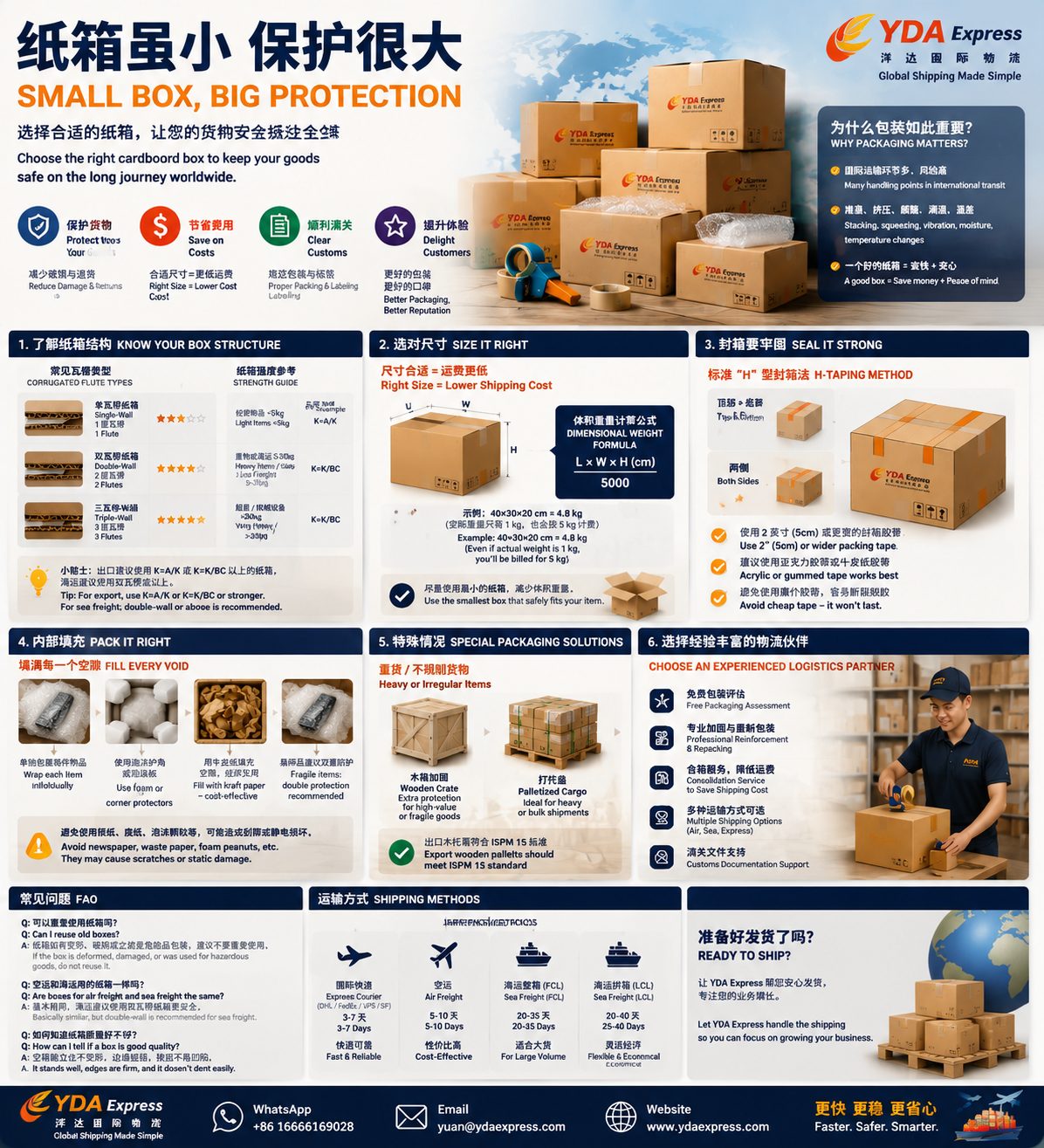
Cardboard boxes aren’t all the same. Walk into any packaging market in Guangzhou, and you’ll see stacks of them—some lightweight and cheap, others heavy and rigid. The difference is in the flute and the wall construction.
Most boxes are made of corrugated fiberboard. The wavy layer inside is called the flute. Single-wall boxes have one flute sandwiched between two liners. Double-wall boxes have two flutes and three liners. You’ll also see triple-wall, but that’s overkill for most shipments unless you’re moving machinery.
For air freight or express courier like DHL, FedEx, or SF International, a single-wall box might be fine for lighter items—say under 5 kg—if the item itself isn’t fragile. But for sea freight or anything over 10 kg, double-wall is the safer bet. The extra strength resists crushing when pallets are stacked or when your box ends up at the bottom of a container.
Here’s a quick rule of thumb: if you can press on the side of the box and it dents easily, it’s too weak for international shipping. Flip the box over and look for a stamp. In China, many boxes show something like “K=K” or “B=C,” which indicates the paper grades used. “K” is the strongest liner; “A” is the thickest flute. A box marked K=A/K is a quality single-wall. For sea, you want something closer to K=K/BC or a double-wall without compromise.
Sizing: Bigger Isn't Better
A common mistake is using a box that’s too large. The extra space means your item moves around, and void fill won’t always stop that shaking on a long trip. Plus, courier companies charge by dimensional weight—the space the box takes up—not just actual weight. An oversized box can easily double your shipping cost.
Dimensional weight formula used by DHL and FedEx: Length × Width × Height (cm) ÷ 5000. A box that’s 40×30×20 cm has a dimensional weight of 4.8 kg. Even if your actual item weighs only 1 kg, you’ll be billed for 5 kg. That’s a harsh surprise.
At YDA Express, we often help customers by repacking their goods into smaller, stronger boxes. Sometimes a seller on Taobao or 1688 will package a small item in a huge box filled with unnecessary wrap—because domestic shipping in China doesn’t have the same dimensional weight penalties. We remove the bulk and get your parcel down to its ideal size, saving you money and reducing the risk of crushing.
Flaps and Tapes: The Underestimated Details
Even a good box fails if the flaps aren’t sealed right. Use 2-inch or wider packing tape—clear acrylic or brown gummed tape (water-activated). Avoid thin office tape or duct tape; they don’t bond well to cardboard in varying temperatures. The “H-taping method” is the standard: tape along the center seam where the two flaps meet, then tape both side seams parallel to it, forming an H. For heavy boxes, add a few wraps around the girth for extra security.
Customs officials will sometimes open boxes for inspection. If your tape is messy or weak, the box may not reseal properly, and contents can fall out. We’ve seen it happen. A clean tape job signals to inspectors that the parcel is well-prepared, and they’re less likely to toss it back in carelessly.
Packing Inside the Box: No Space for Surprises
Fill every void. I mean it. Use bubble wrap for fragile items, but don’t rely on it alone. For electronics, add foam corners or at least double-box: place the item’s retail box inside a larger box with at least 5 cm of cushioning on all sides. If you’re shipping multiple items together, wrap each one separately so they don’t scratch each other.
A trick from our warehouse: for heavy but non-fragile items like books or metal parts, use crumpled kraft paper instead of bubble wrap—it’s cheaper and adds rigidity. But don’t use newspaper as the outermost layer; ink can rub off on goods. And never, ever use Styrofoam peanuts with delicate electronics unless you want static damage.
When to Consider Wooden Crates or Pallets
Cardboard boxes have limits. If you’re shipping something over 30 kg or with irregular shapes, a wooden crate or pallet might be the smarter choice. Crates add weight and cost, but they prevent damage to things like marble carvings or machinery parts. For pallets, you’ll need to factor in fumigation requirements if the wood is going to countries with strict biosecurity rules—think Australia or New Zealand. Most freight forwarders can arrange heat-treated pallets (ISPM 15 certified) that won’t get held up.
How a China Forwarding Service Helps with Box Selection
This is where a company like YDA Express comes in. You don’t have to guess. When you place orders from Chinese platforms like Taobao, 1688, JD.com, or Pinduoduo, they arrive at our warehouse, and our team inspects the packaging. We know what carriers accept and what gets rejected. If a box is damaged or inadequate, we can repack it before forwarding it to you.
We also consolidate multiple orders into one shipment—discarding the cheap packaging from each seller and combining everything into a strong, right-sized box. That consolidation cuts down dimensional weight and protects your items better. For e-commerce sellers restocking from China, this is often the difference between profit and loss on shipping.
Common Questions from Shippers
Can I reuse old boxes? Sometimes, but be careful. If a box has been crushed or has bent corners, its strength is already compromised. Also, most carriers won’t accept boxes with old shipping labels or hazard markings. If you must reuse, remove all previous labels and tape, and reinforce the corners with extra tape.
What’s the strongest type of cardboard box? Triple-wall is the strongest, but double-wall is the practical choice for most international shipments. Look for a box that holds its shape when empty—if it wobbles, it’s too weak.
Do I need double-wall for air freight? It depends on the item’s weight and fragility. For light, unbreakable goods (like clothing), single-wall is fine. But if you’re sending ceramic vases or electronics, double-wall is worth the slight weight increase.
What about express courier vs. sea freight—different boxes? Express courier shipments are handled quickly but roughly. They get thrown onto conveyor belts and stacked in tight spaces. Sea freight containers are heavy. For LCL (less than container load) shipments, your box will be palletized with others, so it must withstand pressure from above. Double-wall is recommended for both.
The Cost-Smart Move: Let the Pros Handle Packaging
You’re already saving money by sourcing from China. Don’t let packaging mistakes eat into that savings. At YDA Express, we provide a free packaging assessment for every item that arrives at our warehouse. If the original box is subpar, we’ll recommend repacking. We have a stock of high-quality double-wall boxes in various sizes, and we can customize foam inserts for fragile products.
We also deal with customs-friendly labeling—no misleading descriptions, clear invoices, and proper HS codes—so your shipment doesn’t get stuck. And because we ship large volumes, our shipping rates are lower than what you’d get as an individual.
Ready to Ship with Confidence?
Choosing the right cardboard box might seem like a small detail, but it’s the foundation of safe shipping. Whether you’re sending a single gift to family abroad or restocking your online store from Alibaba, the box you pick affects cost, delivery time, and customer satisfaction.
If you want to take the guesswork out of packaging and save on international shipping from China, get in touch with us. We’ll help you find the right solution—from box selection to final delivery.
Contact YDA Express: WhatsApp: +86 16666169028 or email: yuan@ydaexpress.com. You can also visit our website at https://www.ydaexpress.com to sign up for a free account and get a shipping quote.
📦 China Parcel Forwarding & International Shipping Already placed your order? Send your purchases to our China warehouse for parcel receiving, photo inspection, up to 180 days of free storage, package consolidation, international shipping, and real-time tracking.
📲 Download the YDA Express App One app for shopping, purchasing assistance, package management, consolidation, international shipping, and worldwide delivery.
🌍 More Helpful Guides Explore practical guides on shopping from China, parcel forwarding, shipping costs, and customs clearance.