Approve custom stationery production with confidence. Check notebook paper, binding, pen performance, artwork, packaging and inspection requirements before mass production.
Custom stationery can look simple in a product photo, yet small specification gaps can change the result. Paper weight affects show-through, a binding choice changes how a notebook opens, and a print finish can alter the color of a logo. Before approving mass production in China, use a physical sample and a written checklist that the supplier, buying agent and inspector can all follow.
Build one product specification sheet
Do not spread important decisions across dozens of chat messages. Create one current specification sheet for every item and give each revision a date or version number. For a notebook, record:
- finished size and orientation;
- cover material, thickness and finish;
- inner paper type, color and stated GSM;
- printed page count and ruling pattern;
- binding method and opening requirement;
- accessories such as an elastic, ribbon, pocket or pen loop;
- artwork position, size and color reference; and
- unit packaging, carton quantity and carton marks.
For pens, add tip size, ink color, refill type, barrel material, clip, mechanism and branding method. For sets, list every component and the exact arrangement inside the retail pack.
If you need help turning links and reference photos into a purchase request, read what a China shopping agent does. The final specification still needs the buyer’s written approval.
Separate digital proof, standard sample and production sample
These three approvals answer different questions. A digital proof checks artwork, spelling, layout, bleed and logo placement. A standard sample shows the supplier’s normal materials and workmanship but may not represent your customization. A pre-production sample uses the agreed materials, printing and construction and is the closest reference for bulk production.
Label every approval clearly. Do not write only “sample approved” if the color is approved but the paper or packaging is not. Photograph the approved sample, note any permitted variation and keep one reference sample where practical.
Check notebook paper and construction
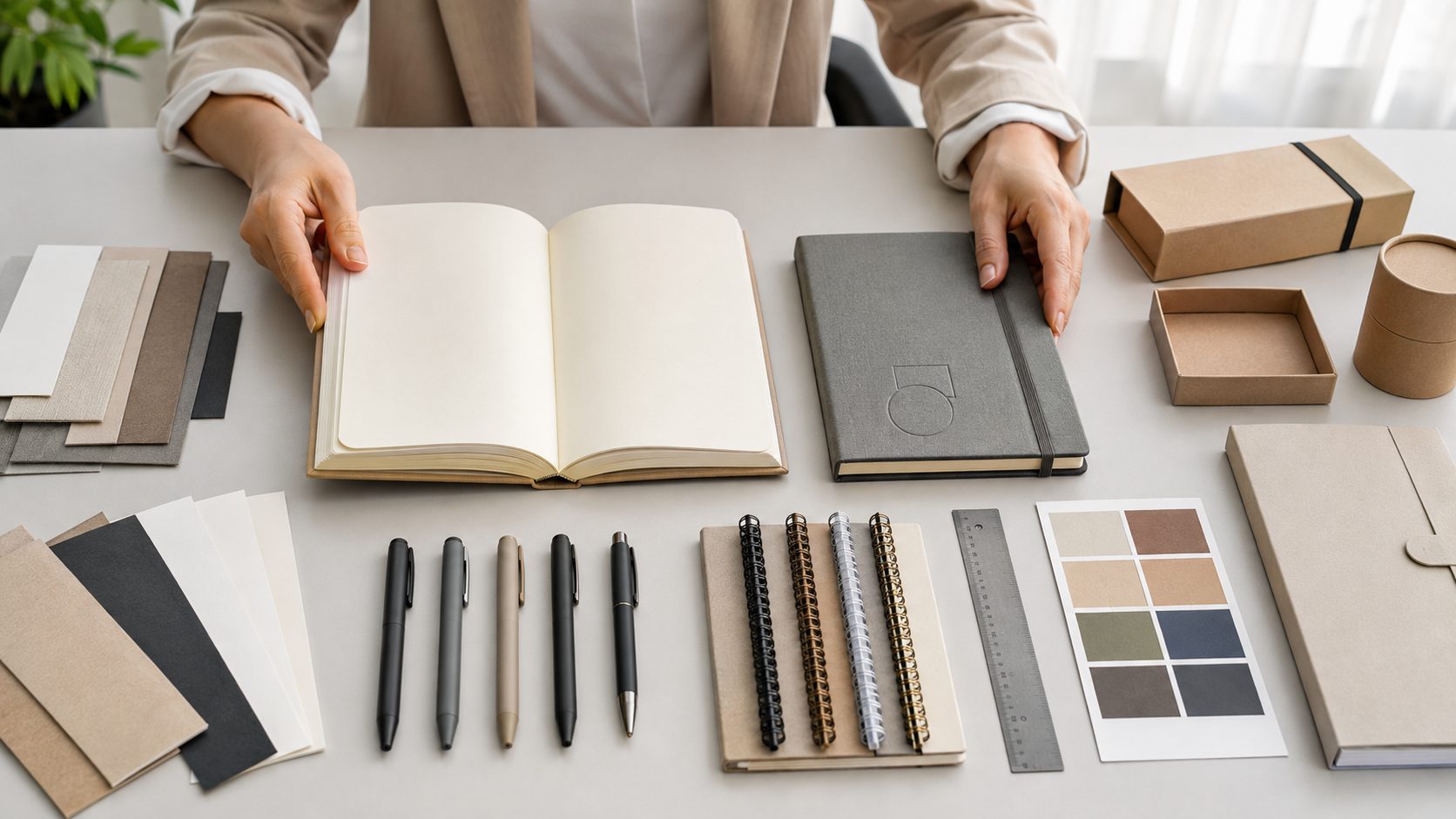
Compare the sample with the specification instead of judging it only by appearance. Confirm finished dimensions, page count, paper feel and visible consistency. Test the pages with the writing tools your customers are likely to use and look for excessive show-through, feathering or smearing.
Open the notebook repeatedly. Check whether pages detach, the spine cracks, the spiral distorts or the book fails to lie as expected. Inspect trimming, corners, ruling alignment, cover lamination, foil, embossing or debossing. A premium finish should be evaluated under normal light from several angles.
Claims such as recycled, acid-free or certified material should be supported by documents relevant to the destination market and the claimed product. A photograph alone does not verify a material claim.
Test pens and writing instruments
For a pen sample, check start-up, continuous ink flow, skipping, scratching, drying and smudge behavior on the intended paper. Confirm tip size, ink color, refill fit, cap or retractable mechanism, clip strength and visible leakage.
A quick warehouse check is not a laboratory performance test. If writing distance, chemical composition, child safety or another regulated requirement matters, define the test method and use a qualified testing or inspection provider. Do not assume a supplier’s generic certificate covers your exact model and production batch.
Approve print color and branding carefully
Screen colors are not reliable production references. State whether the supplier must follow a physical color standard, an approved sample or another defined target. Also record the printing method, number of colors, print area and finish.
Check registration, edges, fine lines, small text, foil position and the relationship between artwork and seams, corners or clips. Approve the final production file—not only a compressed image sent through chat. Confirm that you own or are authorized to use every logo and design supplied for printing.
Define packaging before the freight quote
Packaging is part of both product quality and shipping cost. Approve the retail box or sleeve, inserts, barcode location, warning labels, bundle quantity, inner cartons and export carton strength. Ask for proposed carton dimensions and gross weight, but treat them as estimates until packed production goods are measured.
If several suppliers are involved, consolidation can simplify the shipment. It does not automatically reduce billable weight, especially when protective packaging is needed. Review our package consolidation guide before deciding whether to retain retail boxes or combine sets.
Turn the sample into an inspection checklist
Before production starts, convert approved features into measurable or observable inspection points. List the quantity to verify, specification fields to compare, acceptable visible defects, packaging checks and required photos. State what should happen when a discrepancy is found: pause release, contact the buyer, rework, replace or accept within an agreed tolerance.
Basic warehouse photos can confirm visible details, quantities and packaging condition. They cannot prove every performance or compliance claim. Match the inspection level to the order value, customization and risk. For a first order, consider a smaller trial purchase; the first-order buying agent guide explains how to test the workflow.
Approve only a complete production package
Before paying a production deposit or authorizing mass production, confirm that everyone is using the same specification version, artwork, sample decision, quantity, packaging plan, inspection scope and change-control rule. Require written approval before any material, color, component or packaging substitution.
YDA Express can help coordinate purchasing, receive samples and goods in China, provide inspection photos, manage packages, consolidate eligible orders and arrange international shipping. Begin with a detailed request through our China shopping service, and keep the approved production package as the reference from quotation through dispatch.
📲 Download the YDA Express App
Use the YDA Express App to shop from China, place purchasing orders, receive product inspection photos, manage packages, consolidate shipments, and arrange worldwide delivery—all in one place.
🎁 New customers pay no purchasing service fee on their first order.