
Before forwarding snacks to Japan, use the actual labels to separate animal quarantine, plant quarantine and personal-use food notification rules, then decide which packs to hold.
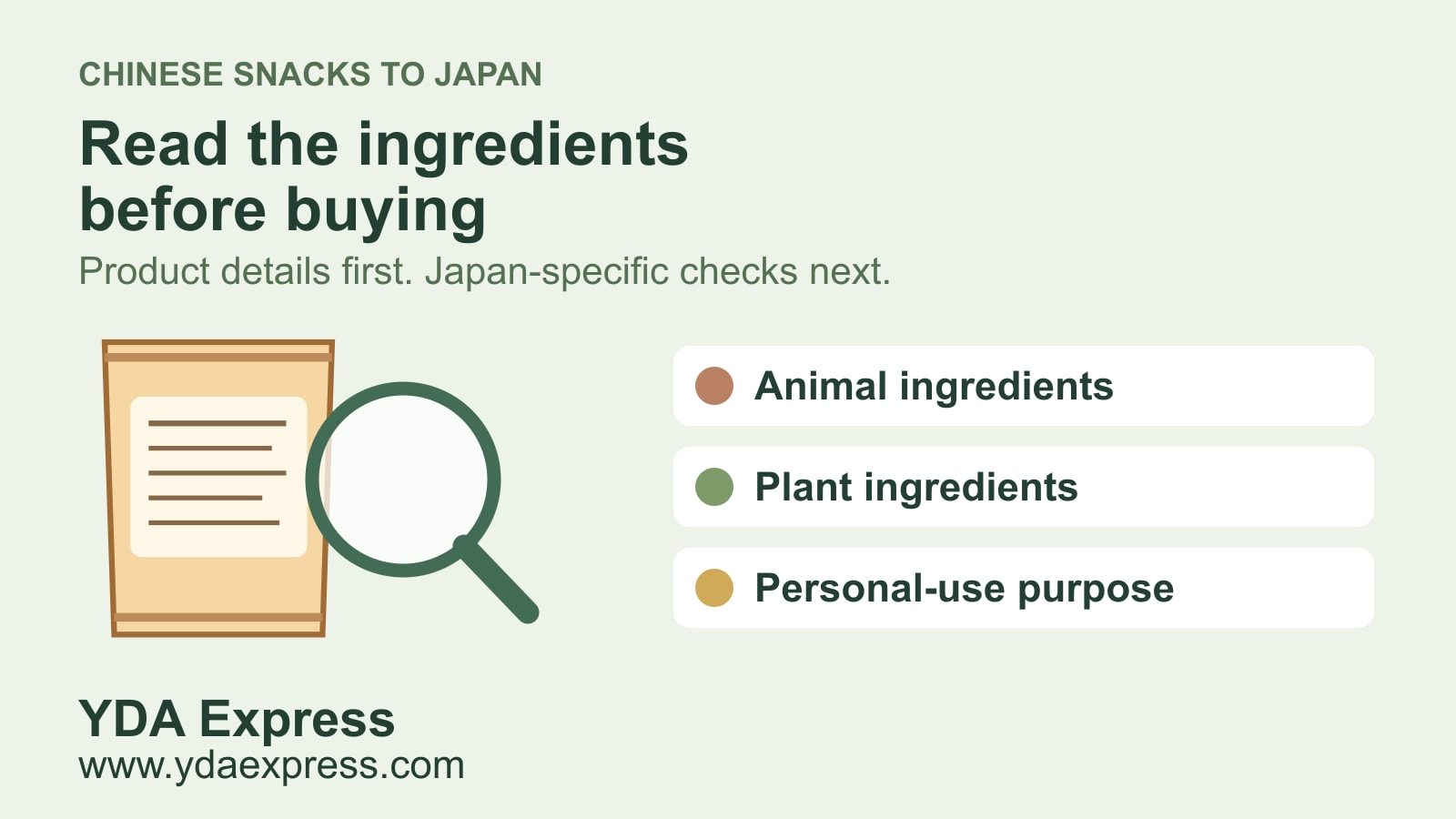
An egg wafer, a bag of sunflower seeds and beef jerky need different checks before they go into a Japan-bound snack parcel. Use the actual ingredients and processing details to decide which packs can stay in this dispatch and which need an answer from a Japanese authority first. If you have not bought them yet, ask the seller for clear back-label photos before paying.
Policy checked: 8 November 2026. This article is for food you will eat yourself in Japan. It does not cover food for a shop, café, resale or business distribution.
What does “for my own use” actually settle?
Under MHLW's food-import procedures, genuine personal-use imports are exempt from the food import notification used for sales or business. That does not decide animal or plant quarantine.
Write down who will eat the snacks and how many packs are being imported. Food for a café or sales stock needs a business-food review, even if it is addressed to you. If the purpose is unclear, ask the MHLW quarantine station responsible for the intended arrival port before using a personal-use exemption. Keep its answer with the product record.
Meat, egg and milk: ask what the product really is
Meat or a meat-containing sachet: pause that item. AQS's animal-product guidance requires a product-specific review; personal use, cooking and vacuum packing do not by themselves remove controls. Required government certificates can be difficult to obtain for retail purchases.
Look inside the listing for separate seasoning and filling information. A flavour name cannot tell you whether a packet contains meat, an extract or only flavouring. Ask the seller for the exact formula and animal species where relevant. Do not accept a substitute flavour without checking again.
Egg-containing foods: Japan's current AQS exclusion criteria include fully coagulated egg and foods where egg is not the main ingredient by weight. Qualifying industrial retort products also have specific criteria. Send the composition and processing evidence to AQS; an “egg snack” or “sealed pouch” label alone does not establish an exclusion. An egg-component exclusion does not clear a meat filling.
Dairy: check the product category, purpose and quantity against AQS's dairy rules. Exemptions exist for certain products and small non-business quantities. The newer Japanese criterion 55 specifies up to 10 kg for qualifying non-business dairy, excluding feed; the older English page says less than 10 kg. If close to that boundary, or combining products, ask AQS to confirm the applicable weight basis before dispatch. Do not substitute a traveller-baggage allowance for a separately forwarded order.
You do not need to obtain a laboratory opinion yourself from a product photograph. You need enough manufacturer information for the authority to identify the relevant rule. If the seller cannot provide it, leave the uncertain item out of this dispatch and check whether a China-side return is still available.
For seeds and dried plants, ask two separate questions
A fresh fruit, an untreated seed and a highly processed snack are different products. Japan's Plant Protection Stations assess the plant, origin and processing. Some products are prohibited; others need a phytosanitary certificate and import inspection; sufficiently processed products may fall outside inspection.
The useful distinction is certificate exemption versus inspection exemption. Japan's certificate-exemption guidance lists some dried edible seeds and nuts that can be exempt from the certificate while still requiring inspection. “Dried” or “for eating” therefore does not answer both questions.
For sunflower seeds, nuts, dried fruit or a mixed herbal pack, record the plant name, origin, shell or seed condition and actual treatment. Ask the Plant Protection Station: “Does this exact product need inspection? If it does, is a certificate required?” If the product does not match a listed category, do not choose the closest favourable result.
Make one enquiry file that identifies every flavour
On Taobao or Pinduoduo, the same listing can contain several fillings or a mixed bundle. On 1688, confirm what is inside the selected retail pack and carton. A seller's China address does not establish the ingredients' origin.
Keep these together for each exact variety:
- Order link, selected option, manufacturer and origin.
- Readable photos of all ingredient labels, including separate sachets.
- Relevant processing information; recipe proportions when the classification depends on them.
- Number of packs, net weight, date markings and storage instructions.
- Personal-use explanation, intended arrival route and the question still unresolved.
Send animal-product questions to the appropriate AQS import contact; send plant questions to a Plant Protection Station. Ask the proposed carrier which arrival port to use for any MHLW enquiry. You or your appointed import professional should obtain the regulatory answer; YDA cannot issue one.
Approve only the packs that match the evidence
If YDA agrees to receive the specific food, request photos of the actual labels and selected varieties before export. If a label differs from the seller's photo, hold that variety and repeat its review. Keep the original labels and keep every inner sachet identifiable. If a sachet cannot be identified, hold that whole variety for clarification. Removing the sachet or its ingredient name from the declaration does not establish that the remaining food is eligible.
YDA can assist with agreed visible checks, seller communication and available transport options. Photos cannot test ingredients or certify safety. Ask separately whether the warehouse and a current route accept each product, including any liquid or temperature-control requirement. Food eligibility does not establish a transport service. The general food forwarding guide covers the packaging and storage questions to settle once the products have been identified.
Low value does not grant food permission
The ¥10,000 customs-value exemption is subject to exceptions and aggregation rules, including postal-parcel rules. It does not waive quarantine. If tax applies, qualifying food generally uses the 8% reduced consumption-tax rate; alcohol is excluded. Duty varies by classification and origin. The import consumption-tax base includes customs value, duty and applicable excises; carrier fees are separate. Keep purchase evidence for the Japan personal-parcel check rather than treating a low shop price as clearance approval.
Give a specific instruction for each variety: exclude it; hold it for a named missing answer; or include it in the route review. Before payment, use the seller's label; after arrival, compare the real pack; immediately before dispatch, recheck current Japanese rules and route acceptance. The policy date above is a record of checking, not a guarantee that restrictions, taxes, exemptions or carrier conditions will stay the same. If the facts or required documents remain unresolved, keep the food out of the shipment.
📲 Download the YDA Express App
Use the YDA Express App to place China purchasing orders, view product check photos, manage packages, and arrange consolidation and international forwarding.